Registered in Dubai
Latent Digital Solutions FZCO, UAE Trade Licence No. 72640, based in Dubai Silicon Oasis.
Find where AI can actually help your business.
02Web, mobile, and business software, built faster with AI.
03Modernize old systems without losing what they already know.
04Make a promising prototype secure, scalable, and ready for real customers.
05GPT-powered assistants and workflows on OpenAI and Azure OpenAI.
06Assistants that talk to customers and staff on WhatsApp, web, and in-app.
07Native and cross-platform iOS and Android apps, built fast with AI-assisted delivery.
View all services →You built it with AI. Now make it ready for customers. Latent Digital Solutions is a Dubai-based MVP-to-production company that takes MVPs built with tools like Cursor, Lovable, Replit, Bolt, v0, and Claude Code, and makes them secure, scalable, and production-ready, without an unnecessary rebuild.
Taking an AI-built MVP into production means someone else's hands are now on your architecture, your data, and your customers' trust. Here's what that looks like working with us.
Latent Digital Solutions FZCO, UAE Trade Licence No. 72640, based in Dubai Silicon Oasis.
We use AI in our own engineering process, so we read Cursor, Lovable, Replit, Bolt and Claude Code output fluently, not as a foreign codebase.
GDPR and UAE PDPL aligned by default, with OWASP-aligned security practices on every project.
Every engagement is covered by a signed NDA before any detail of your product or data is discussed.
A snapshot of software we have built for teams in the UAE and internationally. Every project is covered by an NDA; where clients allow attribution, we name them; otherwise we describe the work anonymously.


You built quickly. You tested the idea. You proved that people want it. Now the questions are different: can it handle 10,000 users, is customer data secure, what happens when something fails, can another developer understand the code, and can you keep adding features without breaking what already works? That's where we come in.
We review what you've already built before recommending what needs to change. You may not need to rebuild everything, or even most of it. We identify what is good enough to keep, what needs improvement, and what could become a problem as you grow.
Is the product built in a way that can grow? We review how the different parts of your application work together and fix structural problems before they become expensive.
Your prototype may now be handling real customer data. We identify security risks and put the right protections in place before you scale.
AI can write code quickly, but fast development can also create duplication, inconsistencies, and code that's difficult to maintain. We clean up what matters without rewriting things simply for the sake of it.
The database that worked for your first 100 users may not work for your next 100,000. We review how your data is structured, stored, protected, and accessed.
We set up the infrastructure your product needs to run reliably in the real world, from deployment and backups to environments and recovery.
More customers shouldn't mean a slower product. We find bottlenecks and prepare the system to handle increased usage.
Moving fast is useful. Breaking existing features isn't. We introduce the right testing so you can continue building with confidence.
When something goes wrong, you should know before your customers tell you. We set up monitoring, alerts, and visibility into how your product is performing.
Real customers, real data, and real revenue ask a different set of questions than a prototype ever had to answer.
You've already invested time building something that works. Our first recommendation isn't "let's start again". We start by understanding what you already have.
The parts that work well.
The parts that need strengthening.
Only the parts that could create serious problems later.
What's missing for the product to be ready for real customers.
We study your product, code, architecture, database, infrastructure, and security.
We separate critical problems from things that can wait.
We fix the areas that could affect security, reliability, performance, or future development.
We put the testing, deployment, monitoring, backups, and infrastructure in place.
We help you move into production and continue improving the product as usage grows.
That's not a problem. AI development tools are incredibly good at helping people turn ideas into working products, and we use AI in our own engineering process too. The difference is that once real customers, real data, and real revenue are involved, the product needs a different level of engineering. You don't need to stop building with AI. You need the right engineering foundation underneath it.
Protect your users and their data.
Keep the product running when customers need it.
Be ready when 100 users become 10,000.
Keep adding features without making the product harder to manage.
Know what's happening inside your product when something goes wrong.
Build on a foundation you won't have to replace six months from now.
MVPs we've taken into production, across the sectors driving business in Dubai and the wider region.
Storefronts and marketplace MVPs that need to survive a real traffic spike, not just a demo.
Payment and finance products where security and data handling can't be an afterthought.
Booking, records and patient-facing tools that need safer data handling before real patients use them.
Listing, CRM and brokerage tools built fast for a launch that now need to hold up.
Dispatch and tracking apps where downtime means a driver or a shipment goes dark.
Internal tools and early SaaS products a founder or small team shipped alone, now onboarding real customers.
My MVP already works and has real users, do I still need this?
Working for early users and being production-ready are different things. This is about whether it can handle real scale, real customer data, and real failure scenarios.
Will you rewrite everything I've already built?
No. We review what exists first and separate what to keep, improve, replace, or build new, rather than defaulting to a rebuild.
I built my MVP with Cursor, Lovable, Replit, Bolt, or Claude Code, is that a problem?
No. We use AI in our own engineering process too. The product just needs the right engineering foundation underneath once real customers and real revenue are involved.
What specifically do you review?
Architecture, security, code quality, database design, cloud infrastructure, performance, testing, and monitoring.
How do I get started?
Send us what you've built. The review covering what needs attention is offered free.
How do I choose a company to take my MVP to production?
Look for a team that reviews what you have before quoting, separates what to keep from what to replace instead of defaulting to a rebuild, is comfortable with AI-built code, and assigns you ownership of the code and accounts. Our buyer's checklist covers the questions to ask, and our pilot to production guide explains why so many prototypes stall before launch.
How much does it cost to take an MVP to production in Dubai?
It depends mainly on what the free review finds, how much of the existing product can be kept, and how much needs to be rebuilt or added. We quote after that review, not before it. Our guide to custom software costs in Dubai explains what drives the number for the build itself.
How long does it take to make an MVP production-ready?
It depends on what the review finds, so we agree a plan after that rather than quoting a timeline up front. Most of the work happens in stages, so you see progress early instead of one long project with nothing to show until the end.
Is my data safe if I hand my MVP over to another team?
We work under a signed NDA from the first conversation, build to UAE PDPL and GDPR expectations, and agree in writing where your data is stored and who can access it before any work starts.
What if my MVP was built by a freelancer or another agency, not by me?
That's common, and it doesn't change our approach. We review what exists first, regardless of who built it or which AI tool they used, before recommending what to keep, improve, replace, or build.
My MVP is on a subscription-locked platform like Lovable or Bolt. Can you still take it further?
Yes. Part of the review is confirming what you actually own and can export, and planning around any platform lock-in before it becomes a bigger problem at scale.
How do I know if my MVP actually needs this yet?
If you have real users, real customer data, or revenue depending on the product, it's worth a free review even if nothing has broken yet. Our buyer's checklist for choosing a custom software partner covers the same due-diligence questions worth asking before you hand a product to anyone.
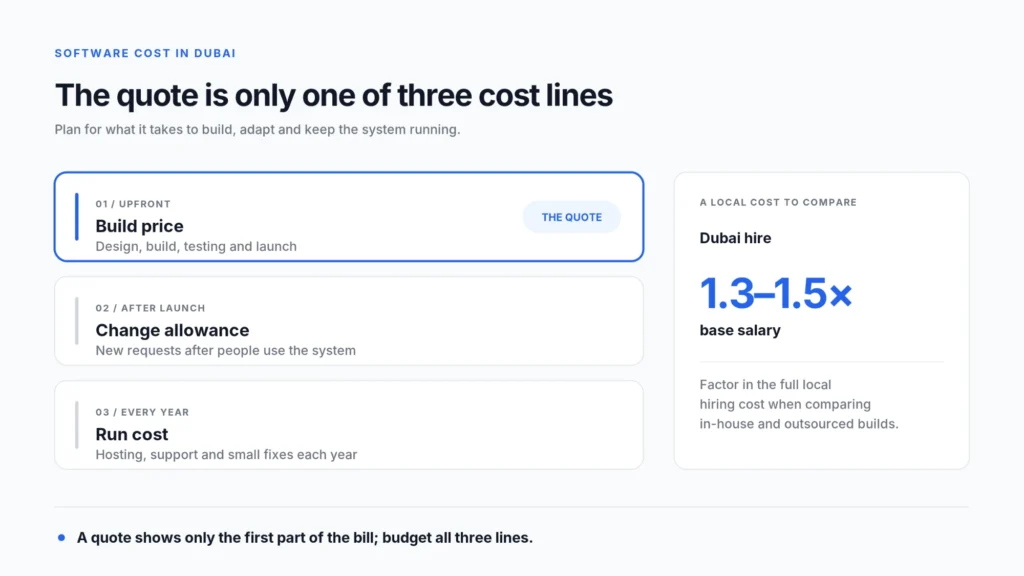
Custom software development cost in Dubai: a sourced 2025 range of $18,000 to $50,000 for custom web apps, UAE hiring costs and ways to cut the…
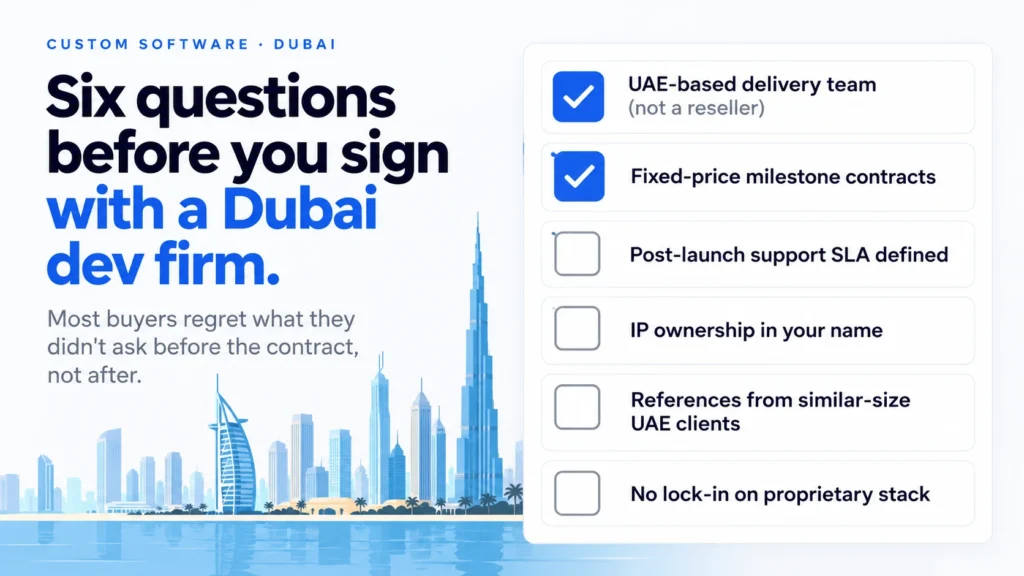
Article Overview Most “best custom software development company in Dubai” lists are directories or the company ranking itself first. This is a working checklist, written for…
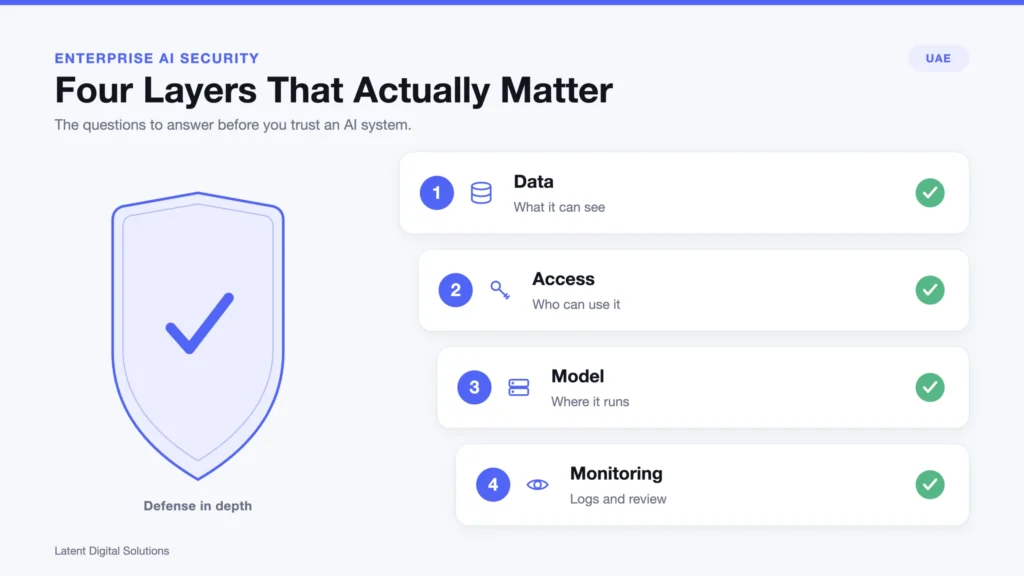
Enterprise AI security sounds like a big-company problem. The risks aren't. Four basics that close most of the gap for a mid-size business.
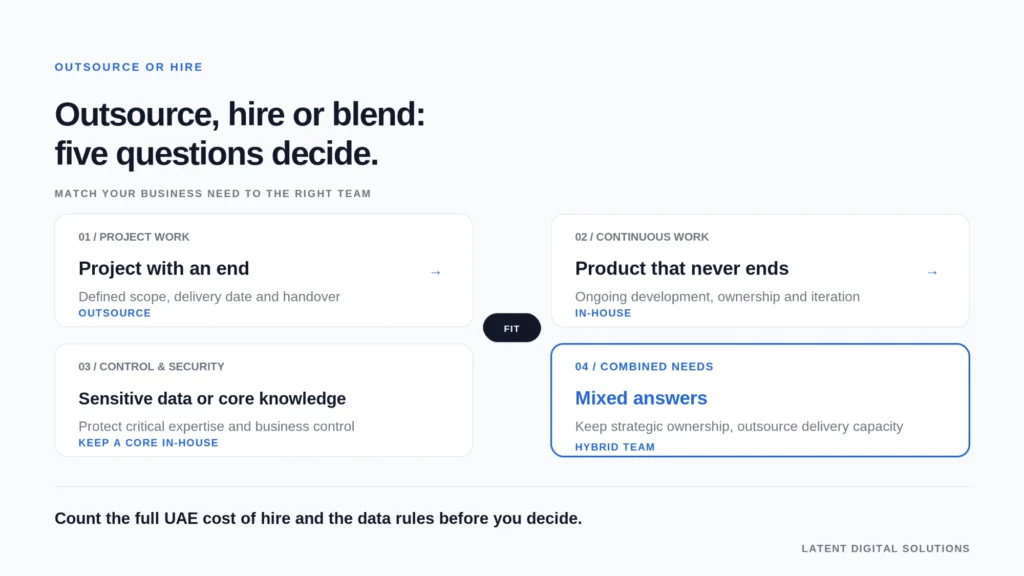
Custom software development outsourcing guide for UAE buyers: when it fits, what it costs, why a UAE hire runs 1.3 to 1.5 times base pay, and…
Send us what you've built. We'll review where it stands, what needs attention, and what it will take to make it production-ready.
Get Your MVP Reviewed For Free →