Article Overview
Every page that ranks for “custom software development cost in Dubai” gives the same non-answer: “it depends.” That is technically true. It is also what a vendor says when they would rather not commit to anything before they have you on a call. This guide breaks down what determines custom software development cost so you can sanity-check any quote before your first call.
Already know you need one?
See our custom software development services for UAE businesses.
Most of what ranks for this search is written to get you to submit a contact form, not to actually inform you. This comes from custom software built around how a UAE business actually works, not to sell you a number that sounds good and gets revised upward later.
- What you are actually paying for is engineering time, not “software” as a fixed product. The same feature can cost three times as much depending on what it has to connect to, because integration work is where most of the engineering hours actually go.
- The single biggest cost lever is whether you are integrating with systems you already run or starting from a clean database. Greenfield projects are faster to scope and build. Projects that must connect to an existing ERP, CRM, or spreadsheet system are a fundamentally different kind of problem.
- A fixed quote for custom software development cost before anyone has seen your systems or data is a quote made up in advance. It will be revised upward once actual complexity becomes visible, which usually happens after you have already committed to the engagement. A real quote follows a real discovery conversation.
- Starting with a working prototype before committing to a full build is the single best way to avoid paying for the wrong thing. It lets you test the core idea against real data and real users before the larger budget is committed.
What Actually Determines the Cost of Custom Software Development?
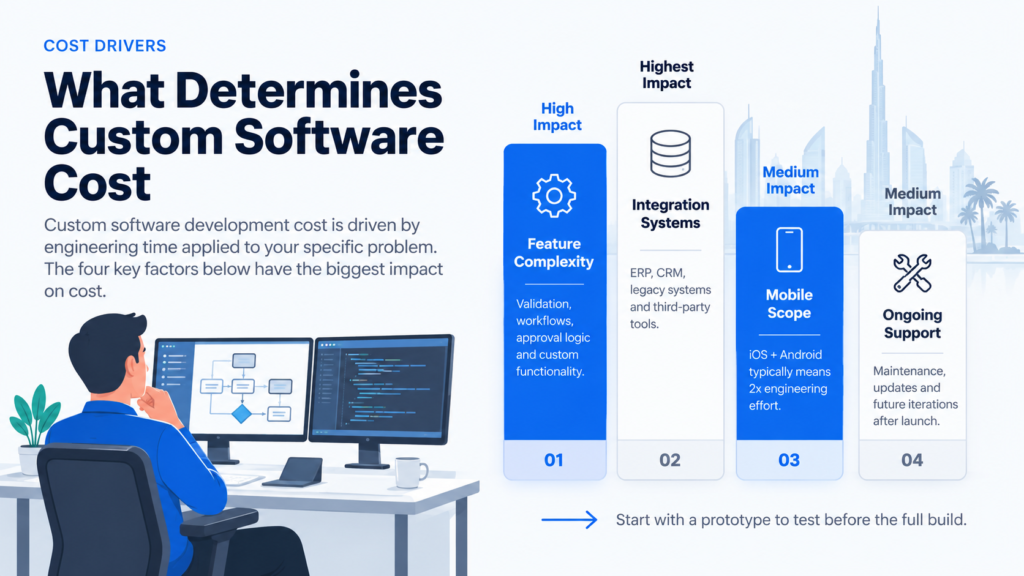
What determines custom software development cost in Dubai is not the project type. It is set by how much engineering time the project consumes, and that depends on four things: how complex the features are, what systems the software must connect to, whether mobile is in scope, and whether ongoing support follows the build.
Not every project needs a build. If the idea is an artificial intelligence app, first check whether a ready-made tool or an AI feature in your current software already does the job.
Feature complexity. A form that captures data and stores it in a table takes a fraction of the time that a form requiring validation, conditional logic, approval workflows, and audit trail does. The visible difference to a user is small. The engineering difference is large.
What the software has to connect to. Building software that starts from a clean database is straightforward. Building software that has to read from an ageing ERP, write back to a CRM, and stay in sync with an existing spreadsheet system is a fundamentally different problem. Integration work, connecting to systems that were never designed to be opened up, is where projects routinely cost twice what was originally expected. The business problem looks simple. The plumbing is not.
Web, mobile, or both. A web application built for desktop browsers is a single codebase. A mobile application for iOS and Android is two codebases with the same features built twice. Adding mobile to an existing web build typically adds 30–50% to the project scope. That is not a surcharge. It is genuinely double the engineering surface area. If mobile is the main thing you are building rather than an add-on, see our mobile app development cost breakdown for native vs. cross-platform specifics.
If the build is an ecommerce app specifically, payments, inventory sync and delivery integrations change the cost picture significantly. See our guide on ecommerce app development Dubai: scope, cost and UAE requirements for how those integrations stack up against a standard mobile build.
One-time build vs. build plus ongoing support. A fixed-scope build has a defined endpoint. A build with ongoing maintenance and iteration does not. The monthly cost of keeping a production system running, which covers updates, security patches, performance monitoring, and new features as the business grows, is real work that happens after launch. It belongs in any honest cost conversation.
Team composition matters too. A two-person team with an experienced engineer and a junior is structurally different from a five-person team with a dedicated QA role and a project manager. The first is faster and cheaper for focused builds. The second is appropriate once the system is handling real business-critical operations and failures cost money.
How Much Does Custom Software Development Cost in Dubai?
There is no single number because “custom software” covers an enormous range. A focused internal tool that replaces a single spreadsheet is a different product than a multi-system platform managing operations across a company. Quoting them the same way is not honest.
To give you a frame of reference, here is an illustrative example (not a quote, not tied to any specific project): a 40-person logistics company wants to replace its spreadsheet-based dispatch process with software that assigns jobs, tracks vehicle status, and keeps a history of completed deliveries. There are no existing systems to integrate with. The scope is bounded and clear. Understanding custom software development cost for a project like that—greenfield and internal-facing with no integrations—shows why such a build costs meaningfully less than one that needs to sync with an existing fleet management tool, feed into an accounting system, and handle a mobile app for drivers. Modernizing an existing system is scoped and priced differently; see legacy system modernization. Once you have a cost range, our checklist for choosing a custom software development company in Dubai covers what else to check before you sign.
Engagement type tells you more about custom software development costs than any tier label:
| Engagement type | Typical duration | What you actually get |
|---|---|---|
| Working prototype | 2–4 weeks | A clickable, testable version of the core idea, before a large investment |
| Fixed-scope build | 6–12 weeks | One complete product, connected to real data and systems |
| Full build + ongoing support | 3–6 months+ | A production system with maintenance and iteration built in |
What UAE developer rates actually look like
According to industry data on software engineer costs in Dubai 2026, freelance developer rates in the UAE break down by experience level as follows:
| Developer level | Hourly rate (AED) | What they typically handle |
|---|---|---|
| Junior (0–2 years) | AED 75–150/hour | UI tasks, standard feature work, basic integrations |
| Mid-level (3–5 years) | AED 150–260/hour | Core feature development, API work, database design |
| Senior (6+ years) | AED 260–750/hour | Architecture decisions, complex integrations, tech leadership |
These are freelance rates. An agency with a structured team — senior tech lead, project manager, dedicated QA — works at a higher blended rate per hour. The trade-off is that a structured team moves faster and catches problems earlier, which changes the hours-to-outcome ratio. A three-person agency team on a 10-week engagement often delivers the same working product as a solo freelancer on a 16-week one.
The rate is not the number that determines your actual spend. Hours are. A project scoped at 120 hours at AED 200/hour looks like AED 24,000. If the integration complexity was not scoped properly upfront, that same project runs to 200+ hours — AED 40,000 or more — regardless of what the original quote said. Rate differences between a junior and a senior developer are real. But a senior developer who prevents scope expansion through better architecture decisions typically costs less in total than a junior who delivers scope expansion for free.
Senior-led projects tend to cost more per hour and fewer hours overall. Junior-heavy projects cost less per hour and often more in the end. Understanding that trade-off is the most practical thing you can take from UAE developer rate benchmarks.
We always start with a working prototype before asking for a large investment, so you can see what you are getting before committing to the full build. That is not a sales technique. It is the most reliable way to avoid spending a large sum on software that solves a slightly different problem than the one you actually have.
Custom Software vs. Off-the-Shelf: the Actual Cost Comparison
Off-the-shelf software looks cheaper on day one. The real comparison requires a three-year view: per-seat licensing fees accumulate monthly whether every feature is used or not, and the cost of manual workarounds for functionality the tool does not cover rarely appears on an invoice.
At 30 employees using a tool that does 60% of what they need, you are paying for the 40% you do not use, and probably maintaining a separate spreadsheet or manual process to cover the gap.
Custom software costs more upfront. Nothing ongoing for licensing. And it is built around how your business actually works, not around how a product manager in another country decided all businesses should work. When a process changes, the software can change with it.
The decision is not “custom versus cheap.” It is “which total cost over three years makes more sense given how different our process is from a generic tool.” If your process is standard (expense reporting, basic scheduling, straightforward CRM), off-the-shelf probably wins. If your process is genuinely specific to how your business operates, the build vs. buy question deserves a more careful answer.
What Actually Drives the Price Up (and What Doesn’t)
Custom software development cost rises when projects carry hidden complexity that was not visible at the scoping stage. The most common sources are data that needs cleaning before migration, legacy systems not designed for integration, compliance requirements that affect the architecture, and scope that grows mid-build because requirements were not locked before development started.
What genuinely drives custom software development cost up:
- Messy or scattered existing data. Before new software can use your data, the data often needs to be cleaned, restructured, or migrated from the places it currently lives. That is engineering time before a single line of new product code is written.
- Legacy system integration. Connecting to systems not designed to expose their data cleanly, old databases, proprietary formats, systems without APIs, is slow and unpredictable. As outlined in AgileEngine’s software development cost breakdown, integration with ERP systems, payment gateways, or external data services adds engineering overhead, increases dependency risk, and typically requires additional QA cycles.
- UAE PDPL and GDPR compliance. If your software processes personal data belonging to UAE residents, the UAE Personal Data Protection Law adds specific requirements around data handling, storage, and breach notification. Getting those right in the architecture from the start is less expensive than retrofitting them later.
- Iteration without scope clarity. If the requirements are not locked before development begins, every change mid-build costs more than it would have if it had been planned upfront. Iteration is healthy. Unplanned scope change is not.
What does not necessarily drive the price up:
- Your industry. Software for a real estate company is not inherently more expensive than software for a logistics company. Complexity is about process and integration, not sector.
- AI features, if scoped correctly. Adding an AI layer to software that does not first do its core job reliably makes the AI layer unreliable. Well-scoped AI integration within a clear build is no more expensive as a percentage than any other feature.
- The vendor’s client list. A long logo wall does not tell you whether the vendor understood the problem before quoting it. References do. A scoping conversation does.
How Does AI-Assisted Development Change the Cost Equation?
AI makes development faster. It does not replace engineering judgement.
In practice, AI-assisted development means a developer produces working code for standard patterns (database connections, form logic, API calls) significantly faster than they would writing from scratch. That translates into real cost savings.
It does not change the time spent understanding your specific problem, designing the architecture, integrating with your systems, and making the decisions that determine whether the software is actually useful once built. Those are judgement calls. From what we have scoped across dozens of projects, AI shortens the time to write working code but lengthens nothing about the core engineering decisions. AI can assist but cannot replace them.
The practical implication: with AI-assisted delivery, more of the budget goes toward product decisions and design work (what to build and why) rather than repetitive coding that follows established patterns. That benefits you more than it benefits the vendor.
Questions to Ask Before You Accept a Quote
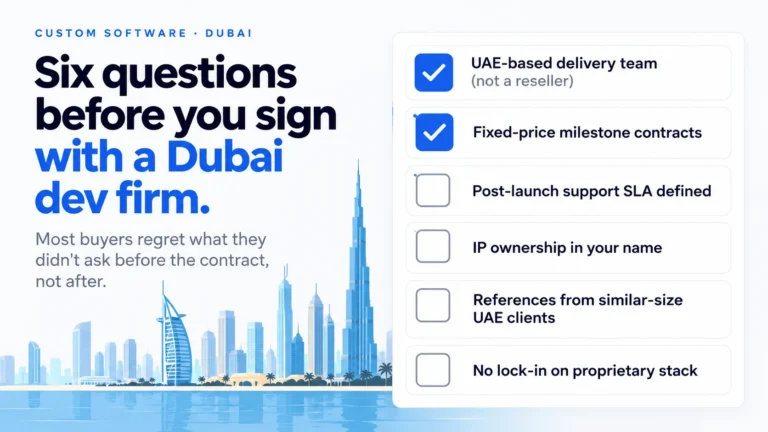
A quote from a vendor who has not asked about your systems, your data, or your current process is a guess. Before accepting any number, ask four questions: what is included in the price and what is not, whether the engagement is fixed-scope or time-and-materials, who owns the code once built, and whether post-launch support is covered or charged separately.
What is included in this number, and what is not? Hosting, third-party licences, QA, deployment, and handover documentation are often quoted separately or not at all. Ask explicitly.
Is this fixed-scope or time-and-materials? A fixed-scope quote says “we will build exactly this for exactly this amount.” A time-and-materials quote says “we will charge you for the hours we spend.” Both are legitimate. You need to know which one you are signing.
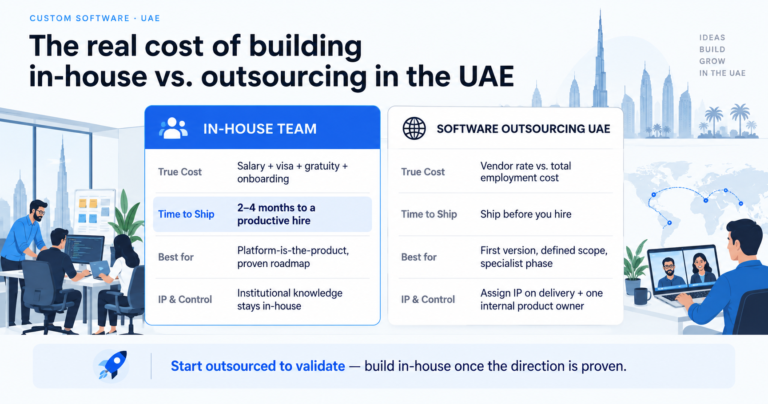
Who owns the code once it is built? In some agency models, the code is technically owned by the vendor. You want ownership of everything built for you.
What happens after launch, and is support included? A working prototype or MVP is not a finished product, and making it production-ready is its own project. Ongoing maintenance, bug fixes, and iteration are real costs. If the quote does not cover post-launch support, you are looking at additional spend the moment something breaks in production.
Want this scoped for your business?
Talk to our custom software development team about what your project would take.
Conclusion
A straight answer beats a fake number. The custom software development cost in Dubai ranges from a working prototype that takes two to four weeks to a production system that runs for years. The gap between those is determined by what the software has to connect to, how clean your data is, and how clearly the problem is defined before anyone writes a line of code.
Get in touch and describe what you are trying to replace or build. That conversation is more useful than any price list.
Frequently Asked Questions
How much does custom software development cost in Dubai?
There is no single figure because the cost depends on what the software has to do and what it has to connect to. A focused internal tool for a small team costs significantly less than a multi-system platform handling operations across a company. The honest frame is engagement type: a working prototype takes 2–4 weeks, a fixed-scope build takes 6–12 weeks, and a full build with ongoing support runs 3–6 months or more. The custom software development cost in Dubai scales with engineering complexity, not with a tier label.
Is custom software cheaper than buying off-the-shelf software?
Not upfront, but the comparison changes over time. Off-the-shelf software charges per seat every month, whether every user needs every feature or not. Custom software costs more to build and nothing ongoing for licensing. If your process is genuinely specific to how your business runs, the total three-year cost of custom is often lower than paying for a tool you have to work around.
Do you charge fixed price or hourly?
Engagement structure depends on how clearly defined the scope is. A well-defined, bounded build with locked requirements suits a fixed-scope model. Exploratory or iterative work suits time-and-materials. We recommend starting with a working prototype before committing to a large fixed-price build—it makes the full scope far easier to define accurately.
How long does a custom software project take from start to finish?
A working prototype: 2–4 weeks. A fixed-scope build: 6–12 weeks. A full build with ongoing support: 3–6 months or more. The biggest variable is how much integration work is involved, connecting to existing systems, cleaning legacy data, and handling compliance requirements can each add meaningful time.
What happens after the software is built; is support included?
Support after launch is real, ongoing work. It covers bug fixes, security updates, performance monitoring, and iteration as your business changes. Whether it is included in the initial engagement or charged separately depends on the agreement. Always ask explicitly before signing, a system that goes live and then has no maintenance plan is a liability, not an asset.
Usually a reply within one working day.