A prototype in weeks
A clickable, testable version of the core flow in two to four weeks, so the idea meets real users before the full budget is committed.
Find where AI can actually help your business.
02Web, mobile, and business software, built faster with AI.
03Modernize old systems without losing what they already know.
04Make a promising prototype secure, scalable, and ready for real customers.
05GPT-powered assistants and workflows on OpenAI and Azure OpenAI.
06Assistants that talk to customers and staff on WhatsApp, web, and in-app.
07Native and cross-platform iOS and Android apps, built fast with AI-assisted delivery.
View all services →Latent Digital Solutions is a mobile app development company based in Dubai, building native and cross-platform iOS and Android apps for teams across the UAE and beyond. We combine experienced engineers with AI-assisted development to move fast without compromising on quality.
We are a Dubai-based team that builds iOS and Android apps for UAE businesses, from a first clickable prototype to the day the app is live on the App Store and Google Play. Every engagement is organised around that launch, so you always know what is being built, why, and what it will take to get there.
A clickable, testable version of the core flow in two to four weeks, so the idea meets real users before the full budget is committed.
We recommend native, cross-platform or a web app based on what your app actually needs, and explain the trade-off in writing.
We prepare and submit to the App Store and Google Play and deal with review feedback, so launch day is not a surprise.
Source code, designs and the store accounts sit in your company name, so you are never locked in to keep your own app live.
A snapshot of apps we have built for teams in the UAE and internationally. Every project is covered by an NDA; where clients allow attribution, we name them; otherwise we describe the work anonymously.


Booking, ordering, loyalty and account apps where your customers deal with you from their phone.
Driver, technician and inspection apps that work on the road or on site, including live location and proof of delivery. Our Xfreightlines dispatch app is one example.
Catalogue, checkout, payments and order tracking, connected to the store or backend you already run.
Apps that earn through subscriptions, such as Monkify, which crossed 1 million dollars in annual recurring revenue.
A mobile layer for a web product you already run, built so your own team can stay on the core platform, as we did for Docupet.
Booking, telehealth and tracking apps built with data protection and sector rules planned in from the start.
Our default for most business apps: one codebase that ships to iOS and Android, typically 30 to 40 percent cheaper than two native builds and easier to maintain.
Worth the premium when the app depends on heavy camera or AR work, deep hardware access, or performance a cross-platform layer cannot match.
If the budget covers one platform first, we help you choose from your own audience data, not from global market-share charts.
If your users do not need the app stores, push-heavy features or device hardware, a web app can reach them sooner and cost less. We will say so if that is the better answer.
Five stages, each with something you can review before the next one starts.
A short session that maps your users, the day-one feature set, and the risky parts: payments, integrations, offline use.
A clickable version of the core flow, usually in two to four weeks, tested with real users.
App and backend built in reviewed stages, with a working demo at the end of each.
The phones and OS versions your users actually have, not just simulators.
Store submission, review handling, then a support plan for iOS and Android updates.
Right-to-left affects every screen, so we plan it at the design stage instead of retrofitting it after launch.
Built to UAE PDPL expectations, with where data is stored and who can see it agreed in writing.
Cards, Apple Pay and, where your audience uses them, buy-now-pay-later and cash on delivery.
Identity and login options common in UAE services, scoped in when your app needs them.
Health and finance apps answer to their own regulators. We flag what applies early because it can change the architecture.
UAE or GCC hosting where it is required, in cloud accounts that belong to your company.
Two to four weeks. A clickable, testable version of the core idea, before a large investment.
Commonly AED 55,000 to 150,000 for a fixed-scope build of eight to fourteen weeks.
Typically AED 150,000 to 400,000 or more, over four to seven months, with support after launch.
The backend and integrations behind the app, not the number of screens. These are frame-setting ranges, not quotes.
Chosen from apps we have shipped, not from trend lists.
How much does mobile app development cost in Dubai?
It depends on the platform approach and backend complexity, not a tier label. See our full cost breakdown for ranges by engagement type and UAE developer rates. We always start with a working prototype before asking for a large investment.
Should I build native or cross-platform?
Cross-platform is the right call for most business apps: one codebase for iOS and Android, typically 30 to 40 percent cheaper to build and maintain. Native is worth it only when the app needs hardware-specific performance. Our Flutter versus React Native comparison goes through the decision.
Should I launch on Android or iOS first?
Decide from your own audience data, such as the device split in your website analytics, not from general statistics. If the split is close or unknown, building both at once with a cross-platform framework usually makes more sense. See how to choose a platform to build first.
Do you build the backend too, or just the app?
Both, if you need it. Some apps connect to a system you already run; others need a backend built from scratch alongside the app. We scope this explicitly rather than assuming either way.
Do you handle App Store and Google Play submission?
Yes. We prepare the listing, submit the app, and respond to review feedback from Apple and Google. The developer accounts are registered in your company name, with our team added as members, so the listing is yours.
How long does it take to build and launch a mobile app?
A working prototype: 2 to 4 weeks. A fixed-scope build for a simple-to-mid complexity app: 8 to 14 weeks. A full build with payments, real-time features or heavy integration, plus ongoing support: 4 to 7 months or more.
Who owns the app, the code and the store listing?
You do. Source code, designs and the store listings are published under accounts and licences you control, so you are never locked in to keep your own app live.
Can the app work offline?
Yes, when the use case needs it, for example field teams in areas with weak signal. Offline mode with clean syncing is real engineering work, so we scope it explicitly from the start.
Can you build an ecommerce app?
Yes. Ecommerce apps are mostly about checkout, payments and order handling, usually connected to a store platform you already run. See what an ecommerce app involves and what it costs.
What happens when iOS or Android ships an update that breaks something?
That is what post-launch support covers. OS updates arrive on Apple and Google's schedule, and an app with no maintenance plan breaks within a year or two. We build this into the engagement rather than treating it as a surprise cost later.
Can you take over an app someone else built?
Yes. If an existing app has become hard to change, slow or expensive to maintain, we review the codebase and either take over maintenance or scope a modernization path, whichever carries less risk to your users.
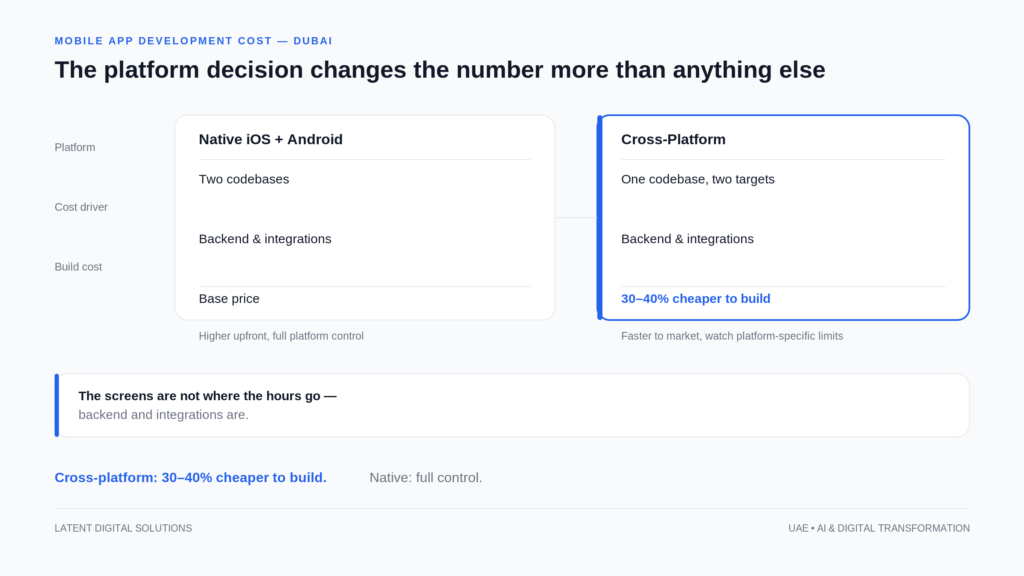
Article Overview Every agency site answering “how much does mobile app development cost in Dubai” gives you a tier chart with no explanation of why the…
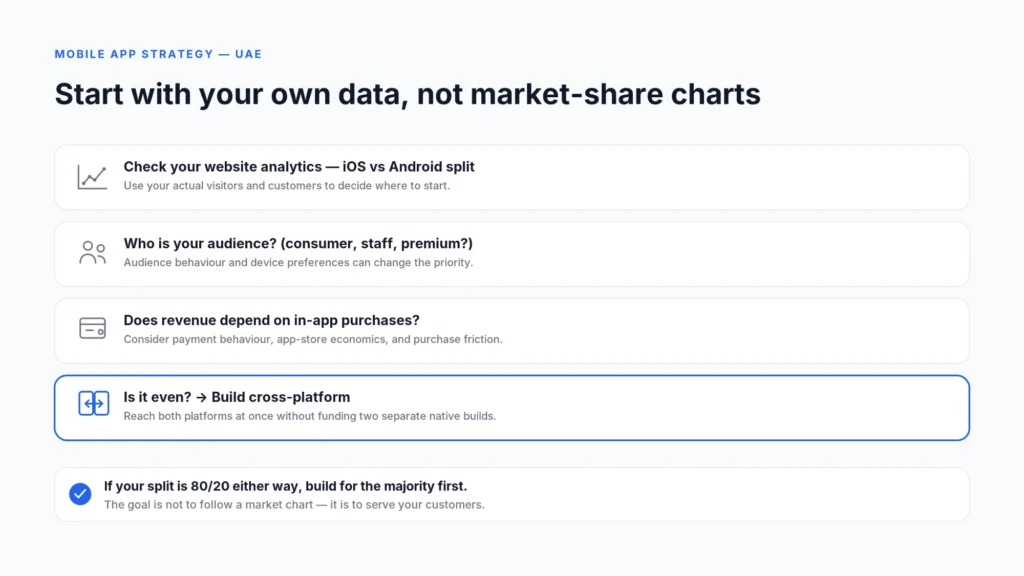
Android or iOS first for your UAE app? Cross-platform typically costs 30-40% less. Check your analytics, then use this decision guide.
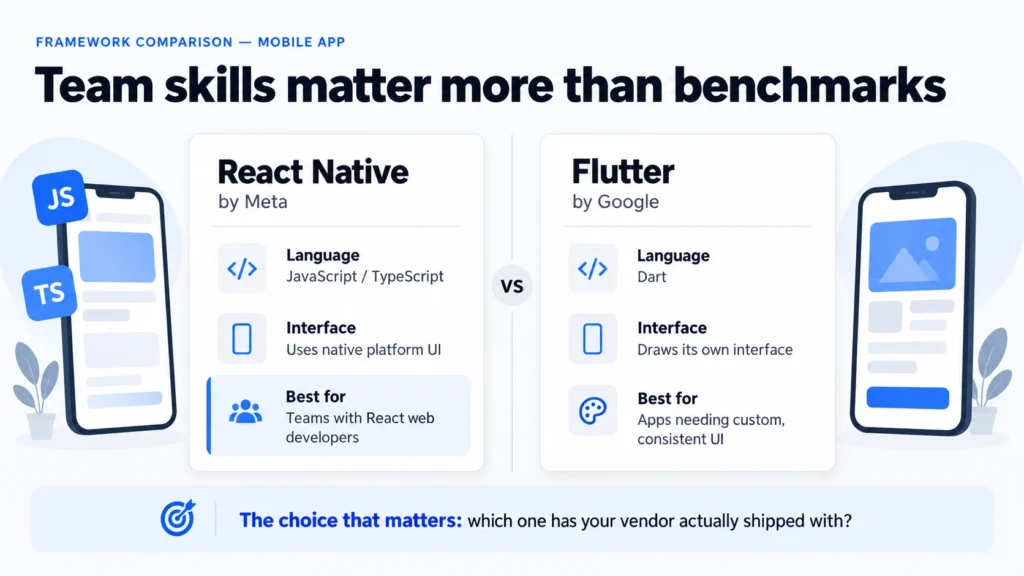
Flutter vs React Native — which framework is right for you? Both build iOS and Android from one codebase. Choose based on team skills, interface needs…
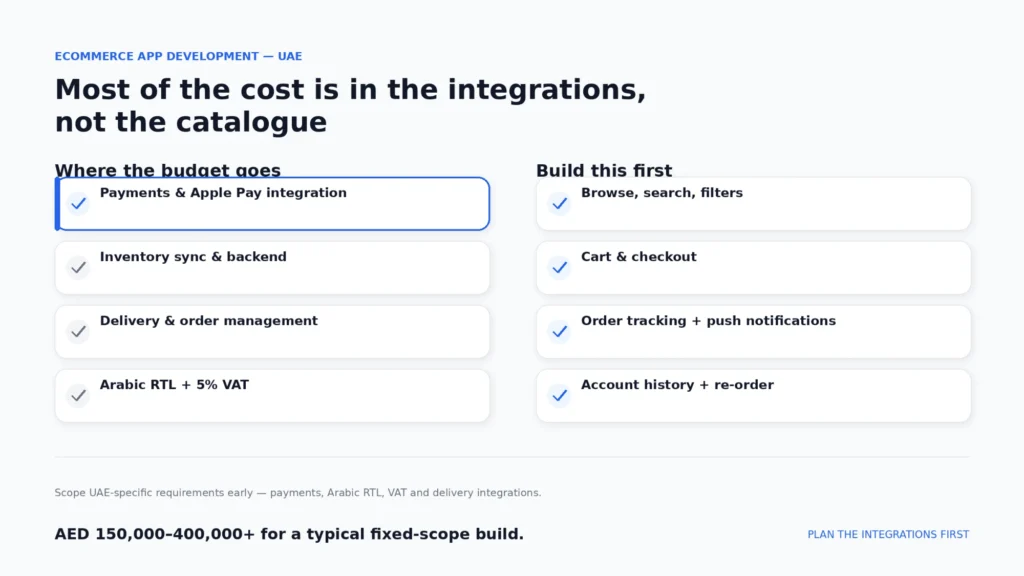
Ecommerce app development Dubai costs AED 150,000–400,000+ for most fixed-scope builds. Most of the budget is in payments, inventory sync and delivery, not the catalogue.
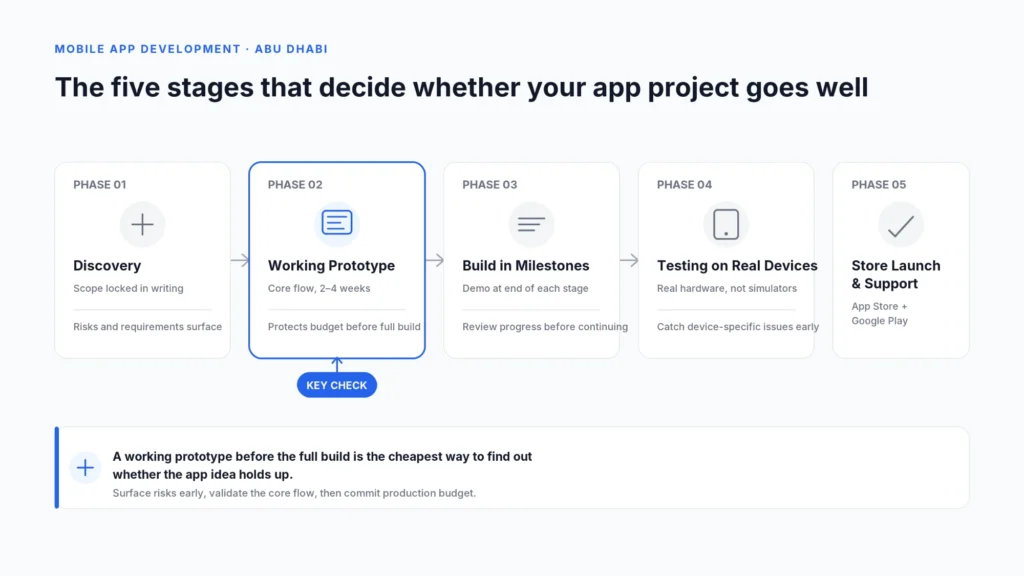
Building a mobile app in Abu Dhabi? The vendor's postcode matters less than their process (Dubai to Abu Dhabi is 150km). Here's what to check before…
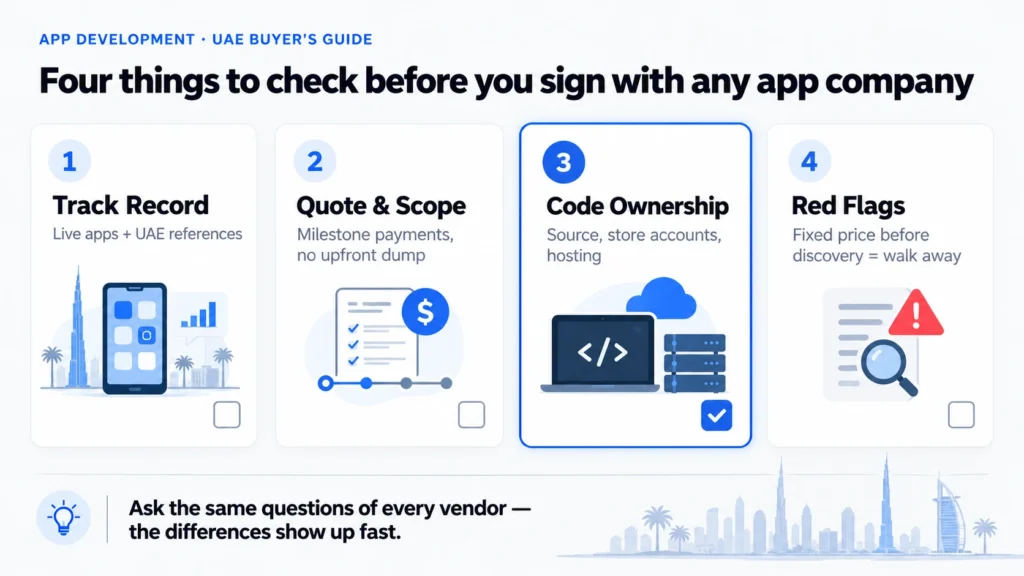
Every app development company in UAE promises the same things. Verify live apps, UAE references, code ownership and milestone payments before signing.
Whether it's a new app, a mobile layer for an existing system, or an app that needs to grow, tell us what you're trying to build. We'll help you figure out the best way to build it.
Talk to Our Team →