Article Overview
Flutter and React Native both let one team build a single app that runs on iOS and Android, and both are good enough that the wrong choice rarely sinks a project. The right flutter vs react native choice still saves money and avoids friction. It affects who you can hire, how easily the app connects to your existing systems, and how it will be maintained in three years. This guide compares the two on the points that matter to a business, not a developer forum.
Already know you need an app?
Skip ahead to our mobile app development services for UAE businesses.
- For most business apps, both frameworks will do the job. The flutter vs react native decision usually comes down to your team and your existing stack, not raw capability.
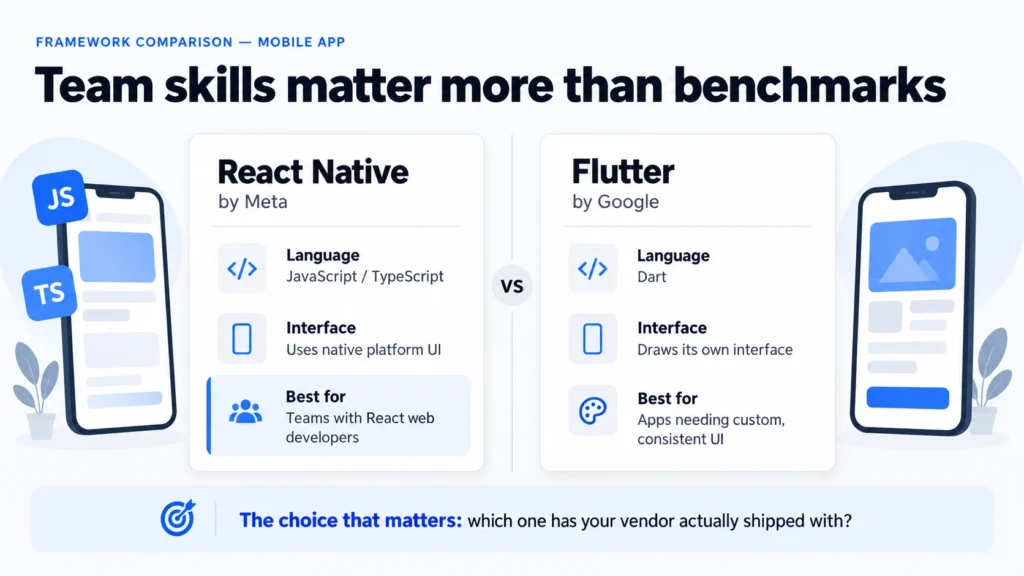
- React Native uses JavaScript and TypeScript, so it fits companies that already have web developers working in React. Flutter uses Dart and draws its own interface, which gives very consistent visuals across devices.
- Hiring and long-term maintenance matter more than benchmarks. Choose the one your vendor has shipped real apps with, and make sure you own the code either way.
- Neither is right for apps that depend on heavy, platform-specific features. Those can justify native Swift and Kotlin builds.
What Are Flutter and React Native?
Both are cross-platform frameworks: you write one codebase and ship it to iOS and Android, instead of building two separate native apps. That is why cross-platform builds are typically 30 to 40 percent cheaper than going native on both.
React Native was created by Meta. You write the app in JavaScript or TypeScript using React, and it renders using the phone’s own native interface components. The React Native documentation covers setup and integration in detail.
Flutter was created by Google. You write in a language called Dart — see the Dart language overview for background on the language — and Flutter draws every pixel of the interface itself, rather than using the platform’s built-in components. The Flutter documentation explains the rendering model and platform integration options.
That single-codebase approach means your development team maintains one project. Updates ship to both platforms at the same time, and one team of engineers covers iOS and Android without separate specialists. It is why the majority of new app projects today start with a cross-platform framework rather than separate native builds.
How Do Flutter vs React Native Compare for a Business?
Here is how flutter vs react native stack up on the factors that affect a business project:
| Factor | React Native | Flutter |
|---|---|---|
| Language | JavaScript / TypeScript | Dart |
| Backed by | Meta | |
| How the interface is built | Uses native platform components | Draws its own interface |
| Look and feel | Follows each platform’s native look by default | Very consistent across platforms and devices |
| Talent pool | Larger, because it shares skills with web React developers | Smaller but growing |
| Sharing code with a web app | Easier if your web app is already React | Possible, but less natural |
| Best fit | Teams with React and JavaScript experience | Apps where a highly custom, consistent interface matters most |
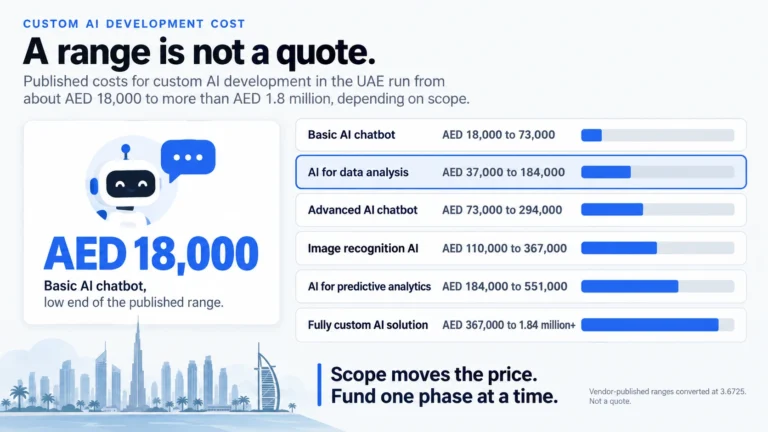
For how these framework choices affect your overall build budget, see our mobile app development cost guide for Dubai.
Which Should You Choose for Your App?
When deciding flutter vs react native, work through these questions in order:
- What does your team already know? If you have React web developers, React Native lets them contribute and share logic, which lowers cost and risk.
- How custom is the interface? If you want a heavily branded, animation-rich design that looks identical everywhere, Flutter’s own rendering is an advantage. If you want the app to feel native on each platform, React Native fits naturally.
- What will the app connect to? Both integrate well with APIs and backends. Check that the specific services you need, such as a payment gateway or mapping provider, have solid, maintained libraries for your chosen flutter vs react native framework.
- Who will maintain it? Pick the framework your vendor has shipped real, live apps with, and one you could hire for in the UAE market if you take maintenance in-house later.
We build with both. Our React Native builds include Monkify and Docupet. The flutter vs react native choice matters less than the team’s experience with whichever one they use.
When Is Native Development the Better Choice?
Cross-platform covers most flutter vs react native scenarios for business apps, but native Swift and Kotlin builds are worth the premium when the app depends on:
- heavy camera, AR or on-device processing
- deep integration with platform-specific hardware
- performance demands that a cross-platform layer cannot meet
If none of those apply, going native mostly adds a second codebase without visible benefit.
What Should You Ask Before Choosing Flutter vs React Native?
No framework comparison settles the people question. The tool matters less than whether the team using it has shipped production apps, handled OS upgrades across multiple releases, and can document what they built so the next team can maintain it. These questions are not about catching vendors out — they are about finding out whether both sides are talking about the same kind of project before anyone signs anything.
Before committing to a flutter vs react native build, ask the vendor:
- Which framework do you recommend for this app, and why?
- Which live apps have you shipped with it, and can I download them?
- How would we handle a feature the framework does not support well?
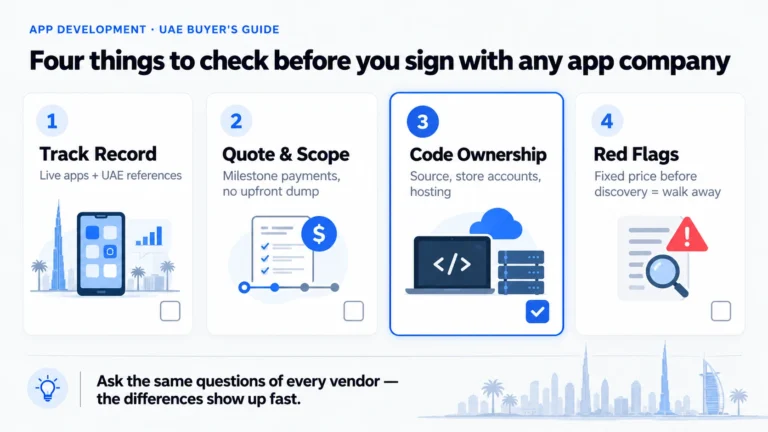
- Will the source code be assigned to my company, in standard, maintainable form?
- What does upgrading look like when the framework or the iOS and Android versions change?
In the UAE market, it is also worth asking about the working arrangement directly. Does the vendor work with UAE-based team members or coordinate across time zones? How does intellectual property assignment work under UAE law? What does support look like once the app is live? These practicalities do not show up in framework benchmarks, but they affect whether the app is still running well two years after launch.
Our buyer’s checklist for app development companies in the UAE covers the wider set of questions to ask before you sign.
Conclusion
Both Flutter and React Native are sound choices for a business app. The flutter vs react native comparison often comes down to one question: which one has your vendor actually shipped with? Decide on team skills, interface needs and who will maintain the app, rather than benchmark debates, and make sure you own the code. A working prototype will tell you more than any comparison article.
Tell us about the app you want to build. We will recommend an approach and explain why.
Written by Chinmay, mobile app developer at Latent Digital Solutions. We have built and shipped production mobile apps for UAE businesses using both frameworks. On each project, the flutter vs react native decision starts the same way: what does this team already know, and what will this app need to do in three years.
Frequently Asked Questions
Is Flutter or React Native better for business apps?
Neither is better in every case. The flutter vs react native comparison shows that React Native suits teams that already work in JavaScript and React, while Flutter suits apps that need a highly custom, consistent interface. For most business apps, team experience matters more than the framework itself.
Which is cheaper to build with, Flutter or React Native?
Build costs are similar. Both are typically 30 to 40 percent cheaper than two native apps. The bigger cost differences come from the backend, integrations and the experience of the team building it, not from the flutter vs react native choice itself.
Is it easy to find Flutter or React Native developers in the UAE?
React Native has a larger talent pool because it shares skills with web React developers. Flutter developers are available too, but the pool is smaller. If you plan to take maintenance in-house, check hiring availability in the UAE market before you commit.
Should I build native instead of cross-platform?
Only if the app depends on heavy camera or AR processing, deep platform-specific hardware features, or performance a cross-platform layer cannot meet. For most business apps, native costs more without delivering a visible benefit.
Can I switch frameworks later?
Switching means rebuilding the app, since the codebases are not interchangeable. That is why the flutter vs react native decision is worth making deliberately at the start, and why owning clean, documented source code matters regardless of which framework you choose.
Usually a reply within one working day.