Article Overview
Every agency site answering “how much does mobile app development cost in Dubai” gives you a tier chart with no explanation of why the tiers exist. That’s not useful before a first call. This guide breaks down what actually drives mobile app development cost, what UAE rates look like by developer level, and the native-vs-cross-platform decision that changes the number more than almost anything else.
Most of what ranks for this search is built to get you to submit a lead form, not to explain the cost. This comes from a mobile app development company that builds native and cross-platform iOS and Android apps for Dubai companies, not to anchor you to a number and revise it upward once the real scope shows up.
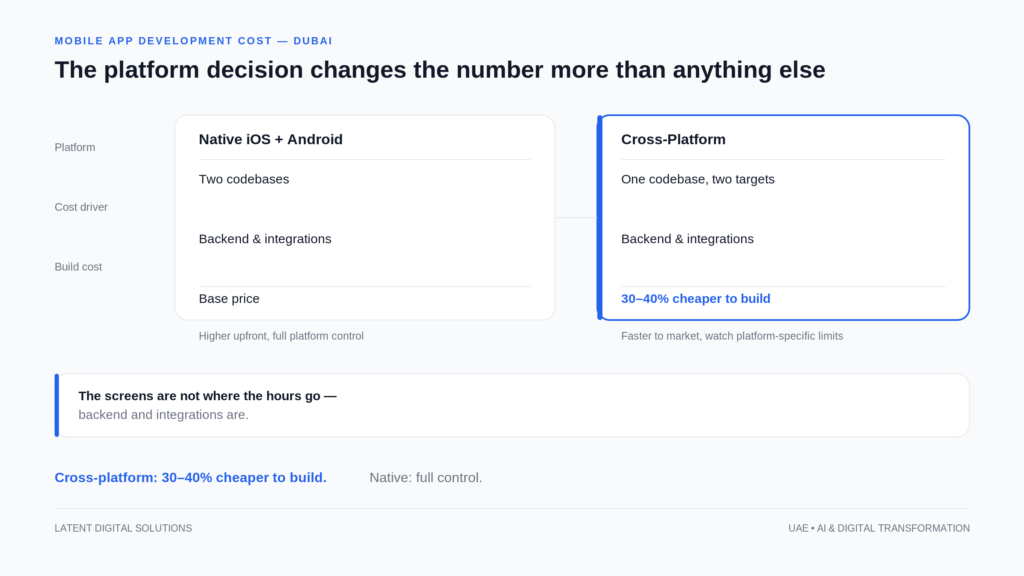
- The single biggest lever on mobile app development cost is the platform decision: native iOS and Android (two codebases) versus cross-platform (one codebase, two targets). Cross-platform is typically 30-40% cheaper to build but can cost more over time if the app leans on anything deeply platform-specific.
- Backend and integration work, not the screens you see, is usually where the hours go. An app with five simple screens and a complex backend (payments, real-time sync, third-party APIs) costs more than an app with twenty simple screens and no backend to speak of.
- A number before anyone has scoped your app is a guess dressed up as a quote. Mobile app development cost in Dubai genuinely depends on whether you’re integrating with existing systems, what your authentication and data model look like, and whether you need offline support.
- Starting with a working prototype, not a full build, is the cheapest way to find out if the core idea works before committing the larger budget to it.
What Determines Mobile App Development Cost in Dubai?
Mobile app development cost in Dubai is set by four things: the platform approach (native or cross-platform), how much the app depends on a backend and integrations, how many screens and user flows it needs, and whether ongoing support follows the launch.
Many development teams now use AI coding tools. Our guide to coding artificial intelligence explains what the tools change, where they add risk and how to adopt them safely.
Native vs. cross-platform. Native means separate codebases for iOS (Swift) and Android (Kotlin) — two builds of the same app, maintained in parallel. Cross-platform (Flutter or React Native) means one codebase that compiles to both. Cross-platform is faster and cheaper to build and easier to maintain going forward. Native is the right call when the app needs deep access to platform-specific hardware or performance that cross-platform frameworks genuinely can’t match — camera-heavy processing, AR, or hardware integrations are the usual cases. For most business apps, that case doesn’t come up.
Backend complexity. An app that just displays content and takes simple form input is a thin client. An app that needs user accounts, real-time data sync, push notifications, payments, or offline mode needs a real backend built alongside it — and that backend is frequently more engineering work than the app itself. The screens are what a client sees in a demo. The backend is what the quote is actually pricing.
Screen count and flow complexity. More screens means more build time, but not linearly — a login flow with password reset, social sign-in, and email verification is more work than ten simple content screens combined. Complexity in flows, not raw screen count, is the better predictor.
One-time build vs. build plus ongoing support. App stores push OS updates on their own schedule, not yours. An app that isn’t maintained breaks within a year or two as iOS and Android move underneath it. Ongoing support, covering OS compatibility, bug fixes, and new features, is a real recurring cost that belongs in the conversation from the start, not discovered after launch.
How Much Does Mobile App Development Cost in Dubai?
There’s no single figure because “mobile app” covers everything from a five-screen internal tool to a consumer app with payments, chat, and real-time location tracking. Engagement type is a more honest frame than a tier label:
| Engagement type | Typical duration | What you actually get |
|---|---|---|
| Working prototype | 2-4 weeks | A clickable, testable version of the core app idea, before a large investment |
| Fixed-scope build (simple-to-mid complexity) | 8-14 weeks | A complete app on one or both platforms, connected to a real backend |
| Full build + ongoing support (complex) | 4-7 months+ | A production app with payments, real-time features, or heavy integrations, maintained post-launch |
What UAE developer rates actually look like
Mobile development rates in the UAE follow the same pattern as broader custom software development cost benchmarks, by experience level:
| Developer level | Hourly rate (AED) | What they typically handle |
|---|---|---|
| Junior (0-2 years) | AED 75-150/hour | UI screens, standard components, basic API calls |
| Mid-level (3-5 years) | AED 150-260/hour | App architecture, state management, third-party SDK integration |
| Senior (6+ years) | AED 260-750/hour | Platform strategy, performance tuning, backend architecture |
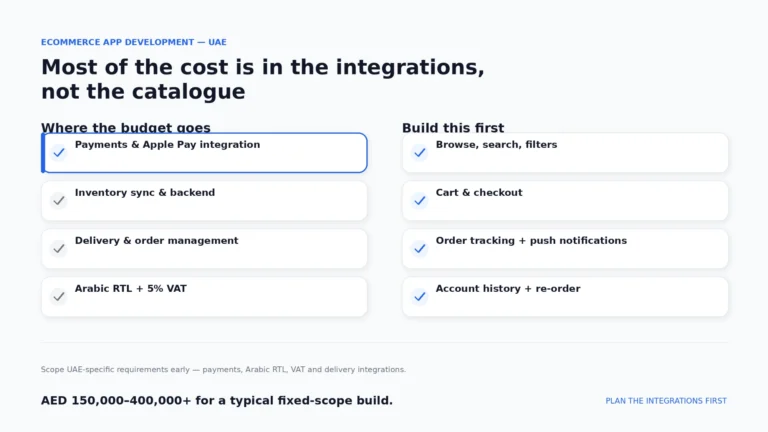
As a rough frame: a simple cross-platform app with a basic backend (account creation, a handful of screens, no payments) commonly lands in the AED 55,000-150,000 range for a fixed-scope build. An app with payments, real-time sync, or significant third-party integration typically runs AED 150,000-400,000+. These are frame-setting ranges, not quotes — the actual number depends entirely on the backend and integration work described above.
The rate per hour matters less than the total hours, and total hours is a function of scope clarity going in. A project scoped properly at 300 hours stays near 300 hours. A project with an unscoped backend and “we’ll figure out the integrations later” routinely runs to 500+ hours, regardless of what the original estimate said.
We start every mobile engagement with a working prototype before asking for the full build budget, so the core idea gets tested against real users before the larger number is committed.
Native vs. Cross-Platform: the Actual Cost Comparison
Cross-platform frameworks (Flutter, React Native) build once and ship to both iOS and Android, which is why they’re typically 30-40% cheaper upfront than building two native apps in parallel. For most business apps — internal tools, customer-facing apps with standard UI patterns, apps built around a backend rather than hardware — that’s the right call, and it’s what most Dubai agencies quote by default now.
Native still wins when the app needs something cross-platform frameworks handle poorly: heavy camera or AR processing, background location tracking with strict battery constraints, or deep integration with platform-specific hardware. If none of those apply to what you’re building, paying the native premium buys very little.
The decision isn’t “cross-platform is always cheaper” — it’s “cross-platform is cheaper for the 90% of business apps that don’t need native-only capabilities, and a bad fit for the 10% that do.” Getting this call right before development starts avoids rebuilding the app on the other approach halfway through, which is the single most expensive mistake in mobile development cost.
What Actually Drives the Price Up (and What Doesn’t)
What genuinely drives mobile app development cost up:
- Payments and financial data. Integrating a payment gateway correctly, with proper error handling, refunds, and reconciliation, is slower and more carefully tested than almost any other feature category.
- Real-time features. Live location tracking, chat, or live data sync require infrastructure (sockets, push notification systems, conflict resolution for offline edits) that a simple CRUD app never touches.
- Legacy or third-party system integration. An app that has to read from or write to an existing ERP, CRM, or booking system inherits all the same integration unpredictability that custom software integration work does on the web side — old APIs, undocumented formats, systems that were never meant to be opened up.
- Offline mode. An app that has to work with no connection and sync cleanly once it’s back online is a meaningfully harder engineering problem than one that assumes the user is always online.
What does not necessarily drive the price up:
- Screen count alone. Twenty simple, similar screens cost less in total than five screens with complex conditional logic and validation.
- App store category. A logistics app isn’t inherently more expensive to build than a retail app. The driver is the backend and integration complexity, not the industry.
- Visual polish, within reason. A well-designed UI costs design time, not engineering time. It’s a smaller share of the budget than people expect.
Questions to Ask Before You Accept a Quote
A number quoted before anyone has asked about your backend, your integrations, or your offline requirements is a guess. Before accepting one, ask: is this native or cross-platform and why, what’s included versus billed separately, who owns the code and the App Store/Play Store listing once it ships, and is post-launch support (OS updates, bug fixes) covered or separate.
Native or cross-platform, and why? If the answer is “native” for an app with no hardware-specific requirement, ask what that premium is buying you.
What’s included, and what isn’t? App Store and Play Store submission, push notification setup, analytics integration, and backend hosting are often quoted separately. Ask explicitly before you compare two numbers that aren’t actually comparable.
Who owns the code and the store listings? You want the app published under accounts you control, not the vendor’s. Losing access to your own App Store listing because a vendor’s account owns it is a real and common problem.
Is post-launch support included? OS updates happen on Apple and Google’s schedule. An app with no maintenance plan breaks within a year or two. If support isn’t in the quote, you’re looking at a second cost the moment iOS or Android ships an update that breaks something.
Conclusion
A straight answer beats a tier chart. Mobile app development cost in Dubai ranges from a two-to-four-week prototype to a production app with payments and real-time sync running into the hundreds of thousands of dirhams. The gap between those is set by the platform decision, the backend complexity, and how clearly the integrations are scoped before anyone writes a line of code.
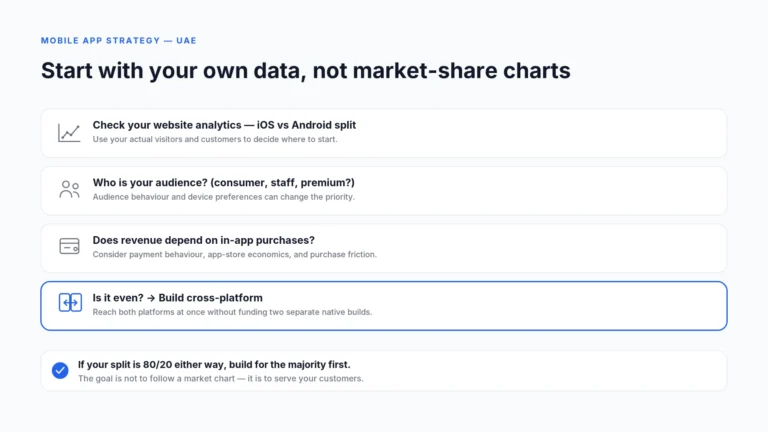
That platform decision, Android or iOS first, shapes the timeline and cost from day one. If you have not settled it yet, our guide on Android vs iOS: choosing the right first platform for your UAE app explains how to read your own analytics and pick the right starting point.
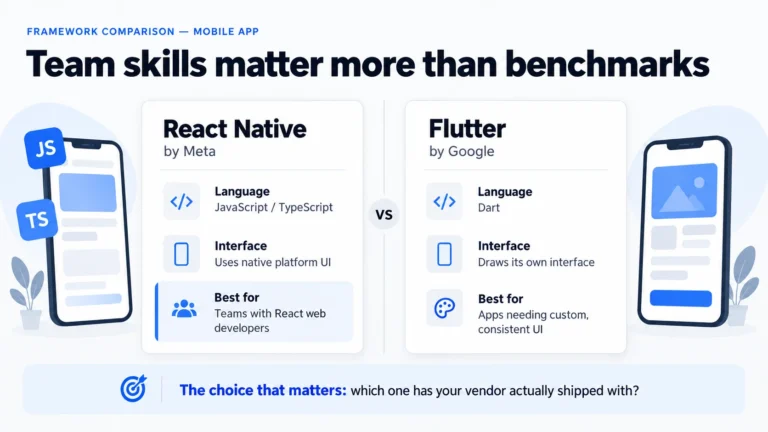
Once you know which platform to start with, the next decision is which framework to build it in. Flutter vs React Native: how to choose for your business app compares both on team skills, interface requirements, and long-term maintenance.
Get in touch and describe the app you’re trying to build. That conversation is more useful than any price list.
Frequently Asked Questions
How much does mobile app development cost in Dubai?
There’s no single figure because cost depends on the platform approach and the backend behind the app. As a frame: a simple cross-platform app with a basic backend commonly runs AED 55,000-150,000 for a fixed-scope build. An app with payments, real-time sync, or heavy third-party integration typically runs AED 150,000-400,000 or more. A working prototype, before committing to either, takes 2-4 weeks.
Is native or cross-platform app development cheaper?
Cross-platform (Flutter, React Native) is typically 30-40% cheaper upfront than building separate native iOS and Android apps, because it’s one codebase instead of two. Native is worth the premium only when the app needs hardware-specific performance that cross-platform frameworks can’t match, heavy camera processing, AR, or deep hardware integration. Most business apps don’t need that and are cheaper and easier to maintain built cross-platform.
What’s the difference between a mobile app development company and a custom software development company?
In practice, very little, mobile app development is a subset of custom software development, not a separate discipline. A company that builds custom web and business software typically builds the mobile layer as part of the same engagement, since the app usually needs the same backend, data model, and integrations as any other part of the system. The distinction matters more in marketing than in actual engineering work.
How long does it take to build a mobile app in Dubai?
A working prototype: 2-4 weeks. A fixed-scope build for a simple-to-mid complexity app: 8-14 weeks. A full build with payments, real-time features, or heavy integration, plus ongoing support: 4-7 months or more. Integration complexity and backend scope are the biggest variables, not the number of screens.
Do I need a separate backend built for my app, or can it just talk to our existing systems?
That depends entirely on what you already have. If there’s an existing system (a CRM, an ERP, a booking platform) with an API that can be extended, the app can often connect to it directly, which is cheaper. If no such system exists or what exists wasn’t built to be opened up to a mobile client, a backend needs to be built alongside the app, which is real additional scope that should be priced explicitly rather than assumed.
Usually a reply within one working day.