Article Overview
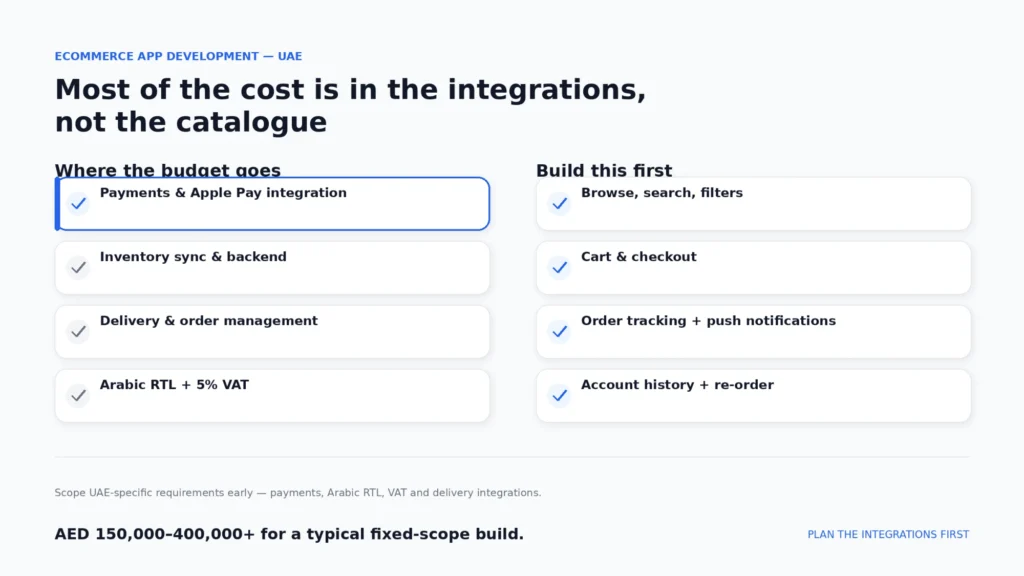
An ecommerce app is not a mobile version of your website. Ecommerce app development dubai is a separate product decision — one with its own checkout flow, its own performance expectations and its own set of integrations. Most of the cost sits in the parts the customer never sees: payments, inventory, delivery and order management. This guide explains what an ecommerce app for a UAE business actually involves, which features belong in a first release, and what drives the budget up.
Already know you need an app?
Skip ahead to our mobile app development services for UAE businesses.
- Most of an ecommerce app’s cost is behind the screens: payments, inventory sync, delivery integration and order management, not the catalogue pages.
- A first release should do a few things well: browse, search, checkout, order tracking and notifications. Loyalty, wishlists and recommendations can follow once real orders show what customers use.
- UAE-specific choices matter early: local payment gateways, Apple Pay, buy-now-pay-later options, cash on delivery, Arabic right-to-left layout and 5 percent VAT handling.
- If you already run a store on Shopify, WooCommerce or a custom platform, the app should connect to it rather than duplicate it, which changes both scope and cost.
Do You Need an Ecommerce App, or Is a Mobile Site Enough?
A fast, well-built mobile website is enough for many businesses, and it is the cheaper place to start. An app starts to earn its cost when you have repeat customers who would use it regularly, when push notifications would genuinely bring people back (re-orders, delivery updates, offers), or when you need device features such as the camera, location or biometric login.
A useful test: if you cannot name a reason a customer would open the app instead of your website, build the website experience first. If you can, the app is worth scoping properly.
The distinction matters for ecommerce app development dubai specifically because UAE consumers have high digital expectations. A slow or cluttered mobile website will push customers to competitors who have invested in a proper app experience. At the same time, a poorly scoped app that duplicates what your website already does is not worth the budget. The honest answer depends on your customer behaviour, not a general trend about app adoption.
Which Features Belong in a First Release?
A focused first release is cheaper, ships sooner, and tells you what customers actually use. For any ecommerce app development dubai project, a sensible core looks like this:
- Browse and search with filters that match how people shop your catalogue
- Product pages with images, variants, stock status and pricing including VAT
- Cart and checkout with saved addresses and saved payment methods
- Payments through the options your customers expect (cards, Apple Pay, and where relevant buy-now-pay-later or cash on delivery)
- Order tracking and status notifications
- Accounts with order history and easy re-ordering
Features to defer until real orders justify them: loyalty programmes, wishlists, reviews, personalised recommendations and social sharing. Adding these to a first release adds scope and cost without confirming that your customers will use them.
The scope question for ecommerce app development dubai mirrors the same decisions that apply to other custom software projects in the UAE — complexity in the first release is where budgets overrun. For how that plays out across project types, our custom software development cost guide explains the relationship between feature scope, integration count and total build cost.
What UAE-Specific Requirements Should You Plan For?
Payments: UAE apps typically integrate a regional or international payment gateway, and many customers also expect Apple Pay — which requires a merchant agreement and a specific iOS integration, separate from your card gateway. Buy-now-pay-later providers and cash on delivery remain relevant depending on your audience. Each payment option adds integration work, so decide which ones are worth supporting at launch — not all of them are.
VAT: UAE VAT is set at 5 percent and applies to most retail transactions. Prices, invoices and receipts need to handle it correctly, including how it appears at checkout and on tax invoices. This is not an afterthought in ecommerce app development dubai — it must be built into the pricing model from the start, not retrofitted after the checkout flow is designed.
Arabic and right-to-left: If part of your audience reads Arabic, plan the layout for it from the design stage. Retrofitting right-to-left support after launch touches every screen. For any ecommerce app development dubai build serving a bilingual UAE market, this is a day-one requirement, not an optional extra.
Delivery: Last-mile delivery in the UAE often means connecting to courier or logistics providers, or running your own fleet. Either way, the app needs reliable address handling and real-time status updates — this integration is one of the larger cost drivers in ecommerce app development dubai projects with a physical fulfilment component.
Data: Customer data falls under the UAE Personal Data Protection Law, so how you store, handle and delete it should be part of the build, not an afterthought added at launch. In 2025, PDPL compliance requirements affect how ecommerce platforms structure data retention and customer consent flows.
How Much Does Ecommerce App Development Dubai Cost?
Because ecommerce app development dubai involves payments, inventory and integrations, these projects sit in the higher part of the range. As a frame, apps with payments or significant third-party integration typically run AED 150,000 to 400,000 or more for a fixed-scope build. A simple catalogue-and-checkout app on top of an existing store backend can land lower. These are frame-setting ranges, not quotes — every ecommerce app development dubai project is scoped individually.
What moves the number most:
- whether you are connecting to an existing store platform or building the backend from scratch
- how many payment methods and delivery integrations you support at launch
- inventory complexity, such as multiple warehouses or real-time stock sync across locations
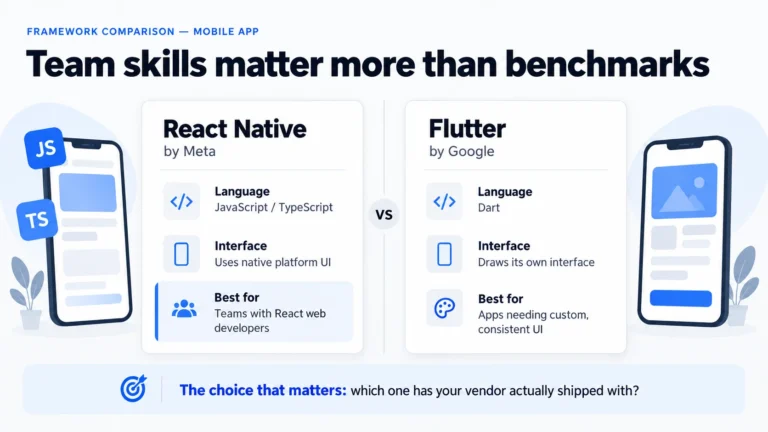
- native versus cross-platform build (our mobile app development cost guide has the full cost breakdown for each approach)
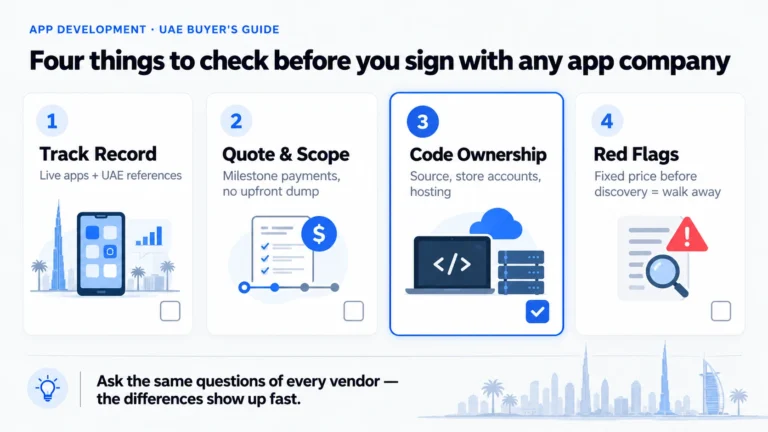
In our experience with ecommerce app development dubai projects in 2025, the backend integration question is the single biggest driver of budget variance: does the app connect to an existing store, or does a new backend need to be built? Confirming this early, before a quote is agreed, avoids scope changes mid-build that push the project beyond the initial estimate.
How Should the App Connect to Your Existing Store?
If you already have a store, treat it as the source of truth for products, prices, stock and orders, and have the app read from and write to it through an API. That avoids running two catalogues, keeps stock accurate and means staff keep using the tools they already know.
If your current platform cannot expose what the app needs, find out in discovery before a quote is agreed. It can add real scope. A platform that cannot support an app API integration may require a backend rewrite that doubles the ecommerce app development dubai project cost.
For a view of how we scope and phase ecommerce app development dubai projects, our mobile app development services page has more on our approach to phasing and building toward production.
Conclusion
Scope an ecommerce app around checkout, payments and order handling first, plan for UAE-specific requirements from the start, and connect it to your existing store instead of rebuilding alongside it. A working prototype of the buying flow is the cheapest way to confirm the idea before committing the full budget to a complete ecommerce app development dubai build.
Tell us about your store and what you want the app to do. We will give you a straight view of scope and approach.
Written by Chinmay, mobile app developer at Latent Digital Solutions. We have built and shipped production ecommerce app development dubai projects and broader mobile apps for UAE businesses across retail, hospitality and fulfilment. In most of these engagements, the first scoping question is which backend the app connects to — that single decision shapes more of the cost than the app screens themselves.
Frequently Asked Questions
How much does ecommerce app development in Dubai cost?
It depends on payments, integrations and whether a backend must be built. As a frame, ecommerce app development dubai projects with payments or heavy integration commonly run AED 150,000 to 400,000 or more for a fixed-scope build, and simpler apps on top of an existing store backend can cost less. These are ranges, not quotes — scoping calls confirm the real number.
Do I need an app if I already have an online store?
Not necessarily. A fast mobile website suits many businesses. An app earns its cost when you have repeat customers, when push notifications would bring them back, or when you need device features such as the camera or biometric login.
Can the app connect to my existing Shopify or WooCommerce store?
Usually yes. The app can read products, prices, stock and orders from your existing platform through its API, so you keep one catalogue and one set of order tools. Confirm in discovery that your platform exposes what the app needs — this is one of the first things we check in any ecommerce app development dubai scoping session.
What payment methods should a UAE ecommerce app support?
Cards and Apple Pay are the usual starting point, with buy-now-pay-later and cash on delivery added depending on your audience. UAE VAT at 5 percent applies to most retail transactions and must be handled correctly at checkout. Each payment method adds integration work, so choose the ones your customers actually use for launch.
How long does it take to build an ecommerce app?
A working prototype of the buying flow takes about two to four weeks. A fixed-scope build of a focused first release typically takes 8 to 14 weeks, and ecommerce app development dubai projects with heavy payment or delivery integration take longer.
Usually a reply within one working day.