Article Overview
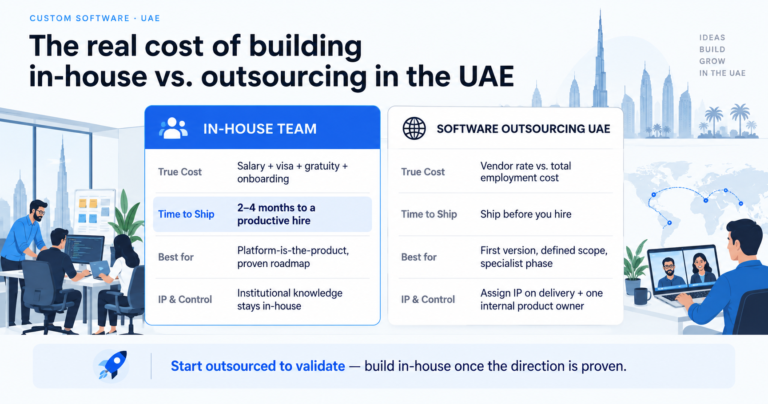
A custom AI development company builds AI software around one specific job in your business, such as reading supplier documents or answering customer queries, instead of selling you a tool every competitor can also buy. It is the right choice when your process or data is unusual, and the wrong one when an off-the-shelf tool already does the job.
Choosing a custom AI development company is a business decision before it is a technical one. Our AI Transformation work starts with the problem and what it costs you each week, and only then looks at which model or tool might help.
Already know you need a custom build?
Skip ahead to our AI transformation services for UAE businesses.
- A custom AI development company builds AI software around one specific job in your business. Most of the custom work is the workflow, the connection to your data and the checks around the model, not a brand-new model trained from scratch.
- Choose custom AI only when your process, rules or data are unusual enough that a general tool keeps getting them wrong. For common jobs, trial an existing tool for two to four weeks first, because it is cheaper and quicker.
- Before you sign, confirm that you will own the code, the instructions, your test cases and the accounts the system runs in. That lets you change supplier or bring the work in-house without losing what you paid for.
- Judge a custom AI development company by its first project: one job, one measurable result, tested on your own data, with running costs stated up front. A firm that cannot describe that project clearly is not ready to build a bigger one.
What does a custom AI development company build?
A custom AI development company builds software that uses AI to do one defined job in your business, designed around your data, your rules and your existing systems. The result is yours to run and change. It is not a subscription to somebody else’s product.
“Custom” does not always mean training a new AI model from scratch. That is rare and expensive. In most projects, the model comes from a large provider, and the custom work is everything around it. That usually covers three things:
- The workflow: what goes in, what the AI is asked to do, and what happens to the answer.
- The data connection: how the AI reads from, and writes back to, your ERP, your CRM or your shared folders.
- The checks: rules that catch wrong answers, send hard cases to a person and keep a record of what happened.
Think of the model as an engine. A custom AI development company builds the car around it: steering, brakes, a dashboard and a seat for the driver. The engine matters, but a good engine in a badly built car still leaves you at the roadside.
Here is a typical example. A trading company receives supplier price lists as PDFs and emails. Staff retype the prices into the ERP every week. A custom AI development company would build a tool that reads each list, matches items to your product codes, flags anything unusual and passes the rest into the ERP for a person to approve. The AI model is one step in that chain, and the rest is ordinary careful software work.
That is why a good custom AI development company talks about your process first and models second. Latent Digital Solutions treats the model as one part to be chosen for the job, not as the product.
Do you need a custom AI development company at all?
Use an existing tool when the job is common and low risk. Use custom AI when your process, data or rules are specific enough that a general tool keeps getting them wrong. If you are unsure, test an existing tool first and let the gaps decide.
| Situation | Better fit | Reason |
|---|---|---|
| Common job, such as meeting notes or email drafts | Existing tool | Cheap, quick, nothing to maintain |
| Process unique to you, such as pricing rules built up over years | Custom AI | A general tool does not know your rules |
| Sensitive client or patient data | Custom or private setup | You control where the data goes |
| AI needed inside your ERP or app | Custom integration | Off-the-shelf tools sit outside your systems |
| You are not sure the idea works | Existing tool first | Prove the value before you build |
Spend two to four weeks using an existing tool on the real job. Write down where it fails: wrong answers, missing steps, data it cannot reach. If the failures are small, keep the tool. If the failures sit in the heart of your process, you have a case for a custom AI development company, and you also have a written brief to hand them.
The wider evidence says to be careful with spending. BCG’s 2025 research found that 60% of companies are getting hardly any material value from AI despite substantial investment. Buying custom AI before you know the job is a common way to join that group.
A useful rule: write the job down as one sentence and one number before you talk to anyone. If you cannot do that, you are not ready to brief a custom AI development company, and a short trial of an existing tool will get you there faster.
Our guide to build vs buy AI walks through the same decision for a specific process, with the questions to ask before you commit.
What should you own at the end of the project?
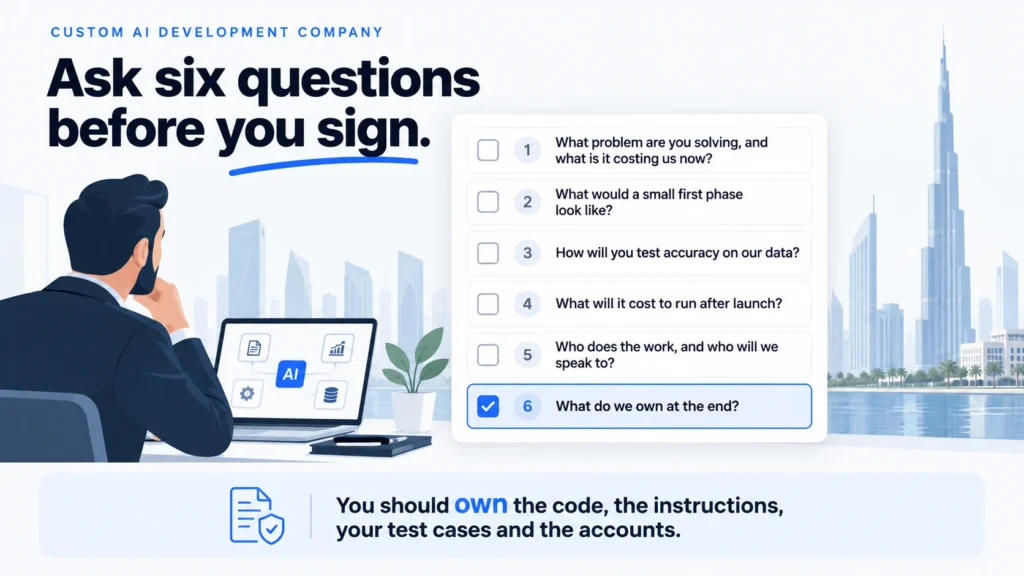
You should own the source code, the instructions given to the AI, your test cases, any trained files, and the accounts it runs in. It should all be handed over in a form another supplier could pick up. If you cannot walk away with it, you are renting, not buying.
Many buyers forget to ask this, yet it matters more than any feature. Ask each custom AI development company what you would be holding if you parted ways in a year.
- Source code and settings: the full code and configuration, stored in a repository that belongs to your company.
- Instructions and prompts: the written instructions that tell the AI what to do, because these carry much of the real value.
- Your test cases: the set of real examples used to check accuracy. They let you test any replacement fairly.
- Trained files: if a model was tuned on your data, the files that result.
- Accounts and keys: cloud accounts and AI provider keys registered in your company’s name, not the supplier’s.
- Documentation: a plain description of how it works, written for the person who takes it over.
Watch for a “proprietary platform” that only the supplier can run. It may work well, but it ties you to them. Prefer a build that can swap the underlying AI model without a rebuild, since providers change prices, versions and terms often.
Data deserves its own check. The UAE’s personal data protection law, Federal Decree-Law No. 45 of 2021, requires outside processors to act on your instructions and work under a contract. So a custom AI development company handling customer or staff data should agree in writing where data is stored, who can see it and whether it is used to train anyone else’s model.
How do you compare a custom AI development company?
Compare each custom AI development company on how it starts, not how it presents. The best signals are a plan that begins with your business problem, a small first phase, a test on your own data and honest running costs. Polished case studies tell you far less.
Ask every custom AI development company the same six questions and keep the answers side by side:
- What problem are you solving, and what is it costing us now? A good firm asks about hours, errors and delays before it mentions technology.
- What would a small first phase look like? Look for one job and one measurable result, not a platform.
- How will you test accuracy on our data? They should name the test, such as 30 to 50 of your real cases, and who judges the answers.
- What will it cost to run after launch? Usage fees, hosting, monitoring and fixes should be itemised.
- Who does the work, and who will we speak to? Ask for names and roles, and whether any work is passed on to another firm.
- What do we own at the end? Use the list in the previous section.
Few firms answer all six clearly, so the ones that do stand out. A firm that cannot has told you something before you have spent anything.
The same questions work whatever a company calls itself: AI agency, software house or consultancy. The label matters less than the answers. Our checklist on how to choose a custom software development company in Dubai covers the general supplier checks that sit underneath these AI-specific ones.
Also ask to speak to a past client with a similar-sized business. A reference from a global bank tells you little about a project at your scale. A reference from a company with ten times your budget tells you even less.
Finally, compare how each firm handles disagreement. Ask what happens if the first phase misses its target. A trustworthy custom AI development company will describe a clear way to stop, adjust or exit, with a price attached.
What should a custom AI development company start with?
A custom AI development company should start you with a small first project that you can finish in weeks. It should be tied to one number you already track, and tested on your real examples before anyone relies on it. It should prove one idea cheaply.
Many disappointing projects start too big. A firm proposes a platform that “transforms operations”, and eighteen months later nobody can say what changed. A better custom AI development company will push you to narrow the scope. A firm that narrows the scope is usually drawing on experience.
A good first project follows these steps:
- Pick one job and one number. For example, hours spent each week retyping price lists, or the share of customer queries answered within an hour.
- Gather real examples. Collect 30 to 50 genuine cases, including messy ones, and write down the correct answer for each.
- Build the smallest version. One workflow, one set of checks, and a person approving the output.
- Run it beside the people. For a few weeks, compare its work with what your team produces.
- Decide with the numbers. Widen, adjust or stop, based on the result you chose at the start.
Illustrative example (not a client case): a Sharjah building-materials distributor spends six hours a week copying supplier prices into its ERP. The first project builds only that: reading the price lists, matching product codes and flagging price jumps for review. After a month, the team compares the time and error rate against the old routine. If the result holds, they add the next job. If it does not, they have spent a small amount to learn that.
This is how our approach to turning one business problem into a working AI tool works in practice. The first result is small, specific and measurable, which makes the next decision easy.
Agree the stop rule before you start. Write down the number that means “continue” and the number that means “stop”. It is much easier to agree this before you have invested emotionally in the build.
What red flags should you watch for?
The clearest red flags in a custom AI development company are accuracy promises made before it has seen your data and no talk of running costs. Others are a platform only it can operate and pressure to sign a long contract before a pilot. Any one of these is a reason to slow down and ask more questions.
- Accuracy promised in advance: nobody can say how well AI will do on your documents until it has been tested on them.
- Demos on their data: a demo built on their examples proves little. Ask for a test on yours.
- No running costs: AI tools have ongoing usage and hosting costs. If the quote only covers the build, the bill is hidden.
- A platform you cannot leave: check the ownership list again.
- No named people: you should know who builds, who reviews and who answers your calls.
- A long contract first: a fair custom AI development company will accept a short paid first phase.
- Vague answers on data: if they cannot say where your data is stored, move on.
Ask how a firm manages risk, too. A capable custom AI development company can explain its answer by reference to a recognised guide, such as the NIST AI Risk Management Framework. It is a voluntary framework for building trustworthiness into the design, use and evaluation of AI systems. You do not need to read it yourself. What matters is whether they have.
For a longer list of questions that applies to AI suppliers in general, see our guide on how to choose an AI implementation partner. It works well as a second pass once you have shortlisted two firms. Keep notes on each answer, because the differences between firms show up in the detail.
What does a custom AI development company cost?
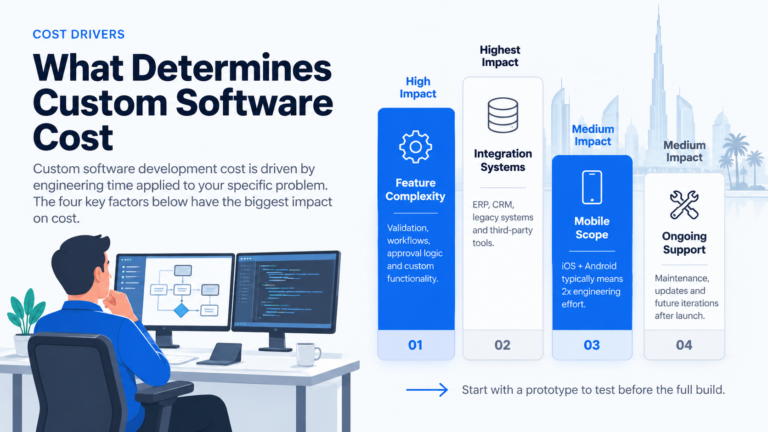
Cost depends on scope far more than on technology. A single-purpose tool that reads one kind of document costs much less than a system connected to your ERP, your CRM and your approval rules. Running costs continue after launch and belong in the budget.
Four things move the price most:
- Number of systems connected: each connection to an ERP, CRM or portal adds build and testing work.
- State of your data: messy, scattered or scanned records take longer to prepare than clean ones.
- Accuracy needed: a tool that suggests a draft for review is cheaper than one that acts alone.
- Review and approval steps: the more regulated the job, the more checks and records it needs.
After launch, expect usage fees for the AI provider, hosting, monitoring and a few hours of fixes each month. Ask for these as a monthly figure in AED. A quote that shows only the build price is incomplete.
Ask each supplier to split the quote into three lines: the build, the first year of running costs and the cost of changes. The split makes quotes comparable and shows which firm has thought about life after launch. It also exposes where a low headline price hides extra fees, such as charges per user, per document or per request. A good custom AI development company will be happy to show this split.
Compare quotes on cost per result, not total price. Cost per result means the full cost divided by the number of jobs done, such as the price per invoice processed. A cheaper build that your staff stop using costs more than a dearer one that sticks. For ranges in dirhams, see our breakdown of AI implementation cost. It covers what UAE projects actually bill and which line items quotes tend to leave out.
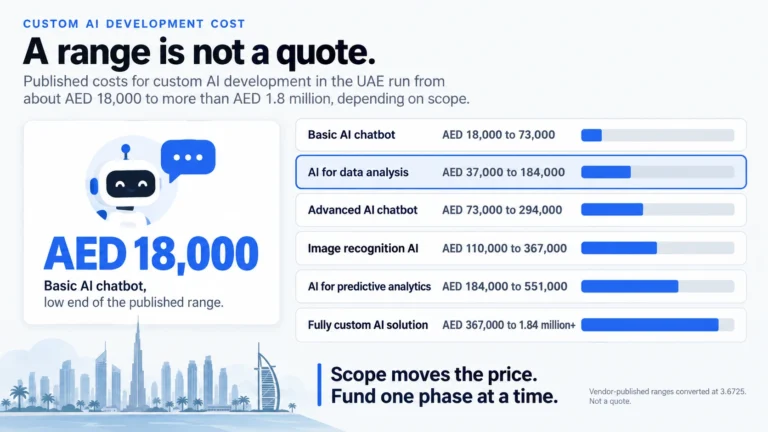
Be cautious with online cost tables. Most are written by vendors, show wide ranges in US dollars and say little about the UAE. Treat any figure as a starting point for a conversation, and ask each custom AI development company to price your specific first phase.
Published vendor ranges, converted to dirhams in our custom AI development cost guide, give the shape of the market:
| Project type | About (AED) |
|---|---|
| Basic AI chatbot | 18,000–73,000 |
| AI for data analysis | 37,000–184,000 |
| Advanced AI chatbot | 73,000–294,000 |
| Fully custom AI solution | 367,000–1.84 million+ |
These are published ranges, not a quote for your project.
What should UAE buyers check before they sign?
Before you sign with a custom AI development company, check where data is stored, whether Arabic and English documents were tested, who handles support in UAE hours, and whether any rules for your sector apply. These are practical points that generic buyer’s guides skip.
- Data location and contracts: get it in writing, in line with the personal data protection law above.
- Arabic and English testing: ask for results on your own mixed-language documents, including scans and handwriting if you have them.
- Support and escalation: confirm who answers in UAE working hours, including the Friday and weekend pattern your team follows.
- Sector rules: if you work in banking, insurance or healthcare, ask whether your regulator has rules on AI or outsourcing, and have the firm explain how its design meets them.
- Currency and invoicing: price in AED with VAT shown, so budgets compare cleanly.
- Exit plan: agree how handover works if either side ends the contract.
Put these in the brief from the start, instead of negotiating them later. A custom AI development company that has worked in the region will have answers ready. One that has not will need time to find them, and you can see which you are dealing with.
Conclusion
A custom AI development company is worth hiring when your process or data is unusual enough that a general tool keeps getting it wrong. Test an existing tool first, start with one job and one number, and make sure you own the code, instructions, test cases and accounts at the end. Compare firms on their first phase, their answers about running costs and their plan for data, not on their case studies. Pick the custom AI development company that asks about your problem before it mentions a model.
In the next 30 days, write down the single job you want to improve. Try an existing tool on it for two weeks, then send the same six questions to two firms. You will learn more from those answers than from any proposal deck.
If you have a specific job in mind and want a straight view on whether it needs custom AI, talk to Latent’s team.
Frequently Asked Questions
What is a custom AI development company?
A custom AI development company builds AI software designed around one job in your business, using your data, rules and systems. Most of the custom work is the workflow and checks around an existing AI model, rather than a brand-new model.
How is a custom AI development company different from buying an AI tool?
An AI tool is built for many customers and works the same way for all of them. A custom AI development company builds for your process, so it can connect to your systems and follow your rules. The trade-off is higher cost and more responsibility for maintenance.
How long does a custom AI development company take to deliver?
A narrow first version often takes weeks to a few months, depending on how many systems it connects to and how clean your data is. Larger builds take longer. Ask for a small first phase with a clear result so you can judge progress early.
Who owns the AI after the project ends?
You should, if the contract says so. Ask for ownership of the code, instructions, test cases, any trained files and the accounts it runs in. Agree this in writing before work starts, along with how handover works.
Do I need a lot of data to start with a custom AI development company?
Usually not. Many projects use an existing AI model and your documents and examples. You do need a set of real cases, often 30 to 50, with the correct answers, so that accuracy can be tested honestly.
Can a custom AI development company handle Arabic documents?
Many can, but quality varies by model, dialect and document type. Ask for results on your own Arabic and mixed Arabic and English documents before you sign, including scans if you have them.
Usually a reply within one working day.