Article Overview
AI implementation cost is the total price of getting an AI project from idea to daily use: assessment, pilot, integration, and handover, not just the model itself. It depends far more on scope than on which firm you hire. A narrow, single-process pilot costs a fraction of a company-wide rollout. Every global guide that quotes “$20,000 to $500,000” is really describing that whole range at once, not answering your specific question.
For a UAE business trying to work out what an AI project actually costs, the more useful question isn’t “what’s the average AI implementation cost.” It’s this: what does a project my size actually bill, in AED? And what happens if it stalls?
Key takeaways
- 01AI implementation cost depends on scope, not on which firm you hire: a pilot and a full rollout are different questions entirely.
- 02Every published guide quotes a global USD range. None give AED figures, UAE hosting costs, or a VAT line.
- 03MIT research found 95% of generative AI pilots fail to deliver measurable business value.
- 04The real cost of a stalled AI project is the months before anyone tries again, not the invoice.
How much does AI implementation cost?
There’s no single AI implementation cost, because “AI implementation” covers work at very different scales.
Our guide to custom AI development cost converts published project ranges into dirhams and shows what drives them.
Our guide to machine learning v deep learning explains how the choice of method affects data, computing and running costs.
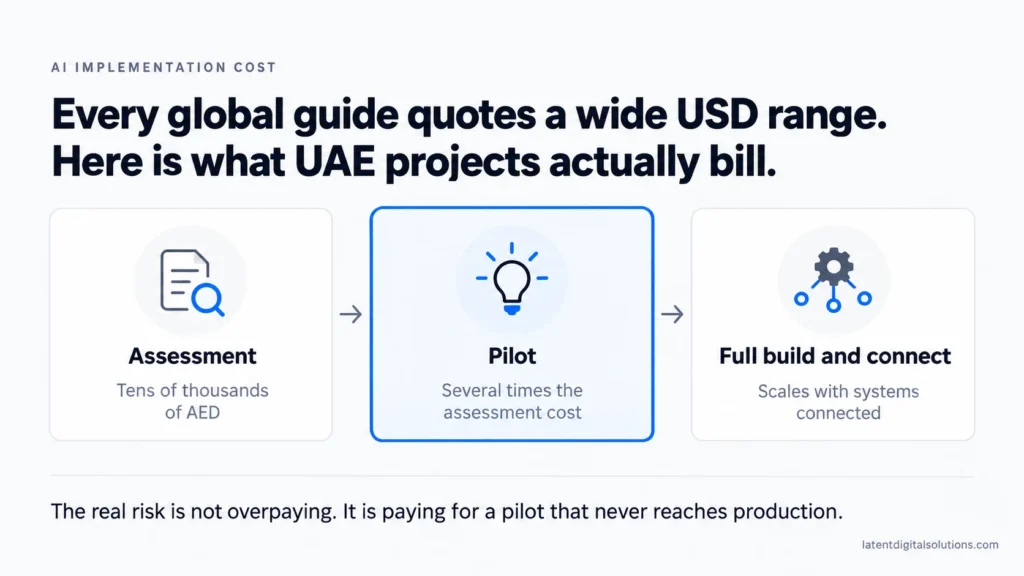
| Phase | Typical range (AED) | Where the range comes from |
|---|---|---|
| Assessment or scoped quick win | 9,000–37,000 | UAE advisory pricing for a fixed, scoped project, from our small-business AI consultant guide |
| Fixed-scope pilot on one workflow | 30,000–80,000 | One process, one AI connection, defined handover, from our AI integration services guide |
| Multi-system build-and-connect | 150,000–400,000 | Three or four core platforms with custom logic and full documentation, from our AI integration services guide |
| Fully custom AI solution | 367,000–1.84 million+ | Published vendor ranges converted to dirhams, from our custom AI development cost guide |
These are ranges, not a quote for your project. The advisory figures are before 5% VAT, so ask whether any quote you receive includes it. A week of data clean-up can add AED 20,000–40,000 to a fixed-scope project, which is why a data review should come before a price.
Any AI implementation cost estimate you’re given before anyone has looked at your actual data and systems is a guess dressed up as a quote. A firm that names a figure in the first call, before reviewing anything, is pricing off a template, not off your business.
The bigger driver of AI implementation cost isn’t the model. It’s integration. Connecting a pilot to one CRM is a different job from connecting it to three disconnected spreadsheets and a legacy database. Most published cost guides bury this distinction inside a single wide range, which is why the ranges all look similar and unhelpful: $20,000 to hundreds of thousands, $50,000 to $500,000, $10,000 to $10 million. Wide enough to be true, too wide to plan around.
A retail business and a logistics business can ask about AI implementation cost for what sounds like a similar project and get very different numbers. The reasons usually have nothing to do with the AI itself. The retail business might have clean sales data in one system. The logistics business might have shipment records split across three legacy tools that don’t talk to each other. The second project costs more, not because the model is more expensive, but because phase three of the work, connecting everything together, is genuinely bigger.
What do UAE projects pay that global guides skip?
Every AI implementation cost guide currently ranking quotes a global USD or GBP band. None mention three things a UAE project actually pays for.
The first is hosting and data residency. If a project needs to keep data inside the UAE, that’s a real infrastructure decision with a real cost attached. It’s worth pricing separately from the build itself, rather than folding it into a single number that hides which part of the bill it actually is.
The second is VAT. A 5% line that global guides, written for markets without it, simply don’t include. It sounds small until it’s applied to a six-figure project and shows up as a surprise on the final invoice instead of the original quote.
The third is local salary and time cost. Every AI implementation cost estimate assumes some internal staff time on your side: reviewing outputs, testing the pilot, approving changes. That time is priced differently in Dubai than in the US or UK markets most published guides are written for. A cost estimate that only counts the vendor’s invoice and ignores your own team’s hours is missing a real part of the bill.
None of this is exotic. It’s just missing from every generic AI implementation cost guide currently ranking, because none of them were written for a UAE business specifically. The closest match in scale is still priced in GBP or USD for a market with none of these three considerations. For how these cost bands map onto the actual phases of the work, see the full AI implementation guide.
Why does 95% of AI implementation fail to pay off?
MIT’s NANDA initiative found that 95% of generative AI pilots at companies fail to deliver measurable business return, according to its July 2025 report (Fortune, reporting on MIT’s “The GenAI Divide: State of AI in Business 2025”). The report states plainly that this 95% failure rate is the clearest evidence of what it calls the “GenAI Divide.” That’s the gap between businesses that adopt AI visibly and businesses that actually get measurable value from it.
That figure changes how AI implementation cost should actually be framed. The real risk isn’t overpaying for a project. It’s paying for a project that never reaches production at all, and then treating that sunk cost as a reason not to try a second, better-scoped attempt. Most of the businesses in that 95% didn’t overspend on a bad model. They spent a reasonable amount on a project that was never properly integrated into how the business actually works. For projects built on OpenAI or Azure OpenAI, see how we scope OpenAI consulting work.
Most AI implementation cost guides never mention this number, because a failure rate that high doesn’t fit neatly into a pricing table. It’s uncomfortable to put next to a cost estimate. But it’s the single most important number in this whole topic. It tells you where the real financial risk actually sits: not in the size of the invoice, but in the odds that the invoice buys nothing lasting.
What does a stalled AI project actually cost?
Not the invoice. The invoice is a known, bounded number, and it’s the one every published guide focuses on. What a stalled project actually costs is the twelve months before anyone in the business tries again. The first attempt left everyone assuming AI “didn’t work here.”
This is the AI implementation cost that never appears on an invoice and rarely gets discussed honestly. A pilot that fails cleanly, with a clear reason why, is cheap, because the business learns something specific and can try again with better information. A pilot that quietly fades out, with nobody sure whether it helped, is the expensive outcome, because it poisons the next attempt before it even starts. The second failure mode is far more common than the first, and it’s the one MIT’s 95% figure is largely describing.
Framing AI implementation cost this way changes the real question a business should ask before starting. It’s not “can we afford this pilot.” It’s “can we afford for this pilot to fail badly enough that nobody wants to try again for a year.” That second question is harder to answer. It’s also the one that actually predicts whether the money gets spent well.
How do you scope a project you can actually afford?
Start smaller than feels comfortable. One process, not five. A pilot scoped to a single, clearly-owned task costs less to run. More importantly, it costs less if it doesn’t work, which is the scenario MIT’s research says is the more likely one.
Ask what a stalled version of this specific project would cost before you start, not after. If the honest answer is “we’d probably just stop trying AI altogether,” the project is scoped too large, regardless of what the initial AI implementation cost estimate says on paper. A project sized so failure is a minor, recoverable setback is a better bet. A project sized so failure becomes a wound the business avoids repeating for years is not. Cost is only one reason projects stall; see what actually stops AI projects at your size.
The maturity level a business is actually at matters here too. Chasing a fully optimised, enterprise-grade AI implementation cost structure before the basics are in place is how the price climbs fastest for the least benefit. A realistic AI maturity model for a business your size names a sensible stopping point. It doesn’t assume every business should aim for the top of the ladder, regardless of what that costs to reach or maintain.
If part of the project depends on modernising an old system before AI can even touch it, that’s a separate cost, and a separate decision, from the AI implementation cost itself. Bundling the two into one number makes both harder to evaluate honestly. An old system that’s fragile enough to need work on its own terms shouldn’t be hidden inside a single AI project quote. Fixing it and adding AI to it are genuinely different pieces of work, with different risks attached.
A practical way to test any AI implementation cost quote is to ask for it broken into these same pieces, each priced or at least scoped separately:
- Assessment: what it costs to confirm the data and process are ready.
- Pilot: what it costs to build and run one process.
- Integration: what it costs to connect the pilot to your real systems.
- Handover: what it costs to hand over a working system someone owns.
A quote that resists this breakdown, and insists on one bundled figure, is usually hiding which part of the number is actually uncertain.
It’s also worth asking what happens to the AI implementation cost if the pilot needs a second attempt. Some providers price a second, adjusted pilot into the original scope. Others treat every restart as a brand new engagement with a brand new invoice. Neither answer is automatically wrong, but knowing which one you’re agreeing to before the first pilot starts avoids an unpleasant surprise if it doesn’t work the first time.
Conclusion
AI implementation cost is not one number. It’s a range that depends almost entirely on scope, and every global guide that quotes a wide USD band is really describing several different projects at once. What’s missing from all of them is AED specificity, UAE hosting and VAT costs, and an honest accounting of what a stalled project costs beyond the invoice. MIT’s own research puts that failure rate at 95%. That makes the real AI implementation cost question less about the price tag, and more about whether the project is scoped small enough to survive not working perfectly the first time. If the work is custom software rather than AI, see what custom software development costs in Dubai.
Before comparing quotes, it’s worth seeing what Latent actually offers. A scope-first conversation tends to produce a more honest AI implementation cost estimate than a vendor who leads with a number.
If you want a specific AED estimate for a project your size, rather than a global range, talk to Latent about scoping something you can actually afford.
Frequently Asked Questions
How much does AI implementation cost in the UAE?
It depends on scope more than on which firm you hire. A single-process pilot costs a fraction of a full, multi-system rollout. Illustrative AED bands exist, but any AI implementation cost quoted before your data and systems have been reviewed is a guess, not a price.
How much does an AI setup cost per month?
Ongoing cost after the initial build usually covers hosting, monitoring, and whoever internally owns the system. This is smaller than the build cost but easy to underestimate, since most AI implementation cost guides only quote the one-time project fee.
Why does 95% of AI projects fail?
MIT’s NANDA initiative found 95% of generative AI pilots fail to deliver measurable business value, mainly because organisations don’t integrate the pilot into real workflows, not because the underlying technology doesn’t work.
How many AI implementations actually fail?
The most cited figure, from MIT’s 2025 research, is 95% of generative AI pilots failing to show measurable return. The businesses in the remaining 5% tend to have scoped a specific, well-owned process rather than a broad rollout.
Is AI profitable yet for a mid-size business?
It can be, but only when the project is scoped to a specific process with a named owner. The AI implementation cost of a narrow, well-scoped pilot is recoverable quickly; the cost of an unscoped, company-wide rollout rarely is.
What’s the hidden cost of AI implementation nobody mentions?
The months of stalled momentum after a pilot fails badly enough that the business stops trying. That’s a bigger cost than the original invoice, and it’s the one AI implementation cost guides almost never discuss.
Usually a reply within one working day.