Article Overview
AI integration services connect artificial intelligence — language models, automation tools, or data pipelines — to the software your business already runs, without replacing it. Every company selling these services in the UAE will tell you they connect your systems, automate your workflows, and deliver results. Very few will tell you what that actually looks like week by week, what it costs, or what questions you should ask before signing. If you are evaluating AI transformation projects in the UAE and trying to decide which AI integration partner deserves the work, the gap between a vendor who ships and one who produces slide decks is rarely visible in their proposal. This guide gives you the framework to tell them apart.
- AI integration services connect artificial intelligence to the systems your business already runs — they are not a rebuild of your tech stack.
- Cost in the UAE depends primarily on the number of systems being connected, the state of your existing data, and whether the engagement includes post-go-live support.
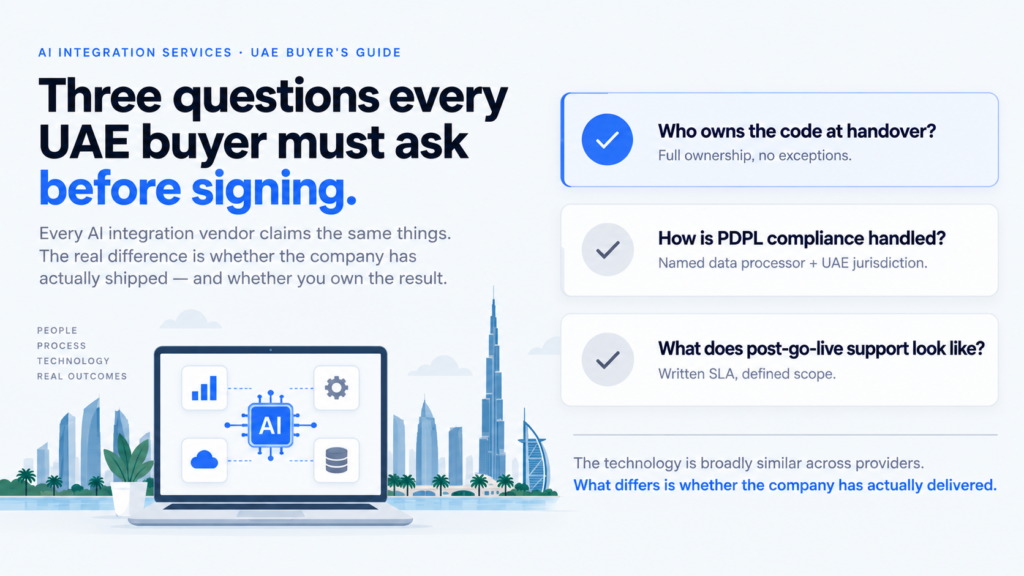
- Before signing with any AI integration company, you need written answers to three questions: who owns the code at handover, who is accountable for PDPL compliance, and what does support look like after the go-live date.
- The most common reason AI integration projects stall is not the technology — it is the gap between a demo that worked and a system that works at real business volume.
What Do AI Integration Services Actually Include?
The phrase “AI integration services” covers a wide range of work, and what you are buying varies significantly between providers. Getting this clear before you start evaluating anyone is the first step.
Our guide to AI integration with existing systems explains what to connect first and what tends to break.
The Three Layers of a Real Integration Engagement
Most AI integration projects involve three distinct layers of work, even if the vendor only describes them as one.
The first is the connection layer — building the link between an AI model and your existing software. This includes API development, authentication, and making sure data flows cleanly between systems. For a typical business, this alone takes longer than expected because most legacy software was not designed to talk to an external model.
The second is the logic layer — deciding what the AI actually does with your data. Does it classify incoming requests and route them? Does it summarise documents and flag exceptions? Does it generate responses that a human then approves before sending? The logic layer is where most of the real design work happens, and it is where shortcuts become expensive later.
The third is the operations layer — making sure the system runs reliably once it is live. Who monitors it? Who fixes it when output quality drops? Who updates the model when your data changes? Most vendors focus their proposal on the first two layers and say very little about the third.
A genuine AI integration services engagement covers all three. If a proposal only describes what gets built and not how it gets run, you are seeing a project that ends at delivery, not a system that actually operates.
What You Are Buying vs. What You Are Not
AI integration services are not the same as building new software from scratch. The assumption is that you have existing systems — an ERP, a CRM, a document management platform, an inbox — and the goal is to connect AI capability to those systems without replacing them.
What you are buying is a working connection between a model and your operations. What you are not buying is a guarantee that your data is clean enough to use, that your internal team is ready to change how they work, or that the AI will perform at the same level your demo showed once real business volume and edge cases arrive.
Explore the AI services in the UAE Latent offers across the full integration and transformation stack, and see where an AI integration engagement typically sits in a broader programme.
How Much Do AI Integration Services Cost in the UAE?
The honest answer is that cost varies by a factor of ten depending on what you are asking for.
| Engagement type | Scope | Typical cost (AED) |
|---|---|---|
| Single workflow | One process, one AI connection, defined handover | 30,000–80,000 |
| Multi-system | 3–4 core platforms, custom logic, full documentation | 150,000–400,000 |
| Ongoing support | Post-go-live monitoring, updates, quality management | Separate contract |
A full-scale AI integration services engagement covering three or four core systems, with custom logic and a full handover, typically sits between AED 150,000 and AED 400,000. Ongoing maintenance runs separately.
What most quotes leave out is the cost of the work your team needs to do. Data preparation, internal testing, change management, and the time your operations staff spend on UAT are not in the vendor’s scope, but they are real costs you carry.
What Drives the Cost Up
Three factors push AI integration services costs higher than an initial estimate:
Data quality issues: If your records are inconsistent, your naming conventions vary across departments, or your historical data was stored in formats that are difficult to parse, the first phase of any engagement becomes data cleaning rather than AI work. A week of data remediation can add AED 20,000–40,000 to a fixed-scope project.
Legacy system complexity: Some ERP and CRM platforms were never designed for external API calls. Connecting an AI model to them requires middleware, workarounds, or a refactor of the data layer. If your core system is more than ten years old, ask specifically about this before you accept any quote.
Scope growth after kickoff: The integration looks simple until the first real-world edge case arrives. Handling exceptions, managing output quality, and adding the one workflow the original scope did not include are the three most common ways a fixed-price project becomes a time-and-materials one.
What a Fixed-Scope Project Looks Like
The strongest signal that a vendor can actually deliver is a clearly defined scope: named systems being connected, named workflows being automated, named deliverables at each phase, and a defined handover that includes documentation, testing criteria, and who owns what after go-live.
If a proposal describes outcomes without describing what gets built, or if it describes what gets built without describing how it gets handed over, those are gaps to address before you sign, not after.
What Should You Ask an AI Integration Company Before Signing?
The evaluation stage is where most buyers lose ground. Vendor presentations are designed to answer the questions you would ask if you were the vendor — not the questions you would ask if you were the buyer who has to live with the result. These are the questions that matter.
Who Owns the Code and the Model at Handover?
This is the most important commercial question in the whole engagement. Some vendors deliver a working system but retain ownership of the model weights, the integration code, or the deployment infrastructure. If you want to switch vendors later, modify the system, or simply understand what is running on your infrastructure, you need clear documentation and full code ownership from day one.
The answer should be unambiguous: you own the code, the configuration, and the documentation. Any vendor who hesitates on this question or frames ownership as a premium add-on is telling you something important about how they manage client dependency.
How Is PDPL Compliance Handled?
The UAE Personal Data Protection Law places obligations on the organisation collecting and processing personal data. When you connect an AI model to your customer records, support history, or employee data, the model is processing that data. The question of where it is processed, who has access to it, and how it is stored is a legal compliance question, not just a technical one.
Ask specifically: does the model run on infrastructure in the UAE or within approved jurisdictions? Are personal data fields masked or excluded before being passed to the model? Who is named as data processor in the contract, and how do they document their compliance obligations?
A vendor who cannot answer these questions clearly is not the right choice for any workflow that touches customer or employee data.
What Does Post-Go-Live Support Look Like?
Most AI systems need monitoring. Output quality drifts as the data it sees changes. Integration endpoints break when upstream systems update. The logic that worked at launch needs adjustment when edge cases accumulate. The question is not whether you will need support — it is what level of support is included, what is charged separately, and how fast problems get resolved.
Get this in writing before you sign, not as a verbal assurance. A support SLA that specifies response times and defines what is in scope versus out of scope is a basic part of any professional AI integration services agreement.
For a more detailed framework on evaluating any AI services partner, the AI Implementation Partner Checklist covers twelve specific criteria across technical quality, commercial terms, and UAE delivery capability.
What Are the Red Flags When Evaluating AI Integration Services Providers?
A 2026 integrate.io data integration report found that 95% of IT leaders report integration issues as the primary barrier to AI implementation. The vast majority of those issues are not technology problems — they are vendor selection and project management problems. Here is what to watch for.
Slide Decks With No Proof of Deployment
Any company can produce a slide deck that shows a diagram of how AI integrates with an ERP. What you want to see is evidence that they have actually done it: a named project with a named outcome, a client you can call, or technical documentation from a real prior engagement.
The absence of this evidence does not always mean the company cannot deliver. But it does mean you would be funding their first real deployment at full price. If you are comfortable with that, price it that way from the start.
Offshore Teams With No UAE Delivery Capability
A team that has never worked in the UAE will miss things that are obvious to anyone who has. How invoice data is structured for VAT returns. How Arabic text needs to be handled in an AI output that will be reviewed by a UAE team. How the e-invoicing mandate phasing in through 2027 affects any ERP integration project started today. These are not edge cases — they are the default operating context for any UAE business.
This does not mean every person on the team needs to be based in the UAE. It does mean the company leading the engagement needs to understand the regulatory and operational environment here.
Scope Creep With No Timeline Accountability
A project that started as a three-month fixed-scope engagement and became a six-month rolling engagement is a pattern, not a surprise. Ask every vendor to show you their last three completed projects: what was the scope at kickoff, what was delivered at go-live, and how long did it take. A vendor who can answer this question without hesitation has a track record. A vendor who deflects it does not.
The OECD AI Principles provide a useful governance baseline for what accountability in an AI services engagement should look like — including transparency, explainability, and clear accountability at every stage of deployment.
How to Integrate AI Into a Company: The Order of Operations
The question “how to integrate AI into a company” has a clear answer that most vendors make complicated: start with one specific problem, not a transformation. The companies that successfully deploy AI integration services start small, build confidence, and then expand. The ones that try to integrate AI across five systems in the first project almost always stall.
Start With One Workflow, Not a Transformation
The most productive first AI integration is usually the one that is already broken. A manual process that your team hates, that produces inconsistent outputs, or that creates downstream errors is the right place to start. Not because it is the easiest, but because the business case is already visible to everyone.
A working AI integration in one workflow does three things: it proves the technical connection works, it builds internal confidence that the technology is real, and it gives you a baseline for what quality looks like before you commit to scaling.
Which Systems to Connect First
The order matters more than most businesses expect. Connecting AI to your communication layer (inbound emails, chat, WhatsApp) is technically straightforward but produces the most visible failures when quality drops. Getting a WhatsApp or chat assistant right is as much about scope and guardrails as it is about the integration itself. Connecting AI to your ERP or finance layer is technically complex but produces the most measurable business outcomes.
For most businesses, the right first integration is document processing — invoices, contracts, or requests that currently require a human to read, classify, and route. In our work with UAE businesses, this is the starting point that consistently delivers a measurable result in the first quarter. The failure modes are contained, the quality bar is clear, and the ROI is immediate. Start there before you connect AI to anything that touches customer communication or financial records.
UAE-Specific Considerations
Three things make AI integration services work in the UAE different from what a global vendor’s playbook describes.
PDPL data handling: Any integration that processes personal data of UAE residents needs to account for the UAE Personal Data Protection Law. This includes customer service data, employee records, and any document that contains names, contact details, or financial information. The integration architecture should handle this from day one, not as a retrofit.
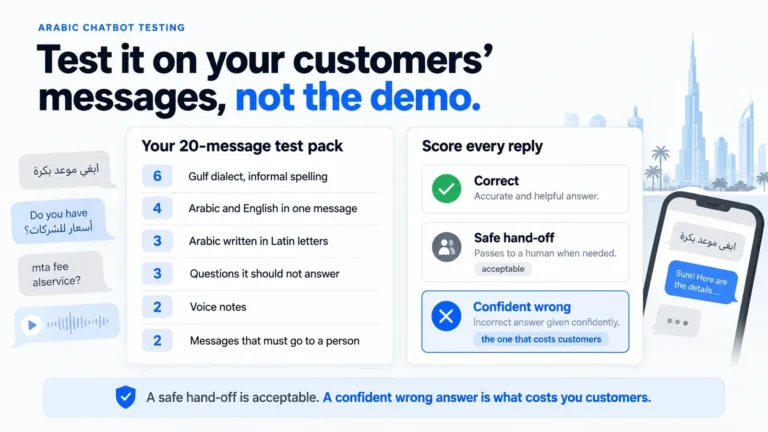
Arabic and English output: If your business serves Arabic-speaking customers or has Arabic documentation, the AI model needs to handle both languages reliably. Most general-purpose models handle Arabic at a reasonable quality for internal tasks, but customer-facing outputs need review. Build this into the quality assurance process, not as an afterthought.
The 2027 e-invoicing mandate: The UAE’s phased e-invoicing rollout means that any ERP integration project starting today will need to account for new data exchange requirements by 2027. An AI integration layer built on top of your current ERP before those changes are implemented may need structural rework. A competent AI integration company will flag this at scoping, not after delivery.
For context on the broader deployment cycle, the full AI implementation services guide covers what getting AI into production actually takes, from proof of concept through handover.
Generative AI Integration Services: Is It a Different Engagement?
Generative AI integration services — connecting large language models, image models, or document processing models to your business systems — are technically different from traditional AI integration but commercially the same. The buyer’s framework is identical: scope, ownership, PDPL compliance, support, and proof of prior delivery.
The practical difference is in the monitoring requirement. A generative model’s outputs are less predictable than a classification model’s outputs. A classification model is either right or wrong. A generative model can be technically correct but commercially wrong — producing output that is accurate but does not match the tone, context, or regulatory requirements of your business. This means the operations layer matters more in a generative AI integration than in a traditional one.
If a vendor is proposing a generative AI integration, ask how output quality is monitored after go-live. Ask what happens when the model produces content that needs correction before it is used. Ask who reviews outputs and at what frequency. A vendor who has not thought through the answer to these questions has not thought through the engagement.
For the AI consulting and strategy layer that typically precedes an integration engagement, the AI Consulting Services Guide covers how to structure an AI programme before you start building anything.
Connecting GPT models to your CRM, ERP and WhatsApp is a common starting point, and our OpenAI integration consulting page covers how we approach it.
Conclusion
Choosing between AI integration services providers is a commercial decision, not a technical one. The technology is broadly similar across providers. What differs is whether the company has actually delivered the type of work you need, whether they understand the UAE operating environment, and whether they have structured the engagement so that you own the result and can operate it independently after handover.
The questions that matter are simple: Who owns the code? How is compliance handled? What does support look like after go-live? What have you actually built before? A provider who answers those questions clearly, with evidence, is worth evaluating further. One who deflects or produces a more elaborate proposal instead of direct answers is telling you something useful.
If you are ready to scope an AI integration project and want a direct conversation about what it would involve for your business, get in touch with the Latent team.
Frequently Asked Questions
What is an AI integration service?
An AI integration service connects artificial intelligence — a language model, a classification model, or an automation tool — to the software your business already runs. The goal is not to replace your existing systems but to add AI capability on top of them, so your team works faster and your processes produce more consistent outputs without a full technology overhaul.
How much does AI integration cost in the UAE?
A single workflow integration typically costs AED 30,000–80,000. A multi-system engagement covering three or four core platforms with custom logic and full handover usually sits between AED 150,000 and AED 400,000. The final number depends heavily on the state of your existing data, the complexity of the systems being connected, and how much post-go-live support is included in scope.
What are the best AI integration companies in the UAE?
There is no objective ranking, but there are clear criteria. The right company has delivered a comparable integration in the UAE before, can name the client and the outcome, owns the delivery rather than subcontracting it, and gives you clear written answers on code ownership and PDPL compliance. Start with those criteria before you evaluate technical capability.
How long does an AI integration project take?
A well-scoped single-workflow integration typically takes six to twelve weeks from kickoff to go-live. Multi-system projects run three to six months. The most common cause of delays is not the AI work itself — it is data preparation, internal testing, and stakeholder alignment that takes longer than the original estimate.
What is the difference between AI integration and AI implementation?
AI integration is the work of connecting AI capability to existing systems. AI implementation is the broader programme of deploying AI across a business — which includes integration, but also strategy, change management, training, and governance. An integration engagement is typically a component of an implementation programme, not the whole thing.
Can a small business in the UAE use AI integration services?
Yes, and a fixed-scope single-workflow integration is often the most practical starting point. The key is scoping correctly — one specific process, a defined outcome, and a clear handover — rather than attempting a full-scale AI programme on a smaller budget. The cost of getting the first integration right is significantly lower than the cost of restarting a project that was scoped too broadly.
Usually a reply within one working day.