Article Overview
If you’ve searched for AI implementation services in the last month, you’ve probably found two kinds of pages. One is priced and scoped for a company with a transformation budget and an internal AI team. The other is a list of ten vendors with a paragraph each and no detail on what any of them actually do. Neither answers the question most UAE businesses trying to get an AI pilot into production have. What does this work involve, in what order, and what does it cost at our size?
AI implementation services cover the work between “we’ve heard AI could help” and a system your team actually uses every day: assessing what’s realistic, running a small pilot, connecting it to your existing systems, and handing it over so someone owns it. That’s different from AI consulting, which is the earlier decision about whether and how to start. Consulting answers “should we do this and how.” AI implementation services answer “now build it.”
Most of what’s published about AI implementation services in the UAE right now sits at one of two extremes. Global enterprise providers scope the work for a company with hundreds of millions in revenue and a data science team already in place. Directory pages rank ten vendors by name with no pricing and no delivery detail at all. A 50 to 250 person business fits neither.
Key takeaways
- 01AI implementation services cover assessment, pilot, integration and handover, not just the model itself.
- 02Every enterprise provider in the UAE market prices for a company ten times your size; every directory listing skips scope and cost entirely.
- 03PDPL data residency and the 2027 e-invoicing mandate are two concrete UAE rules that change the order this work should happen in, and almost nobody writing about this says so.
- 04The right-sized engagement for a 50-250 person business starts with one process, not a company-wide rollout.
What does AI implementation actually include?
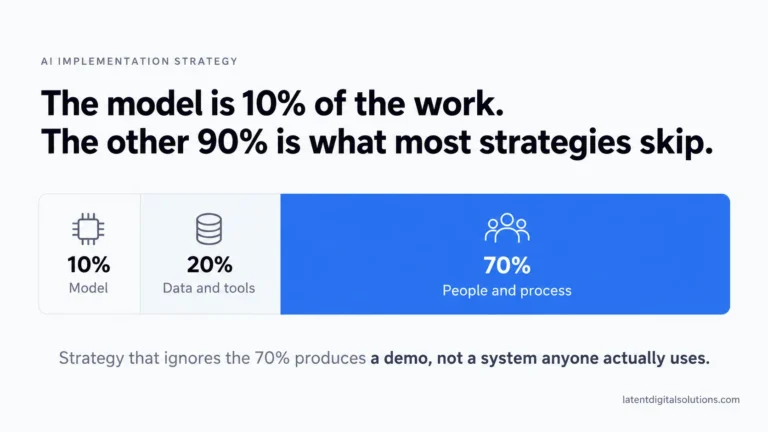
AI implementation is the work of turning a chosen AI approach into something running inside your business, not the choice of which approach to use. That distinction matters because most guides jump straight to “select your model” and skip the parts that take real time. Those parts are exactly what good AI implementation services are built around. For the strategy behind good implementation, see why the model is only 10% of the work.
Our guide to a machine learning pipeline explains the seven stages, the checks between them and how automated it needs to be.
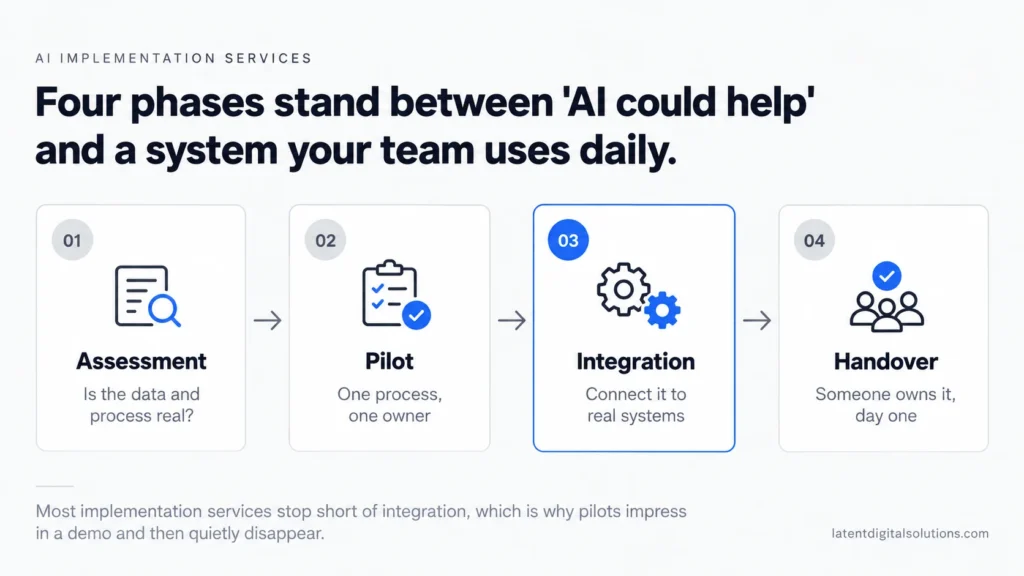
A complete AI implementation project usually has four parts, in this order:
- Assessment: check the data, the process, and the success measure are all real, before anything gets built.
- Pilot: build one process, small and fast, with a single named owner.
- Integration: connect the pilot to the systems your team already runs.
- Handover: hand over a working system to someone who owns it from day one.
| Phase | What happens | Who owns it |
|---|---|---|
| Assessment | Check the data, process and success measure are real | The named internal owner, plus whoever’s delivering the project |
| Pilot | Build one process, small and fast | The internal owner, hands-on |
| Integration | Connect the pilot to existing systems | The implementation provider, with your IT contact |
| Handover | Hand over a working system someone owns | The internal owner, from day one |
The first is an assessment. Is there enough clean data for this to work? Who owns the process today? What does “working” look like in three months? Skipping this step is the single most common reason pilots stall. Take a 150-person freight forwarder, as an illustrative example. The team assumes shipment data is clean because it lives in one system. During the pilot, they find a third of records are missing a field the AI needs. That’s not a technology failure. It’s an assessment that never happened.
The second part is a pilot. This is deliberately small: one process, one owner, a fixed timeframe. A pilot that tries to cover five departments at once isn’t a pilot. It’s a rollout with extra risk, and it fails for reasons that have nothing to do with whether the underlying AI works. A simple AI readiness assessment is usually run here, before anyone commits to a build. A pilot built on data nobody trusts produces answers nobody trusts either.
The third part is integration: connecting whatever was built in the pilot to the systems your team already uses. This is where AI implementation services differ most from a generic “AI project.” The pilot proves the idea works in isolation. Integration proves it survives contact with your actual CRM, your actual spreadsheet exports, your actual approval process. A lot of AI implementation services stop short of this part, which is why so many pilots impress in a demo and then quietly disappear.
The fourth part is handover. Someone on your team needs to own this once the project team leaves. Who checks it’s still working? Who gets called when it breaks? Who decides whether to expand it? Guides written for enterprise buyers assume a full-time AI team exists to receive this handover. At a 50 to 250 person business, that team usually doesn’t exist yet. A good AI implementation services provider should tell you that upfront, rather than assume it away. If nobody’s named for this before the project starts, that’s worth raising before you sign anything, not after.
How much do AI implementation services cost?
Cost depends more on scope than on which firm you hire. A narrow, one-process pilot costs a fraction of a company-wide rollout, and the honest answer to “how much does AI implementation cost” is “it depends which of those two you’re asking about.”
As a rough example, not a quote: assessing one process alone usually runs into the tens of thousands of dirhams. A fixed-scope pilot that produces something running on real data usually costs several times that. A full build-and-connect project scales again from there, mostly driven by how many systems it has to connect to. These are illustrative bands, not a price list. Any AI implementation services provider who gives you a single number before looking at your data is skipping a step.
A full breakdown is covered in a separate guide on AI implementation cost. It’s in AED, with the specific cost drivers that change the number, and what a stalled project actually costs versus a shipped one. This section exists because “how much does AI implementation cost” is one of the questions people search for right alongside AI implementation services. Skipping it here would leave a real gap in this guide.
The short version: expect the assessment and pilot phase to be priced separately from integration and handover. Be wary of any quote that bundles all four into one number before anyone has looked at your data.
As a frame, a fixed, scoped quick-win project typically runs AED 9,000–37,000, a single-workflow implementation AED 30,000–80,000, and a multi-system engagement covering three or four core platforms AED 150,000–400,000 (see our AI integration services guide and small-business AI consultant guide). A week of data remediation can add AED 20,000–40,000 to a fixed-scope project. These are ranges, not quotes.
What makes AI implementation different for a UAE business?
Two things almost never show up in a global guide to this work, because they’re specific to this market. Both change how AI implementation services should be delivered here.
The first is data residency. Federal Decree-Law No. 45 of 2021, the UAE’s Personal Data Protection Law, sets out how personal data must be handled, including rules on cross-border transfer, according to the UAE government’s own data protection portal. Most AI implementation projects touch customer data somewhere, which means this check belongs in the assessment phase, not discovered after a pilot is already running on infrastructure that was never reviewed for it.
Take a retail business piloting an AI tool on customer purchase history, as an example. It needs to know where that data is allowed to sit before the pilot starts, not after.
The second is the UAE’s e-invoicing mandate. The UAE Ministry of Finance’s own eInvoicing programme page confirms the rollout is phased: large businesses first, smaller businesses on a later date, both inside 2027. Any AI implementation touching finance, procurement, or invoicing should sequence around this deadline, since building around the current process this year only to rebuild around structured e-invoicing next year is wasted work.
Neither of these appears in the enterprise service pages currently ranking for AI implementation services in the UAE, and neither appears in the vendor directories either. They’re not edge cases. That covers most businesses: anyone handling customer data or issuing invoices. Both constraints should shape when each part of the project happens. Neither should be a surprise halfway through.
What does a realistic AI implementation timeline look like?
If you haven’t yet named which single problem AI should solve first, that’s a strategy question, not a build one, and it’s worth settling before you read any further. Once that’s decided, timelines matter. Most published ones are either vague (“weeks to months”) or built for a scale that doesn’t apply here. A single-process pilot, run properly, typically moves from assessment to a working pilot in a matter of weeks, not quarters. Integration and handover add time on top of that, and the total mostly depends on how many existing systems the pilot needs to connect to. One CRM is a different project from three disconnected spreadsheets and a legacy database. Where an ERP is part of the picture, see what ERP implementation actually takes.
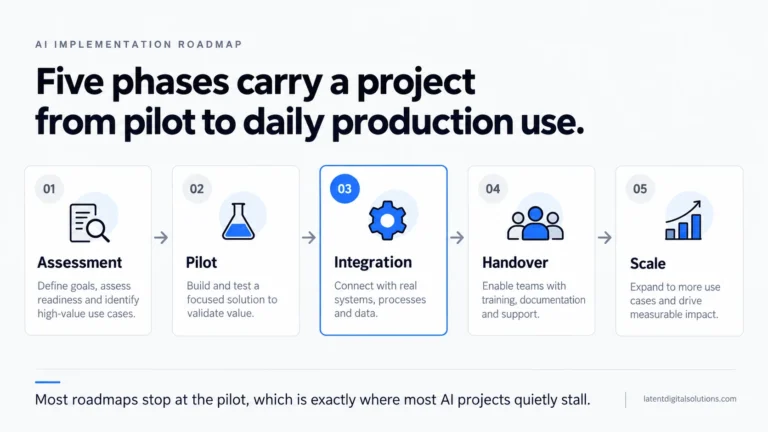
The point of naming a timeline at all is simple. Vague AI implementation services engagements, the ones with no stated duration and no stated exit point, are the ones most likely to drift. A companion article on the AI implementation roadmap covers this in full: what should happen, in what order, with a stated duration for each phase.
Who actually delivers AI implementation services in the UAE?
The UAE market for AI implementation services currently splits into two groups, and neither is built for a 50 to 250 person business. That market exists partly because of deliberate government policy: the UAE’s national AI strategy sets out a goal of becoming a world leader in the AI sector, according to OECD.AI’s policy tracker. That ambition has attracted plenty of enterprise-focused providers. It hasn’t produced many studio-sized ones. We’ve seen owners get quoted a six-figure enterprise scope for a problem that needed one process fixed. They give up on the idea entirely rather than ask for something smaller.
The first group is global enterprise providers. This is the kind of firm that shows up when you search. It quotes a scope built for a company with hundreds of millions in revenue and its own data science function. Their process is usually sound. Their pricing and their assumptions about what you already have in place are not built for a business your size. Their sales process alone can take longer than the pilot you actually need.
The second group is the directory listings. These are pages ranking ten AI consulting companies in Dubai with a paragraph each. No pricing. No detail on what any of them would actually deliver. These read like they were built to rank for the search term, not to help someone evaluate a vendor. They rarely distinguish AI implementation services from AI consulting or general software development.
What’s missing is a studio-sized option. Someone who scopes AI implementation services to what a business your size can actually own. They state what gets delivered and by when, and they’re honest about who needs to be involved on your side. For a hospitality group, that might mean one AI tool that drafts guest replies for a front-desk team to review, not a system that touches every property at once. Small enough that one manager can own it, specific enough that it’s obviously working or obviously not within a few weeks. If your project is built on GPT models, our OpenAI consulting services are scoped that way.
You might not be sure this is even the right next step, as opposed to more research or a smaller experiment first. That’s a fair question. It’s worth answering honestly before you talk to anyone selling AI implementation services.
How do you choose between AI implementation services providers?
UAE AI adoption is already high. Microsoft’s 2026 AI Economy Institute analysis gave the UAE a 70.1% diffusion score, ranking it first globally, according to The National’s reporting on the Microsoft data. Widespread AI use is not the same as widespread AI implementation services actually being delivered well, though, which is why choosing the right provider still matters more than the adoption headline suggests. Three questions cut through most of the noise faster than a feature comparison, whichever AI implementation services provider you’re evaluating:
- Who owns the code and the data once the project ends?
- What happens if the pilot doesn’t work?
- Is the pricing tied to scope, or to time?
Who owns the code and the data once the project ends? Some AI implementation services engagements hand over a working system with full ownership. Others keep you dependent on the original vendor indefinitely. Ask this before signing, not after the invoice arrives.
What happens if the pilot doesn’t work? A provider who has never had a pilot fail to reach production is either very lucky or not being honest with you. The useful question is what happens next if it does. Do you get a diagnosis, or just a bigger invoice for a bigger attempt?
Is the pricing tied to scope, or to time? Scope-based pricing gives you a fixed deliverable. Time-based pricing can drift, especially once integration starts and the systems involved turn out to be messier than expected. Neither is automatically wrong, but you should know which one you’re agreeing to.
Sometimes part of the work touches an old system that’s fragile or hard to change safely. That’s often a separate, earlier problem worth scoping on its own. See legacy modernization for what that looks like, since bolting an AI pilot onto a system that’s already struggling rarely goes well.
A longer, twelve-point version of this evaluation, written specifically for choosing between AI implementation services partners, is covered in a dedicated checklist article.
Is your business ready to start an AI implementation project?
The national ambition behind this doesn’t answer whether your specific business is ready yet. Three questions are worth answering honestly before you start looking for AI implementation services in the UAE:
- Is there one process, clearly owned by one person, where AI could remove real manual work?
- Is the data for that process actually accessible, and does someone already trust it?
- Does someone have the time to own this once it’s running?
Is there one process, clearly owned by one person, where AI could remove real manual work? Not five processes. One. If you can’t name the process and the person in a sentence, the project isn’t scoped yet. That’s true no matter how good the AI implementation services provider you hire turns out to be.
Is the data for that process actually accessible, and does someone already trust it? A project like this surfaces data problems that were already there. It doesn’t create new ones. It just makes existing ones impossible to ignore once the pilot is running against them.
Does someone have the time to own this once it’s running? Not full-time. But real, protected time, not “whoever has a spare hour.” Projects that skip this question tend to work fine in the pilot. Then they quietly stop being used a few months later, no matter how well the AI implementation itself was built.
If the answer to all three is yes, you’re ready to scope the project. If any answer is no, that’s worth fixing first. It’s cheaper to fix before the project starts than after.
Conclusion
AI implementation services means the practical work of getting AI from an idea into something your team uses daily. That’s assessment, a small pilot, integration with what you already run, and a clear handover. Most of what’s currently written about AI implementation services in the UAE either prices for enterprise or lists vendors with no detail. Almost none of it accounts for PDPL data residency or the 2027 e-invoicing mandate. Both genuinely change how a UAE project like this should be sequenced. Scoping the work to one process, owned by one person, with real time set aside for it, is the part that decides whether the project reaches production or quietly stalls. A longer, twelve-point checklist for evaluating who actually does this work is covered in a dedicated partner checklist article.
If you’re weighing up whether to start, talk to Latent about scoping a first AI implementation project. The conversation costs nothing and it’s usually clearer after thirty minutes than after another week of reading about AI implementation services.
Frequently Asked Questions
What is an AI implementation?
It’s the practical work of turning a chosen AI approach into something your business actually uses. That means checking the data and process are ready. It means running a small pilot, connecting it to your existing systems, and handing it over to someone who owns it. It’s different from AI strategy or AI consulting, which happen before implementation starts.
What is an AI implementation company?
An AI implementation company is a firm that delivers AI implementation services: the build-and-integration work, rather than just a recommendation. In the UAE, this market currently splits between global enterprise providers priced for large companies and thin vendor directories with no scope detail. A genuine studio-sized option that states scope, price and delivery timeline is harder to find than it should be.
How much does AI implementation cost?
It depends far more on scope than on which firm you hire. A narrow, single-process pilot costs a fraction of a company-wide rollout. A separate article breaks this down in AED with the specific cost drivers, since no genuinely UAE-priced figure exists in the market yet.
Do PDPL and the 2027 e-invoicing mandate actually affect an AI implementation project?
If the project touches customer data or anything that generates an invoice, yes. PDPL sets rules on how personal data is handled and transferred; the e-invoicing mandate sets a phased 2027 deadline for structured electronic invoicing. Both should be reviewed during the assessment phase of any AI implementation, not discovered afterward.
How long does an AI implementation project take?
A single-process pilot typically takes weeks, not months. Connecting it to your existing systems and handing it over add time on top of that. The full breakdown, phase by phase, is in the roadmap article linked above.
Is AI legal in the UAE?
Yes. The UAE actively encourages AI adoption as part of its National AI Strategy 2031 and has a dedicated government office focused on the sector. What’s regulated is how personal data is handled once AI touches it, which is where PDPL applies. Any AI implementation involving customer or employee data should be checked against PDPL during the assessment phase. It’s not a separate legal question tacked on at the end.
Usually a reply within one working day.