Article Overview
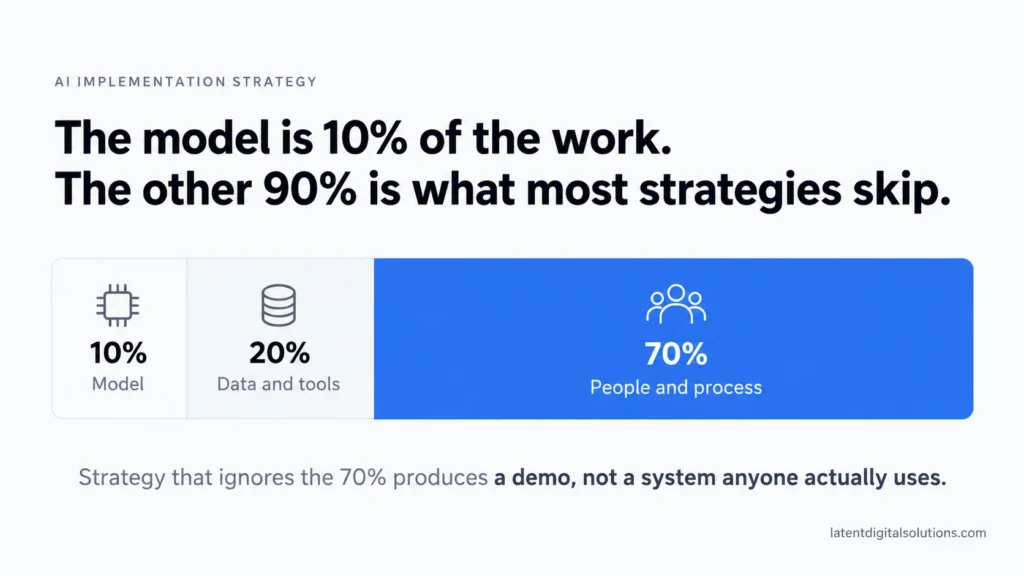
An AI implementation strategy is the plan for where AI effort should actually go: not primarily which model to use, but which process, which owner, and which decisions the business needs to get right first. According to BCG’s own research, the model accounts for roughly 10% of what determines whether an AI project delivers value. Technology and data make up another 20%. The remaining 70% is people, process, and organisation, and it’s the part almost every published strategy guide skips.
If your AI implementation strategy spends most of its energy comparing tools, it’s optimising the smallest 10% and ignoring the 70% that actually decides whether any of it sticks. That’s true whether you’re a UAE business planning its first real AI project or refining a second one that didn’t go as expected.
Key takeaways
- 01BCG’s 10-20-70 rule: the model is roughly 10% of AI value, technology and data 20%, people and process 70%.
- 02Most published strategy guides open with objectives and team-building, none build around this ratio directly.
- 03In the GCC, 39% of organisations are “AI Leaders” against 61% “Laggards.” The gap is organisational, not technical.
- 04A working AI implementation strategy sequences effort toward the 70%, not the 10%.
What is the 10-20-70 rule for AI?
The 10-20-70 rule, according to BCG’s own research on GCC AI adoption, breaks AI value down like this:
| Share of value | Where it comes from |
|---|---|
| 10% | The algorithm or model itself |
| 20% | Technology and data infrastructure |
| 70% | People, process and organisational change |
People, organisation and process issues are the primary barriers to AI adoption, accounting for 70% overall (BCG, Unlocking Potential: How GCC Organizations Can Convert AI Momentum into Value at Scale).
This matters for how you build an AI implementation strategy because it flips where the effort should go. Most businesses spend the bulk of their planning time evaluating which model or vendor to use. BCG’s own numbers say that’s the smallest lever available. Spending three weeks comparing tools and one afternoon deciding who owns the outcome is, by this ratio, backwards.
The split isn’t a call to ignore technology. It’s a call to size the effort correctly. A team that gets the model roughly right, and the people right, usually beats a team that finds the perfect model and skips the rest.
What makes this useful for an AI implementation strategy specifically isn’t just the ratio itself. BCG ties the number to a measurable regional outcome, the leader-to-laggard gap covered next. That’s more useful than an abstract principle nobody can act on.
Why does every guide still start with the model?
Search for “AI implementation strategy” and the guides you’ll find, even from strong institutions, tend to open the same way. Define objectives. Assess readiness. Build a cross-functional team. Then evaluate tools. It’s not wrong advice. It’s just not aimed at where the actual difficulty sits.
None of them build their structure around the 10-20-70 split, despite it being exactly what people search for when they ask what the rule is. An AI implementation strategy that copies this generic sequence ends up spending real planning time on the 10%. The 70% becomes an afterthought, usually a single paragraph near the end labelled “change management” or “adoption.” For the phase-by-phase version, see our five-phase AI implementation roadmap.
Part of the reason is that the 10% is the easy part to write about. Comparing models and vendors produces a tidy table. Describing how a team’s habits need to change doesn’t compress as neatly. It gets less space, even though it does more of the actual work.
What does the GCC data actually show?
The same BCG research puts 39% of GCC organisations in the “AI Leaders” category, against 40% globally, and 61% as “AI Laggards,” against 60% globally. The gap between leaders and laggards is widening faster in the GCC than globally too. Leaders show a 14 percentage point scaling advantage over laggards regionally, against an 8 point gap globally.
That gap tracks the 10-20-70 split closely, and it’s exactly what a well-built AI implementation strategy is meant to close. AI Leaders in the GCC aren’t necessarily using better models than everyone else. They’re the ones who’ve done the organisational work the 70% actually requires: naming an owner, fixing a process, deciding who approves what before something goes live. An AI implementation strategy built only around technology selection doesn’t explain a 22-point regional spread between leaders and laggards on its own. An AI implementation strategy built around organisational readiness does a much better job of explaining it.
BCG also found that GCC AI Leaders plan to upskill staff at close to twice the rate of laggards over the coming year. That’s another data point in the same direction. The businesses pulling ahead are investing in the people side of the ratio, not just newer tools.
What does the 70% actually look like in practice?
The 70% of an AI implementation strategy is rarely dramatic. It’s naming one person who owns the outcome, not a committee that meets monthly. It’s deciding, in writing, which decisions the AI is allowed to make on its own and which still need a person to sign off. It’s making sure the person whose job actually changes is involved before the system goes live, not informed about it afterward.
Take a logistics business as an example. It might have a technically sound AI tool for route planning that nobody actually uses. The dispatchers who’d need to trust its output were never consulted on how it would change their day. The model worked fine in testing. The 70% never happened. That’s a strategy failure, not a technology failure, and it’s the exact failure mode BCG’s ratio is describing.
The same pattern shows up in smaller, less visible ways too. A tool that drafts customer replies but nobody tells the support team it exists. A reporting dashboard nobody trained the finance team to read. Each of these is a working model sitting inside an AI implementation strategy that skipped the 70%.
A hospitality business offers a cleaner version of the same lesson. A front-desk AI tool that drafts guest-reply suggestions is only useful if the manager reviewing them trusts the drafts. That trust comes from being involved early enough to say what “good” looks like. Ship the tool without that conversation, and it sits unused next to the inbox it was meant to help with, regardless of how well it drafts a reply.
How do you sequence an AI implementation strategy?
An AI implementation strategy should start with the 70%, not the 10%. Name the one process where AI could remove real manual work, and name the person who owns that process today. Decide what changes for them specifically, and involve them before anything is built, not after it’s already running.
Only once that’s settled does model selection matter, and at that point it’s a genuinely small decision within the wider AI implementation strategy. Most reasonably current models handle a well-scoped business problem competently. The real question is whether the organisation around that model is actually ready to use it, not which model scores marginally higher on a benchmark nobody in the business will ever see.
This is also where a UAE-specific check belongs, if the process touches customer data. Review it against the Personal Data Protection Law before committing to a specific tool, since Federal Decree-Law No. 45 of 2021 sets real rules on how personal data can move, according to the UAE government’s own data protection portal. Sequencing that check into the 70% stage, rather than bolting it on after the model is chosen, avoids rebuilding something later. What wasn’t designed for the requirement the first time rarely fits it cleanly the second.
What belongs in an actual strategy document?
Keep an AI implementation strategy document to one page. That’s the same conclusion a practical strategy guide for business leaders reaches from a different angle: three decisions, documented plainly, beat a long framework nobody rereads. A long strategy document tends to signal that the 70% hasn’t been thought through yet, not that it has.
- The named process and owner: plain language a non-technical reader can check for themselves. Not “customer service automation.” Something closer to “drafting first-pass replies to booking enquiries, owned by the front-desk manager.”
- The decision boundary: what can the system decide on its own, and what needs a person to approve first? This is the part most AI implementation strategy templates skip entirely.
- The success measure: a specific number and a specific date, not “improved efficiency.” A number that existed before the project started, and a date by which it should have moved.
Everything else, the technology stack, the vendor comparison, the architecture diagram, is useful working detail, but it isn’t the strategy. It’s the 10% and 20% dressed up to look like the whole plan.
Here’s a useful test for any AI implementation strategy document. Hand it to someone outside the project. Ask what would need to be true for it to work. If their answer is about the model, the strategy has drifted back toward the 10%. If their answer is about who owns the process and what happens when the AI gets something wrong, the strategy is pointed at the 70% that actually matters. That single question catches most strategy documents that look thorough but are really just a technology brief wearing a strategy’s title.
What role does AI engineering play in this strategy?
Once the organisational side is settled, someone still has to build and maintain whatever gets deployed. For a business that wants development to stay in-house rather than fully outsourced, that’s an enablement question as much as a technology one. AI Engineering Enablement covers exactly that gap. Your own team stays in control of the work. AI-assisted tooling makes them faster, rather than handing the whole thing to an outside vendor.
That distinction matters for sequencing too. A strategy that assumes an outside team will build and then vanish tends to under-invest in the 70%. Nobody on the buyer’s side ends up feeling ownership of the outcome. An AI implementation strategy that plans for the internal team to run this afterward tends to get the organisational side right. Someone on the inside has to live with the result.
This is also where the 20% and the 70% overlap a little. Technology choices that assume constant outside support quietly push more of the 70% back onto a vendor who won’t be there in six months. Choosing tooling your own team can realistically maintain is part of getting the people and process side right. It’s not a separate technical decision.
Conclusion
An AI implementation strategy built around model selection is optimising for roughly 10% of what determines whether the project actually works, according to BCG’s own research. The 70% that matters more is organisational. A named owner, a clear decision boundary, and the people whose work changes actually being part of the plan from the start. The GCC’s own adoption data backs this up directly. The gap between AI Leaders and Laggards regionally is wider than the global average, and it tracks organisational readiness, not model quality. That’s the actual substance of an AI implementation strategy worth writing down. Once a strategy turns into an actual project, the full AI implementation guide covers the same organisational groundwork in practice.
Building an AI implementation strategy and want a second opinion on where the real risk sits? Talk to Latent about sequencing your first project around the 70% that actually decides it.
Frequently Asked Questions
How do you implement an AI strategy?
Start with the 70% BCG’s research points to: name one process, name the person who owns it, and decide what changes for them before you build anything. Model and tooling decisions come after that, not before.
What is the AI implementation approach most businesses get wrong?
Leading with model selection. Comparing tools feels like progress, but BCG’s own data puts the model at roughly 10% of what determines whether an AI project delivers value. Most of the risk in any AI implementation strategy sits in the 70% that’s organisational.
What is the 10/20-70 rule for AI?
Roughly 10% of AI value comes from the algorithm, 20% from technology and data, and 70% from people, process and organisational change, according to BCG’s research on enterprise AI value creation.
What is the 30% rule in AI?
There’s no single widely-cited “30% rule” with the same research backing as the 10-20-70 split. If you’ve seen this figure somewhere, it’s worth checking the original source directly rather than treating it as an established benchmark.
Why do AI implementation strategies fail even with a good model?
Because the model was never the main risk. A technically sound tool that nobody uses, because the people whose work it changes weren’t involved in building it, fails for organisational reasons the strategy didn’t address.
How does GCC AI adoption compare to the rest of the world?
BCG’s 2026 research found 39% of GCC organisations qualify as AI Leaders against 40% globally, with a wider leader-to-laggard performance gap regionally than the global average. That’s a sign the organisational half of AI adoption is the bigger regional variable, not access to technology.
Usually a reply within one working day.