Article Overview
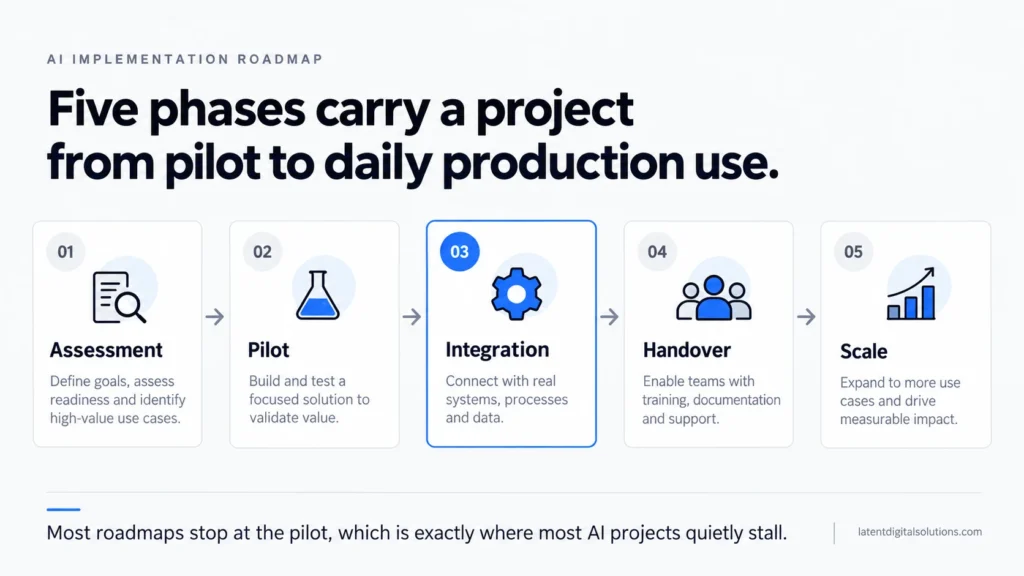
An AI implementation roadmap is the five-phase sequence a business follows to get an AI idea from pilot to daily use: assessment, pilot scoping, pilot execution, integration, and production handover. Each phase has a job to finish before the next one starts. Most roadmaps you’ll find online are either built for a company with a dedicated AI team, or they’re a gated form that asks for your email before showing you anything. This one is neither.
- Assessment: name the process, the owner, and what success looks like.
- Pilot scoping: pick one process, small enough for one owner.
- Pilot execution: run it for real, and get a clear yes or no.
- Integration: connect it to the systems your team already runs.
- Production handover: hand it to a named owner who knows what “broken” looks like.
If you’re a UAE business trying to move an AI idea past the talking stage, this AI implementation roadmap is sized for you. No dedicated AI team required. No enterprise budget assumed. Use it as a checklist against whatever AI implementation roadmap you’ve already been given.
Key takeaways
- 01An AI implementation roadmap has five phases: assessment, pilot scoping, pilot execution, integration, and handover.
- 02Most published roadmaps are enterprise-scale, off-topic, or hidden behind a lead form.
- 03Each phase has a stated exit condition, not an open-ended timeline.
- 04PDPL and the 2027 e-invoicing mandate can change which phase happens first.
What are an AI implementation roadmap’s five phases?
| Phase | Typical duration | Exit condition |
|---|---|---|
| 1. Assessment | 1-2 weeks | The process, owner and data are named and real |
| 2. Pilot scoping | 1 week | One process is chosen, small enough for one owner |
| 3. Pilot execution | 2-4 weeks | The pilot works, or you know exactly why it doesn’t |
| 4. Integration | 2-6 weeks | The pilot survives contact with your real systems |
| 5. Production handover | 1 week | Someone owns it, and knows what “broken” looks like |
Total time for a single-process AI implementation roadmap usually runs six to fourteen weeks. That range moves with how many systems phase four has to connect to. One CRM is a fast integration. Three disconnected spreadsheets and a legacy database is not.
The push behind all this is real at a national level. The UAE’s AI strategy names developing an AI-friendly ecosystem among its own stated objectives, according to OECD.AI’s policy tracker. That ambition doesn’t shorten any individual roadmap. It does explain why so many providers now offer one.
Every AI implementation roadmap published for enterprise buyers assumes a team with a data scientist, a project manager and a change lead already in place. This one assumes one owner, one process, and whatever time that owner can genuinely protect each week. That’s the actual difference between an enterprise roadmap and a roadmap sized for a business your size.
Most search results for “AI implementation roadmap” fall into three groups: an enterprise step-list from a hyperscaler or analyst firm, a gated form that asks for an email before showing anything, or a roadmap written for a completely different audience, like healthcare procurement or an individual engineer’s career path. Almost none of them commit to a real number of weeks. An AI implementation roadmap without a stated timeline isn’t really a roadmap. It’s a description of what a roadmap should eventually contain. For the wider company-level view, see our practical UAE AI transformation roadmap.
Phase 1: Assessment. Is this problem ready for AI?
Assessment answers three questions. Is there enough clean data? Who owns this process today? What does “working” look like in three months?
Skip this phase and you find out the hard way. A retail business might assume its sales data is clean because it lives in one system. During the pilot, a third of records turn out to be missing a field the AI needs. That’s not a technology failure. It’s a skipped assessment, and it’s the single most common reason an otherwise sound AI implementation roadmap stalls before phase two even starts.
This phase also flags anything specific to the UAE that changes the plan. If the process touches customer data, check it against the Personal Data Protection Law now, not after the pilot is built. Federal Decree-Law No. 45 of 2021 sets out how personal data must be handled, including cross-border transfer rules, according to the UAE government’s own data protection portal. If the process touches invoicing, the UAE’s e-invoicing mandate is worth checking too. It phases in through 2027 for businesses of different sizes, and building around the old process now only to rebuild around structured e-invoicing next year is wasted work.
Assessment is also where you decide if this is genuinely an AI problem at all, or a process problem that AI would just make faster to do wrong. Take a logistics business as an example. If nobody agrees on which delivery-status field is the source of truth, an AI tool built on top of that confusion inherits it. Fixing the source-of-truth question belongs in assessment, not in the pilot.
Exit condition: you can name the process, the owner, and what success looks like, in one sentence each. If you can’t, the roadmap hasn’t really started yet, no matter what’s already been built.
Phase 2: Pilot scoping. How small should it be?
Smaller than feels comfortable. One process. One owner. A fixed number of weeks.
A pilot that tries to cover five departments at once isn’t a pilot. It’s a rollout wearing a pilot’s name, and it fails for reasons that have nothing to do with whether the AI itself works. The whole point of a pilot inside an AI implementation roadmap is to learn something small and specific before real budget gets committed to phase four.
Pick the process where manual work is obvious and repetitive. Not the hardest problem in the business. The clearest one. A hospitality business, for example, might pick “drafting first-pass replies to guest emails for a front-desk manager to review,” rather than “handling every guest interaction across three properties.” Small enough that one manager can own it. Specific enough that it’s obviously working, or obviously not, within a few weeks.
Scoping also means deciding upfront what “done” looks like, in a way that isn’t debatable later. Not “it seems to help.” A number, a time saved, or a specific task that no longer needs a person.
Exit condition: one process is named, one person owns it, and everyone agrees what “done” looks like before it starts.
Phase 3: Pilot execution. What happens here?
The pilot runs against real data, with the named owner using it daily, for the fixed period set in phase two. Not a demo. Not a sandbox. Real work, on the real process chosen in phase two, since this is the phase most AI implementation roadmap guides skip over as if it were a formality.
Two outcomes count as success in this part of an AI implementation roadmap, and they’re not the same thing. One is the pilot working as hoped. The other is the pilot failing clearly enough that you know exactly why. Both are useful outcomes. A pilot that “sort of” works, with nobody sure if it’s actually helping, is the outcome to avoid, and it usually means the exit condition from phase two wasn’t specific enough.
This is also the phase where the temptation to expand scope mid-pilot shows up. Someone notices the tool could help with a second process too, and wants to add it now. Resist that. Widening scope mid-pilot is how a four-week pilot quietly becomes a four-month one with no clear result at the end of either.
Exit condition: a clear yes or no on whether this process is worth integrating, with a specific reason either way.
Phase 4: Integration. How does a pilot go live?
Integration connects whatever worked in the pilot to the systems your team already runs. This is usually where an AI implementation roadmap takes longer than anyone expects, because the pilot proved the idea works in isolation, not that it survives contact with your actual CRM, your actual spreadsheets, your actual approval chain.
Before anything touches live customer or financial data, it’s worth a quick check against generative AI risk management basics: what needs a human check before it goes external, and what data shouldn’t enter a prompt in the first place. This takes an afternoon, not a compliance department, and it belongs in this phase rather than as an afterthought once the system is already live.
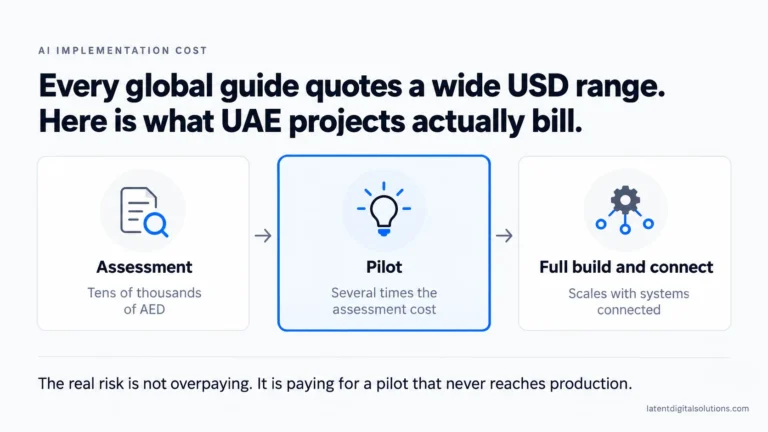
Integration is also where the four-part cost of an AI implementation roadmap becomes visible: the pilot itself was cheap to prove, connecting it to three different systems is where the real time goes. Budgeting phase four as “a bit more work than the pilot” is the most common estimation mistake in this whole roadmap.
Exit condition: the system runs on your actual data, inside your actual workflow, without a person quietly working around it because it’s easier than trusting it.
Phase 5: Handover. Who owns this once it ships?
Someone on your team needs to own the system from day one of production. Not the vendor. Not “whoever’s free.” A named person who checks it’s working, gets called when it breaks, and decides whether to expand it.
This is the phase every enterprise-focused AI implementation roadmap assumes away, because it assumes a dedicated AI team receives the handover. At a 50 to 250 person business, that team usually doesn’t exist yet. Naming an owner before production starts, not after, is what actually decides whether this reaches month six still in use, rather than quietly abandoned the first time it needs attention.
A good handover also includes a plain answer to one question: what does “this is broken” actually look like? Without that, small failures go unnoticed until someone stumbles on them weeks later.
Handover is also the natural point to decide what “production” means for this specific system. A production-ready build is one thing when it’s a small internal tool one person watches. It’s a different thing once it touches customer-facing work, and the difference is worth naming honestly rather than discovering under load.
Exit condition: one named person owns the system, and knows what “it’s broken” looks like before it happens, not after.
How long does this roadmap actually take?
Six to fourteen weeks for a single, well-scoped process, from assessment through handover. That’s shorter than most enterprise timelines because the scope is smaller, not because the work is rushed. It’s worth separating that from how fast people start using AI generally: Microsoft’s 2026 AI Economy Institute analysis ranked the UAE first globally for AI adoption, at a 70.1% diffusion score, according to The National’s reporting on the data. People picking up AI tools quickly is a different thing from a business finishing a five-phase AI implementation roadmap.
Two things change that number the most. How many systems phase four has to connect to. And whether phase one turns up a data problem nobody expected. Padding the roadmap for problems you haven’t found yet isn’t useful. Naming which phase depends on what, so a delay in one phase doesn’t quietly extend all five without anyone noticing, is.
A roadmap that runs past fourteen weeks without reaching production is rarely a technology problem. It’s almost always a scoping problem from phase two that nobody caught in time. The fix is usually to shrink phase two’s scope, not to add more time to phase four.
It also helps to decide, before you start, which of the five phases you’d cut first if something has to give. For most businesses running their first AI implementation roadmap, that’s phase four’s ambition, not phase one’s rigour. Connecting to two systems instead of four keeps the timeline honest. Skipping the assessment to save a week almost never does.
Want this scoped for your business?
Talk to our AI transformation consulting team in the UAE. We start with a working prototype, not a large proposal.
Conclusion
An AI implementation roadmap works when each of its five phases has a stated exit condition: assessment names the process and the owner, pilot scoping keeps it small, pilot execution gives a clear answer, integration survives contact with real systems, and handover names who owns it next. Skip a phase’s exit condition, and the whole roadmap tends to drift rather than fail cleanly, which is harder to notice and harder to fix. For the wider picture beyond the roadmap itself, including cost and how to choose who does the work, see the full AI implementation guide.
If your own timeline is already stretching past fourteen weeks without a result, that’s worth a conversation before it becomes a sixth month. Talk to Latent about scoping a first AI implementation project.
Frequently Asked Questions
Is there a free AI implementation roadmap template?
The five-phase structure above is the template: assessment, pilot scoping, pilot execution, integration, and handover, each with a stated exit condition. Most templates online are gated behind a form or scaled for enterprise; this AI implementation roadmap is neither.
What comes first in an AI implementation roadmap?
Assessment. Before any pilot starts, you need a named process, a named owner, and a working definition of success. Skipping straight to a pilot is the most common reason projects stall later.
How long does each phase take?
Assessment and pilot scoping each take about a week. Pilot execution runs two to four weeks. Integration is the widest range, two to six weeks, depending on how many systems it connects to. Handover takes about a week once a system is ready.
What does “AI roadmap” actually mean for a small business?
It means the same five phases as an enterprise AI implementation roadmap, sized down. One process instead of a company-wide programme, one owner instead of a dedicated team, and weeks instead of quarters.
How do you know a pilot phase is finished?
When you have a clear yes or no on whether the process is worth integrating, with a specific reason either way. A pilot that “sort of” worked, with nobody sure if it helped, means the exit condition wasn’t specific enough at the start.
Do PDPL and the 2027 e-invoicing mandate change the roadmap?
They can. If the process touches personal data, check it against PDPL during assessment. If it touches invoicing, the e-invoicing mandate phases in through 2027 and is worth checking before you build around a process that’s about to change. Either one is a reason to review an AI implementation roadmap’s first phase carefully, rather than treat it as a formality on the way to the pilot.
Usually a reply within one working day.