Article Overview
Most of what’s written about generative AI risk management is aimed at people who already have a risk department. But if you’re a business owner running one of the models yourself—not buying it from a vendor, but actually using ChatGPT or Claude or Gemini in your operations—what you actually need to know is much shorter.
Most of what’s written about generative AI risk management is aimed at people who already have a risk department. NIST’s own framework runs to dozens of pages of categories, subcategories, and proposed mitigations. That’s the right document for an organisation big enough to have a governance board. It’s the wrong first step for a business that just gave three teams access to a generative AI tool and wants to know, in plain terms, what could go wrong and what to do about it.
The honest answer is: not everything on that list applies to you yet. Some of it does, urgently. Telling the two apart is the actual decision in front of your business.
- Generative AI risk isn’t one problem — it’s three separate ones (accuracy, exposure, and provenance) that need different answers.
- The size of the risk depends on what the output touches next, not how impressive the tool is.
- A short written policy on what gets checked before use closes most of the real gap.
- Review it when a tool changes what it’s connected to, not on a fixed schedule.
What does generative AI risk management look like?
It’s deciding, before a generative AI tool is used for something that matters, what needs a human check first and what doesn’t.
Our guide to generative AI implementation covers the five moves, from picking one task to measuring the result.
That’s a narrower question than it sounds. A tool that drafts a marketing email a person reviews before sending carries a different risk than one that writes text that goes straight into a contract, a customer message, or a public-facing page. Same underlying technology, very different consequences if it gets something wrong.
NIST’s 2024 Generative AI Profile — the US government’s own standards guidance on this exact question — groups the risk into specific, defined categories. Most businesses don’t need to address all of them. Three cover almost everything a non-technical business owner actually runs into.
The three risks that matter for most businesses
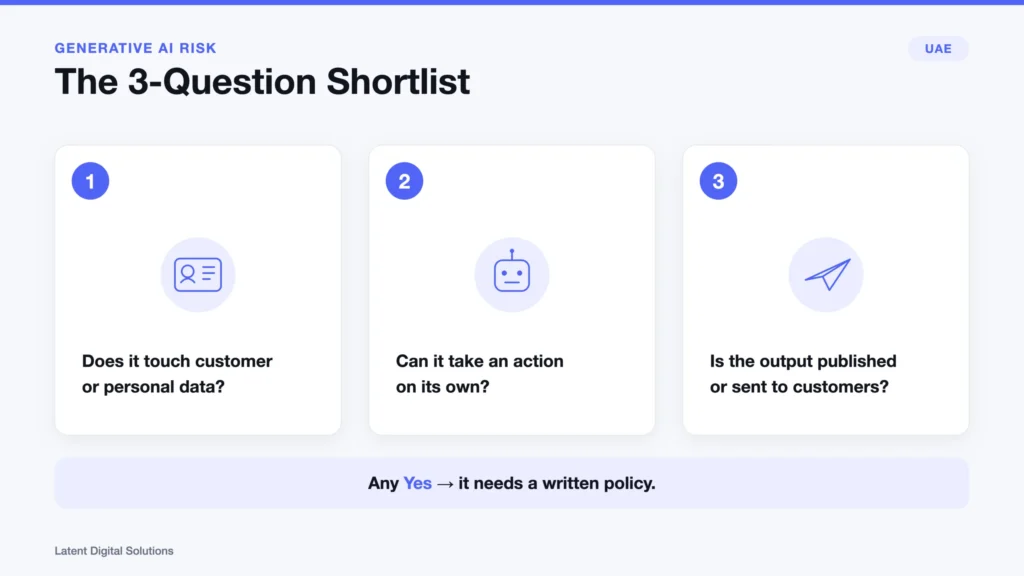
Generative AI risk management comes down to three categories that account for almost every real incident at a normal-sized business.
Accuracy. Generative AI produces confident, well-formatted answers that are sometimes wrong. Not obviously wrong — plausibly wrong, in a way that reads fine until someone who actually knows the subject checks it. This is the risk everyone’s heard of and the one most businesses already have some instinct for. It’s rarely the one that causes real damage, because it’s the one people already treat with suspicion.
Exposure. This is the quieter risk. Generative AI tools built into everyday software often send whatever you type into them to a third-party model to generate a response. If someone pastes a client contract, a draft financial figure, or an unreleased product detail into a prompt to get help rewriting it, that information has now left the building in a way it never did before. Most staff don’t think of typing into an AI assistant as sharing data externally. It is.
Provenance. Can you tell, after the fact, that a piece of content was AI-generated, and can you tell what it was based on? This matters more than it sounds for two reasons: some claims a generative AI tool makes about your own business (a policy, a price, a capability) need to be traceable back to something true, and some jurisdictions and platforms are starting to require disclosure of AI-generated content. Neither is exotic. Both are becoming ordinary compliance questions.
Almost every real incident with generative AI at a normal-sized business traces back to one of these three. Good generative AI risk management means knowing which of the three your current tools actually expose you to.
How do you decide what actually needs a review step?
The core question in generative AI risk management isn’t which tools you’re using — it’s what those tools’ outputs touch next.
Ask what the output touches next, not how the tool works.
Content that’s read once by the person who requested it — an internal summary, a first draft, a brainstorm — carries low risk almost regardless of accuracy, because a human is already the check. Content that goes external unreviewed — a customer email sent automatically, copy that publishes without a second look, a number that feeds into a report someone else relies on — is where a wrong or fabricated answer actually costs something.
Exposure works on the same principle. A generative AI tool used to summarise a public news article carries no exposure risk. The same tool used to draft a reply to a client email, where the model sees the full thread to generate a response, does, because now client information has passed through a system outside the business’s direct control. What the tool can see matters as much as what it produces. Once the policy is written, our 2026 shortlist of AI risk management tools compares the tooling.
This is usually a custom software problem more than a policy one: building the workflow so a human check happens at the exact point a generative AI output goes external, instead of accepting whatever review step — or lack of one — a vendor’s product shipped with by default. Off-the-shelf tools rarely ship with the safest setting on. They ship with the most impressive one.
Do you need a formal risk management framework?
Most businesses approaching generative AI risk management for the first time assume they need a formal framework. Almost certainly not — most of what ranks for “generative AI risk management” implies otherwise.
A framework like NIST’s Generative AI Profile solves a coordination problem: getting dozens of teams, vendors, and use cases aligned on the same standard. If your business has a handful of generative AI tools in active use, that coordination problem doesn’t exist yet. A short written answer to two questions — what gets checked before it’s used externally, and what information is off-limits to paste into a prompt — covers the same ground a framework would, without the overhead of a document nobody reads.
The same principle that makes risk work around other AI tools manageable applies here: the size of the answer should match the size of the actual exposure, not the size of the technology’s reputation.
What should the written policy actually say?
A working generative AI risk management policy is short. Three sections cover most businesses:
What gets reviewed before it’s used externally. Anything a customer, partner, or regulator will see — email replies, published content, figures in a report — gets a human check before it goes out. Anything used only internally by the person who generated it doesn’t need the same step.
What’s off-limits to paste into a prompt. Client data, unreleased pricing, anything under an NDA, and anything that would be a problem if it appeared in a vendor’s training data. This is the single highest-value line in the whole policy, because it’s the one nobody thinks to write down until after it’s been crossed.
Who owns the tool list. One person or small group who knows which generative AI tools are actually in use, so a new one doesn’t get adopted quietly by a team that never reads the policy in the first place. This is less about control and more about simply knowing what exists.
That’s the whole document. It fits on one page, and a one-page policy people actually read outperforms a comprehensive one that sits in a drive nobody opens.
When should this get revisited?
Generative AI risk management isn’t a one-time exercise. Not on a fixed schedule — when what a tool is connected to changes.
A generative AI feature that starts as a drafting assistant and later gets connected to your CRM, your email, or your customer database has crossed from a content-generation risk into something closer to an operational one. That’s the trigger to revisit the policy, not a calendar reminder. Vendors add integrations quietly, usually as a feature announcement rather than a risk disclosure, so the practical habit is checking in on active tools whenever a vendor ships an update, roughly the same discipline that catches third-party AI risk before it becomes a bigger problem than the tool that introduced it.
Conclusion
Generative AI risk management sounds like it requires a framework, a committee, and a compliance calendar. For most businesses, it requires three questions answered honestly: what gets checked before it goes external, what’s off-limits to type into a prompt, and who’s keeping track of what’s actually in use. Everything past that is scale you don’t have yet: useful to know about, not worth building today.
If it would help to have a second opinion on where your own generative AI tools actually sit on this list, talk to us. Most of these conversations are shorter than people expect, because the answer is usually simpler than the framework made it look.
Frequently Asked Questions
Is generative AI risk management the same as AI governance?
No. AI governance is the broader structure — policies, ownership, and oversight across every AI system a business uses. Generative AI risk management is one slice of that: specifically the risk that comes from generative AI tools that create content, code, or answers on request. A business can need one without yet needing the other.
What’s the biggest generative AI risk businesses actually underestimate?
Exposure, not accuracy. In most generative AI risk management conversations, accuracy gets all the attention. Far fewer people think about what happens to the information they type into a prompt to get that answer — and that’s usually where a real incident starts.
Does every generative AI tool need a formal review process?
No. A proportionate generative AI risk management approach means reserving formal process for tools whose output reaches a customer, a public page, or a decision unreviewed. Tools that only produce content a human reviews before use carry low risk by default.
Are there legal requirements around generative AI risk management?
Yes, and they’re expanding. It depends on jurisdiction and industry, and this is changing quickly enough that it’s worth checking current rules rather than relying on general guidance. What’s consistent across most emerging rules is a disclosure expectation — being able to say what was AI-generated and what it was based on — which is exactly what the provenance section of a generative AI risk management policy is for.
How does generative AI risk management differ from agentic AI risk management?
Generative AI risk is about what a tool produces — text, code, images, answers. Agentic AI risk is about what a tool does — whether it acts on your behalf without a person checking first. A tool can carry both: one that drafts a reply is a generative AI risk, the same tool sending that reply automatically is an agentic one.
Usually a reply within one working day.