Article Overview
Enterprise AI security content is almost always written by security vendors selling a product built for a company with a dedicated security operations centre. The word “enterprise” makes it easy for a 50-person business to assume none of it applies to them, but the underlying risks are the same regardless of company size. Only the tooling being sold for them is priced for a much bigger business.
It’s really just AI security, described by vendors selling to the biggest possible buyer. Keeping your business systems secure starts with understanding which of those risks actually apply at your size, and most of them are addressable without buying anything labelled “enterprise.”
- “Enterprise AI security” is mostly a marketing label. The underlying risks apply to any business using AI tools, not just large ones.
- Most small businesses have already been attacked and still don’t believe they’re a target, which is exactly the gap that gets exploited.
- A handful of basics (access control, data handling, output checks) cover most of what actually matters at your size.
- You don’t need a security specialist or a tool until you’re managing AI across enough systems that the basics stop being enough on their own.
What does AI security actually protect against?
Three things, mainly: your data ending up somewhere it shouldn’t, an AI tool being manipulated into doing something it shouldn’t, and an AI-generated output causing damage before a person catches it.
To find the AI tools your staff already use, see our six-step guide on how to audit AI tools.
Enterprise material adds categories like model theft, adversarial attacks, and supply-chain risk across dozens of vendors, all real concerns for an organisation running its own models at scale. A business using off-the-shelf AI tools is exposed to a narrower slice: what happens to the data you type into a tool, whether someone could trick that tool into leaking information, and whether a bad output reaches a customer before anyone reviews it. For product comparisons, see the 2026 AI risk management buyer’s shortlist.
The UAE’s National Cyber Security Policy for Artificial Intelligence breaks this into six categories: governance, infrastructure security, algorithm security, operational safety, adversarial attack monitoring, and incident response. That framework applies to any organisation using AI in the UAE, not just large ones.
Why does “enterprise” mislead mid-size businesses?
Because enterprise AI security implies a size threshold that doesn’t actually exist for the risks themselves, only for the products being sold to address them. A mid-size business reading that content reasonably concludes the risks don’t apply yet. That conclusion is where the real exposure sits.
Attackers don’t check company size before targeting a business, and AI tools make some attacks (convincing phishing, impersonation, automated probing) cheaper to run at any scale, including against small targets.
A June 2025 Coalition study conducted by Wakefield Research, surveying 1,000 small business decision-makers, found that 79% had experienced at least one cyberattack in the past five years, yet 64% still didn’t believe their business was an attractive target. That gap between what already happened and what people believe is happening is exactly what “enterprise” framing widens.
Which enterprise AI security risks actually apply at your size?
Nearly all of them, just at a smaller scale. Data exposure through what you paste into AI tools, prompt manipulation tricking a chatbot into revealing information it shouldn’t, and unchecked output reaching a customer are the three that matter most for a business your size, regardless of what enterprise vendors call them.
Data exposure is the most common and the easiest to prevent: check whether the AI tools your team uses train on your input by default, and restrict what gets typed into tools that do. Prompt manipulation matters mainly if you’ve built anything customer-facing on top of an AI model, like a support chatbot, where someone could try to talk it into doing something outside its intended scope. If that customer-facing surface is a WhatsApp or web chat assistant, building it with those guardrails from the start is more reliable than bolting them on after. Unchecked output is the quiet one: an AI-drafted email or report going out without review is a small mistake that compounds if it happens often enough.
Businesses that already run ageing systems alongside new AI tools face a compounding risk — the older the system, the harder it is to enforce even basic data controls. If that sounds familiar, legacy modernisation is usually the first conversation worth having, because enterprise AI security controls assume modern infrastructure that older systems simply don’t have.
What are the main AI-specific security risks?
Most AI security incidents come from a short list of risks. The OWASP Top 10 for LLM Applications names most of them, and they apply to any organisation that uses or builds on language models, whatever its size.
- Prompt injection. Text hidden in an email, document or web page that tells the AI to ignore its instructions or take an action.
- Sensitive data disclosure. Staff paste customer or contract data into a tool, or the model repeats confidential material in an answer.
- Excessive agency. An AI agent holds more access than its job needs, so one bad instruction can change records, send messages or move money.
- Supply chain. Models, plug-ins and data sources from third parties that nobody has reviewed.
- Data and model poisoning. Bad or planted data that changes what a model learns or retrieves.
- Improper output handling. AI output passed straight into another system, such as a database or a payment step, without being checked.
- Shadow AI. Tools staff adopt without approval. It is not an OWASP category, but it is often where exposure starts.
What does an enterprise AI security programme cover?
An enterprise programme turns that risk list into controls with owners. It usually covers:
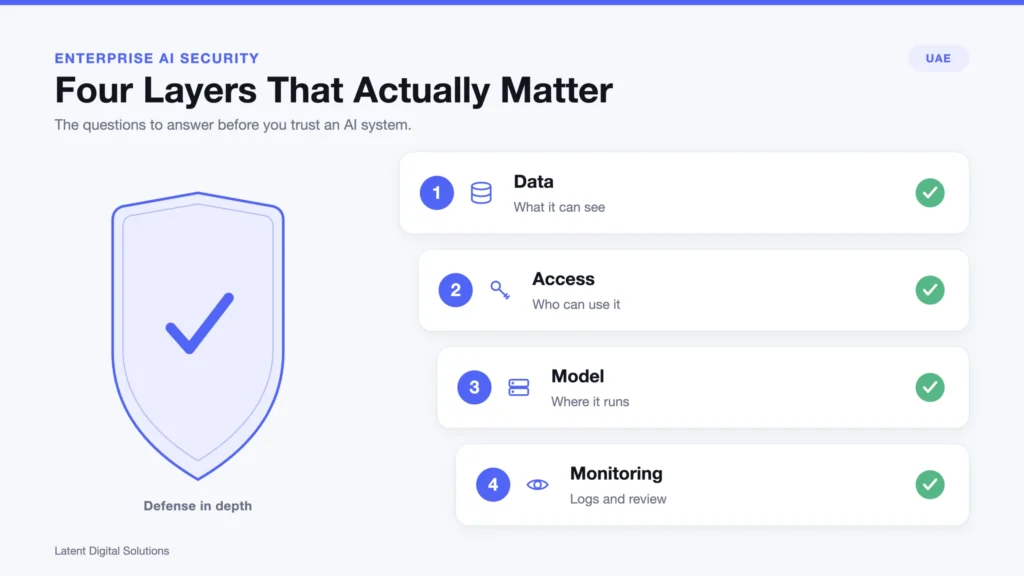
- Identity and access. Least privilege for people and for AI agents, with separate credentials for each.
- Data rules. Which data classes may be sent to which AI tools, enforced with data loss prevention where it exists.
- Logging and monitoring. A record of what AI tools were used, what they accessed and what they produced.
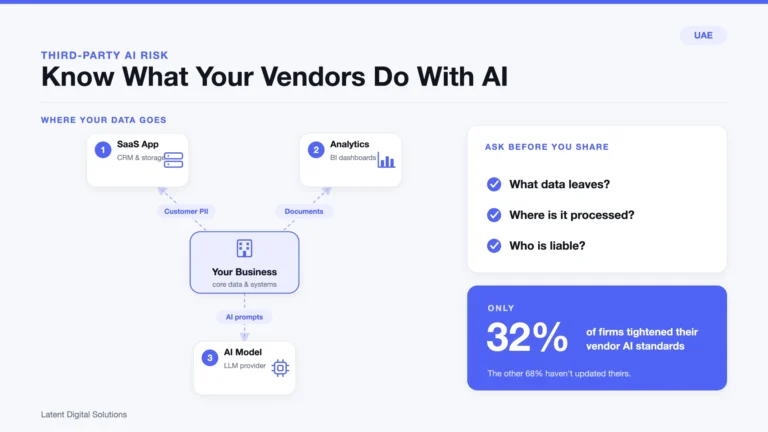
- Vendor review. Where each AI provider stores and processes your data, and what its contract says about training on it.
- Testing. Regular tests for prompt injection and data leakage against the AI systems you run.
- Incident response. A plan that names AI scenarios, such as a leaked prompt or an agent acting on bad input.
- Ownership. A named executive accountable for AI risk, reporting alongside security and compliance.
The frameworks below give you the structure for assigning these.
Which AI security frameworks and standards should you know?
Three names come up in almost every enterprise AI security conversation. You don’t need all of them, but you should know what each is for:
- NIST AI Risk Management Framework: voluntary guidance organised around four functions: Govern, Map, Measure and Manage. Useful as a structure for who is accountable and how risks get tracked.
- OWASP Top 10 for LLM Applications (2025): a ranked list of the most common security risks in applications built on large language models. It is led by prompt injection and sensitive information disclosure, and includes excessive agency (an AI system given more access or autonomy than it needs) and supply-chain risks. Useful as a checklist for anything you build or buy.
- ISO/IEC 42001: the first international standard for an AI management system, and one you can be certified against. Useful if a customer, regulator or tender asks for it; most mid-size businesses don’t need certification to get started.
For a mid-size business, a practical order is to use the OWASP list as a checklist for any AI tool that touches your data, borrow NIST’s four functions to decide who owns what, and look at ISO/IEC 42001 only when someone asks you to prove it.
What are the basics worth doing right now?
Four things, none of which require a security specialist: restrict which AI tools can touch customer or financial data, check each tool’s data-training settings, require a human check on anything AI-drafted before it reaches a customer, and name one person responsible for noticing if something goes wrong.
None of this is what a vendor would sell you. It’s the equivalent of locking the door rather than installing a monitored alarm system, and for a business your size, it closes most of the realistic gap. Enterprise AI security material tends to skip past this stage because the tools it’s selling assume you’ve already done these basics and need something bigger. Most businesses this size haven’t, and the basics alone cover more ground than the material suggests.
When do you need a specialist or a tool?
Once your AI use is customer-facing at real volume, touches regulated data, or spans enough systems that the four basics stop being something one person can track. Below that point, enterprise AI security tooling is solving a problem you don’t have yet. If your product has reached that point, it’s also worth a security review as part of getting it production-ready, not just adding a tool on top of it.
That threshold is usually about scale and exposure, not ambition. A business running an internal AI tool for drafting reports doesn’t need the same security posture as one running a customer-facing AI agent handling payment details. If you’re building something in that second category, that’s a genuinely different conversation, worth scoping in from the start rather than bolting on afterward.
How do you keep this from becoming a big project?
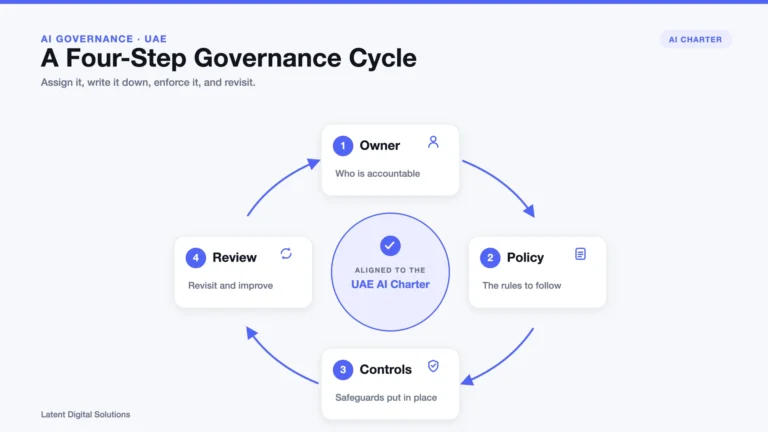
By treating enterprise AI security as four small decisions and a short review, not a security programme. Write down the four basics, name an owner, and revisit it every quarter alongside whatever else you’re reviewing about AI use in the business.
That’s the whole exercise for most businesses this size. Enterprise AI security content makes this sound like it requires a dedicated function because that’s the buyer it’s written for. If you want a broader view of how to weigh AI risks without overcomplicating things, a practical risk management framework covers the same territory without the enterprise overhead. A business that treats the basics as a genuine, if modest, priority, rather than something to defer until it’s “enterprise” enough to matter, closes most of the gap that the 64% in the Coalition study didn’t realise they had.
Conclusion
Enterprise AI security describes real risks using language built to sell products to large organisations. A mid-size business faces a smaller version of the same risks, and can close most of the gap with four basic decisions and a named owner, not a security team or a platform.
The businesses most exposed aren’t the ones with the fewest defences. They’re the ones who assumed, like most of the businesses in that Coalition survey, that this wasn’t about them yet. The word “enterprise” gives them permission to keep assuming. Dropping that assumption and spending half a day on the basics is the single highest-return security decision most businesses this size can make.
If you want a second opinion on whether your current AI use has a real gap in it, talk to us — it’s usually a shorter conversation than the word “enterprise” makes it sound. If you are weighing platforms and data-residency options, see our OpenAI and Azure OpenAI consulting, or book a conversation.
Frequently Asked Questions
How do you secure AI in an enterprise?
Large organisations formalise this with dedicated security teams, model monitoring, and vendor audits across every AI system in use. A business your size gets most of the same protection from four basics: controlling what data reaches AI tools, checking each tool’s training settings, reviewing AI-drafted output before it goes external, and naming one person accountable for noticing problems.
What does enterprise AI security do differently?
It applies the same core security principles, access control, monitoring, and incident response, at a scale and formality suited to large organisations with dozens of systems and teams. The principles apply to any business; the scale and tooling described as “enterprise” usually don’t apply until you’re operating at that size.
What exactly is AI security?
Protecting against the ways AI use can go wrong: sensitive data ending up somewhere it shouldn’t, an AI tool being manipulated into unintended behaviour, and AI-generated output causing harm before a person reviews it. It’s a subset of general security focused specifically on risks that AI tools introduce or amplify.
Do small businesses really need to worry about AI security?
Enterprise AI security content is almost always written by security vendors selling a product built for a company with a dedicated security operations centre. The word “enterprise” makes it easy for a 50-person business to assume none of it applies to them, but the underlying risks are the same regardless of company size. Only the tooling being sold for them is priced for a much bigger business.
What is the OWASP Top 10 for LLM applications?
It is a ranked list, published by the OWASP Gen AI Security Project, of the most common security risks in applications built on large language models. The 2025 edition is led by prompt injection and sensitive information disclosure. It works well as a checklist when you build or buy an AI tool.
Do we need ISO/IEC 42001 certification?
Usually not to get started. ISO/IEC 42001 is the first international AI management system standard and can be certified, but it matters most when a customer, regulator or tender requires it. For most mid-size businesses, the basics in this guide close more of the gap sooner. Regional banks considering AI should also review [**how AI in UAE banking is regulated and what use cases are live**](https://latentdigitalsolutions.com/ai-in-uae-banking-guide/) before making deployment decisions.
Usually a reply within one working day.