Article Overview
Most businesses didn’t decide to adopt AI. It arrived in pieces. Someone on the marketing team started using an AI writing tool. Customer support added a chatbot. Finance started running numbers through an AI model to speed up reporting. None of it went through a formal approval process, because none of it felt like a big decision at the time.
An AI governance framework is simply the answer to a question that follows a few months later: if one of these tools makes a mistake, exposes customer data, or produces a decision nobody can explain, who is responsible, and how would you even find out?
This guide walks through what an AI governance framework actually is, why it matters for a business operating in the UAE specifically, and how to build one without hiring a compliance team or slowing your business down. It’s written for the person running the business, not the person writing the code. That’s also the starting point behind how AI adoption actually works for a UAE business.
Key takeaways
- 01.An AI governance framework is a set of decisions about who can use AI tools, for what, and who checks the outcome, not a technical system.
- 02.The UAE government issued a national AI Charter in 2024 setting out 12 governance principles. It isn’t legally binding yet, but it signals the direction regulation is heading.
- 03.Most small and mid-size businesses don’t need a dedicated AI officer. They need one person accountable for a short, written policy.
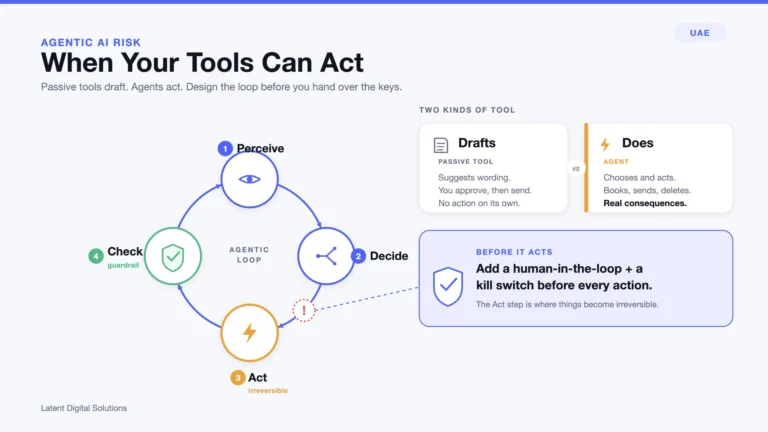
- 04.The biggest risk isn’t a rogue AI system. It’s an AI tool quietly making customer-facing decisions that nobody signed off on.
What is an AI governance framework?
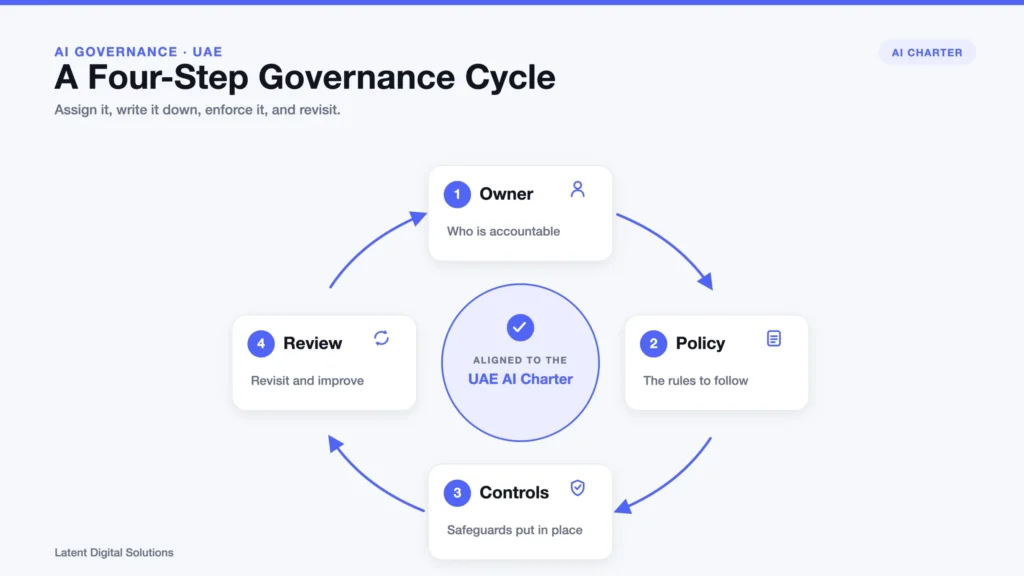
It’s a written set of rules for how your business decides to use AI, who’s allowed to introduce a new AI tool, and who’s accountable when something goes wrong. It isn’t software. It isn’t a piece of infrastructure. It’s a decision-making process, written down.
Think of it as the same thing you already have for who can sign off on a new supplier contract or approve a marketing spend over a certain amount. AI governance applies that same logic to a different category of decision: which AI tools touch your data, your customers, or your operations, and who’s watching.
Most vendor guides on this topic (IBM, Databricks, and similar providers) describe governance as a large-scale enterprise programme with dedicated committees and audit trails. That’s genuinely necessary if you’re running AI models across a bank or a hospital system. It’s overkill for a business that’s adopted three or four AI tools and wants to make sure nobody’s cutting corners with customer data.
Why does this matter for a UAE business right now?
It matters because the regulatory direction is already set, even though enforcement isn’t fully built out yet. In 2024, the UAE government’s AI Office published the UAE Charter for the Development and Use of Artificial Intelligence, a set of 12 principles covering safety, fairness, privacy, transparency, human oversight, and accountability.
The charter is not legally binding today. Legal counsel quoted at the time noted that it doesn’t specify enforcement mechanisms or penalties, and that further regulatory developments were expected to follow. What it does tell you is the shape of what’s coming: a UAE business that already has clear ownership, a basic approval step, and a written policy will not be starting from zero when binding rules do arrive.
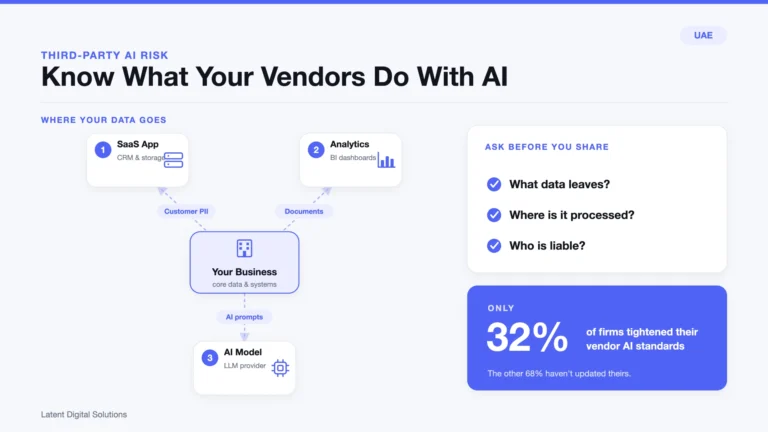
There’s a second, more immediate reason this matters, and it has nothing to do with regulation. If an AI tool handles customer communication, pricing, or personal data and something goes wrong, “we didn’t really have a process for that” is not a position you want to explain to a client or a partner. Governance isn’t there to satisfy a regulator. It’s there so you can answer a straightforward question when someone asks it.
What are the core components of an AI governance framework?
A workable framework for a business your size needs four things, not forty. Each one answers a specific question you’d otherwise be answering after something has already gone wrong.
An approved-tools list
A short, maintained list of which AI tools are allowed for business use, and which ones aren’t. This stops the situation where three different teams are using three different AI products with no visibility into any of them.
A review step
Not a committee. One person who checks, before a new AI tool goes live, whether it’s handling anything sensitive and whether that’s acceptable.
A named owner
Someone whose job includes AI governance, even if it’s a small part of a broader role. Without a name attached, “someone should probably look at that” never actually happens.
An incident process
A simple, written answer to “what do we do if an AI tool gets something visibly wrong.” Who gets told, how fast, and what happens next.
This is usually where AI Transformation work starts to matter in practice. The tools already in place need structure around them before more get added. We’ve seen this come up most often when a business is about to expand its AI use and realises, partway through, that nobody actually owns the decision.
How do you build one, step by step?
Building one doesn’t require a project plan. It requires an afternoon and a willingness to write things down that were previously informal.
List every AI tool currently in use
Ask each team directly (marketing, support, finance, operations) rather than assuming you already know. This step alone usually surfaces at least one tool leadership didn’t know was in use.
Classify each tool by what it touches
Does it see customer data? Does it make a decision that affects a customer or a financial outcome? Or is it purely internal, like drafting an email?
Write a one-page policy
Who can introduce a new AI tool, who approves it, and what triggers a review. One page. Not a document nobody reads.
Name an owner
Attach a real name to the policy, not a department.
Set a review point
Every quarter is reasonable for most businesses. The point is to check whether anything’s changed, not to run a full audit.
Write down what happens if something goes wrong
Two or three sentences. Who gets told first, and what the first action is.
None of this requires new software or a compliance hire. It requires someone deciding this is worth an afternoon, and following through on the six steps above.
Who should own this in a small or mid-size business?
In most businesses this size, it shouldn’t be a new hire. It’s usually the operations lead, the founder, or whoever already manages vendor relationships and IT decisions. The role doesn’t need deep technical knowledge. It needs the authority to say no to a new AI tool and the visibility to know what’s already in use.
What matters more than the job title is that the responsibility is explicit. We’ve seen businesses assume AI oversight is “everyone’s job,” which in practice means it’s nobody’s. One accountable name, even as a small addition to an existing role, changes that.
If you’re weighing this against bringing in outside help to get the first version of the framework in place, that’s a reasonable conversation to have. See our services for how that kind of engagement typically works. It’s rarely the right call to outsource the framework indefinitely. Someone inside the business needs to own it once it exists.
What happens if you skip this?
The realistic risk is rarely a dramatic AI failure. More often it’s something smaller and more ordinary: a chatbot promises a customer something the business can’t deliver, an AI tool drafts a communication that goes out without review, or a decision gets made by a model and nobody can explain afterwards why it happened that way.
Individually, each of these looks minor. Together, they add up to a business that’s adopted a genuinely useful set of tools without anyone able to say, with confidence, what those tools are doing or who’s watching them. That’s the actual gap a governance framework closes: the ordinary risk of not knowing what your own systems are doing, rather than some hypothetical regulatory fine.
Conclusion
An AI governance framework doesn’t need to be complicated to be effective. For most UAE businesses, it comes down to four things: knowing which tools are in use, having one person accountable for that list, a short written policy, and a plan for when something goes wrong. The UAE’s own AI Charter shows where regulation is heading, even before it’s enforced. Businesses that put basic structure in place now won’t be starting from nothing when it is.
Frequently Asked Questions
Do small businesses actually need an AI governance framework?
Yes, if you’re using more than one or two AI tools that touch customer data or communications. The framework doesn’t need to be elaborate. A one-page policy and a named owner covers most small businesses. What matters is that someone is accountable, not the size of the document.
Is the UAE AI Charter legally binding?
Not currently. It’s a set of 12 principles issued by the UAE government’s AI Office in 2024, and legal experts have noted it doesn’t yet specify enforcement mechanisms. It signals the direction of future regulation rather than imposing binding requirements today.
What’s the difference between AI governance and data privacy compliance?
Data privacy compliance covers how you collect, store, and use personal data generally. AI governance is specifically about how AI tools are approved, monitored, and held accountable within your business. They overlap, particularly when an AI tool processes personal data, but governance is broader than privacy alone.
Who should be responsible for AI governance in a business without a dedicated compliance team?
Usually whoever already manages vendor relationships or IT decisions, such as an operations lead or founder. The role needs authority and visibility more than technical expertise. What matters most is that one named person owns it.
How often should an AI governance policy be reviewed?
Quarterly is reasonable for most small and mid-size businesses. Rather than a full audit each time, it’s a quick check on whether new tools have been adopted or existing ones have changed in ways the current policy doesn’t cover.
Does having an AI governance framework slow down AI adoption?
It shouldn’t, if it’s built correctly. A one-page policy with a clear approval step usually takes minutes to apply to a new tool. What actually slows businesses down is discovering, after the fact, that an ungoverned tool needs to be unwound or replaced.
Usually a reply within one working day.