Article Overview
Agentic AI isn’t a new category of AI. It’s a shift in what you let it do. Instead of writing a draft for you to review, an agentic tool acts on your behalf without waiting for approval. The risk isn’t philosophical. It’s direct: things can break before you notice, and some breaks are bigger than others. If you grant the tool a narrow lane, the real damage is limited.
Search this phrase and you land on frameworks built for organisations running multi-agent systems across cloud environments, chaining tool calls through protocols most business owners have never heard of. That material is real, and it is not for you. It assumes a security team, an AI governance board, and agents complex enough to need their own audit trail.
Your situation is simpler and more urgent than that. Somewhere in the tools your business already runs on, a feature quietly changed from suggesting to doing. The difference matters more than the vendor’s release notes let on.
- Agentic AI risk isn’t about multi-agent systems — it’s about any tool that now acts instead of drafts.
- The real question is one word: can it act on your behalf without you checking first?
- Give an agentic tool a narrow lane, not general access, and most of the risk disappears.
- A mistake you can undo in five minutes is a different category of risk than one you can’t.
What makes a tool “agentic” instead of just AI-powered?
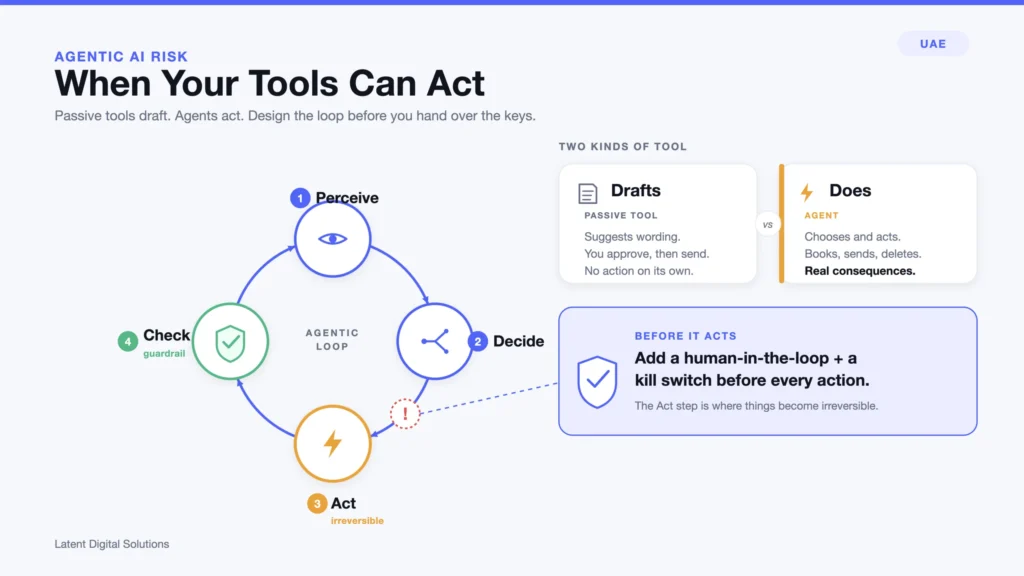
The difference isn’t intelligence. It’s whether a human reviews the output before anything happens.
An AI-powered tool drafts a reply and waits for you to hit send. An agentic one sends it. An AI-powered tool suggests which invoices look overdue. An agentic one emails the customers itself. Same underlying model, in some cases the same product, with one setting flipped from suggest to act.
That flip is what agentic ai risk management is actually about for a business your size. Not the technology. The removal of the pause where a person used to look at something before it went out.
Why doesn’t the enterprise material apply to you?
Because it’s solving a coordination problem you don’t have. Enterprise agentic risk frameworks worry about agents delegating to other agents, five tools deep, each one making decisions the next one builds on without a human in the loop anywhere in the chain.
A genuine standards effort exists for exactly that problem — the Agentic AI Risk Management Standards Profile, published in February 2026 out of UC Berkeley’s Center for Long-Term Cybersecurity, developed with input from security researchers working on exactly the multi-agent, cross-system scenarios that material addresses. It’s a serious piece of work. It’s also written for organisations with agents talking to other agents across infrastructure you don’t operate.
You most likely have one or two tools that now act instead of suggest. That’s a narrower, more manageable problem, and it doesn’t need a standards profile to solve.
What does agentic AI risk look like for a UAE business?
Two things make agentic ai risk management a slightly different conversation in the UAE.
The first is communications infrastructure. UAE businesses rely heavily on WhatsApp Business API for customer interaction — support queries, appointment reminders, order confirmations. Many of these integrations are now agentic: the tool sends, cancels, and reschedules without a person reviewing each message. That is a real agentic tool, running on a channel your customers treat as a direct line to a human. The permission question — what exactly is this allowed to send, to whom, under what conditions — deserves a deliberate answer, not the vendor’s default. Getting that right is exactly what a properly scoped WhatsApp AI build needs to answer before it goes live.
The second is data handling. The UAE Personal Data Protection Law (Federal Decree-Law No. 45 of 2021) creates obligations around how personal data is processed and where it goes. An agentic tool that updates customer records, sends personalised messages, or runs behavioural triggers is doing data processing under that law. If the tool sits on infrastructure outside the UAE, the PDPL’s cross-border transfer provisions apply. That’s not a reason to stop using the tool; it’s a reason to understand what it does with data before letting it act without a human in the loop.
Neither of these is a reason to avoid agentic features. They are a reason to go into the settings rather than inheriting whatever the vendor decided by default.
Which of your tools have quietly become agentic?
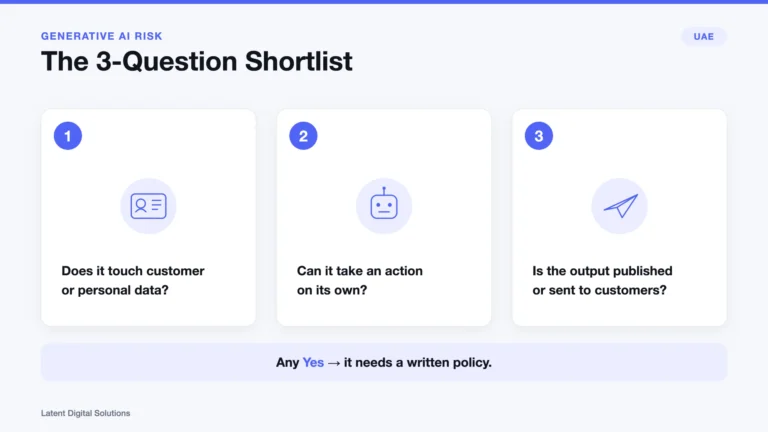
This is the practical starting point for agentic ai risk management: go through your subscriptions and ask one question per tool — does it take an action, or does it hand you something to approve first?
A tool that drafts a reply, flags a lead, or highlights an anomaly is still asking permission. A tool that sends the reply, updates the record, or moves money is not. The second category is where agentic ai risk management actually lives for you — usually in customer-facing software (support, CRM, billing) that’s had automation added to its feature list without a clear line drawn around what it’s now allowed to do unattended. If those tools come from vendors you haven’t formally reviewed recently, the same due diligence questions that apply to third-party AI risk apply here too.
Most businesses find this list is short. One tool. Maybe two. That’s the entire scope of the problem, not twenty.
What could actually go wrong if a tool acts on its own?
Three things, roughly in order of how often they happen. It sends something wrong — a reply with the wrong price, a record updated with bad data, an email to the wrong customer. It sends something right but at the wrong time — a payment reminder to someone who paid yesterday. Or it does something you’d have vetoed if you’d seen it first — closing a support ticket that wasn’t actually resolved.
None of these are exotic. They’re the kind of mistake a junior employee might make in their first week, except this one runs continuously and doesn’t get more careful over time unless someone tells it to.
How do you actually contain that risk?
Give the tool a lane, not general access. Two questions get you most of the way there.
- What can this tool do without asking me first, specifically?
- If it gets that wrong, how long before I’d notice, and how hard is it to undo?
A tool that can send a routine reply is a narrow lane. A tool that can also change account settings, issue refunds, or delete records is not — that’s general access wearing a narrow tool’s name. Most vendors let you restrict what an agentic feature can touch. Very few businesses actually go into the settings and do it, mostly because nobody told them the feature’s permissions had grown past what they’d originally approved.
The undo question matters as much as the permission question. A wrongly-worded reply is a two-minute fix. A refund that already left the account is not. Where a mistake is expensive to reverse, that’s where a human checkpoint stays, even if it slows the tool down. Getting this right is mostly a matter of deciding deliberately rather than inheriting vendor defaults — the same discipline that makes AI transformation stick rather than stall: you decide what the system owns, you don’t let the tool decide for you.
Do you need a governance framework for this?
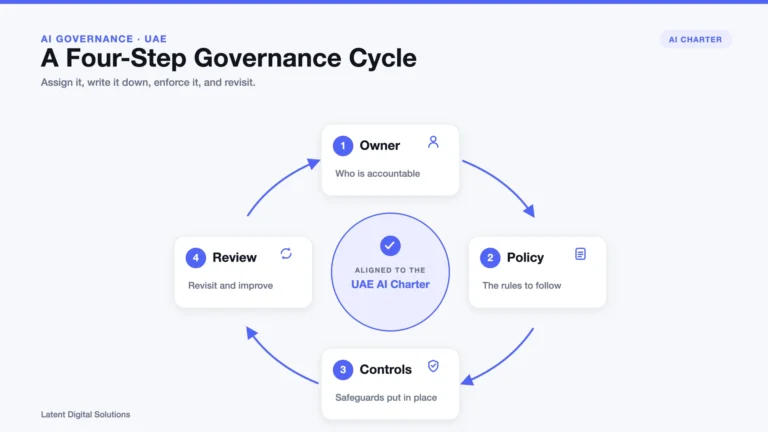
Not at this size. Formal agentic ai risk management, in the governance-framework sense, is the right tool once you’re coordinating agent behaviour across a team large enough that no one person can track what’s live. Below that point, a short written answer to two questions — which tools can act without approval, and what happens if one of them gets it wrong — covers what a framework would formalise anyway, without the overhead of maintaining one.
Revisit it when a vendor announces a new capability, since that’s usually where new agentic features quietly arrive. A twice-a-year review of your active tools, asking whether each one still only suggests or now also acts, catches the rest.
Conclusion
Agentic ai risk management, for a business without a security team, is not a framework exercise. It’s knowing which of your tools can act without you, giving each one a narrow lane, and keeping a human in the loop wherever a mistake would be expensive to undo. The businesses most exposed here aren’t the ones ignoring AI. They’re the ones who approved a suggestion tool a year ago and never noticed it became an action tool.
If you want a second opinion on which of your tools deserve a closer look, talk to us — most of these conversations are shorter than people expect, since the same two questions from this guide are usually where they start too.
Frequently Asked Questions
What is agentic AI risk management?
It’s the work of knowing which of your tools can take action on your behalf without a human checking first, and putting a boundary around what each one is allowed to do. For most businesses it isn’t about advanced multi-agent systems — it’s about an existing tool that quietly gained the ability to act instead of just suggest.
How is agentic AI different from a regular AI feature?
A regular AI feature drafts something and waits for approval. An agentic one carries out the action itself — sending, updating, deleting — without a person reviewing it first. The underlying technology can be identical; the difference is whether a human checkpoint still exists.
Do I need a formal governance framework to manage this?
Almost certainly not yet. Governance frameworks solve a coordination problem across many agents and teams. With one or two tools that act on their own, a short written answer to what they can do and what happens if they get it wrong covers the same ground without the overhead.
How often should I check whether a tool has become agentic?
Whenever a vendor announces a feature update, since that’s usually where new capability quietly arrives. A twice-a-year review of your active tools, asking whether each one still only suggests or now also acts, catches the rest.
Usually a reply within one working day.