Article Overview
The AI transformation roadmaps published by Gartner, Microsoft, Databricks and similar vendors describe a multi-year programme run by a transformation office with its own budget line. If your business doesn’t have a transformation department or a six-figure software line item to redirect, that roadmap doesn’t apply to you, even though the underlying steps are real. A workable AI transformation roadmap has to start from the scale you actually operate at.
A roadmap for a business your size doesn’t need fewer ambitions. It needs phases defined by what your business gets out of each one, not by which platform gets rolled out next.
- A roadmap for a business your size is phased by outcome, not by platform rollout.
- Enterprise roadmaps assume a transformation office. Most of what they describe still applies; the scale doesn’t.
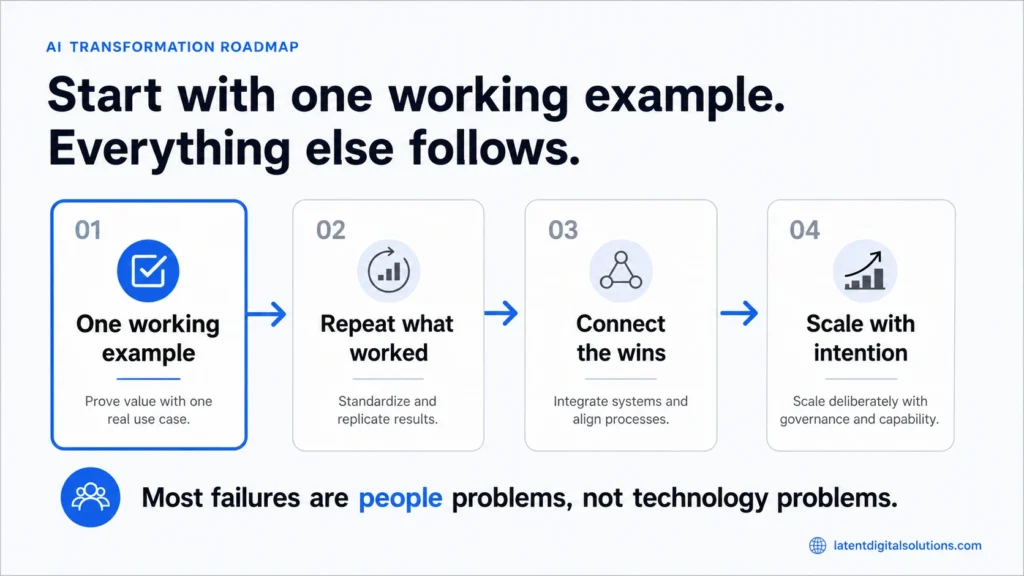
- The first phase should be one working example, not an assessment or a strategy document.
- Most AI implementation failures are people and process problems, not technology problems.
What is an AI transformation roadmap when you’re not an enterprise?
An AI transformation roadmap is an ordered list of what the business tries next with AI, and what has to be true before moving to the next thing. Nothing more complicated than that.
Our guide to machine learning system design explains the seven parts around a model and the decisions that belong to the business.
Enterprise material makes it sound like infrastructure: a data platform, a centre of excellence, a governance board, then use cases layered on top. That sequence exists because a large organisation genuinely has those pieces to coordinate. A business your size doesn’t have a data platform team to coordinate with. The roadmap is really just: what did we try, did it work, what’s next.
Why do enterprise AI transformation roadmaps not fit a mid-size business?
Because most of what’s written about an AI transformation roadmap is built around resources you don’t have, not steps you can’t take. Strip out the parts that assume a transformation office and most of what’s left is genuinely useful.
The phases enterprise guides describe (assess, pilot, scale, embed) aren’t wrong. What’s wrong is the assumption baked into each one: “assess” means a formal readiness audit run by consultants, “scale” means a platform capable of serving the whole organisation at once, “embed” means retraining every department through a change-management programme. For a business with fifteen or fifty people, assess can mean one afternoon and an honest list. Scale can mean the second team adopts what the first team proved worked. None of that requires the infrastructure the enterprise version assumes.
There’s a second mismatch worth naming. Enterprise AI transformation roadmaps are usually written by, or sold by, whoever’s going to run the transformation office: a systems integrator, a platform vendor, an internal PMO. Each of those has a reason to make the roadmap look bigger than it needs to be, because bigger roadmaps justify bigger engagements. A business your size reading that material and concluding “we’re not ready for this” isn’t wrong about the roadmap. They’re right that it doesn’t fit, and reasonably wrong about what that means for whether AI itself is worth pursuing.
What should the first phase actually be?
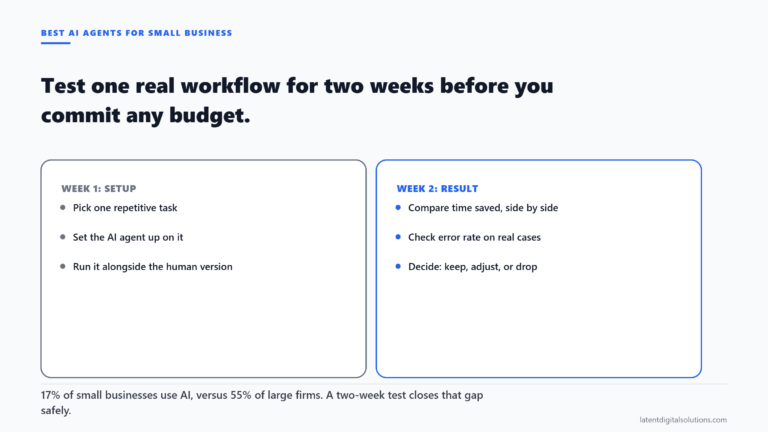
One real pilot, on one real problem, run by one named person, not an assessment and not a strategy document.
It’s tempting to start with planning: a readiness assessment, a tool evaluation, a policy. All of that has its place eventually, but none of it produces evidence. The fastest way to learn whether AI is useful for your business is to run it against one specific, bounded problem and watch what happens. Pick something with a real cost today (a report that takes someone three hours every Monday, a backlog of enquiries that sits for two days before anyone replies) and give it four to six weeks with a clear owner. That single pilot tells you more than a month of assessment would. If the pilot itself needs to be built rather than assembled from off-the-shelf tools, that’s a smaller, more specific version of what our custom software development dubai work covers.
How do you sequence the phases without a platform purchase?
By outcome, not by tooling. Phase one proves one thing works, phase two proves it works reliably enough to stop babysitting it, and phase three is the second team adopting what the first team already validated.
This is the part enterprise AI transformation roadmaps get backwards for a business your size: they sequence by capability build-out (data layer, then tooling layer, then use-case layer), which makes sense when you’re standing up infrastructure for hundreds of future use cases at once. When you only need to prove three or four things work, sequencing by capability is slower than just doing the next real thing:
- Phase one is the pilot from the previous section: one problem, one owner, four to six weeks.
- Phase two is running that same pilot for a full quarter without the original owner checking in daily, to see if it holds up unsupervised.
- Phase three is handing the same approach to a second team with a different but related problem, to see if the lesson generalises or if it was specific to the first case.
How do you know a phase is done before moving on?
When the thing you built stops needing you to explain it. If someone new on the team can pick up the process without you walking them through it, the phase is genuinely finished.
A softer, more honest test than a formal exit criterion: could you go on holiday for two weeks and have it keep running correctly without you checking in? If the answer is no, the phase isn’t done, whatever the calendar says. Moving to the next phase before this is true is the most common way these roadmaps stall. The second team inherits something fragile, it breaks on their watch, and the whole initiative gets blamed for a phase-one problem nobody closed out.
This is also usually the point where a business decides whether the next phase gets built in-house or brought in from outside. Neither answer is automatically right; it depends on whether the team that ran phase one has the time and the skill to also run phase two, or whether they need someone alongside them for that stretch. If you’re weighing that decision, it’s worth seeing the fuller range of what a technology partner can help with at each stage, from our services overview rather than assuming it’s an all-or-nothing outsourcing decision.
What derails an AI transformation roadmap most often?
Treating it as a technology rollout rather than a change to how a handful of people work day to day. According to a BCG survey covered by PR Newswire, most AI implementation failures trace back to people and process issues, not the technology or the underlying models.
That tracks with what derails smaller roadmaps too, just at a different scale. The tool works fine in testing. What breaks it is nobody owning it once the person who set it up moves to something else, or a second team getting handed the process with none of the context the first team built up by trial and error. The same BCG research found that companies further along focus on fewer initiatives at once rather than more; trying to run three pilots in parallel usually produces three half-finished ones instead of one that’s genuinely proven.
Conclusion
An AI transformation roadmap for a business your size is the same idea as the enterprise version, minus the parts that assume infrastructure you don’t have. One real pilot, a clear test for when it’s genuinely done, and a second team inheriting something that’s already been proven rather than something fragile. The businesses that get stuck usually aren’t behind on technology. They moved to phase two before phase one was something a stranger could run without help.
If you want to work through which problem is worth that first pilot, or want a second opinion on your own AI transformation roadmap before you commit to it, talk to us — that conversation is usually shorter than the roadmap document people expect to need.
Frequently Asked Questions
What are the typical stages of an AI transformation roadmap?
For a business your size, an AI transformation roadmap really only needs three stages: one proven pilot, that same pilot running unsupervised for a full quarter, and a second team adopting it. Enterprise material often splits this into five to seven stages, but most of the extra steps exist to coordinate resources a smaller business doesn’t have to coordinate.
How long should the first phase take?
Four to six weeks is usually enough to know whether a pilot is worth continuing. Longer than that and you’re not really piloting anymore, you’re just running something without having decided if it works.
Do we need a data strategy before starting?
Not for the first phase. A single, bounded pilot rarely needs more than the data already sitting in the system you’re using for that specific problem. A broader data strategy becomes worth doing once you’re on your second or third proven use case, not before the first one.
What if the first pilot doesn’t work?
That’s still useful information, and it’s a normal outcome. Note what specifically didn’t work (the tool, the process, or the fit with that particular problem) and move to the next candidate rather than treating one failed pilot as proof the whole roadmap is wrong.
Who should run the roadmap if we don’t have a transformation team?
The AI transformation roadmaps published by Gartner, Microsoft, Databricks and similar vendors describe a multi-year programme run by a transformation office with its own budget line. If your business doesn’t have a transformation department or a six-figure software line item to redirect, that roadmap doesn’t apply to you, even though the underlying steps are real. A workable AI transformation roadmap has to start from the scale you actually operate at.
Usually a reply within one working day.