Article Overview
The best AI agents for small business are not the ones topping vendor rankings — they’re whichever one survives a two-week test against one real task in your own operation. Most published comparisons are written by a company selling one of the entries on the list, which is why the evaluation method matters more than which specific product wins it.
UAE businesses working with Latent Digital Solutions on AI adoption consistently run into the same problem: not a shortage of options, but no reliable way to evaluate them before spending money. This article is not a ranked list. It is a two-week test you can run on one workflow in your own business to find out whether a specific AI agent is worth keeping.
Key takeaways
- 01.Every “best AI agents for small business” list on page one was written by a company selling one of the entries — the evaluation method is what’s missing, not more lists.
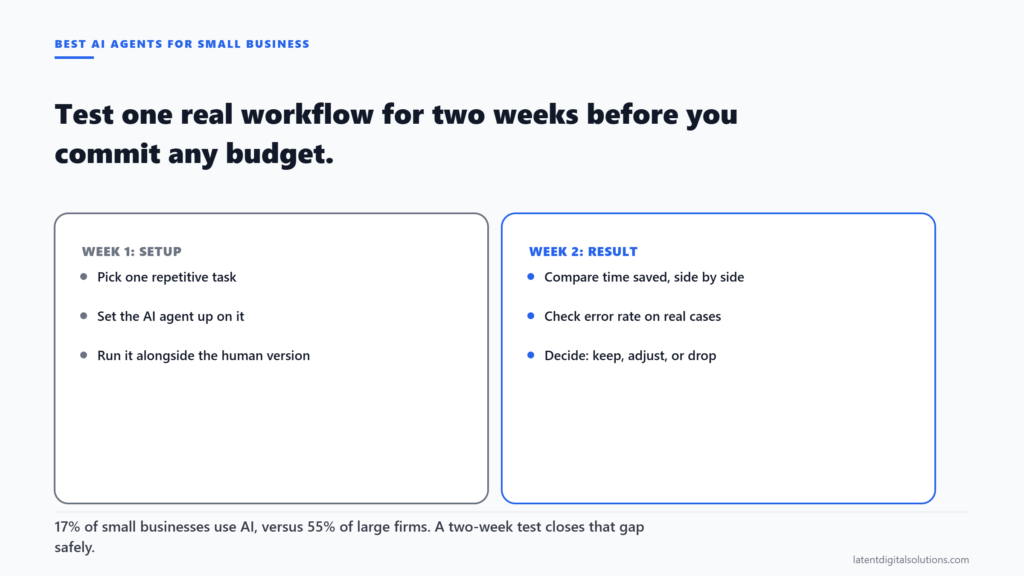
- 02.According to Eurostat’s 2025 data, 17% of small enterprises in the EU used AI technologies, compared to 55% of large enterprises — the adoption gap is structural, not a sign that the tools don’t work at smaller scale.
- 03.The right test for best AI agents for small business is one task, two weeks, one measurable result — not a platform-wide trial.
- 04.If the agent cannot handle a real, messy version of your task by week two, the problem is the fit, not the configuration.
Why does every “best AI agents for small business” list disagree?
Because each list was written by a vendor, and each vendor put itself at number one.
Our guide to agentic AI in retail explains which retail tasks an agent can take over and which a person keeps.
Our guide to the AI agent workflow explains which steps an agent can prepare and which should stay with your team.
Our guide to AI marketing tools explains which marketing tasks to hand to software first and which to keep with your team.
Agents are one type of helper. Our guide to choosing an artificial intelligence assistant compares all five types and the jobs each suits.
This is not a content quality problem with articles about best AI agents for small business. It is a structural one. Building a product and writing an honest comparison of that product against competitors are not compatible goals. The six vendor articles ranking on page one for “best AI agents for small business” are marketing content using the format of editorial content. The reader gets the appearance of a ranking with none of the credibility of one.
The Forbes article is the exception, written independently and not by a company selling an agent. It is also the ranking that disagrees most with all the others. That is not a coincidence.
Comparing those best AI agents for small business lists, then, produces no useful output. Every best AI agents for small business list agrees that an AI agent will save time on customer support, email drafting, data entry, and scheduling. Every list disagrees on which product does this best. The disagreement is manufactured noise, not genuine product differentiation.
What none of the lists publish is the evaluation method: which task to test, what to measure, what the result means, and when to stop.
What can an AI agent realistically do at your size?
Less than the vendor page suggests, and more than most small businesses are currently getting.
According to Eurostat’s 2025 data on AI in enterprises (ec.europa.eu, retrieved September 2026), 17% of small enterprises in the EU used AI technologies in 2025, compared to 55% of large enterprises. This is EU data, not UAE-specific — no comparable UAE breakdown exists publicly at the size-band level. The structural gap between small and large firm adoption is consistent across regions and is explained primarily by two factors: IT resource capacity and the time cost of evaluating tools correctly. The UAE’s National Strategy for AI 2031 sets a national-level push toward broad AI adoption across sectors (oecd.ai, retrieved September 2026), which means the pressure to adopt is increasing regardless of whether the tools are ready for a given business’s workflows.
An AI agent is a software system that takes a task, runs a sequence of steps to complete it, and returns an output, without a person managing each step. At small-business scale, the tasks that fit this definition well are narrow and patterned: drafting responses to a specific type of incoming email, summarising a specific document format, triaging a specific kind of customer request. The tasks that do not fit are open-ended, require verified facts, or depend on information the agent cannot access. The AI Maturity Model for UAE Businesses gives a structured way to assess which category most of your current workflows fall into before committing to a tool. In Latent’s experience working with UAE SMEs, the majority of businesses attempting a first AI agent trial have not yet mapped which of their tasks is actually patterned enough to automate — the evaluation framework is what they are missing, not a better product.
The realistic scope for best AI agents for small business is one narrow task, done reliably, without a person managing each run. That is useful, not because it replaces a person, but because it removes one category of work from the daily interrupt queue.
Which AI agents are worth putting on a shortlist?
Start the shortlist from the job you want done, not from a ranking. These are examples to look at for each job, not endorsements or a ranked list.
| Job | Agents to look at | What to measure in your two-week test |
|---|---|---|
| Answering customer questions on chat and email | Intercom Fin, Zendesk AI agents | Share of real questions answered correctly without a person, and how cleanly it hands over |
| Inbox, documents and meeting notes | Microsoft Copilot, Google Gemini in Workspace | Hours saved on one weekly admin task, and errors caught in review |
| Connecting your apps with AI steps | Zapier Agents, Make, n8n | One repeat task, such as invoice or lead routing, run end to end, and how often it fails |
| Sales follow-up inside a CRM | HubSpot Breeze, Salesforce Agentforce | Follow-ups drafted correctly, and how much editing each needs |
| Research and first drafts | ChatGPT, Claude, Gemini | Share of drafts you can use with a light edit, and whether the sources check out |
Vendors rename and re-price their agent products often, so check each one’s current plan, where it stores your data and whether it works in Arabic before you start the test below.
Which task should you test best AI agents for small business on first?
The one that is most patterned, most interruptive, and least consequential if the agent gets it wrong.
Three criteria:
Patterned enough that the inputs are predictable. If every occurrence of this task is genuinely different, an AI agent will not help — it will produce a different output every time, which still requires a person to evaluate each one. The best test tasks are the ones where ninety percent of cases fit the same shape: same information needed, same response format, same length.
Interruptive enough that handling it manually costs real time. A task that takes two minutes and happens twice a week is not worth automating. A task that takes ten minutes and happens thirty times a week is worth a two-week test. The interruption cost is the baseline against which the agent’s speed is measured.
Low enough stakes that a wrong output is recoverable. A wrong summary of an internal meeting is recoverable. A wrong response sent to a client is not. The best first test for best AI agents for small business is a task where a person reviews the output before it goes anywhere, or where a wrong output causes no more than an inconvenience.
| Task type | Worth testing | Not worth testing |
|---|---|---|
| Same format, predictable inputs | Yes | — |
| Happens 20+ times a week | Yes | — |
| Output reviewed before use | Yes | — |
| Open-ended, varies every time | — | Yes |
| Requires verified numbers | — | Yes |
| Sent directly to clients, no review | — | Yes |
Latent’s Services covers AI implementation scoping for exactly this kind of pre-decision work on best AI agents for small business: identifying which task in a specific operation is actually worth testing, before a contract is signed.
How do you run a two-week evaluation of best AI agents for small business?
Set up the agent on one task. Run it for two weeks. Measure three things.
What to measure:
-
Time per instance. How long does each run take, end to end, including review? Compare this to how long the manual version took. If the agent requires five minutes of prompt-tweaking plus two minutes of review on a task that used to take four minutes manually, it has a negative return.
-
Error rate. How often does the agent produce an output that is wrong in a way you would have caught if you were doing it yourself? Track this by instance, not by impression. If it makes errors on 20% of runs, the review step has to be more careful than if it makes errors on 2% of runs.
-
Escalation rate. How often does the agent fail to complete the task at all and hand it back for a human to handle? If the escalation rate is above 30%, the task is probably too variable for the agent’s current configuration.
What not to measure: how impressive the demo looked, how many features the platform has, or whether the company’s other customers seem happy. These are all vendor-provided signals. The only signal that counts is what the agent does on your task, with your data, over two weeks. The OECD’s AI adoption guidance for SMEs (oecd.org) makes the same point: self-reported vendor metrics are not a substitute for in-context evaluation.
A pre-evaluation framework covering task selection and measurement criteria for best AI agents for small business is in the AI Readiness Assessment Guide — it applies the same structure to broader AI readiness questions before any tool is chosen.
What result with best AI agents for small business means you should keep paying?
The agent saves you more time than it costs to review and maintain it.
For best AI agents for small business, that calculation has four components:
- Time saved per instance = manual time minus (agent run time + review time)
- Instances per month = how often the task runs
- Monthly time saving = (time saved per instance) × (instances per month)
- Monthly cost = subscription cost + time spent on maintenance and prompt-tweaking
If monthly time saving exceeds monthly cost — in time value, not just in dollars — the agent is worth keeping. If not, stop paying before month two. The sunk cost of the trial is not a reason to continue.
The two-week window is enough to see whether the error rate is stable, whether the task structure is actually patterned enough for the agent to handle, and whether the review step adds more time than the agent saves. A two-week trial either produces a clear answer or it does not. That is the whole point of the best AI agents for small business evaluation. The vendors who want you to run a longer trial are the ones whose tools take longer to produce a clear answer.
Start the conversation if you want help scoping a two-week test before you commit: the starting point is confirming whether the task is actually worth testing in the first place.
Conclusion
The best AI agents for small business are not the ones at the top of a vendor’s list. They are the ones that survive a two-week test against one of your own tasks and cost less in review time than they save in run time. That test is available to any business regardless of size or technical resource. What it requires is picking the right task to start with.
The evaluation is simpler than the vendor pages suggest. One task, two weeks, three measurements: time per instance, error rate, escalation rate. If the numbers work, keep it. If they do not, stop early and pick a different task or a different tool.
Frequently Asked Questions
What are the best AI agents for small business?
An AI agent is software that completes a task by running a sequence of steps — drafting, searching, classifying, summarising — without a person managing each step. For a small business, the practical version is an agent configured to handle one specific, patterned task: a particular type of email response, a document summary in a fixed format, or a customer query classification. The best AI agents for small business are the ones narrow enough to work reliably on one task, not the ones with the most features.
How do I choose which of the best AI agents for small business to test?
Don’t start with the agent — start with the task. Identify one task in your operation that is patterned (most instances look the same), interruptive (it happens frequently enough to be a real cost), and low-stakes enough that a wrong output is recoverable. Then pick an agent rated for that task type and run a two-week evaluation. The specific product matters less than whether the task is a fair test.
Do the best AI agents for small business also work for very small businesses?
Yes, if the task is a match. The adoption gap between small and large firms — 17% vs 55% of enterprises using AI technologies in 2025, according to Eurostat — is mostly explained by IT resource capacity and evaluation time, not by the tools being unsuitable. A business with five people can automate one email-drafting task just as effectively as one with five hundred, if that task is patterned enough.
How long should an AI agent trial last?
Two weeks is enough for most tasks. That window gives you enough instances to see whether the error rate is stable, whether the agent handles the real variability in your inputs, and whether the review step adds more time than the agent saves. A trial that needs more than two weeks to produce a clear answer is usually a sign that the task is too variable for the agent to handle reliably.
What should I do if the agent keeps making errors?
First, check whether the errors are consistent (the same type of input fails every time) or random (different inputs fail unpredictably). Consistent errors usually mean the task needs a narrower definition or the prompt needs adjustment. Random errors usually mean the task is too variable for the agent at current capability levels — it is a fit problem, not a configuration problem. If random errors persist past week one, stop the trial early rather than waiting for week two.
Can I use an AI agent without any technical help?
For most small-business tasks — email drafting, document summarisation, query classification — yes. The setup is typically prompt-and-test, not code. Where technical help becomes useful is in connecting the agent to existing tools (your CRM, your inbox, your file system) and in building the review workflow so outputs are checked before they go anywhere consequential. A scoping conversation before you start costs less than a month of subscription on a tool that turns out not to fit. If your business is at the 50–300 staff mark and thinking about the broader transformation, AI transformation for SMEs works differently from enterprise frameworks — that guide covers what to expect.
Usually a reply within one working day.