Article Overview
Most AI maturity models describe a five-level ladder from “ad hoc” to “optimized,” built by firms like Gartner and Accenture for organisations with a dedicated transformation budget. They rarely say which rung is actually worth reaching for a smaller business, or that most companies never climb near the top and do fine anyway. A useful AI maturity model for a UAE business should say where to stop, not just how to climb.
An AI maturity model is only useful to your business if it tells you where to stop, not just where to climb.
- Every published maturity model is built as a ladder to the top. Most businesses shouldn’t be climbing the whole thing.
- The right level is the one where the return still exceeds the effort, not the highest number on the chart.
- Very few organisations reach the top of any AI maturity model, and that isn’t a failure.
- Moving up one level deliberately usually beats chasing the full five.
What is an AI maturity model, without the jargon?
It’s a ladder with a handful of rungs, describing how deeply AI is used across a business, from “barely used, no process around it” at the bottom to “embedded everywhere, continuously optimised” at the top.
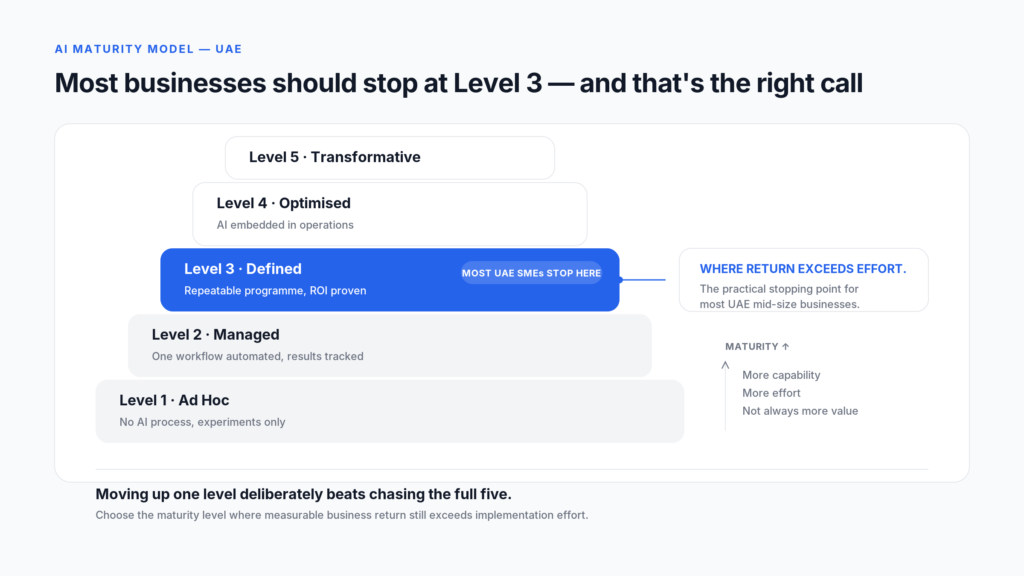
Most AI maturity models use five levels with different names depending on who wrote them: ad hoc, opportunistic, systematic, differentiating, and optimised is one common set. The details vary; the shape doesn’t. Each AI maturity model assumes the goal is to climb toward the top, because that’s how a maturity model reads to whoever built it for consulting engagements. Reaching the top level generally means dedicated AI teams, formal governance, and AI woven into most core processes. That’s a real destination for a large enterprise. It’s not automatically the right one for you.
Why do standard AI maturity models mislead smaller businesses?
Because they present every rung as strictly better than the one below it, when in practice each rung costs more to reach than the last, and the return doesn’t always keep up.
Level one to level two is usually cheap: a few people start using AI tools deliberately instead of by accident. Level two to three starts requiring process and ownership. Level three to four typically means dedicated infrastructure and specialist hires. Four to five means the kind of governance and integration work that only pays off at real scale (our AI governance framework guide covers what that actually involves). Presenting all five jumps as equally worth making is either written for an organisation with the budget to fund all five, or written by someone who benefits from you trying to reach the top regardless of whether it fits.
What does each AI maturity model level actually cost to reach?
The cost of climbing an AI maturity model is roughly proportional to how much organisational infrastructure each level assumes, which means the jumps get steeper the higher you go.
| Level | Common name | What it actually costs | Who it fits |
|---|---|---|---|
| 1 | Ad hoc | Time only — agree to be deliberate about which tools get used | Any business starting out |
| 2 | Opportunistic | Low — a few deliberate uses, nobody formally accountable yet | Most small businesses |
| 3 | Systematic | Moderate — named owners, a review habit, maybe one lead | Most mid-size businesses |
| 4 | Differentiating | High — specialist hires, dedicated infrastructure, formal process | Larger businesses |
| 5 | Optimised | Very high — governance, cross-process integration, continuous review | Enterprise scale only |
The first couple of levels cost mostly time and a decision to be deliberate rather than accidental about which tools get used and by whom. The middle levels start costing real coordination: named owners, a review process, maybe one dedicated hire. The top levels cost the most and deliver the least incremental value for a business that doesn’t operate at enterprise scale, because the benefits of full integration compound mainly when you have dozens of processes to integrate across.
Which AI maturity model level is “enough” for a mid-size business?
The level where AI is being used deliberately, with a named owner and a way to check it’s working, on the two or three problems that matter most. For most businesses that size, that’s level two or three, not five.
That’s not a compromise position, it’s usually the correct one. Going further only pays off once you’ve genuinely exhausted the return on your current use cases and have more problems worth solving than you have attention for. Most businesses this size aren’t there yet, and won’t be for a while. Treating “enough” as level three rather than level five applies just as much to systems you already run: getting more out of what’s already in place, closer to what our Legacy Modernization work covers, usually beats chasing a higher maturity level on paper.
How do you tell which level you’re at now?
By checking whether AI use in your business is deliberate or accidental, whether anyone owns it, and whether it’s actually measured or just assumed to be working.
If people are using AI tools without anyone having decided they should, that’s level one. If a handful of uses are deliberate but nobody’s checking whether they’re paying off, that’s level two. If there’s a named owner and a rough sense of what’s working, you’re likely at level three already, which for most businesses this size is a genuinely fine place to be. Very few organisations get much further than that: an August 2026 IDC MaturityScape benchmark of 1,900 organisations worldwide found that 61.3% are still in the two least mature stages, and only 3.1% have reached the most optimised stage. Most of the businesses you’re competing with aren’t further up this ladder than you think.
What’s the one move that raises your level fastest?
Naming an owner for whatever AI use already exists, and putting a simple way to check it’s working behind it. That single change usually moves a business from level one to level two or three faster than any tooling decision.
It’s tempting to think the next level requires new infrastructure or a bigger budget. Mostly it requires ownership and a review habit applied to what’s already happening. A business with three unowned AI experiments running quietly is closer to level three than it looks, once someone takes responsibility for each one and starts checking the results. If one of those experiments is close to something the business could depend on daily but isn’t quite there yet, that’s a narrower, more specific problem than “raise our maturity level”, and closer to what our MVP to Production work covers.
Conclusion
An AI maturity model is only useful if you’ve decided where you actually want to get to, not just which direction the ladder points. For most UAE businesses, that’s a level where AI use is deliberate, owned, and checked, not the top of someone else’s five-level chart. Very few organisations reach that top level, and reaching it isn’t automatically the goal worth having.
If you want help figuring out which level is genuinely worth reaching for your business, talk to us. That’s usually a shorter, more useful conversation than the five-level chart suggests.
Frequently Asked Questions
What are the 5 levels of maturity modelling?
Most AI maturity models describe some variation of: ad hoc (no deliberate use), opportunistic (some deliberate use, no process), systematic (owned, with a process), differentiating (AI shapes how work gets done in specific areas), and optimised (embedded and continuously improved across the business). The names vary by source; the shape is consistent.
What is the Gartner AI maturity model?
Gartner’s version follows the same five-level shape as most others, built primarily for enterprise IT and data teams to benchmark against peers. It’s a reasonable reference point, but it assumes organisational scale and budget most mid-size businesses don’t have, so treat the top level as informational rather than a target.
What is an AI governance maturity model?
A narrower version focused specifically on how AI decisions get made, reviewed and controlled, rather than how widely AI is used. A business can be at a modest overall AI maturity level while still having solid, well-owned governance around the AI it does use, which matters more for risk than overall maturity does.
Is it bad to stay at a lower AI maturity level?
Most AI maturity models describe a five-level ladder from “ad hoc” to “optimized,” built by firms like Gartner and Accenture for organisations with a dedicated transformation budget. They rarely say which rung is actually worth reaching for a smaller business, or that most companies never climb near the top and do fine anyway. A useful AI maturity model for a UAE business should say where to stop, not just how to climb.
Usually a reply within one working day.