Article Overview
The AI readiness assessment frameworks published by Microsoft, UNDP, and similar organisations are built for a government ministry or a Fortune 500 company to run over several weeks with outside consultants. None of that fits a 50-person UAE business with a Tuesday afternoon and no consulting budget. A readiness assessment worth running at that size needs to answer one thing fast: is there anything worth automating yet, or not.
An AI readiness assessment framework for your business doesn’t need a consulting engagement. It needs a short, honest set of questions you can answer yourself, about your data, your team, and how decisions get made.
- Most published readiness frameworks are built for enterprises with a data platform and a dedicated team, not a business your size.
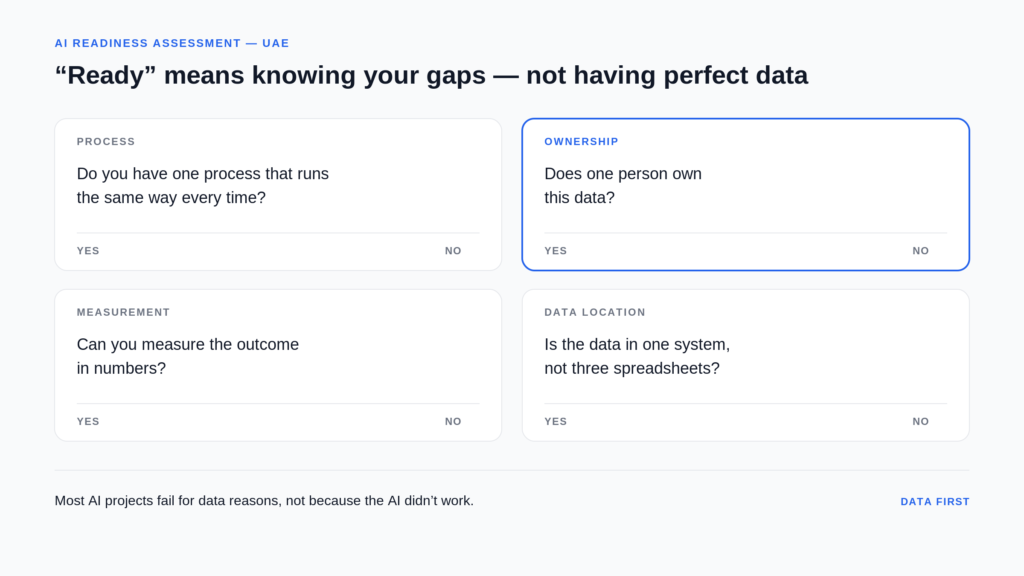
- “Ready” doesn’t mean perfect. It means you know enough about your own gaps to pick a sensible first project.
- The questions that actually predict readiness are about ownership and data, not technology maturity.
- Most AI projects that get abandoned fail for data reasons, not because the AI itself didn’t work.
What does an AI readiness assessment framework actually check for a business?
For a business your size, it means knowing where your data lives, who would own a new AI tool, and how you’d tell if it worked. Nothing about servers, platforms, or a formal maturity score.
Most published versions of an AI readiness assessment framework measure things like data architecture maturity, model governance capability, and change-management infrastructure, categories that assume you already have people whose job is exactly that. A business your size doesn’t fail an AI readiness assessment framework by lacking those things. You fail it, functionally, by not knowing the answers to three much smaller questions: what data would this touch, who decides if it’s working, and what happens if it goes wrong.
Why are most AI readiness assessment frameworks overkill?
Because they’re designed to produce a scored report a consultant can present back to a board, which requires far more structure than a business this size needs to make a decision.
A 40-question enterprise AI readiness assessment framework exists partly to be thorough and partly to justify the engagement that comes after it. Most of those questions map to infrastructure or governance layers a UAE SME doesn’t have and doesn’t need yet. Running the full version on a business without a data team produces a report full of gaps that were never going to be fixed before the first AI pilot anyway, which is discouraging and not especially useful. A shorter, honestly-scoped version tells you the same thing that matters in a fraction of the time.
What questions should an AI readiness assessment framework actually ask?
Three things, in order: is there data behind the problem you want AI to help with, is there one named person who’ll own the result, and is there a way to tell within weeks whether it worked.
| Question | What to check | Red flag |
|---|---|---|
| Is there data? | Consistent records in one place for this task | Data scattered across systems, inconsistent, or not recorded |
| Who owns the result? | Named person with authority to say yes or no | “Everyone” is responsible, which means nobody is |
| How will you know it worked? | Measurable outcome you can check within weeks | No agreed measure; “we’ll know when we see it” |
In a real AI readiness assessment framework, everything else on a longer checklist is secondary to those three. A business can be missing a formal AI policy, a data governance board, and a change-management plan, and still be perfectly ready to run a focused pilot, as long as those three answers are solid. Conversely, a business can have all the enterprise infrastructure in the world and still fail if nobody’s clearly accountable for the result. If you’re thinking about what comes after the readiness check, our AI strategy guide for business leaders covers what a practical first plan looks like. Once you know where you stand, our AI transformation roadmap maps the next steps.
How do you assess your data, your team, and your processes?
An AI readiness assessment framework does this by asking, for one specific problem at a time, whether the data exists and is consistent, whether someone has the authority to say yes or no, and whether the current process is documented well enough that an AI tool could follow it.
Data: pick the task, then check whether the information it needs is recorded consistently in one place, not scattered across three systems with three different formats. Team: name the person who’d own this before you start, not after something goes wrong. Process: if nobody could explain the current process clearly to a new hire, an AI tool won’t be able to follow it either, and that’s worth fixing before automating it. A quick self-check across these three areas is a real AI readiness assessment framework in practice, done honestly rather than run through a scoring template built for someone else’s organisation. If it points to a broader gap in how your systems handle that data day to day, that’s a related but separate exercise, closer to what our custom software development for UAE businesses work covers.
What if the assessment says you’re not ready?
Then you’ve found the actual blocker, which is more useful than a vague sense that AI “isn’t for us yet.” Fix the specific gap, not everything at once.
If the data isn’t consistent, that’s a one- to two-week fix scoped to the single process you care about, not a company-wide data project. If nobody’s clearly accountable, naming an owner takes an afternoon. If the process itself is undocumented, writing down how it currently works, even roughly, is often more valuable than the AI tool itself turns out to be. None of these are reasons to abandon the idea. They’re the specific, small things worth fixing before the pilot, instead of guessing and finding out the hard way.
How do you turn the result into a first step?
By choosing the smallest version of the readiest problem, not the most impressive one. Run it as a genuine pilot, with the owner you named, for a few weeks, and decide honestly whether it held up.
This is where a lot of readiness work stalls: the assessment gets done, produces a reasonable answer, and then nothing happens because the next step feels too big. It shouldn’t be big. According to Gartner’s prediction, 60% of AI projects will be abandoned through 2026 because they weren’t supported by data that was genuinely ready for the job, not because the underlying AI tools failed. A short, honest readiness check, followed by a small pilot on the problem it points to, avoids exactly that outcome.
Conclusion
A genuinely useful AI readiness assessment framework for a business your size is a much shorter, more honest set of questions than the enterprise checklist: is there usable data behind this problem, who owns the result, and how will you know if it worked. Answer those three, fix whatever they expose, and you’re genuinely ready to try, which is further than most businesses using the enterprise version ever get.
If you want a second opinion on whether a specific idea is genuinely ready to pilot, talk to us. Most of that conversation is just working through the three questions above together.
Frequently Asked Questions
What are the three pillars of AI readiness?
For a business without a dedicated data team, the three pillars an AI readiness assessment framework should focus on are usable data behind the specific problem, a named owner accountable for the result, and a clear way to measure whether it worked. Enterprise frameworks list more, but most of the extra pillars assume infrastructure a smaller business doesn’t have yet.
How do you measure AI readiness?
Not with a numeric score modeled on enterprise maturity models. The more honest measure is whether you can answer, for one specific AI use case, where the data lives, who owns it, and how you’d know if the result was working. If you can answer all three clearly, you’re ready to pilot that use case.
Do we need a formal readiness assessment before trying AI at all?
Not a formal one. A short, honest version of the three-question check above, done in an afternoon, tells a business your size what it actually needs to know. A longer, scored assessment is worth doing later, once you have several AI projects running and need to compare them systematically.
What’s the difference between AI readiness and an AI strategy?
The AI readiness assessment frameworks published by Microsoft, UNDP, and similar organisations are built for a government ministry or a Fortune 500 company to run over several weeks with outside consultants. None of that fits a 50-person UAE business with a Tuesday afternoon and no consulting budget. A readiness assessment worth running at that size needs to answer one thing fast: is there anything worth automating yet, or not.
Usually a reply within one working day.