Article Overview
Agentic AI for enterprise is real and already working in production, but only on a specific class of task — and most vendor pitches skip the part where 80% of the deployment effort goes into data work, not the model. That gap between what gets demoed and what gets deployed is what decides whether a project reaches production or stalls after the pilot.
Latent Digital Solutions works with UAE businesses on AI transformation, and the honest position is this: agentic AI for enterprise is real, it is working in production today, and it is also being significantly oversold. The gap between those two things is what a business owner needs to understand before agreeing to a budget line.
Key takeaways
- 01.Agentic AI for enterprise works reliably today in a specific band: multi-step tasks with defined rules, variable inputs, and a checkable output.
- 02.A spring 2025 MIT Sloan Management Review and BCG survey found 35% of organisations had adopted AI agents, but deployment projects routinely consume 80% of their effort on data work and workflow integration — not the model itself.
- 03.The word “enterprise” in most vendor material means large companies with platform teams and integration budgets; the underlying capability applies at smaller scale where the process qualifies.
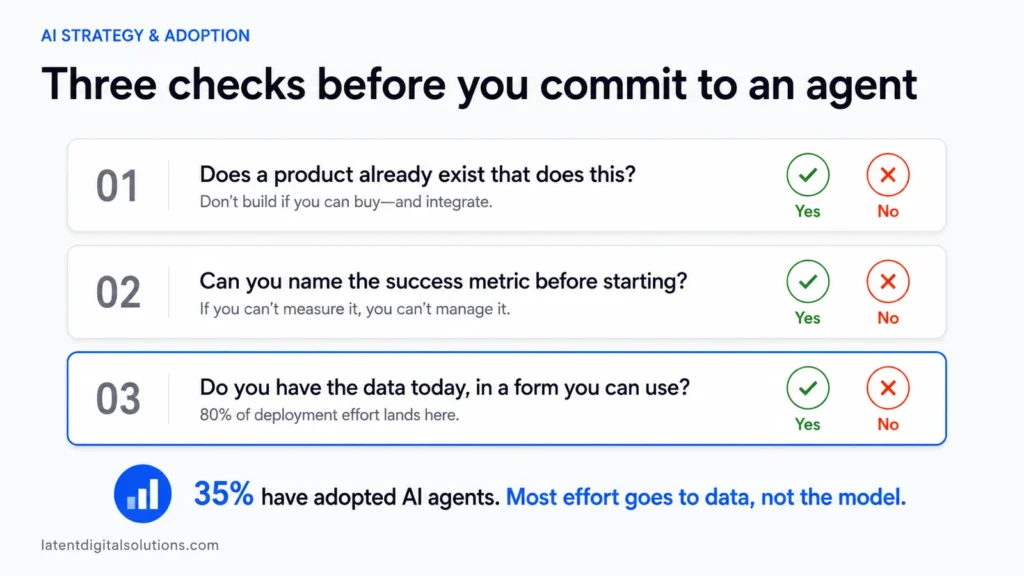
- 04.Three questions — does a product already exist, can you name the success metric before starting, do you have the data today — will tell you whether a proposed agentic AI for enterprise project is worth attempting.
What does agentic AI for enterprise actually mean?
An AI agent is software that can take a sequence of actions on its own, using tools and information, to complete a goal, without someone clicking through each step.
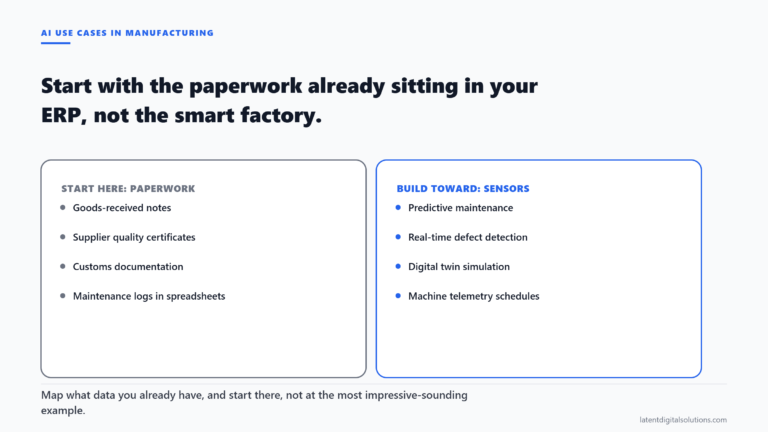
Our guide to agentic AI use cases in manufacturing explains which agent tasks work in a plant and where a person approves.
Our guide to the best AI agent to use compares six kinds of agent and gives a scorecard for choosing one.
Many agents now take phone calls as well as text. Our guide to speech artificial intelligence explains what voice tools can do, how they handle Arabic and how to test them.
The difference from a standard AI prompt is the loop. You describe the outcome. The agent decides which steps to take, executes them, checks the result, and tries again if something fails. A business owner does not see the steps unless they want to.
For enterprise use, “agentic AI” typically refers to agents that connect to real business systems: reading from a CRM, querying a database, sending an email, updating a record, triggering a workflow. The agent acts across those systems rather than just generating text.
What makes agentic AI for enterprise genuinely different from automation tools that have existed for years is the ability to handle variable inputs. A rules-based automation breaks when something unexpected appears. An agent can interpret the unexpected input, decide what to do about it, and carry on, within limits. IBM’s technical overview of agentic AI maps this to seven components — perception, reasoning, goal-setting, decision-making, execution, learning, and orchestration — which is a useful frame for understanding where an implementation can stall.
Is it real yet, or is it still demos?
Agentic AI for enterprise is real. The scepticism the Reddit thread captures is legitimate, but the answer to “does agentic AI exist” is yes, with conditions.
A spring 2025 MIT Sloan Management Review and BCG survey found that 35% of organisations had adopted AI agents, with a further 44% planning deployment in the near term. That is adoption at scale, not a research project.
The conditions matter. The organisations reporting success are deploying agents on tasks with a specific shape: defined process steps, inputs that vary but stay within a known type, and an output that can be checked, either automatically or by a person before anything consequential happens. Invoice matching, customer query triage, multi-step data retrieval, compliance document review. These are working in production.
Where it is still closer to demo is tasks where the steps themselves are not knowable in advance, where the agent needs genuine judgement about competing priorities, or where a wrong action cannot easily be undone. Strategy work, creative direction, and high-stakes decisions with unclear criteria are not what these systems handle reliably today.
| What agentic AI for enterprise handles reliably | What stays closer to demo today |
|---|---|
| Invoice matching and document extraction | Strategy formulation and creative direction |
| Customer query routing and initial response | Tasks with unknowable steps in advance |
| Multi-step internal lookups across systems | Decisions where a wrong action is hard to reverse |
| Scheduled monitoring and alerting | Work requiring genuine judgement on competing priorities |
Which tasks do agents handle reliably today?
The simplest test is whether you could write out the process as a decision tree, even a messy long one. If yes, an agent can probably follow it. If not, you are looking at a problem that requires human judgement, and the agent will fail at the same point.
These are the tasks where agentic AI for enterprise is reliably in production:
- Customer query routing and initial response — reading a query, classifying it, pulling relevant account data, drafting a response for review, and logging the interaction.
- Document processing and extraction — invoices, purchase orders, contracts, compliance submissions — where the agent reads the document, extracts structured data, flags exceptions, and files or routes the result.
- Multi-step internal lookups — an agent that connects a question to three internal systems, assembles the answer, and presents it, rather than asking someone to do the same manually each time.
- Scheduled monitoring and alerting — checking data sources on a schedule, comparing against thresholds, and triggering a notification or action when something falls outside the expected range.
Latent’s MVP to Production service is specifically scoped to taking agents that have been proved in a controlled setting into real business systems. That transition is consistently where projects stall.
What consumes the effort on a real deployment?
This is the finding most vendor presentations omit.
Research by MIT Sloan’s Kate Kellogg and colleagues, documented in MIT Sloan’s Agentic AI, explained (February 2026; retrieved September 2026), tracked an agent deployed to detect adverse events in cancer patients and found that 80% of the agentic AI for enterprise deployment effort was consumed by data engineering, stakeholder alignment, governance requirements, and workflow integration, not the model. The AI model was the small part.
In the agentic AI for enterprise projects Latent runs alongside UAE businesses, this ratio holds consistently. Data preparation, stakeholder alignment, and integration work take the majority of the timeline. The model itself is rarely the constraint.
A business that agrees to an agentic AI for enterprise project based on a demo is typically agreeing to something that looks like: three weeks of discovering which data is accessible, two weeks of cleaning or restructuring it, several rounds of defining what a correct output actually means for this specific process, configuration work to connect the agent to existing systems, and then a period of supervised operation before anyone trusts it to run without a person watching.
None of this is a reason not to do it. It is a reason to price it correctly and to start with a process where the data situation is already understood. Choosing the wrong first project turns a three-month engagement into a six-month one with a worse result.
Do you need to be an enterprise for this to apply?
No. “Enterprise” in the vendor material means companies with a dedicated platform team, a data lake, and a budget line for infrastructure. Most businesses in this part of the UAE market do not have any of those.
What matters for agentic AI for enterprise is whether the process qualifies, not whether the organisation is large. A business with twenty people can have an invoice processing workflow that an agent would handle better than a person. A business with two hundred people can have a customer query process that is still entirely manual and still better suited to an agent than to a hire.
In the UAE specifically, the businesses seeing early results with agentic AI for enterprise are not necessarily the largest ones. They are the ones that started with a well-understood process, clean data, and a measurable success condition, regardless of headcount.
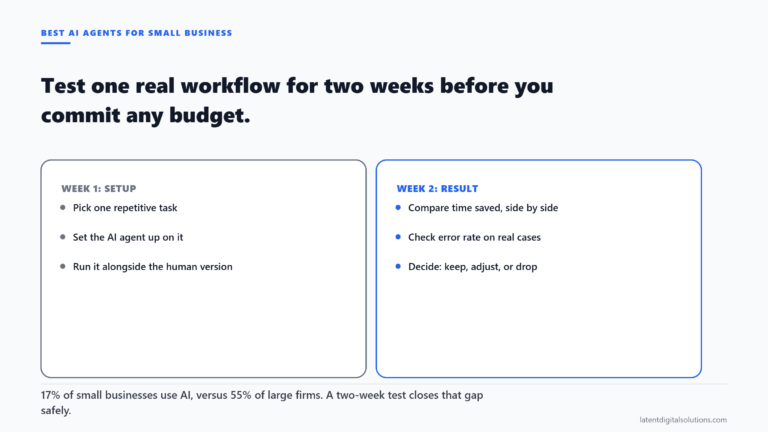
The scale difference is in what the agent connects to. A large enterprise deploys agents into a purpose-built integration layer. A smaller business deploys agents into the tools it already uses: an email client, a CRM, a spreadsheet, an accounting system. Both work. The technical approach is different; the underlying logic of what qualifies is the same. At smaller scale, the practical question changes; see best AI agents for small business.
For context on what realistic agent deployments look like at different sizes, the AI agents for business guide covers the decision framework with more detail on where to start.
How do you tell if your process is a fit?
Three questions, in order.
First: does a product already exist that does this? If a SaaS tool already handles this workflow for businesses your size, subscribe to it and measure whether it works. A proof of concept built from scratch is not warranted. The time to build something is when the thing you need genuinely does not exist yet.
Second: can you name the one number that will decide success, before starting? “It will save time” is not a number. “It will reduce the time to process an invoice from four hours to forty minutes, measurable from week one” is. If you cannot state the success condition before the project begins, the project will run until the budget ends and call itself a success. This is the most common way agentic AI for enterprise projects fail quietly.
Third: do you have the data the agent needs, today, in a form it can use? Not approximately. Not with some manual work to get it. Today. If the answer is no, the first phase of the project is data work, not agent work. That is fine, but it needs to be priced and scoped as data work, not embedded inside an AI estimate where it becomes a surprise.
If all three answers point the right way, an agentic AI for enterprise deployment is worth scoping properly. Start the conversation here: the first step is understanding whether the process fits before any commitment is made.
Conclusion
Agentic AI for enterprise is working in production, on the right class of tasks, for organisations that started with clear data and a defined success condition. It is not working reliably for tasks requiring genuine judgement, or for organisations that began with a demo and discovered the data situation later.
The Reddit thread ranking on page one for this term is not an embarrassment for the technology. It is useful information about where the market actually is. Most vendor material is written for an audience that has already decided. This article is for the audience that has not.
Latent Digital Solutions helps UAE businesses decide whether a proposed AI project is worth attempting. If it is, the work starts with scoping it properly, so the 80% of effort that goes into foundations is not a surprise. Talk to the team to check whether your process qualifies.
Frequently Asked Questions
What is the difference between agentic AI for enterprise and regular AI automation?
Standard automation follows a fixed script and breaks when something unexpected happens. Agentic AI for enterprise uses a model to handle variable inputs and decide between steps, which means it can complete a process even when the inputs differ from run to run. The trade-off is that agents require more setup, clearer success conditions, and better data than simpler automation tools.
Is agentic AI for enterprise only relevant to large companies?
No. The word “enterprise” in most vendor material refers to large organisations with dedicated infrastructure teams, but the underlying capability applies wherever the process qualifies: multi-step, defined rules, checkable output. Businesses with 20 to 200 people can deploy agentic AI for enterprise into the tools they already use.
How long does an agentic AI for enterprise deployment typically take?
A realistic timeline for a well-scoped agentic AI for enterprise deployment is eight to sixteen weeks, depending on how accessible the relevant data is. The majority of that time is not building or configuring the agent. It is ensuring the data is in a usable form and that the success condition is measurable. Projects that skip this phase typically take longer and produce a worse result.
What is the biggest reason agentic AI for enterprise projects fail?
Starting without a defined, measurable success condition. “It will save time” is not sufficient. Agentic AI for enterprise projects that cannot state what success looks like before they begin tend to run until the budget is exhausted and declare themselves successful regardless of outcome. The second most common reason is beginning without first confirming the data situation.
Do you need an agentic AI platform to get started?
Not necessarily. Agents can be built to connect to tools a business already uses: a CRM, an email system, an accounting platform. A purpose-built platform is useful at scale or when deploying multiple agents that need to coordinate, but the first agentic AI for enterprise deployment rarely requires one. Starting with the simplest configuration that would work is almost always the right call.
How is agentic AI different from a chatbot?
A chatbot responds to a question with a generated answer. An agent takes a series of actions in a system to produce a result: it can read from a database, update a record, send a notification, and verify the outcome, all as part of completing a single task. The user sees the result, not the steps.
Usually a reply within one working day.