Article Overview
Speech artificial intelligence is software that listens to human speech and turns it into text, or reads text aloud in a natural voice. It sits behind call transcription, meeting notes, voice bots and dictation. For a UAE business the practical questions are which jobs it suits, whether it copes with Arabic and English, and how to test it on your own recordings before you pay for it.
Conversational AI services from Latent start from the same place: pick the job, then test the tool on real material.
Already know you need a voice assistant?
Skip ahead to our conversational AI services for UAE businesses.
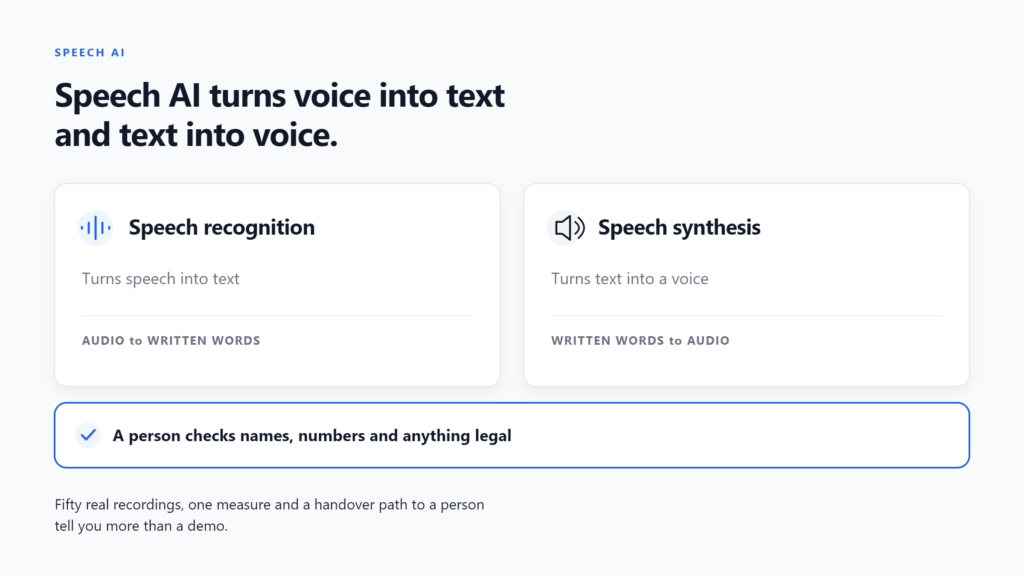
- Speech artificial intelligence has two halves: speech recognition, which turns speech into text, and speech synthesis, which turns text into a voice.
- It saves the most time on call transcription, meeting notes and first-line phone queries, and it needs a person to check names, numbers and anything legal.
- Arabic support is real but uneven. The UAE dialect is covered by some tools, so test with recordings from your own staff and customers.
- Test before you buy. Fifty real recordings, one measure and a handover path to a person tell you more than a demo.
What is speech artificial intelligence?
Speech artificial intelligence is the family of AI tools that work with spoken language. They either recognise speech and write it down, or take written text and speak it. A voice assistant uses both: it listens to your question, works out the answer and speaks it back.
Three terms come up often:
- Speech recognition: also called speech to text. It turns a recording or a live call into a written transcript.
- Speech synthesis: also called text to speech. It reads written text aloud in a synthetic voice.
- Voice analytics: tools that look at a transcript or a call for patterns, such as complaints, topics or silence.
Speech artificial intelligence is not new, but it has improved sharply with large language models. Older systems needed clear audio, one speaker and a fixed vocabulary. Current ones cope with background noise, several speakers and natural phrasing, although they still make mistakes.
For a business owner the point is simple. Much of your company’s knowledge is spoken, in calls, meetings and site visits, and it is lost the moment the conversation ends. Speech artificial intelligence turns that talk into searchable text. Latent Digital Solutions looks at it as a way to capture and use what your people already say.
How does speech artificial intelligence work?
Speech artificial intelligence works in four stages. It captures sound, converts it into text, works out what the text means and, if needed, replies in a synthetic voice. Each stage can go wrong, which is why testing matters more than reading a feature list.
- Capture: a microphone or a recorded call supplies the audio. Poor audio is the most common cause of poor results.
- Recognise: a model turns the sound into words, using patterns learned from large amounts of recorded speech.
- Understand: a language model reads the text, finds the meaning and decides what to do, such as summarising or answering.
- Speak: if the tool replies aloud, a synthesis model turns the answer into a voice.
Most business tools built on speech artificial intelligence only use the first two or three stages. A meeting-notes tool captures, recognises and summarises, and never speaks. A phone bot uses all four.
Speed matters for live use. A bot that takes four seconds to answer on a phone call feels broken, even if the answer is right. Meeting transcription can run after the call and does not need that speed. Ask any vendor how long each stage takes on a real line, not in a lab demo.
Where errors enter matters. Wrong words at stage two flow into the summary at stage three, so a mistake in a customer’s name or an amount can end up in a neat, confident report. This is why a person should check the details that carry weight, such as names, figures, dates and anything contractual. For help comparing speech and language model options, see our OpenAI consulting service.
What can speech artificial intelligence do?
Speech artificial intelligence can transcribe calls and meetings, answer routine phone queries, take dictation, add subtitles and produce voiceovers. These jobs share one feature: a lot of spoken material that a person would otherwise listen to, type up or answer repeatedly.
| Job | What it replaces | Check first |
|---|---|---|
| Call transcription | Manual call notes | Names and numbers |
| Meeting notes | Minutes typed by hand | Who said what |
| Voice bot | First-line phone queries | Handover to a person |
| Dictation | Typing reports | Specialist terms |
| Voiceovers and subtitles | Studio recording | Pronunciation of names |
Illustrative example (not a client case): a Sharjah car rental firm takes about 600 calls a month. A manager listens to a handful to check quality. With call transcription, every call is turned into text and scanned for complaints, cancellations and promises made to customers. The manager still listens to the flagged calls, but now covers all of them, not a small sample.
Subtitles and voiceovers are the quiet winners. A training video or product demo in English can get Arabic subtitles in hours, and a synthetic voice can read short notices on your website or in your app. Check pronunciation of brand and place names, and have a native speaker listen before anything goes public.
Voice bots deserve extra care. A bot that answers opening hours and booking questions can free staff from repetitive calls. A bot that tries to handle complaints can frustrate customers if it cannot hand over to a person quickly. For that kind of work, see our guide on whether you need a conversational AI consultant.
Dictation suits professions that write a lot after speaking a lot, such as clinics, law firms and surveyors. The key check is specialist vocabulary. A tool that handles everyday speech may stumble on drug names, legal terms or place names, so test with your own material.
Does speech artificial intelligence understand Arabic?
Speech artificial intelligence now supports Arabic, but quality varies by tool, dialect and audio. UAE speech mixes Gulf Arabic, Modern Standard Arabic, English and other languages, often in one sentence. A tool that does well on newsreader Arabic may do poorly on a phone call between two Emiratis.
Two facts show the position. Researchers behind the Casablanca project describe a dataset covering eight Arabic dialects, including Emirati, built because many dialects lack the recorded and transcribed speech that these systems learn from. On the product side, Google’s Speech-to-Text documentation lists Arabic (United Arab Emirates) as a supported locale, so a UAE setting is available to choose.
Support on paper does not guarantee quality on your calls. Four things affect the result:
- Dialect: Gulf, Levantine and Egyptian speech differ in vocabulary and sound. Test the dialects your customers actually speak.
- Mixing languages: switching between Arabic and English mid-sentence is common in UAE business and is harder for many systems.
- Names and places: local company names, road names and people’s names are often written wrongly.
- Audio: a phone line, a car or a noisy site reduces accuracy for every language.
A useful habit is to keep a short word list of your own terms: product names, supplier names, branches and common places. Many tools let you supply such a list, and it often lifts accuracy on exactly the words that matter most to your business. It costs an afternoon and saves many corrections.
The safe approach is to treat Arabic accuracy as something you measure. Take recordings from your own staff and customers, run them through two or three tools and compare. Our guide to AI implementation challenges explains why local conditions so often decide whether a tool works.
What are the risks of speech artificial intelligence?
The main risks of speech artificial intelligence are privacy, consent, wrong details, bias against some accents and misuse of synthetic voices. None is a reason to avoid the technology. Each is a reason to set rules before you switch it on.
- Privacy and consent: recorded calls hold personal data. Tell callers that a call is recorded and transcribed, and keep the files only as long as you need them. Data protection and telecom rules differ by sector and free zone, so check with your legal adviser.
- Where data goes: some tools send audio to a vendor’s servers. Ask where it is stored, who can access it and whether it is used to train models.
- Wrong details: a transcript that looks tidy can hide a wrong name or amount. Keep the audio so a person can check.
- Accent bias: systems usually work better on accents common in their training data. Test with the accents of your own team and customers.
- Voice cloning: synthetic voices can imitate real people. Never use a staff member’s voice without consent, and be alert to fake voice calls asking for payments or passwords.
A plain notice is a good start. A line such as “This call may be recorded and transcribed to help us serve you” at the start of a call tells people what is happening. Your legal adviser can confirm the wording that suits your sector and licence.
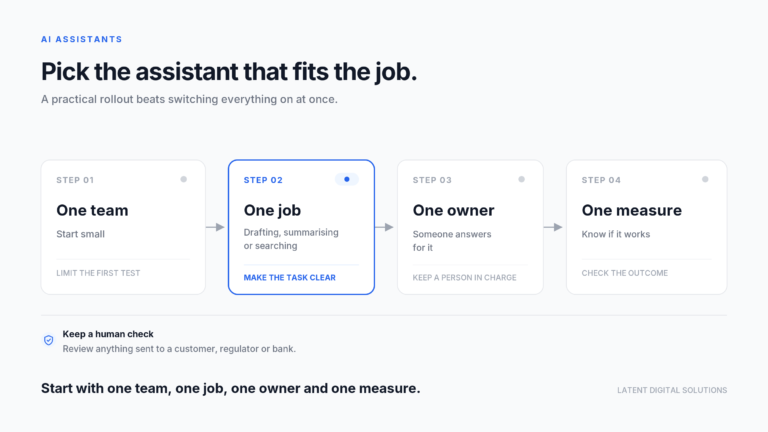
A short rule set covers most of this. Say when calls are recorded. Limit who can read transcripts. Check any figure or name before acting on it. Approve voice tools through one named person.
Keep an incident plan, too. If a recording is shared by mistake or a transcript goes to the wrong person, someone should know who to tell and what to do first. A one-page plan with a named owner is enough for most businesses.
Treat speech artificial intelligence as a security question as well. If someone phones your finance team and sounds like the managing director, a second check by message or call-back costs nothing and stops a costly mistake.
How do you test speech AI before you buy?
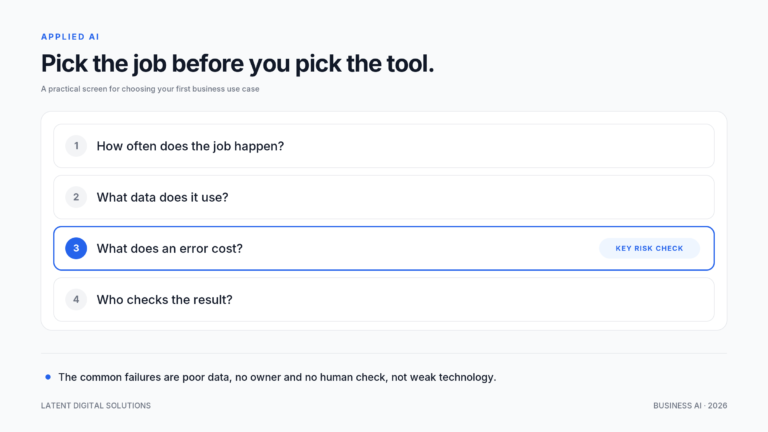
Test speech artificial intelligence by running fifty real recordings through the tool and checking the results against what was actually said. Decide one measure beforehand, such as the share of names and amounts transcribed correctly, and agree what result would justify buying. Many tests stall once the first excitement fades, and our guide on moving from AI pilot to production explains how to avoid that.
- Collect fifty recordings: use real calls or meetings, with different speakers, accents and noise levels. Remove anything you may not share.
- Pick one measure: for example, the share of names, numbers and dates transcribed correctly.
- Run two or three tools: use the same recordings for each, and keep the audio.
- Check by hand: a colleague compares a sample of each transcript with the audio and marks the errors.
- Decide and set a floor: choose the tool that meets your threshold, and decide when a person must review.
Keep a simple tally during the check. Count errors in three groups: names, numbers and everything else. Also note which recordings failed, because they often share a cause, such as a noisy site or a single speaker with a strong accent. That pattern tells you whether to change the tool, the microphone or the process.
Look at where errors occur, not only how many. A tool that mishears small words is harmless. One that mishears amounts and names is not. Also check what happens when the tool is unsure, because a good system flags low confidence instead of guessing.
Should you buy or build speech AI?
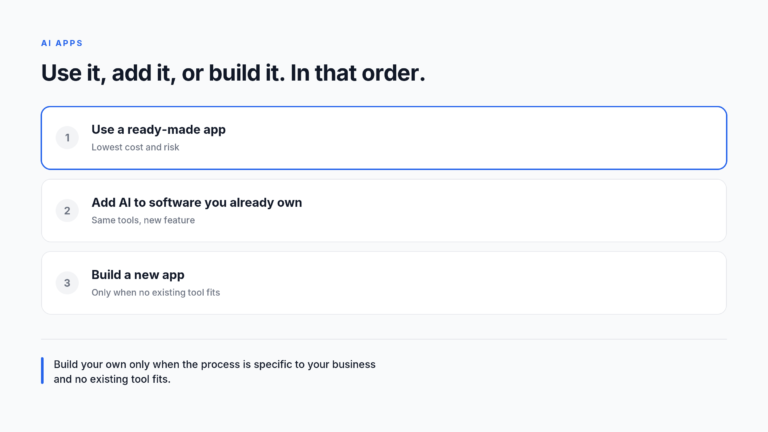
Buy speech artificial intelligence first. Speech recognition and synthesis are mature products from large providers, and building your own models is costly and rarely worthwhile for a UAE business. Build only the layer around it that is specific to you, such as how transcripts feed your CRM or how a bot hands over to staff.
Put four questions to every supplier. Where is our audio stored, and for how long? Is it used to train your models? How do we export our transcripts if we leave? What happens when the tool is unsure of a word? Clear answers to these four are worth more than any feature comparison, and a vendor who dodges them has told you something.
A conversational AI partner is most useful at the join between the tool and your process. The tool listens and writes. Someone has to decide what happens next: who reads the transcript, which flags trigger a call-back, and how results reach your existing systems.
The cost of speech artificial intelligence is mostly a per-hour or per-minute fee for audio, plus a licence for any bundled tool and the time your team spends checking results. Ask for the full three-year cost, and test volume pricing before you commit. Prices and features change often, so compare current offers when you are ready to decide.
Read the contract for three things. First, the notice period and your right to export transcripts. Second, any minimum monthly volume you must pay for. Third, what the supplier may do with your audio after processing. A short trial on a monthly plan lets you learn all three before you sign a longer term. Finally, agree who reviews the arrangement each year. Tools improve and prices change, and a yearly review is a cheap way to avoid paying last year’s rates for last year’s accuracy. Keep the contract terms with your approved-tools list so renewals do not pass unnoticed.
Conclusion
Speech artificial intelligence turns spoken work into text and text into speech. It suits call transcription, meeting notes, simple phone queries and dictation, and it needs a person to check names, numbers and anything legal. Arabic support in speech artificial intelligence is improving but varies, so test with your own recordings, set rules for consent and storage, and start with one job and one measure.
In the next 30 days you can choose one job, collect fifty recordings and run them through two tools. You will then know, from your own audio, whether speech artificial intelligence is ready for that job in your business.
If you want help choosing the first job and testing tools on your own recordings, talk to Latent’s team.
Frequently Asked Questions
What is speech artificial intelligence?
Speech artificial intelligence is software that understands spoken language and turns it into text, or turns text into a spoken voice. It powers call transcription, meeting notes, voice assistants and dictation.
What is the difference between speech recognition and speech synthesis?
Speech recognition converts spoken words into text. Speech synthesis does the reverse and reads text aloud in a synthetic voice. A voice assistant uses both.
Does speech artificial intelligence work in Arabic?
Yes, many tools support Arabic, including a UAE locale in some products, but accuracy varies by dialect, audio quality and mixed Arabic and English. Test with recordings from your own staff and customers.
Is it legal to record and transcribe customer calls in the UAE?
Rules depend on your sector, your licence and your use of the data, so ask your legal adviser. As good practice, tell callers when a call is recorded and transcribed, and store the files securely for only as long as needed.
How accurate is speech artificial intelligence?
It depends on audio quality, accent, vocabulary and language. Clear single-speaker audio does best. Noisy calls, mixed languages and specialist terms do worse, so measure accuracy on your own recordings.
Can speech artificial intelligence replace my call centre staff?
It can handle routine, well-defined queries and transcribe every call. Complaints and complex requests still need people, so plan a quick handover from the first day.
Usually a reply within one working day.