Article Overview
Moving AI from pilot to production is where most UAE business AI programmes stall. The pilot proves the concept, the board approves the budget, and then the system sits in a staging environment for three months while integration tickets pile up and the team that championed the pilot moves to the next initiative.
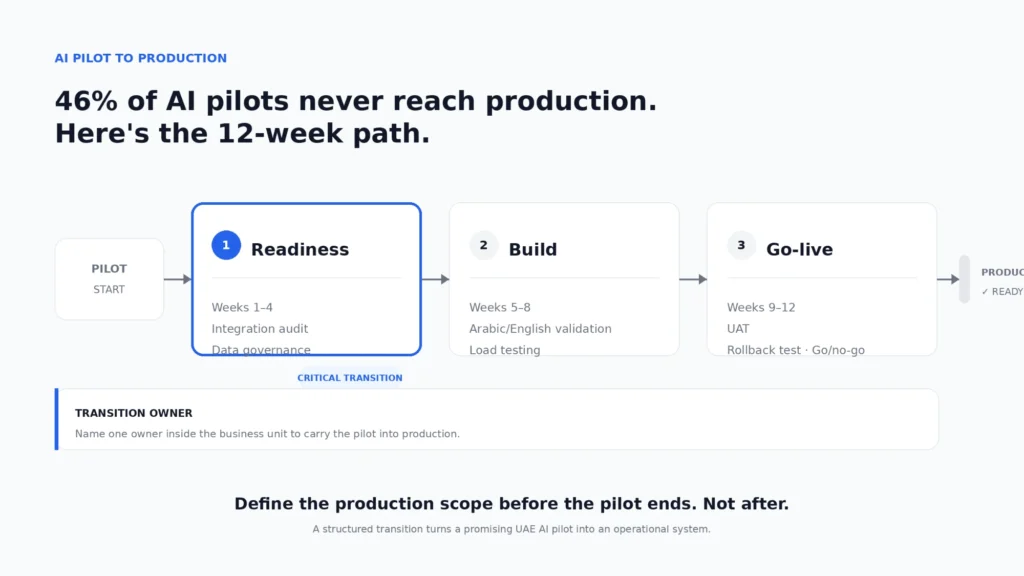
According to S&P Global (2025), 46% of AI pilots are scrapped before reaching production. The failure is not technical. The model does not stop working between pilot and production. What changes is the environment, the ownership, and the complexity of integration requirements that the pilot was never designed to expose.
This guide explains why AI pilot to production transitions stall in UAE businesses, what production-ready actually means for a UAE AI system, and what the 12-week transition checklist looks like when the process is managed correctly.
- 46% of AI pilots are scrapped before reaching production (S&P Global, 2025); the pilot works, the transition does not.
- AI pilot to production is not a technical handover: it is a production readiness process covering data governance, system integration, Arabic/English validation, and change management in parallel.
- UAE-specific blockers (fragmented legacy systems, data residency requirements, and multilingual validation) are not addressed by generic AI deployment playbooks designed for US or European environments.
- A realistic AI pilot to production timeline for UAE businesses is 12 weeks, structured across three phases, with a named transition owner from the business unit (not the implementation team) holding accountability.
Why does an AI pilot fail to reach production?
An AI pilot fails to reach production for three structural reasons. Almost never for a purely technical one.
Choosing the model is the easier half of the problem. Our guide to artificial intelligence models explains the types, how to compare them on your own examples and how to keep one working after launch.
The model does not suddenly stop working between pilot and production. What changes is the environment, the ownership, and the complexity of the integration requirements.
Scope creep after the pilot
The most common AI pilot to production failure is scope creep that begins the moment the pilot succeeds.
A pilot that processes 200 invoices a day in a controlled environment is approved. By the time the production requirements document is written, the system is expected to process 2,000 invoices, handle exceptions, and integrate with a legacy ERP that was never part of the pilot. A compliance report format the pilot never included has appeared in the spec.
This is not the implementation team’s fault. It is the predictable result of a pilot that was designed to prove the AI concept, not to define the production scope.
AI pilot to production transitions that succeed define the production scope in writing before the pilot begins, not after it ends. The production-scope document is a gate, not a formality.
The integration gap
The second reason AI pilot to production transitions stall is the integration gap.
The pilot ran on cleaned, structured data extracted from the production system. The production system itself was never integrated. In UAE businesses, this gap is larger than in comparable markets for one specific reason: legacy systems that were not designed to expose APIs.
A document management system deployed in 2011, an ERP localised for Gulf VAT compliance, or a government-connected reporting system may have no REST API and no documented integration path.
The fix is a discovery phase before the production build begins, a technical audit of every system the AI must read from or write to. Without this audit, the integration timeline is guesswork, and the production deadline is fiction.
Stakeholder fatigue
The third pattern is stakeholder fatigue.
A pilot has a champion, typically the business unit head who approved the budget and attended the demos. When the AI pilot to production transition drags past 90 days, that champion’s attention moves elsewhere. The implementation team loses its internal escalation path. Decisions that need senior sign-off sit in an approval queue for two weeks.
The momentum that carried the pilot collapses.
Stakeholder fatigue is not inevitable. It is the result of a transition plan that did not define decision points, owners, and escalation paths before the pilot ended. AI transformation programmes for UAE businesses that avoid this pattern treat the transition plan as a deliverable of the pilot, not as a post-pilot exercise.
What production-ready actually means for a UAE AI system
Production-ready is not a technical milestone. It is a state in which the AI system can run at full operational volume, handle failures gracefully, and produce outputs that the people acting on them actually trust. For UAE businesses, production-ready has three specific dimensions that generic AI deployment frameworks do not address.
Data governance and residency
UAE data residency requirements, particularly for financial services, healthcare, and government-adjacent businesses, mean that an AI system processing customer or transactional data must confirm where that data is processed and stored before it goes live at production volume. A pilot that ran on anonymised sample data does not confirm this.
The AI pilot to production data governance review must address three questions: which data classification applies to the inputs this AI processes; whether the processing infrastructure meets UAE data residency requirements; and who in the organisation is accountable for data governance compliance on the production system.
This review is not the implementation partner’s responsibility alone. It requires the business’s compliance, legal, and IT security teams to sign off on the data handling architecture before production go-live.
System integration and fallback
A production AI system must handle the case where it fails. In a pilot, a failure is noted and explained. In production, each failure mode must be designed in advance: what happens when the AI is unavailable, what happens when it produces a low-confidence output, and what the manual fallback process is for each scenario.
For UAE businesses using AI transformation services to move from pilot to full deployment, the integration and fallback design is the single most time-consuming element of the production readiness process, typically accounting for 30–40% of the production build timeline.
Arabic and English validation
UAE AI systems that process customer-facing content, legal documents, or government submissions must be validated in both Arabic and English. A pilot that ran on English-language inputs is not validated for Arabic. In many UAE businesses, the operational data the AI processes in production is bilingual or predominantly Arabic.
Arabic/English validation is not a translation exercise. It is a functional test of the AI system’s accuracy on Arabic inputs, including right-to-left text handling, Arabic numerals versus Western numerals in mixed documents, and the specific vocabulary of Gulf Arabic business usage.
This validation phase must be budgeted as a separate workstream in the AI pilot to production timeline; it is not covered by the English-language testing that proved the pilot.
The production readiness checklist for UAE businesses
A production readiness checklist for AI pilot to production transitions in UAE businesses covers eight mandatory items. All eight must be complete before the system goes live at full operational volume.
- Production scope document signed off: the exact functions the AI system performs in production, with explicit exclusions that define what it does not do
- Integration audit complete: every upstream and downstream system documented, API availability confirmed, fallback manual process defined for each integration point
- Data governance review signed off: data classification, residency requirements, and compliance sign-off from legal/IT security
- Arabic/English validation complete: functional test results at production data volumes, not sample data volumes
- Load and stress test results accepted: the system has been tested at 120% of expected peak production volume
- Error handling and alerting live: monitoring, alerting, and the on-call escalation path are configured and tested before go-live
- Rollback plan documented and tested: the procedure to revert to the manual process is documented, and at least one team member has practised it
- Change management complete: role descriptions updated, training delivered, feedback loop live (see the change management AI transformation framework for the full approach)
No item on this checklist is optional. A production go-live with an unsigned integration audit or an untested rollback plan is a risk decision, not a project management decision; it must be escalated to senior leadership and documented explicitly.
How to manage the AI pilot to production transition without losing momentum
The AI pilot to production transition window — the period between pilot sign-off and production go-live — is where most UAE business AI programmes lose momentum. The key is treating this transition as its own project, with a named owner, a fixed timeline, and success criteria separate from both the pilot and the production deployment.
Keep the momentum from the pilot
The transition owner’s first task is to capture the momentum from the pilot before it dissipates. That means three things: conducting a formal pilot close-out session within five business days of pilot sign-off; producing a pilot results document distributed to every stakeholder who attended a demo; and scheduling the first production planning session before the close-out session ends.
The pilot results document is not a technical report. It is a business document that restates the AI pilot to production business case: what the pilot proved, what the production system will deliver, and what the 12-week timeline looks like. This document is the transition owner’s primary tool for maintaining stakeholder engagement. For context on how successful UAE deployments in financial services, healthcare, and logistics have handled this transition, the AI transformation examples guide covers the patterns in detail.
Who owns the transition
The transition owner must be inside the business unit, not the implementation partner and not IT. The implementation partner owns technical delivery. IT owns infrastructure. The business unit transition owner owns one question: are the right people making decisions at the right time?
This person does not need to be technical. They need to be organisationally positioned to unblock decisions, escalate to the business unit head when required, and hold the production readiness checklist to its completion date. Without this role filled by a named individual before the pilot ends, the AI pilot to production transition has no owner, and no owner means no accountability.
What a realistic production timeline looks like
A realistic AI pilot to production timeline for UAE businesses is 12 weeks from pilot sign-off to production go-live. Deloitte (2026) found that only 25% of organisations moved 40% or more of their AI pilots to production; the businesses that did reach production consistently used structured timelines rather than rolling deadlines.
| Phase | Weeks | Focus |
|---|---|---|
| Phase 1: Readiness | 1–4 | Integration audit, data governance review, scope document, team assignment |
| Phase 2: Build | 5–8 | Production integration, Arabic/English validation, load testing, change management |
| Phase 3: Go-live | 9–12 | UAT, error handling, rollback test, go/no-go checklist, production launch |
Phase 1: Weeks 1–4 (Readiness)
The first four weeks of the AI pilot to production timeline are not a build phase. They are a readiness phase: everything that must be resolved before the build begins. The integration audit, the data governance review, the production scope document, and the change management plan are all deliverables of Phase 1, not prerequisites that were handled during the pilot.
The transition owner runs Phase 1. The implementation team attends the integration audit and scope sessions, but the business drives the decisions. If a Phase 1 deliverable is incomplete at the end of week 4, the Phase 2 start date moves, not the Phase 3 go-live date. Compressing Phase 2 to absorb Phase 1 delays is the most common reason AI pilot to production timelines produce an unstable production system.
Phase 2: Weeks 5–8 (Build)
Phase 2 is where the integration is built, the Arabic/English validation runs, and the load tests are conducted. For the AI proof of concept in the UAE that preceded this transition, Phase 2 is the first point at which the full production dataset is processed, not a sample, not a controlled extract, but the actual operational data at production volume.
This phase reveals the issues the pilot never exposed: edge cases in the Arabic text processing, integration timeouts on the legacy system under load, data classification queries from the compliance team. These are expected. Phase 2’s purpose is to surface them in a controlled environment where they can be fixed before go-live, not in production.
Phase 3: Weeks 9–12 (Go-live)
Phase 3 begins with UAT, not a second pilot, but a formal acceptance test against the production readiness checklist. Every item on the checklist must be signed off before the go/no-go decision is made. A Phase 3 that begins with outstanding Phase 2 items is a go-live that will fail within 30 days.
The go-live itself is not the end of the AI pilot to production transition. The first 30 days of production operation are the validation period, the period in which the system proves it can sustain production volume without the transition team’s active management. Until the 30-day validation is complete, the rollback plan must remain live and the transition team must remain available.
Conclusion
The AI pilot to production transition fails in UAE businesses for three reasons: scope creep that inflates requirements after pilot sign-off, an integration gap between the pilot environment and the actual production systems, and stakeholder fatigue that removes the internal champion before the transition is complete. All three are preventable when the transition is treated as its own structured project, with a named transition owner, a 12-week timeline, and an eight-item production readiness checklist that must be complete before go-live. UAE-specific requirements — data residency, Arabic/English validation, legacy system integration — require a production readiness process built for UAE businesses, not adapted from global templates. If your AI pilot has succeeded and the transition has stalled, the starting point is not a new technical assessment. It is a conversation with a named individual inside your business unit about who owns the checklist and what the go-live date actually is. Latent Digital Solutions works with UAE businesses to move AI from pilot to production with a structured 12-week framework built for the UAE market.
FAQ
Why do AI pilots fail to reach production?
AI pilots fail to reach production for three structural reasons: scope creep that expands requirements after pilot sign-off, an integration gap between the controlled pilot environment and the actual production systems, and stakeholder fatigue when the transition drags past 90 days without a named owner. The technical model is rarely the problem. The AI pilot to production transition is a project management and change management challenge, not a machine learning challenge.
What does production-ready mean for a UAE AI system?
Production-ready for a UAE AI system means three things beyond technical functionality: data governance and UAE data residency requirements are confirmed and signed off by compliance and legal, all upstream and downstream system integrations are built and tested with fallback procedures, and the system has been validated on Arabic and English inputs at production data volume. A system that passes only the technical tests is not production-ready for UAE deployment.
What is on the production readiness checklist for an AI pilot to production transition?
The eight mandatory items are: production scope document signed off, integration audit complete with fallback procedures defined, data governance review signed off, Arabic/English validation complete at production volume, load and stress test results accepted at 120% peak volume, error handling and alerting live, rollback plan documented and tested, and change management complete with role descriptions and feedback loops live. No item is optional in the AI pilot to production readiness process; a missing item is a risk escalation, not a project management decision.
How long does an AI pilot to production transition take in UAE businesses?
A realistic AI pilot to production timeline for UAE businesses is 12 weeks from pilot sign-off to production go-live, structured across three phases: readiness (weeks 1–4), build (weeks 5–8), and go-live (weeks 9–12). Timelines shorter than 12 weeks are possible for simple, low-integration systems, but typically produce a production system that fails within the first 30 days because Phase 1 readiness work was not completed before the build began.
Who should own the AI pilot to production transition in a UAE business?
The transition owner must be inside the business unit, not the implementation partner and not IT. This is the person who holds the production readiness checklist to its completion date, escalates decisions to the business unit head, and is accountable for the 12-week timeline. The transition owner does not need to be technical. They need to be organisationally positioned to make or unblock decisions at the pace the transition requires.
Usually a reply within one working day.