Article Overview
Applied artificial intelligence is AI used to do one specific job inside a business, such as reading invoices, sorting customer messages or forecasting stock. It is different from AI research, which builds new models in a lab. Most UAE businesses will never do research. They will buy or build applied artificial intelligence for a task that costs them time or money today.
AI transformation services from Latent start with that same question: which job, in which business, is worth handing to software?
Already know where AI should go to work?
Skip ahead to our AI transformation services for UAE businesses.
- Applied artificial intelligence means AI pointed at a defined business task, with a measurable result and a person responsible for it.
- Research AI creates new models. Applied AI uses existing ones to change how work gets done, which is the only kind most businesses need to buy.
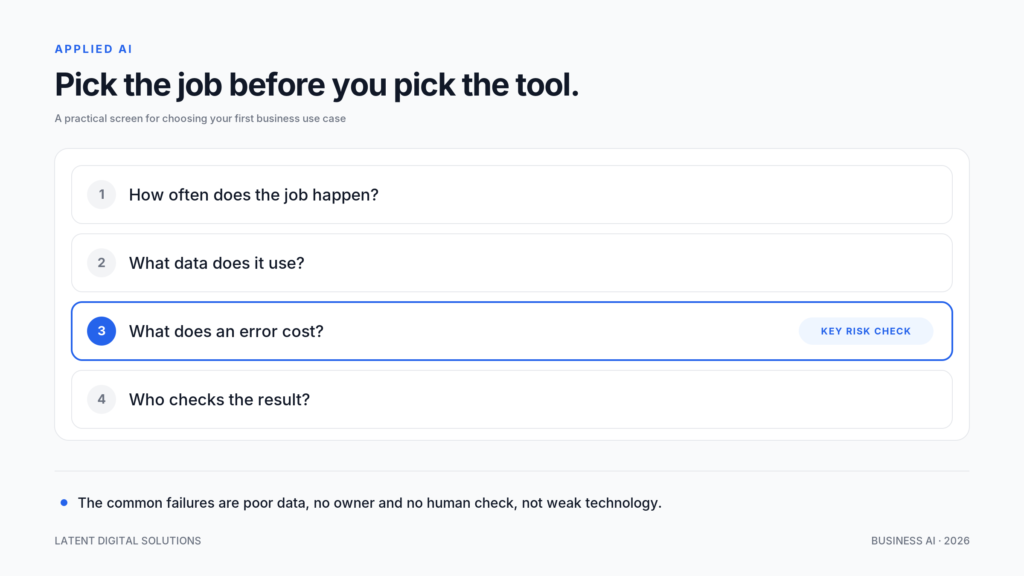
- A four-question screen (how often, what data, what an error costs, who checks) picks a sensible first use better than a vendor demo does.
- The common failures are poor data, no owner and no human check, not weak technology.
What is applied artificial intelligence?
Applied artificial intelligence is the use of existing AI techniques, such as machine learning and language models, to perform a real task in a real organisation. One widely used industry definition describes it as the branch of AI that takes the technology out of the lab and into the real world, so that computers can carry out real tasks.
The key word is task. An applied artificial intelligence project has a narrow job, such as checking supplier invoices against purchase orders. It has data to learn from or work on, a result you can measure and a person who owns the outcome. If any of those four is missing, you probably have an experiment, not an applied AI project.
This matters because adoption is already wide. The Stanford 2025 AI Index reports that 78% of organisations used AI in 2024, up from 55% the year before. Wide adoption does not mean wide success. Many of those organisations use AI in one corner of the business, and the question for you is which corner pays back. Counting users says little about results, so the useful figure is what the software actually changed.
Latent Digital Solutions treats applied artificial intelligence as a business decision first and a technology choice second. The technology is the method. The saved hours, fewer errors or faster answers are the outcome.
How does applied AI differ from AI research?
Applied AI differs from AI research in who does the work, what it produces and what a business pays for. Research creates new methods and models. Applied AI takes methods that already work and fits them to a specific process. A business almost always buys the second.
| Aspect | AI research | Applied artificial intelligence |
|---|---|---|
| Who does it | Universities, large labs | Businesses, with partners or vendors |
| What it produces | New models and methods | A working tool for one task |
| How success is judged | A better benchmark or paper | Hours saved, errors cut, revenue kept |
Think of it like cars and taxis. Engine research happens in a laboratory, and a taxi firm never funds it. The taxi firm cares about which vehicle gets passengers across Dubai on time at the lowest cost. Applied AI is the taxi firm’s question.
A second difference is time horizon. Research may take years and may fail, and that is accepted. A business project is expected to show a result within months, so applied AI favours methods with a proven record over new ones. That is a strength, because proven methods are cheaper and easier to support.
Two related terms are worth separating. Machine learning is one technique that applied AI often uses, for example to forecast demand. Generative AI is another, for example to draft replies. Applied artificial intelligence is the wider idea of using either, or both, for a defined business job. You can apply AI without building any model yourself, by buying a tool that already contains one.
Where is applied artificial intelligence used?
Applied artificial intelligence is used wherever a business repeats a task that follows patterns and produces data. In the UAE the common starting points are paperwork, customer messages, forecasting and checks. Each example below is a type of job, not a promise of a result. All of them depend on usable records, so check your data readiness for AI before you pick a tool.
- Document handling: reading invoices, delivery notes, contracts or trade licences, and pulling the key fields into your accounts or ERP system. Logistics, trading and construction firms handle thousands of these.
- Customer messages: sorting enquiries by topic, drafting a first reply or routing a WhatsApp message to the right person. Hospitality and retail businesses often start here.
- Forecasting: predicting demand, stock levels or staffing needs from past sales. A retailer with several outlets can use this to avoid both empty shelves and dead stock.
- Quality and compliance checks: flagging entries that do not match a rule, such as a missing document in an onboarding file.
- Maintenance planning: estimating when equipment is likely to fail, using past service records.
These tasks share three traits. Each is repeated, each produces records the software can work from, and each has a person who can check the result. Tasks that lack all three, such as a one-off strategic decision, make poor applied AI projects.
Illustrative example (not a client case): a Dubai trading company receives about 800 supplier invoices a month in four different layouts. An applied AI tool reads the fields, matches them to purchase orders and passes only the mismatches to an accounts clerk. The clerk’s day shifts from typing to checking. The business measures hours per invoice before and after, and uses that number to decide whether to extend the tool to delivery notes.
A realistic expectation is a partial result. The software handles the routine cases and passes the unusual ones to a person. That split is normal, and it is where most of the saving comes from. For assistants that talk to customers, see our conversational AI service.
How do you choose the first use?
Choose the first use of applied artificial intelligence by asking four questions about each candidate task: how often it happens, what data it creates, what an error would cost, and who will check the result. The task that scores best on all four is your starting point. This screen is a working framework, not an official standard.
- How often does it happen? A task done every day gives the software plenty to learn from and plenty of time to save. A task done twice a year does not.
- What data does it leave behind? You need records of past cases, in a form someone can use and in one place, not scattered across inboxes.
- What does a mistake cost? Sorting internal emails tolerates errors. Approving a payment does not. Start where a wrong answer is cheap to catch.
- Who checks the result? Name one person. If nobody reviews the output, nobody will notice when it drifts.
Score each candidate from one to three on each question, and add the scores. A task that scores ten or more out of twelve is a strong first choice. A task that scores below eight needs better data or a clearer owner before you spend anything.
Once you have a candidate, the next question is whether to test it small first. Our guide to the AI proof of concept explains when a test is worth the cost and when you can go straight to a build.
What can go wrong with applied artificial intelligence?
Applied artificial intelligence goes wrong for ordinary reasons: poor data, no owner, no human check and a tool that no one uses. Technical failure is the rarest of the four. The same causes appear again and again, so you can plan for them.
- Poor or scattered data: if past records are incomplete or split across systems, the software inherits the mess and produces unreliable answers.
- No named owner: without one accountable person, nobody measures whether the project works.
- No human check: software makes confident mistakes. A review step catches them before a customer or supplier sees them.
- Low adoption: staff who do not trust the output work around it, and the saving never appears.
- A demo mistaken for a result: a tool that works on ten clean examples may fail on your real files.
Vendor claims deserve the same scrutiny. Ask for results on data like yours, not on a demo set, and ask what accuracy means for your specific task. A figure such as “95% accurate” says little until you know what the remaining 5% costs you.
Keep a record of what the software gets wrong in the first three months. That list tells you whether to fix the data, change the tool or narrow the task. It is also the evidence you need to decide whether to expand.
How do you know applied AI is working?
You know applied artificial intelligence is working when a number you already track moves and stays moved. Pick one measure before launch, record the baseline and review it every month. Good measures are hours spent per week, error rate, time to answer a customer, or stock-outs per month.
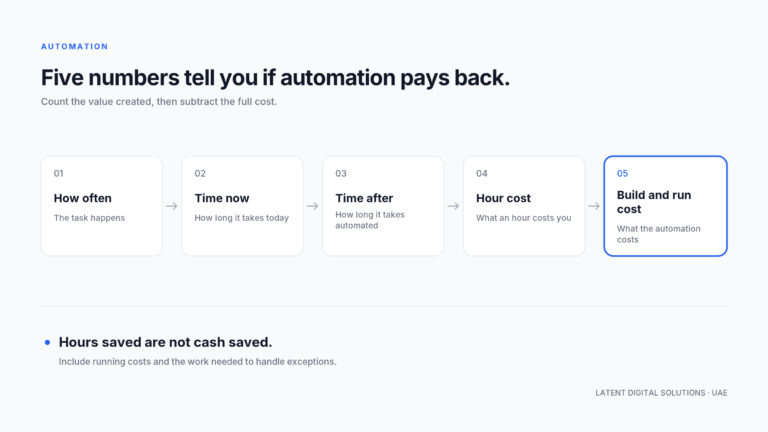
Compare the three months before launch with the three months after. Include the cost of the tool and the time your team spends supporting it, otherwise the result looks better than it is. Also track the share of cases the software handles without a person, because that share produces the saving.
If the number does not move, do not add features. Check the data, the owner and the review step, in that order. An AI transformation partner can review those three quickly, and the fixes are usually small. If the number moves, widen the task slowly by adding one case type at a time.
Should you build or buy applied AI?
For most UAE businesses the answer is to buy or configure an existing applied artificial intelligence tool first, and to build something custom only when the task is unusual and valuable enough to justify it. Buying is faster and cheaper to test. Building gives more control but needs people who can maintain it.
The deciding factors are how specific your process is, how much control you need over the data and how long you expect to use the tool. A standard task such as invoice reading usually has good products on the market. A process built around your own rules and records may justify a custom build. The trade-off is control against speed. A custom build costs more and takes longer, but it fits your process exactly. A bought tool starts working sooner, but you adapt your process to it. Neither is wrong, and the right answer depends on how unusual your task is and how many people can maintain the result.
Whichever route you take, keep the same discipline: one task, one owner, one measure. Applied artificial intelligence earns its place by changing a number you already track.
Conclusion
Applied artificial intelligence is AI pointed at a specific business job, with an owner and a measure. Research stays in the lab. Your task is to find the job where a repeated, data-rich, low-risk process can be handed to software, and to keep a person checking the output. Use the four-question screen to choose, test small where the risk is high, and measure the result against a number you already track.
If you have a list of candidate tasks and want help choosing the first one, talk to Latent’s team.
Frequently Asked Questions
What is applied artificial intelligence in simple terms?
Applied artificial intelligence is AI used for one real business task, such as reading invoices or forecasting demand. It uses models that already exist and fits them to a process, with an owner and a measurable result.
What is the difference between AI and applied AI?
AI is the broad field, including research that creates new models. Applied AI is the practical use of those models in a business. Most companies buy applied AI and never do research.
What are examples of applied artificial intelligence in business?
Common examples are invoice and document reading, sorting and answering customer messages, demand forecasting, compliance checks and equipment maintenance planning. Each is a repeated task that produces data and can be checked by a person.
Is applied AI the same as machine learning?
No. Machine learning is one technique that applied AI often uses. Applied artificial intelligence is the wider practice of using machine learning, language models or other methods for a defined business job.
How do I know if my business is ready for applied AI?
You are ready when you can name a repeated task, show past records for it, state what an error would cost and name the person who will check the result. If any of those is missing, fix it first.
Do small businesses need applied artificial intelligence?
Not necessarily. A small business benefits when one repeated task takes a lot of staff time. If no task is large enough to justify a tool, simple software or a spreadsheet may do the job.
Usually a reply within one working day.