Article Overview
An AI transformation partner is an outside firm that helps your business decide where AI should be used. It sets the work up with your people and leaves your team able to run it. Choose one on how it plans to work with your business, not on its demos, and ask the nine questions below before you sign.
Our AI Transformation work sits on the other side of this table, so we know which answers a good partner gives and which should worry you. The questions are written for an owner, not for an IT department.
Already know you need a partner?
Skip ahead to our AI transformation services for UAE businesses.
- An AI transformation partner should change how work gets done in your business, not just install software. Judge a partner on how it involves your people, picks the first problem and measures the result.
- Specialist partners tend to do better than going alone. MIT NANDA’s 2025 report found that buying from specialist vendors and building partnerships succeeded about 67% of the time, and internal builds about one-third as often.
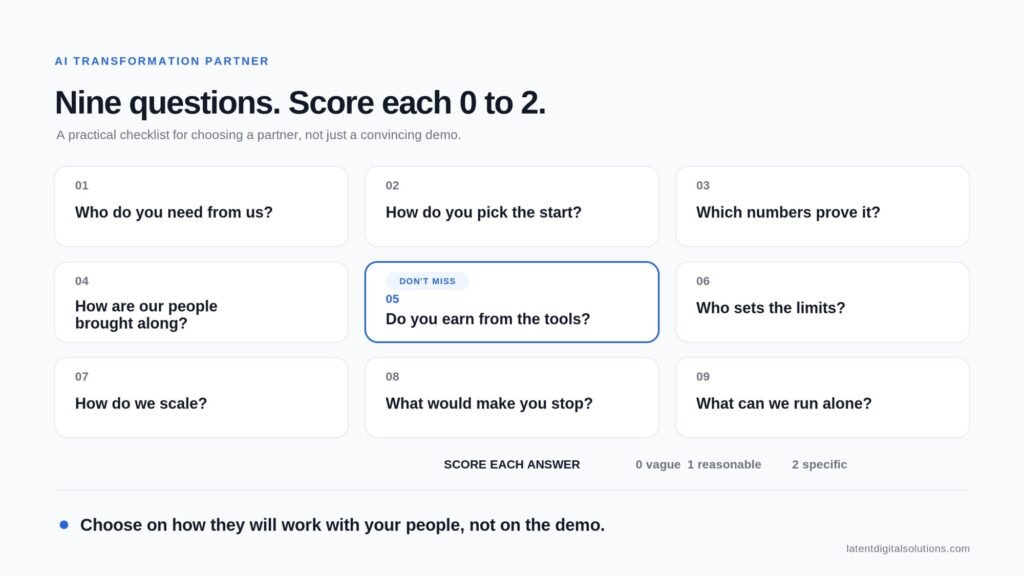
- Ask nine questions. They cover who you must provide, how the partner picks the start and which numbers prove it worked. They also cover how staff are brought along and whether the partner earns from the tools. The rest cover who sets limits, how it scales, when it would stop and what you can run alone.
- Test an AI transformation partner with a short paid diagnostic before a long contract. The diagnostic costs little and shows how the firm thinks about your real problems, which no demo can show you.
What does an AI transformation partner actually do?
An AI transformation partner works with your leadership to find where AI removes real work, then helps you set it up, check it and keep it running. It combines advice with delivery, and it should leave your own team more capable than before.
That differs from three roles that are often confused with it:
- A software supplier sells you a product and supports it. The supplier’s interest is that you use its product.
- A consultant gives advice and a report. Delivery is usually your job.
- A developer builds what you specify. The question of what to build stays with you.
An AI transformation partner covers the gaps between those roles. It helps pick the problem, builds or configures the answer, and works with your staff so the change holds. That makes it closer to a long working relationship than a one-off purchase.
For a business owner, the useful test is simple. After the engagement, can your team do something they could not do before, and do they want to? If the answer is only “we have a new tool”, you hired a supplier. Latent Digital Solutions measures its own work against the first answer.
Do you need an AI transformation partner at all?
Many mid-size businesses benefit from an AI transformation partner, because few have an in-house team that has run AI projects before. If you already employ people who have done this and have time to lead it, you may need only a lighter form of help.
The outside evidence leans towards partnering. Fortune reported on MIT NANDA’s “GenAI Divide” study in August 2025. It says purchasing AI tools from specialised vendors and building partnerships succeed about 67% of the time, while internal builds succeed only one-third as often. The same report found that most pilots stall without measurable financial impact. Those are largely US findings, so treat them as a direction, not a forecast for your business.
A partner makes the most sense when:
- Nobody in the business has led an AI project from idea to daily use.
- Leaders disagree about where AI should start.
- Past pilots stalled and no one is sure why.
You may need less help when a capable technical lead exists, the first use case is already clear, and the task is narrow. In that case, a short advisory engagement may be enough.
An AI transformation partner can change how the work is done, but it cannot take over the accountability. Someone in your business must own the result, sign off the measures and decide when to widen. Partners can advise on all three, but they cannot hold the responsibility for you. If nobody on your side has the time, fix that first, because the best partner will stall without an owner. Without that owner, even a strong firm ends up waiting for decisions that nobody on your side feels able to make. Ask yourself who that person is before you speak to any firm, and whether their calendar allows two or three hours a week.
The legal and delivery terms matter too. Our checklist for choosing an AI implementation partner covers the delivery terms such as code ownership and exit plans. The nine questions here cover the business side that sits above those terms.
Which nine questions should you ask first?
Ask each AI transformation partner the same nine questions, in the same order, and score the answers. The aim is to learn how the firm will work with your business, so listen for specifics from past work rather than general promises.
Treat the answers as evidence about habits. A firm that works well with owners explains things in plain language. It gives examples from its own past work and is comfortable saying what it does not know. A firm that talks mainly about models and platforms is describing its tools, not how it will work with you. The questions below are ordered to move from your side of the table to theirs.
- Who from my business do you need, and how much of their time? A good AI transformation partner names roles and hours in week one: a sponsor, a process owner and a few daily users. It also says what it will ask of them, such as a weekly review and access to the people who do the work today. Red flag: “we handle everything”, which usually means your people are brought in late and resist.
- How do you choose where to start? A good AI transformation partner ranks problems by business value, ease of checking and risk, and can explain why a task was left out. Ask for an example of a task it advised a client not to automate, because that shows judgement. Red flag: they start from a tool they want to demonstrate.
- Which numbers will show it worked, and who tracks them? A good AI transformation partner agrees a baseline before work begins, such as hours per task or error rate, and shares how it will be measured. Our guide on measuring AI transformation ROI explains how to set these up. Red flag: success defined as “adoption” or “satisfaction” only.
- How will my people be brought along? A good partner describes training, early feedback from users and how complaints are handled. Red flag: the plan covers technology only.
- Do you earn money from the tools you recommend? A good AI transformation partner states any reseller arrangements and explains how they affect advice. Red flag: a dodge, or every recommendation coming from one supplier.
- Who decides what the AI may and may not do? A good AI transformation partner helps you write simple rules on data, review and approval, and puts a named person from your side in charge. Red flag: those rules are left for later.
- How do you move us from a pilot to wider use? A good AI transformation partner sets stage gates, with clear results needed to move forward and a way to pause. Red flag: a large rollout planned before any pilot result.
- What would make you tell me to stop? A good partner can name results at which they would recommend stopping or changing course. Red flag: they cannot imagine such a result.
- What will my team be able to do without you at the end? A good partner lists skills and routines that will transfer: who maintains the instructions, who reviews results, who trains new staff. Red flag: your team depends on them for every change.
Use the questions in two rounds. In the first, send them in writing a few days before the meeting. That way the answers come from the people who will do the work, not from the sales lead. In the second, ask the same questions aloud and compare the replies. Differences between the two tell you how well the firm’s story holds together. Score each answer from 0 to 2: 0 for vague, 1 for reasonable, 2 for specific with an example. A partner scoring under 12 of 18 needs more questions before you sign. The scores are a guide to your own judgement, not a test an AI transformation partner can pass or fail.
Written answers are easier to compare, and a partner who dislikes being asked usually tells you something.
Use this simple key when you score:
| Score | What the answer sounds like | What to do |
|---|---|---|
| 0 | General and confident, with no example | Ask again in writing |
| 1 | Reasonable, but no past case behind it | Note it and test in the diagnostic |
| 2 | Specific, with a named example and numbers | Treat it as evidence |
How do you vet an AI transformation partner?
Vet an AI transformation partner with three checks. Use a short paid diagnostic of a few weeks, a reference call and a look at who will actually do the work. A diagnostic of a few weeks costs little compared with a long programme, and it shows how the partner thinks on your real problems.
The diagnostic should produce a plain document, not a slide deck. From an AI transformation partner, it should list your top candidate tasks, how each was ranked, what data each needs and a first pilot with a measure and a stop rule. If the document could apply to any company, the partner has not looked closely at yours.
Then check three things:
- A reference: speak to a past client of similar size. Ask what surprised them and what the partner did when something went wrong.
- The team: ask who will do the work and how many hours the senior people will spend. Meeting a senior lead who then disappears is common.
- A disagreement test: during the diagnostic, raise an objection to their plan. A good partner takes it seriously and either changes the plan or explains clearly why not.
This diagnostic-first approach is how our work on choosing where AI should start in your business begins. It keeps the first commitment small and gives you a document you own, whether or not you continue with the firm.
Be wary of free proposals that are mainly sales material. A partner that invests real time in your problem before you pay is useful. One that sends a standard deck with your logo is not.
Compare two or three partners the same way. Different styles are fine. The point is to see how each one handles the same questions on the same day, with your own data in the room.
What should an AI transformation partner do in 30 days?
In the first 30 days, an AI transformation partner should agree the problem and the measures, check your data and set up a small, reviewed pilot. You should see a written plan, a named owner on each side and early results from real work, not a long list of ideas.
A realistic first month looks like this:
- Week one: meet the sponsor and users, agree the problem and write down the baseline numbers.
- Week two: review the data and systems the pilot needs, and agree the rules on data and approval.
- Week three: set up the pilot with a few users and begin reviewing every output.
- Week four: compare results with the baseline and decide whether to continue, adjust or stop.
Illustrative example (not a client case): a Dubai clinic group asks two firms to propose an AI project for appointment reminders and patient follow-up. Firm A sends a general deck and a price. Firm B asks to meet the front-desk manager first and proposes measuring missed appointments before and after. It also names a rule that a person reviews every message at the start. Both are credible. Only Firm B has answered questions 1 to 4. The group chooses Firm B and starts with a four-week diagnostic.
If the first month ends without a baseline, a named owner and one reviewed pilot, raise it at once. Early drift is the easiest kind to correct.
Adoption deserves attention in these weeks, because it fails quietly. People who were not consulted stop using a tool without saying so. Our article on why AI transformation programmes fail at adoption explains what to watch for. A good AI transformation partner will raise the subject before you do. Ask also how the firm will collect feedback from users in the first month, and who on your side will read it each week.
What do UAE businesses need to check?
UAE businesses should check three practical points. Has the partner tested Arabic and English documents on your own material? Who answers in UAE working hours? How is customer data handled under the personal data protection law? They are easy to ask, and just as easy to forget.
- Language: ask to see results on your documents in Arabic, in English and in a mix of both, not on sample text from elsewhere.
- Support: confirm who responds during UAE working hours and what happens when the main contact is away.
- Data: get the location, the access list and the training policy written into the contract, and have your lawyer review it before any live data moves.
Add one more question if your sector is regulated. Banks, insurers and healthcare providers face extra rules on outsourcing and data. A partner who works in your sector should be able to describe those rules without prompting.
Conclusion
The right AI transformation partner plans to work with your people and picks a small first problem. It agrees the numbers up front and leaves your team stronger. Ask the nine questions in writing, score the answers, test the leading candidate with a short paid diagnostic and speak to a past client. Prefer specifics from past work over confident promises.
Over the next month, write down your top three candidate tasks. Then send the nine questions to two or three partners and compare the answers side by side. Laying the answers next to each other makes weak ones easy to spot. That comparison shows you more about each firm than any proposal does.
If you would like to compare notes before shortlisting, talk to Latent’s team and bring your questions.
Frequently Asked Questions
What is an AI transformation partner?
An AI transformation partner is an outside firm that helps you choose where AI should be used. It sets the work up with your people and leaves your team able to run it, combining advice with delivery through the first results.
What are AI transformation services?
AI transformation services usually include a diagnostic of where AI can help, a first pilot and rules for data and approval. They also cover training for staff and a plan to scale what works, with measures agreed at the start.
How is an AI transformation partner different from an AI consultant?
A consultant mainly advises and reports. An AI transformation partner also helps deliver and stays through adoption. The labels vary between firms, so ask what each one will do in the first month.
How do I check an AI transformation partner before signing?
Ask the nine questions in writing, run a short paid diagnostic, speak to a client of similar size and confirm who will do the work. Compare two or three partners on the same questions.
Should I hire a partner or build an in-house team?
Many mid-size businesses start with an AI transformation partner because few have run AI projects before, then build skills inside as the work matures. MIT NANDA’s 2025 findings point the same way, though they come mostly from US companies.
Usually a reply within one working day.