Article Overview
If you have approved an AI budget and six months later your team is still telling you it is “going well,” you have a measurement problem. AI transformation ROI is genuinely difficult to track, not because the numbers do not exist. It is because most businesses measure the wrong things, at the wrong time, using benchmarks borrowed from standard software projects. This guide gives you a practical framework for understanding what AI transformation ROI actually looks like, what drives it, and how to build measurement into your AI transformation work in the UAE from the start.
By Chinmay Chandgude, AI Strategy Consultant at Latent Digital Solutions
- AI transformation ROI is a business outcome question, not a technology metric. Measure what changes for the business, not what the system processed.
- Most businesses see meaningful ROI signals within 6–12 months for automation-focused use cases, and two to four years for strategic AI integration.
- You need a baseline before you start. Teams that skip this cannot compare before and after, which means they cannot calculate ROI at all.
- There are three levels of measurement that actually matter: process-level, team-level, and business-level, and they do not all appear at the same time.
Why measuring AI transformation ROI is harder than it looks
Standard software projects have a clear before and after. You bought an ERP, it replaced a spreadsheet, and the time saved is obvious. AI transformation ROI does not work the same way, and expecting it to is where most measurement efforts break down. For that measurement to mean anything, you first need a clear [**AI transformation strategy**](https://latentdigitalsolutions.com/ai-transformation-strategy-guide/) to measure against.
The measurement gap
The business problem is not that AI delivers no value. It is that the value lands in places that were never being tracked.
A process that took three people two days a week may now be handled automatically, but if nobody measured those three people’s time before the project started, there is no denominator for the calculation. You end up with a system that clearly works and no number to prove it.
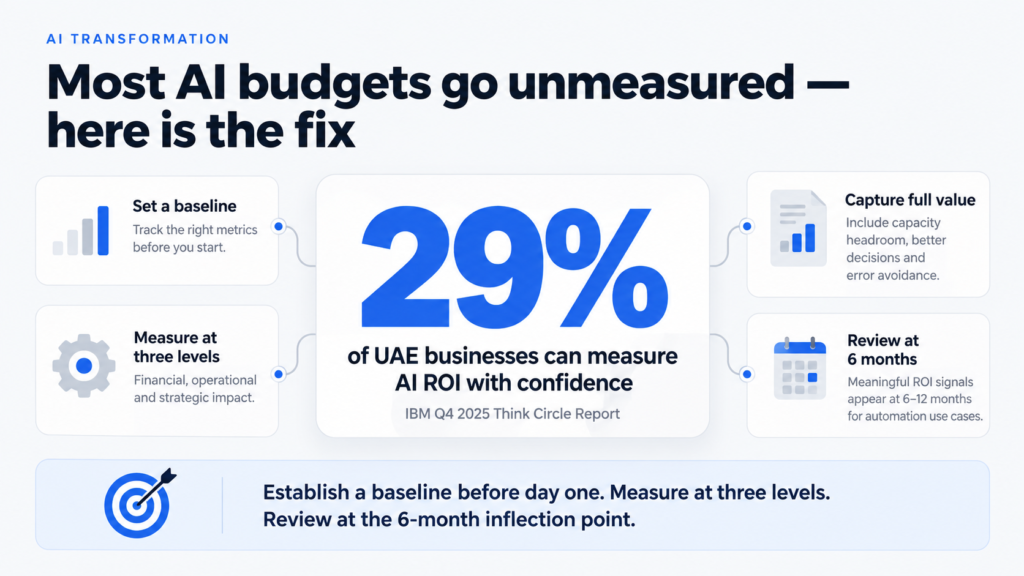
This is not a hypothetical. Only 29% of organisations report being able to measure AI ROI with confidence, according to IBM’s Q4 2025 Think Circle Report (cited via geeks.ltd’s research on AI ROI timelines). The other 71% are either relying on gut feel or tracking the wrong indicators.
Why standard project ROI does not work for AI
A standard project ROI calculation is straightforward: cost in, value out, divided over time. AI transformation ROI is messier because the value compounds.
The first workflow you automate saves hours. The data that workflow generates improves the second decision you automate. The second improvement changes how your team approaches a third problem they could not have tackled before. You are not buying a system. You are changing how the business learns.
This makes AI transformation ROI genuinely non-linear, which means a business that measures at six months and finds modest returns may be measuring at exactly the wrong point.
What actually drives ROI in an AI transformation programme?
The highest AI transformation ROI does not come from the technology itself. It comes from the right combination of use case selection, baseline data quality, and what changes when the manual work goes away.
Time savings and error reduction
The most immediate and measurable driver is time. When a task that took four hours a day is handled automatically, that time can be counted, costed, and compared against the investment. Error reduction is the second signal: if a manual process produced a 5% error rate and the automated version produces 0.3%, that difference has a real business cost attached to it.
For UAE businesses, this often shows up most clearly in document-heavy processes: invoice matching, regulatory submissions, contract review, and Arabic/English translation of operational communications. These are high-frequency, high-error-risk tasks where AI transformation ROI is tangible quickly.
Decision quality
Slower to appear but more significant in the long run is improved decision quality. When a business owner has access to a real-time view of margins, inventory, or customer behaviour instead of a monthly report assembled by hand, decisions change. The ROI of that is harder to calculate but real, and it is the category most likely to appear in the two-to-four year horizon.
Cost avoidance versus cost reduction
There is a meaningful difference between costs that disappear and costs you avoid incurring. AI transformation ROI often shows up as cost avoidance first: you did not have to hire a fifth person in finance to handle the additional invoices from a new contract, because the existing process scaled automatically. This counts as ROI but will not appear in a before-and-after cost comparison unless you are tracking capacity headroom specifically.
How long should UAE businesses expect to wait?
For AI transformation ROI, the timeline depends on what you are automating. Organisations that scale AI across multiple business units achieve up to 2.84 times the return on investment compared to those that implement it narrowly, according to Konica Minolta’s analysis of IDC and Microsoft’s 2025 frontier firms research. But that number is a long-run average, not a starting point.
Timeline by use case type
- Document and workflow automation (invoice processing, approval routing, data entry): ROI signals typically appear within 6–12 months. The baseline is measurable, the improvement is immediate, and the cost of the use case is usually contained.
- Customer-facing AI (service automation, recommendation, Arabic-language response handling): ROI signals typically appear within 9–18 months. There is an integration and training cost, and customer behaviour changes gradually.
- Strategic AI integration (decision support, demand forecasting, operational intelligence): Two to four years to full ROI is realistic. The early investment is in data infrastructure and model quality, not in visible process changes.
The 6–12 month inflection point
Most businesses that measure AI transformation ROI carefully find a meaningful signal somewhere between months six and twelve, but only if they were measuring from the start. This is not when ROI is “complete.” It is when you have enough comparative data to make a confident decision about whether to extend, scale, or change direction. Treating this inflection point as a final ROI verdict is a mistake. Treating it as a decision checkpoint is exactly right.
Which KPIs actually tell you if it is working?
Most AI programme KPIs are operational. They tell you the system is running. The KPIs that actually measure AI transformation ROI tell you the business is changing.
Operational KPIs (process level)
These are the baseline indicators, necessary but not sufficient on their own:
- Processing time per task (before vs. after)
- Error rate per 1,000 transactions
- Volume handled per FTE (full-time equivalent)
- Automation rate (percentage of a process handled without human intervention)
- Time to exception escalation (how long before the system correctly identifies something it cannot handle)
Business KPIs (outcome level)
These are what AI transformation ROI actually looks like when you step back from the system:
- Labour cost as a percentage of revenue in the affected department
- Time your senior team spends on manual administration vs. decisions
- Headcount growth rate versus revenue growth rate (AI should let revenue scale faster than headcount)
- Cost per customer served in the automated area
- Speed of a measurable business decision (monthly report to real-time dashboard; how many decisions changed as a result?)
For UAE businesses with e-invoicing mandates on the horizon, the compliance cost of meeting those requirements without automation is itself an ROI calculation worth running. Businesses that have already automated finance workflows will absorb the mandate with minimal additional cost. Those that have not will face a resourcing problem at a fixed deadline.
What NOT to measure
The metric that gets reported most often but matters least is AI usage. How many users accessed the tool, how many prompts were submitted, how many documents were processed. These are activity metrics. They tell you the system is used, not that the business improved. Track them as diagnostics. Do not report them as outcomes.
How to build a measurement framework before you start
The single biggest factor in whether a business can calculate AI transformation ROI accurately is whether they established a baseline before the programme started. This is the step most businesses skip under pressure to move quickly, and it is the one that makes every subsequent measurement impossible to interpret.
Establishing baselines
Before any AI system goes live, measure and record:
- How long the affected process takes, per unit, under current conditions
- The error or exception rate in that process
- The number of people involved and approximate time per week
- Any costs directly attached to the process (e.g. external review, rework, compliance submissions)
These four data points create a denominator. Without them, your after-state is a number with no comparison. With them, you can calculate AI transformation ROI objectively rather than qualitatively.
For guidance on structuring the broader programme around these baselines, Latent’s AI transformation consulting framework covers how to build measurement planning into the discovery and scoping phase, not as a reporting afterthought.
Milestones at 3, 6, and 12 months
A practical milestone structure for any AI transformation programme:
- Month 3: Is the system performing as scoped? Track operational KPIs against the baseline. Identify exceptions and their root causes.
- Month 6: Are the process-level KPIs stable? What is the annualised cost saving or capacity gain against the investment to date?
- Month 12: Are business-level KPIs showing movement? Is the programme tracking toward the expected use-case ROI timeline? Should it expand, stay focused, or be redirected?
This is not a reporting structure. It is a decision structure. Each milestone should end with a specific recommendation (continue, scale, or change), not a status update. This milestone discipline matters most in AI transformation programmes where multiple stakeholders have different views of what success looks like.
The businesses that do this well share a common trait: they committed to measuring from the first day of scoping, not from the first day of deployment.
Conclusion
AI transformation ROI is not one number and it does not arrive on a fixed schedule. But it is absolutely measurable, provided businesses know what to track, when to look, and what the difference is between a system working and a business improving.
The AI transformation ROI framework is straightforward: establish baselines before you start, track at three levels (process, team, business), review at the right milestones, and use the inflection point at six to twelve months as a decision checkpoint rather than a final verdict.
UAE businesses that build measurement into their AI programmes from the outset consistently make better decisions about where to scale, where to redirect, and where to stop. Those that wait until a budget review to ask “what did we actually get?” rarely have a satisfying answer.
If you are planning an AI programme and want help building measurement into the scoping phase, get in touch with Latent’s team. our engagements are designed around business outcomes, which means measurement is built in, not bolted on.
Explore AI strategy for UAE business leaders and AI in business statistics for UAE for further context on how to build the business case before investment decisions are made.
Frequently asked questions
How is AI transformation ROI different from regular software ROI?
Standard software ROI is linear: you replace a process, measure the time saved, and divide by cost. AI transformation ROI compounds over time. Each automation generates data that improves the next decision, which creates value that was not present in the original use case. This makes early-stage measurement look modest even when the programme is working well. The right comparison is not month one versus month zero; it is the 12-month trajectory versus the baseline.
What is a realistic AI transformation ROI timeline for a mid-size UAE business?
For automation-focused use cases (document processing, workflow routing, data entry), meaningful ROI signals typically appear within 6–12 months. For more strategic AI integration (decision support, demand forecasting, business intelligence), two to four years is a realistic expectation. The key is matching your measurement milestones to the type of use case you are running, not applying a single timeline to every programme.
Why is AI ROI so hard to measure?
Three reasons account for most of the difficulty:
- Baseline measurement is skipped. Organisations often skip measuring before a programme starts, which means there is no denominator for the calculation.
- The value lands in untracked places. Capacity headroom, decision quality, and error avoidance rarely appear in direct cost lines.
- AI transformation ROI is non-linear. The value compounds over time rather than appearing in a single measurable step change.
What KPIs should UAE businesses track for AI ROI?
Track at two levels. Process-level KPIs (processing time per task, error rate, automation rate) tell you whether the system is working. Business-level KPIs (labour cost as a percentage of revenue, headcount growth versus revenue growth, time senior staff spend on administration versus decisions) tell you whether the business is improving. AI transformation ROI lives in the second set. The first set is a diagnostic, not a result.
When should a UAE business stop an AI transformation programme?
At the 6-month or 12-month milestone, if the programme has not produced measurable process-level improvement despite the system performing as scoped, that is the right moment to redirect rather than cancel. It usually means the use case was chosen for technical interest rather than operational impact. The better question is: what was the business problem this was meant to solve, and is it still unsolved? If yes, investigate whether a different use case within the same programme would address it more directly.
Usually a reply within one working day.