Article Overview
“AI transformation” appears on the capability pages of most large consulting firms. It never says what you’re actually buying. The language is about themes — cloud readiness, data governance, intelligent automation — and the engagement starts only after you’ve already agreed that you need one. What’s missing is a plain account of how a real programme is structured, what it costs in rough terms, and where it typically stalls before it ever gets to deployment.
Related: Change management for AI transformation: why UAE adoption fails and what to do before go-live
This article covers that. It’s not a pitch for any particular programme. It’s a description of what AI transformation consulting actually involves when the work is scoped properly, so you can judge whether what a firm is proposing lines up with what a real engagement looks like.
Already know you need one?
Skip ahead to our AI transformation consulting team in the UAE for UAE businesses.
- AI transformation consulting is the work of moving a business from using AI opportunistically to using it operationally — in specific processes, measured by specific outcomes.
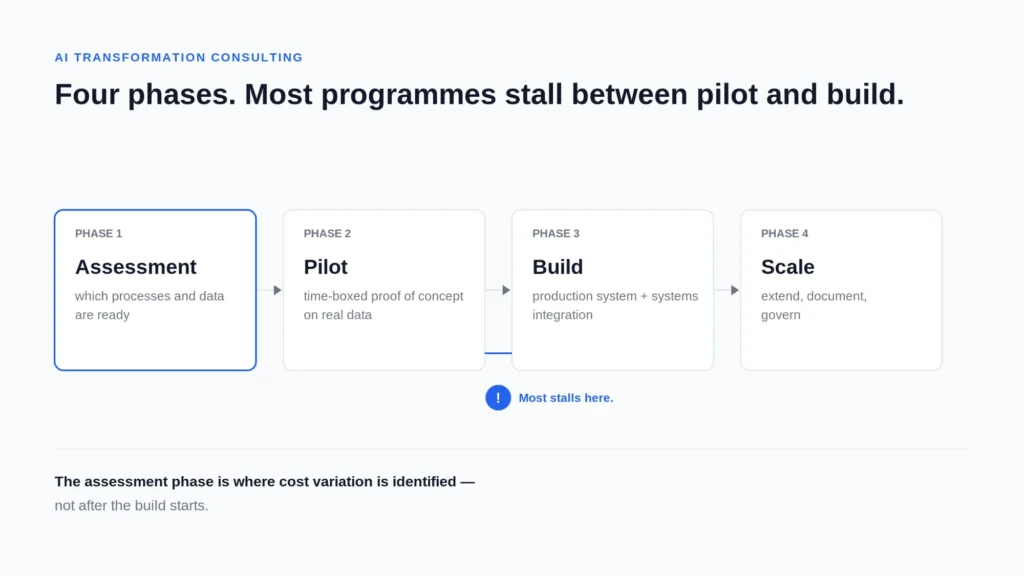
- A real programme has four phases: assessment, pilot, build, and scale. Most stalls happen between pilot and build, not at the start.
- Timeline and cost scale with business complexity, not just employee count — two businesses with the same headcount can have very different data infrastructure.
- The difference between enterprise AI transformation and a programme sized for a mid-size UAE business is scope and governance, not quality of outcome.
- Before evaluating transformation consulting firms, the more useful first step is understanding what an AI consulting engagement actually delivers — our AI consulting services guide covers that specifically for UAE businesses.
What does an AI transformation programme actually include?
An AI transformation programme is the structured work of changing how a business uses artificial intelligence, moving from experimentation or isolated tools to repeatable, operational use of AI in specific processes.
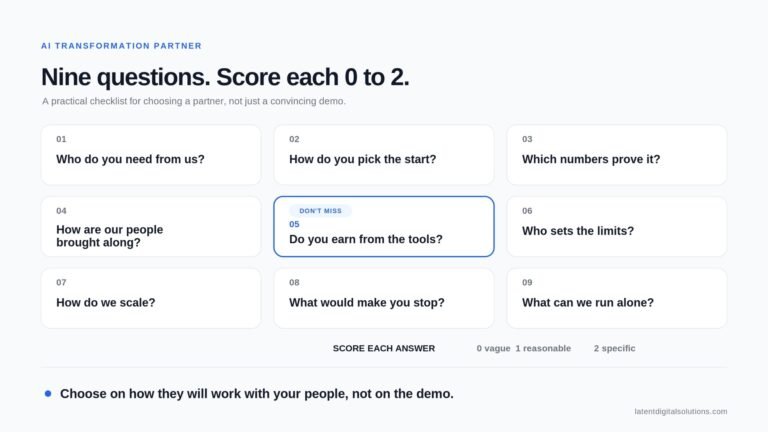
Our guide to choosing an AI transformation partner sets out nine questions to ask before you sign.
This is different from “implementing an AI tool.” Buying a product and plugging it in is a procurement decision. An AI transformation consulting programme typically starts before a product is chosen and continues after it’s deployed — because the transformation includes how people work, not just what software they use.
In practice, a transformation programme covers: identifying which processes are worth transforming (most aren’t), building or cleaning the data those processes depend on, selecting and configuring the appropriate AI capability, integrating it with existing systems, and then establishing how the business will maintain, monitor, and improve it over time. That last part — governance and monitoring — is what most implementation projects skip, and it’s where transformation programmes diverge from one-off builds.
Latent Digital Solutions takes this approach deliberately: we scope transformations at the process level, not the platform level. An engagement is defined by what changes in how the business operates, not by which product gets installed.
The phases: assessment, pilot, build, scale
Most well-run AI transformation consulting programmes follow this sequence. The phases are not fixed in duration — they flex based on what’s found at each step — but the sequence almost never skips.
Assessment. The programme starts with a structured look at the business: which processes have enough data behind them, which problems cost enough to justify an AI solution, and which parts of the organisation have the capacity to test and give feedback on something new. A good assessment ends with a ranked shortlist of two or three use cases, not a fifty-slide AI roadmap. The assessment for a mid-size UAE business typically takes four to eight weeks.
Pilot. The highest-priority use case gets a time-boxed, resource-constrained proof of concept. The goal is not to build a production system — it’s to find out whether the approach works on your actual data before committing to a full build. A pilot that validates is a green light for the next phase. A pilot that fails is information, and should be treated as such: it narrows the field, not ends the programme.
Build. If the pilot validates, the build phase is where a production system is designed, tested, and delivered. This is the phase most often underscoped in AI transformation consulting engagements. The typical underestimate is in systems integration — connecting the AI output to whatever downstream system actually acts on it (a CRM, an ERP, an operational workflow) is almost always more complex than scoping assumes.
Scale. The final phase extends what worked in the first use case to adjacent processes, documents the playbook so the business can repeat it, and establishes the monitoring and governance needed to keep the system accurate over time. Scale is also where workforce changes happen: the people whose workflows the AI has entered need to understand what it does and doesn’t do.
The reason this sequence matters is that every shortcut has a cost. Going straight to build without a validated pilot is the most common way to spend six months on something that doesn’t work. Skipping the scale phase is the most common way to end up with a successful pilot that never becomes part of how the business actually operates.
For a connected view of how these phases fit into a longer-term planning horizon, our AI transformation roadmap guide covers the strategic sequencing side of that question.
What usually breaks along the way
AI transformation consulting programmes stall for predictable reasons. They are not primarily technical failures.
The data isn’t ready when the build starts. The assessment phase usually surfaces data gaps, but the severity is often underestimated. Structured data in a spreadsheet looks usable; the same data distributed across four systems with inconsistent field names does not. Data preparation frequently takes longer than the AI development work itself, and programmes that don’t budget for it appropriately run out of runway at the wrong moment.
The pilot team doesn’t transfer to the build team. This is a consulting-firm problem more than a client problem. If the team that ran the pilot is not the team that builds, context is lost. The build team inherits requirements that made sense in a conversation the pilot team had with the client, but which are now expressed only as a document. Handover failures of this kind account for a significant share of AI programme overruns.
Stakeholder alignment degrades between phases. The people who approved the programme at the assessment stage are not always the people who approve the budget for the build. Between a ten-week assessment and a twenty-week build, organisational priorities shift. Programmes that don’t manage stakeholder alignment explicitly — including written check-ins and visible progress metrics — find themselves re-litigating the business case mid-build.
Change management is left to the end. The people whose jobs will change when an AI system is deployed often don’t know this is coming until the deployment date. Resistance that would have been manageable if raised in the pilot phase becomes expensive in the build phase and nearly insurmountable at scale. The OECD’s framework on human-centred AI flags exactly this gap — that the human dimension of AI programmes is consistently underweighted relative to the technical dimension, with measurable consequences for adoption.
How cost and timeline actually scale with business size
Cost and timeline in AI transformation consulting scale with complexity, not just headcount. Two businesses with the same number of employees can have very different AI programmes if their data infrastructure differs.
As an illustrative example — not a quote or a guarantee — a programme for a professional services firm with 80 staff and relatively clean operational data might run across 20–30 weeks of active consulting time, with the majority of cost concentrated in the build and integration phase. A business the same size but running on fragmented legacy systems across three offices would need an additional six to ten weeks of data-preparation work before the same build could begin.
The practical implication: the assessment phase is where cost variation is identified. Any firm quoting an AI transformation programme without an assessment phase is working from assumptions about your data and processes, not from evidence. That’s a scoping risk, and it tends to surface later as overruns or scope reductions.
For UAE businesses, the relevant additional layer is UAE data-residency requirements and the governance frameworks that apply when the AI system touches customer data, financial records, or employee information. Those requirements affect where data can be processed and how the programme is architected — they’re a real constraint, not a compliance formality, and a well-run programme scopes for them explicitly in the assessment phase.
The more useful first question than “what does this cost?” is: what does the assessment tell us about what it would cost to do this well? A firm that can answer that is a firm that has actually scoped your situation. One that gives a fixed quote before the assessment is pricing its template, not your problem. Our guide to what an AI consulting engagement involves covers how we approach that scoping conversation specifically.
As a frame in dirhams, an assessment or scoped quick win typically runs AED 9,000–37,000, a fixed-scope pilot on one workflow AED 30,000–80,000, and a multi-system build covering three or four core platforms AED 150,000–400,000 (see our small-business AI consultant guide and AI integration services guide). A programme is these phases added up, which is why it can be bought one phase at a time. These are ranges, not quotes.
Enterprise transformation vs. a programme sized for a UAE mid-size business
Enterprise AI transformation programmes — the kind BCG or McKinsey runs at a FTSE 100 or S&P 500 client — are not the relevant reference point for most UAE mid-size businesses. The phases are the same. The scope, governance requirements, and price are not.
Enterprise programmes typically involve dedicated transformation offices, multi-year roadmaps, change management teams running in parallel, and governance boards with sign-off authority over each phase. The overhead cost of managing the programme is itself significant.
For a UAE business with 50 to 300 staff, the same outcome — AI deployed in specific processes, measured by specific metrics, with a governance model that keeps it accurate over time — is achievable with a leaner programme. The difference is that the consulting firm needs to wear more hats: the scoping, the technical build, and the knowledge transfer back to the client’s team happen in a single integrated engagement rather than separate workstreams.
What to watch for is a firm that runs an enterprise-scale programme structure on a mid-size budget: the overhead alone (programme management, steering committees, enterprise architecture documentation) can consume 40% of engagement time without producing any working system. For most UAE mid-size businesses, a correctly sized programme produces a working system faster and at lower total cost than an enterprise methodology applied at the wrong scale.
Want this scoped for your business?
Talk to our AI transformation consulting team in the UAE. We start with a working prototype, not a large proposal.
Conclusion
A real AI transformation consulting programme has clear phases, named deliverables at each gate, and a governance model that outlasts the engagement. That’s the description to test any proposal against. If a proposal is mostly a roadmap document and a retainer to guide implementation later, it’s a strategy engagement — which may be useful, but is not the same thing as a transformation programme.
If you’re evaluating what a transformation programme would look like for your business, get in touch and describe the process you want to change. That conversation is more useful than a generic scope document.
Frequently Asked Questions
What does AI transformation consulting actually include?
A structured programme covering four phases — assessment of which processes and data are ready, a time-boxed pilot to validate the approach, a production build, and a scale phase that extends the model and establishes governance. The distinguishing element from a one-off build is the governance and monitoring work that continues after deployment.
What is the difference between AI consulting and AI transformation consulting?
AI consulting is the broader category — it can cover a single use case, a readiness assessment, or advice on vendor selection. AI transformation consulting specifically refers to a programme that changes how the business operates across one or more processes, with sequenced phases, stakeholder alignment work, and a governance model that persists after the engagement ends.
Why do AI transformation programmes stall?
The four most common causes are: data that’s less ready than assumed, a pilot team that doesn’t carry through to the build, stakeholder alignment that degrades between phases, and change management that’s treated as an end-of-project activity rather than a programme-wide concern.
How long does an AI transformation programme take?
It depends on complexity, not just size. A mid-size UAE business with clean operational data in one or two systems might run a complete programme across 20–30 weeks of active work. Add six to ten weeks for data preparation if the data is fragmented. Enterprise programmes at larger organisations run longer because governance and alignment work are substantially more complex.
What’s the difference between an enterprise AI transformation programme and one sized for a UAE mid-size business?
The phases are the same. The scope, overhead, and governance model differ. Enterprise programmes have dedicated transformation offices and multi-year roadmaps; mid-size programmes consolidate those roles into a single integrated engagement. Watch for firms applying enterprise programme management overhead to a mid-size budget — the overhead alone can consume programme time without producing a working system.
What should I look for in an AI transformation consulting firm?
A firm that starts with an assessment before quoting. One where the pilot team carries through to the build. One that can describe its handover and governance model specifically, not generically. The checklist of questions in our AI consulting companies guide covers this in detail.
Usually a reply within one working day.