Article Overview
What is AI consulting, in practical terms? For a UAE business owner deciding whether to hire one, half of what’s written under that question is actually aimed at people who want to become a consultant, not hire one: how to get certified, what it pays, how to break in. This is written for the other side of that question, what AI consulting means when you’re the buyer, and when the honest answer to “should we hire one” is no.
- AI consulting is the work of identifying where artificial intelligence can solve a specific business problem, planning how to get there, and in many cases doing the work to make it happen.
- AI consulting covers a wide range, from a two-week assessment to a six-month implementation — knowing which version you’re buying is the only question that matters before you compare quotes.
- Most businesses that benefit from AI consulting have one thing in common: a named, expensive process they want to fix, with usable data behind it.
- If you can’t name the process, you’re not ready for AI consulting yet — but you are ready for a shorter conversation about where to look first.
What does an AI consultant actually do?
What is AI consulting, in practice? An AI consultant’s job is to work out where artificial intelligence can make a measurable difference to how your business operates, and then help you get there. That sounds broad, but the work almost always follows the same shape: identify the problem, figure out whether AI is the right tool for it, plan the approach, and either advise on execution or execute it themselves.
Consulting is easier to judge once you know what is being applied. Our guide to applied artificial intelligence explains how it differs from research AI and where a business should start.
The first phase is usually assessment. A consultant looks at your processes, your data, and the specific pain you’ve described, and tells you whether there’s a real fit. This includes things you haven’t thought of — a logistics company focusing on demand forecasting might also have a supplier-invoicing problem that costs more and is easier to solve. An assessment worth having pushes back on your initial framing if a better one exists.
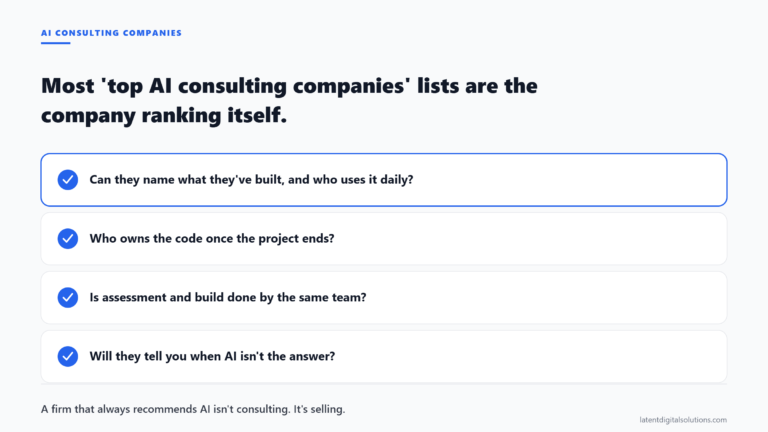
After assessment comes scoping. If AI is the right fit, the consultant defines what “done” looks like: which system it connects to, what data it trains on, what your team uses it to do, and how you tell if it’s working. Weak scoping is the single biggest reason AI projects fail. It’s also where you should be able to tell the difference between an AI consulting firm that has built something similar before and one that hasn’t.
Then delivery. Depending on the firm, this is either handed off to a separate implementation team or done in-house. For most mid-size businesses, one firm handling both assessment and build is cleaner — you don’t lose context between the team that understood the problem and the team writing the code.
AI consultants are also a buffer against AI vendor marketing. A firm offering to “integrate AI” into your business has an obvious incentive to recommend their own product. An independent consultant’s job is to recommend the approach that actually fits, not the one they happen to sell. That distinction is worth paying for when you don’t know the space well enough to evaluate vendor claims yourself.
At Latent Digital Solutions, this is the work we do for UAE businesses: identify one process worth fixing, scope it honestly, and build the thing — not sell a vision and leave you with a document. The AI consulting and the implementation are the same engagement.
What AI consulting is not
Answering what is AI consulting also means being clear about what it isn’t. The career version of AI consulting is a different thing entirely. There is a large market for courses, certifications, and guides aimed at people who want to work as AI consultants. If that’s your question, this isn’t the article for it — search “how to become an AI consultant” and you’ll find what you’re after.
For a business owner, AI consulting is also not the same as digital transformation, IT consulting, or hiring a developer. A developer builds what you specify. An AI consultant helps you work out what to specify, and whether AI is the right tool at all. That front-end thinking is where most of the value sits. Running a smaller company? See our small-business AI consultant guide for what to hire for.
It is not a technology sale either. The firms worth hiring are the ones who can tell you when your problem doesn’t need AI, when a simpler piece of automation or a process change would get you further for less money. A consultant who always recommends AI isn’t really consulting.
AI consulting also doesn’t come in one size. A short readiness conversation and a six-month implementation programme are both called AI consulting. The first could cost a few hours of a senior consultant’s time. The second could run for months and touch multiple systems. Knowing which version you’re pricing is the thing most buyer confusion is actually about.
When does a business actually need an AI consultant?
That’s really the test for what is AI consulting good for: a business needs an AI consultant when two things are true: there’s a specific, named process that costs too much or takes too long, and there’s usable data sitting behind it.
A contracting firm spending twelve hours a week manually matching supplier invoices to purchase orders has a specific, named process. Three years of those invoices as PDFs or exported spreadsheets is usable data. That business is ready for an AI consultant. A logistics company with clean sales records across two systems that both export to CSV is a strong fit for demand forecasting. A clinic re-entering patient intake data into three separate platforms by hand is a candidate for automation even before anyone says the word AI.
The common thread isn’t the industry. It’s whether there’s a process you can describe in one sentence, with structured information behind it.
A business probably doesn’t need an AI consultant yet if its goal is “to do something with AI” without being able to name the process. That’s a reasonable instinct, but it’s not yet a brief for an AI consulting engagement. The right first step is a shorter, cheaper conversation about where to look — not a formal engagement. It’s also not the right time if the core data is scattered across spreadsheets nobody maintains consistently, or if the team doesn’t have capacity to test and give feedback on a pilot. Those aren’t permanent disqualifications. They’re usually signs that some groundwork needs to happen first.
An honest AI readiness check will tell you which camp you’re in before you commit to anything. Our AI readiness assessment framework covers what that evaluation actually looks at and what it typically surfaces. And if you’ve already decided to hire an AI consultant but want a detailed breakdown of what an engagement actually includes — costs, timelines, and what to ask before you sign — our full AI consulting guide covers each of those specifically for UAE businesses.
How is AI consulting different from AI implementation?
This is the other question worth answering alongside what is AI consulting: AI consulting covers the thinking, AI implementation covers the building.
AI consulting is the work of deciding what to build. Assessment, scoping, identifying the right use case, choosing the right approach. The output is a plan, a recommendation, and sometimes a proof of concept — something you use to decide whether and how to proceed.
AI implementation is the work of actually building it. Writing the code, connecting the systems, testing against your real data, training your team to use what’s been built. The output is something running inside your business.
The reason the distinction matters is that some firms only do one. A strategy consultancy can give you a thorough assessment and a clear recommendation — but they hand you a document, not a working system. A development shop can build exactly what you specify — but they’re not the ones helping you figure out what to specify. For businesses working with AI for the first time, a firm that does both is usually the safer bet. You don’t lose anything between the team that understood the problem and the team building the answer.
The implementation side draws on a wide range of AI capabilities — pattern recognition, natural language processing, predictive modelling — and IBM’s overview of AI applications illustrates just how broad that range is. The consulting step doesn’t need to map all of it. Its job is to pick the one capability that matches your actual problem, then scope it so the build team knows exactly what to connect and test.
At Latent, the legacy systems we modernize often need exactly this combined approach: the AI question and the integration question turn out to be the same question. A business running an older system alongside AI tools isn’t just adding a feature; it’s changing how data moves and decisions get made across the whole operation. Treating the AI consulting and the implementation as separate engagements, with different firms responsible for each, is where that kind of project tends to go wrong.
For one specific kind of consulting, building GPT-based systems on OpenAI or Azure OpenAI, see our OpenAI consulting company page.
Conclusion
AI consulting is, at its clearest, the work of figuring out whether artificial intelligence can solve a problem worth solving in your business — and then getting there. It covers a wide range: from a short readiness conversation to a full implementation programme. The buyers who get the most from AI consulting are the ones who come with a named process and real data behind it, not a general interest in the technology.
If you can describe the process you want fixed, the data is there, and you want to understand what solving it would actually involve, get in touch and describe the problem. That is a more useful starting point than any definition.
Frequently Asked Questions
What is AI consulting, in simple terms?
What is AI consulting, stripped to one line: the work of identifying where artificial intelligence can genuinely help a business, planning how to get there, and in many cases doing the build work to make it happen. The consultant’s job is to start with your business problem, not with the technology.
What does an AI consultant do, day to day?
In practice: assess your processes and data, identify which problems AI can actually solve, scope what a solution would look like, and either advise on delivery or carry it out. A significant part of the work is telling clients when AI is not the right tool — that’s what distinguishes genuine consulting from sales.
Is AI consulting the same as hiring a developer?
No, and this is part of what is AI consulting versus development. A developer builds what you specify. An AI consultant helps you work out what to specify — and whether AI is the right fit at all. For businesses that don’t already know the answer to that question, the consulting step comes first.
How do I know if my business needs an AI consultant?
The clearest signal is whether you can name a specific process that costs too much or takes too long, and whether there’s structured data sitting behind it (invoices, tickets, orders, records). If you can, you’re a reasonable fit. If your goal is “to do something with AI” without a named process, start with a readiness conversation rather than a full engagement.
What is the difference between AI consulting and AI implementation?
AI consulting is the thinking — assessing, scoping, and planning. AI implementation is the building — writing the code, connecting the systems, and delivering something your team uses. The strongest engagements keep both under one firm rather than handing off between a strategy team and a separate development shop.
When is AI consulting the wrong move for a small business?
What is AI consulting, in practical terms? For a UAE business owner deciding whether to hire one, half of what’s written under that question is actually aimed at people who want to become a consultant, not hire one: how to get certified, what it pays, how to break in. This is written for the other side of that question, what AI consulting means when you’re the buyer, and when the honest answer to “should we hire one” is no.
Usually a reply within one working day.