Article Overview
Most lists of AI consulting companies are written by one of the companies on the list, ranking itself first with no disclosed method behind the ranking. That’s a poor way to choose a firm you’re trusting with something that matters to your business. What actually separates an AI consulting company worth hiring from one that just talks well is a short, answerable checklist, not a badge.
Already decided to hire a partner?
Skip the checklist and talk to our AI transformation team directly.
This guide is structured differently. It does not rank any company. It gives you a checklist of nine questions to ask any AI consulting company you’re considering, a list of red flags to watch for, and enough context to tell whether a firm is actually built to deliver or just to win a pitch.
- Most “top AI consulting companies” lists are written by firms ranking themselves first, with no disclosed methodology.
- The right way to evaluate an AI consulting company is not a ranking — it’s a set of questions about track record, delivery model, code ownership, and handover.
- Red flags are faster to spot than green ones: a firm that can’t name what it’s built and who uses it every day is not a delivery partner.
- Company size matters less than fit — a boutique firm that has solved your specific problem before is almost always better than a large firm that has a practice area called “AI.”
- Before you evaluate consulting companies, confirm the build decision: build vs. hire is a different question worth answering first.
What do AI consulting companies actually do?
An AI consulting company’s job is to identify where artificial intelligence can solve a specific business problem and then help you get there. In practice this covers a wide range: a short readiness assessment at one end, a full multi-month implementation at the other, and almost every combination in between.
The clearest distinction is between firms that only advise and firms that also build. A strategy-only firm produces a document (a scoping assessment, a roadmap, a vendor recommendation). A delivery firm produces something running inside your business. Many firms do both, which is usually the better model for a first engagement: the team that understands the problem is the same team writing the code. What you want to avoid is a firm that sells the assessment, hands it off to a separate build team, and leaves you managing the gap between what was scoped and what gets built.
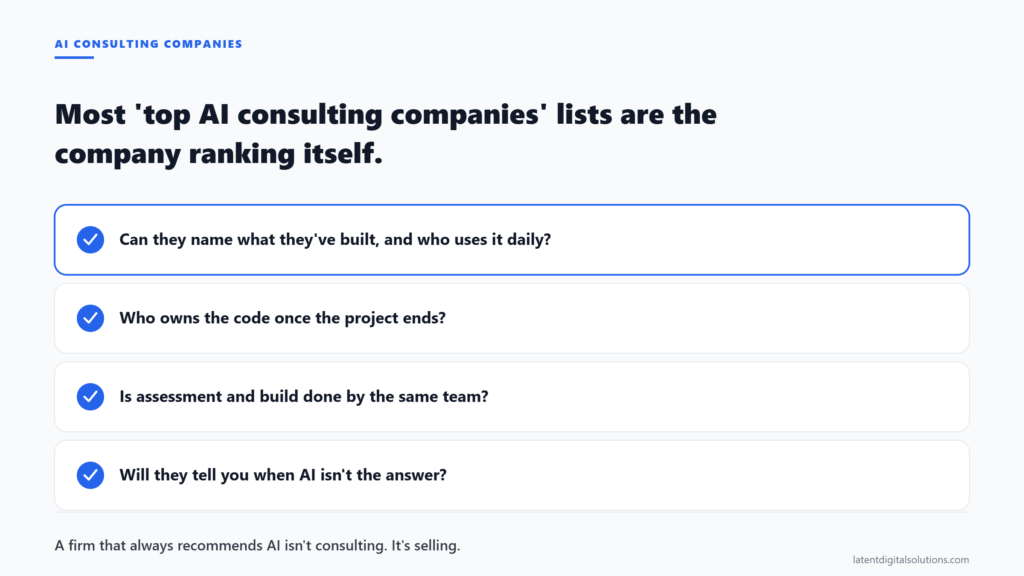
The other thing an AI consulting company should do is tell you when AI is not the right answer. A firm that always recommends AI is not consulting. It’s selling. The value of good consulting is proportional to how willing the firm is to say “there’s a simpler fix here.”
Latent Digital Solutions does both assessment and delivery in the same engagement: identify the problem, scope it honestly, and build the thing. That combination matters because the context doesn’t have to travel between two different teams with different incentives.
Why most “top AI consulting companies” lists can’t be trusted
The self-ranking pattern is structural, not incidental. A firm that publishes a “top AI consulting companies” list and ranks itself first has an obvious incentive to do so, and no external check on the methodology. The criteria are chosen after the ranking, not before. Competitors get described in ways that happen to exclude what that firm does best.
This doesn’t make the firms themselves bad. Most are real businesses with real clients. The list is still useless as a decision tool. You can read ten of them and learn nothing about how to choose between them, because none were written to help you choose.
There are also directories and paid rankings that charge for inclusion or placement. Being listed prominently in a directory that sells listings tells you a firm’s marketing budget, not its delivery record.
Asking specific questions directly gets you further than any list.
Nine questions to ask before hiring AI consulting companies
These questions work on any firm, boutique or large, local or international. A firm that can’t answer most of them clearly is a firm you shouldn’t hire.
1. Can you name a specific project you’ve completed, what the problem was, and what the measurable outcome was?
A real delivery firm can name clients (or at minimum describe the industry and problem clearly), what was built, how long it took, and what changed for the client. Vague answers (“we’ve helped many companies with AI”) are not answers.
2. Who owned the project day to day on your side — a senior consultant or a junior team member?
Many larger firms pitch senior consultants and then staff the actual project with junior team members once the contract is signed. Ask who specifically will be doing the work on your project, and what their background is.
3. After the project ends, who owns the code?
In a well-structured engagement, you own it: full IP transfer, no licensing dependency on the consulting firm. If the answer involves ongoing platform fees, licence agreements, or any form of dependency on the firm continuing to host or operate what they built, factor that into the total cost.
4. What does your handover process look like?
A firm that hands over a running system without documentation and a knowledge-transfer period is setting you up to fail after they leave. Ask what handover looks like specifically: a transition week, written documentation, a period where your team runs it with their support.
5. What happens if the first approach doesn’t work?
AI projects involve experimentation. An AI consulting company that claims certainty about what will work before touching your data is either inexperienced or selling. Ask how they handle a proof of concept that doesn’t validate: is that a checkpoint to stop, or a reason to iterate, and how does that affect pricing.
6. How is the project scoped and priced?
Fixed-price projects with clear deliverables are cleaner for buyers than open-ended time-and-materials retainers. Ask what the scope covers, what out-of-scope looks like, and how changes to scope are handled mid-project. A firm that can’t scope clearly at the start is unlikely to deliver clearly at the end.
7. What do you not do?
An AI consulting company that says it handles everything (AI strategy, data engineering, ML engineering, product design, change management) probably doesn’t do all of them well. The best firms have a clear core and honest referrals for adjacent areas. “We don’t do X, but we know who does” is a more trustworthy answer than “we do everything.”
8. Have you worked in our industry or with our type of data before?
Not a requirement, but relevant. An AI consulting company that has solved a similar problem before will scope more accurately, anticipate more edge cases, and move faster. One that is learning your industry on your budget will move slower and price higher for the same outcome.
9. What does data security and compliance look like in your engagements?
For UAE businesses especially: where is data processed, which jurisdictions does it cross, and how does the firm handle UAE data-residency requirements. OECD guidelines on responsible AI stewardship address exactly the kind of transparency and accountability a vendor should demonstrate. If an AI consulting company can’t describe its data handling in plain language, that’s a gap to take seriously.
This is also where you confirm the firm understands how AI gets deployed into production versus how it gets piloted — two different things with different data handling requirements.
Red flags that signal a listicle vendor, not a delivery partner
These are faster to spot in AI consulting companies than green flags:
No named projects or outcomes. If an AI consulting company’s website lists only industry verticals and generic capabilities with no specifics on what they’ve built, treat that as a sign they haven’t built much. Case studies with real problems, real timelines, and real outcomes are a reasonable minimum expectation.
The pitch team is not the delivery team. If the people who take the meeting disappear after the contract is signed, ask who replaces them. This is more common at larger firms and is worth probing directly in the first meeting.
Every engagement starts with a large strategy phase. Strategy is legitimate, but an AI consulting company that always sells a multi-month, five-figure strategy phase before any delivery is worth scrutinising. A shorter discovery or readiness check is more proportionate for most mid-size businesses and should be enough to scope a build phase.
Vague IP and licence language. Any contract that uses phrases like “licensed for use” or “proprietary platform” without clearly specifying what you own at the end deserves a close read before signing. Standard practice is full code ownership transferred to the client.
No clear escalation path. Who do you contact if the project is behind schedule, if the team is underperforming, or if requirements need to change? A firm without a clear answer here will be hard to hold accountable mid-project.
They haven’t asked about your data yet. Before scoping any AI project, a serious firm wants to know what data you have, how it’s structured, and whether it’s sufficient. If a firm is ready to quote without asking about your data, they’re quoting from a template, not from understanding your actual problem.
For a detailed breakdown of what an AI consulting engagement involves (costs, timelines, and what good looks like), our AI consulting services guide covers the structure of an engagement specifically for UAE businesses.
How this differs by business size
Among boutique AI consulting companies, the one that has solved your exact problem before is almost always the better choice over a large firm with a broad AI practice, for a business with fewer than 50 employees. Large firms have overhead, account management layers, and pricing structures built for enterprise clients. The senior expertise you’re paying for may be four management layers away from anyone actually working on your project. A boutique that can put its best person directly on your problem is worth more even at a higher hourly rate.
For businesses with 50–200 employees, the relevant question shifts to whether you need the consulting firm to also train your team and hand over something your people can actually run. That capability (building internal literacy, not just a system) is worth asking about explicitly, because not all firms prioritise it.
For larger businesses, the due-diligence questions above apply with more weight: IP ownership, data governance, and clear escalation paths matter more when the project is larger and the contract is more complex.
In all cases, the question of whether to hire externally or build the capability in-house is worth settling first, because that decision shapes what kind of engagement makes sense. Our analysis of the build-vs-hire decision covers that separately.
Want this scoped for your business?
Talk to our AI transformation consulting team. We prove the idea on a working prototype before you commit.
Conclusion
Finding the highest-ranked AI consulting company on a list the company itself wrote is not a selection process. Asking specific questions, checking actual delivery evidence, and taking red flags seriously before signing is.
If you’ve worked through this checklist and want to understand how Latent approaches an engagement — what we’ve built, for whom, and what a scoping conversation actually involves — get in touch and describe the problem. That conversation will tell you more than any ranking.
Frequently Asked Questions
How do I choose the right AI consulting company?
Start with the nine questions above for any of the AI consulting companies you’re evaluating. The most important are: can they name a completed project with a measurable outcome, who specifically does the work, and who owns the code when the engagement ends. A firm that can’t answer these clearly is not a delivery firm.
Are “top AI consulting companies” lists reliable?
Rarely. Most “top AI consulting company” lists are written by one of the companies being ranked, with no disclosed methodology and criteria that shift to favour the author. Paid directories are similar — listing prominence is bought, not earned. Use the questions above instead of any ranking.
What’s the difference between a boutique and an enterprise AI consulting firm?
Boutique AI consulting companies are typically smaller, more specialised, and put senior people on the work directly. Enterprise firms have broader capability and more overhead. For most small and mid-size businesses, the boutique AI consulting company that has solved your exact problem before will deliver faster and at lower total cost than the large firm with a general AI practice area.
Who owns the code after an AI consulting project?
In a well-structured engagement, you do — full IP transfer, no ongoing licensing dependency. This should be explicit in the contract. If a firm’s agreement involves “licensed access” or a platform fee after the project ends, read that clause carefully before signing.
What is a good AI consulting firm’s handover process?
A good handover includes written documentation, a knowledge-transfer period (at least one to two weeks where your team runs the system with the firm’s support), and a clear point at which responsibility formally transfers. A handover that is just “here’s the GitHub link” is not a handover.
How do I evaluate AI consulting companies in the UAE specifically?
Most lists of AI consulting companies are written by one of the companies on the list, ranking itself first with no disclosed method behind the ranking. That’s a poor way to choose a firm you’re trusting with something that matters to your business. What actually separates an AI consulting company worth hiring from one that just talks well is a short, answerable checklist, not a badge.
Usually a reply within one working day.