Article Overview
OpenAI now runs its own consulting arm, and the headline number attached to it, a client size in the tens of millions of dollars, matters to almost nobody reading this.
Already know you need one?
Skip ahead to our OpenAI & Azure OpenAI consultants in the UAE for UAE businesses.
That’s not a criticism of OpenAI. A company building a new services business has to start somewhere, and starting with the clients who can absorb the highest-touch, most expensive engagement makes sense for them. It just means the interesting question for most UAE businesses isn’t “how do I hire OpenAI consulting.” It’s “I want the same kind of GPT-based system, at a size someone my size can actually afford, so who do I actually call.”
This guide explains what OpenAI consulting actually is, why it’s built for a different client than most readers, and what a smaller business does instead.
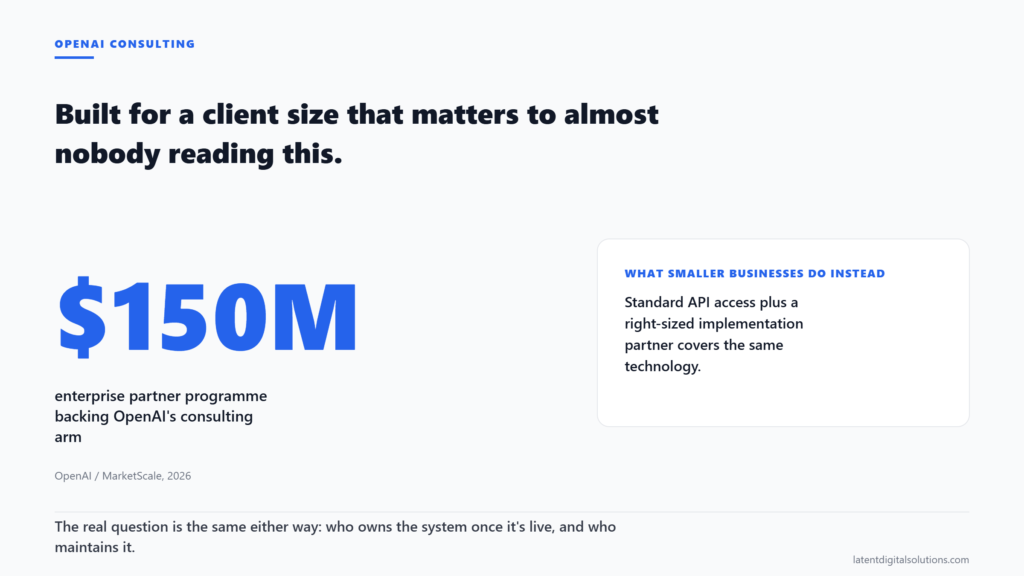
- OpenAI formed a dedicated deployment company in 2026, built around forward-deployed engineers who work inside a client’s operations, backed by a reported $150 million enterprise partner programme.
- The client size circulating in commentary is well beyond what most UAE mid-size businesses represent, and that’s by design, not an accident.
- You don’t need OpenAI consulting to build a working GPT-based system. Standard API access plus an implementation partner covers the same underlying technology.
- The real question to ask any smaller implementation partner is the same one you’d ask OpenAI’s team: who owns the system once it’s live, and who maintains it.
What is OpenAI consulting, exactly?
OpenAI consulting refers to a new, dedicated arm of OpenAI, built through the acquisition of the consulting firm Tomoro, that places engineers directly inside client organisations to build and ship AI systems rather than just providing model access.
This is different from what most businesses picture when they think about “using OpenAI.” Buying API access to GPT models is a self-service purchase anyone can make. OpenAI consulting is something else: a services business, backed by a reported $150 million enterprise partner programme, where OpenAI’s own people, not a third-party agency, sit inside a client’s team and build the thing.
Latent Digital Solutions works in the same underlying technology, GPT-based and other large language models, without requiring the client to be large enough to justify OpenAI standing up its own team inside the business.
Why does OpenAI consulting target such large clients?
Because that’s where the model-access-to-working-system gap is currently most expensive to close, and where OpenAI can justify staffing an engagement with its own engineers rather than a partner.
OpenAI’s own team has described the core problem plainly: owning access to a model and having a working AI system inside your business are two completely different things. Closing that gap at enterprise scale, across a bank’s credit risk systems or a large retailer’s supply chain, takes sustained, embedded engineering effort. That’s expensive to deliver directly, which is why OpenAI consulting is currently prioritising organisations that can absorb that cost and already have an existing OpenAI relationship to build from.
None of that means a smaller business can’t use the same underlying models. It means the specific service of “OpenAI’s own engineers, embedded in your team” isn’t built for a 50-person UAE logistics company, and was never going to be.
What do you do if you’re not a $10M client but want GPT-based systems?
Hire an implementation partner sized for the project, not the vendor’s own newest business line.
The technology itself, GPT-based models accessed through a standard API, is available to any business regardless of size. What OpenAI consulting actually sells is the embedded engineering effort of making that technology work reliably inside a specific set of systems, and that same work can be done by a smaller studio at a scope and price that matches a smaller business.
This is the kind of engagement our AI Transformation work covers: scoping where a GPT-based system genuinely solves an operational problem, then building and handing over something your own team can run, without requiring the client to be OpenAI’s next flagship account.
What does an OpenAI-adjacent implementation actually involve at a smaller scale?
The same core steps as the enterprise version, scaled down: connect the model to your actual data, define what a correct answer looks like, and build in a way for the system to admit when it’s wrong.
A mid-size implementation usually starts narrower than people expect, one specific workflow, like drafting first-pass customer replies or extracting structured data from documents, rather than a company-wide rollout. That narrower scope is what makes the project affordable and testable before anything gets expanded. Our guide on agentic AI in enterprise settings covers where this kind of system genuinely works in production today versus where it’s still mostly demo-grade, which is worth reading before scoping any GPT-based project regardless of size.
Data readiness tends to matter more than model choice at this scale. A business with clean, accessible records for the specific workflow being automated will see a working system faster than one still sorting out where its data actually lives, and that’s true whether the implementation partner is OpenAI’s own team or a smaller studio. If you are ready to scope one, see OpenAI consulting for UAE businesses.
Does Azure OpenAI consulting change any of this?
Not the underlying logic, only the delivery route. Azure OpenAI consulting refers to implementation work built on Microsoft’s hosted version of OpenAI’s models rather than OpenAI’s own API directly, and the choice between the two is usually about existing infrastructure, not capability.
A business already running on Microsoft’s cloud, with data residency or procurement requirements that favour an existing Azure relationship, often finds Azure OpenAI consulting the more practical route, since it keeps data inside infrastructure already approved internally. A business with no existing Microsoft footprint may find going directly through OpenAI’s own API simpler. Neither route requires the client size that OpenAI’s own embedded consulting arm is currently built around, and a competent implementation partner should be able to work through either one, explaining the trade-off rather than defaulting to whichever platform they’re more comfortable with. We work through both routes; see how we approach Azure OpenAI and OpenAI API projects.
What do OpenAI consulting services typically include?
OpenAI consulting services cover the work of turning a general-purpose model into a system that does one specific job reliably inside your business. For a mid-size UAE company that usually means six pieces of work:
- Scoping one workflow. Picking a single process with a measurable outcome, such as answering questions from your own documents or extracting data from invoices, instead of an open-ended “AI strategy”.
- A prototype on your real data. A working version tested on genuine examples before a large commitment.
- Integration. Connecting the model to your CRM, ERP, email or WhatsApp so it works where your team already works. This is the OpenAI integration consulting most projects actually need.
- Evaluation and guardrails. A test set that defines what a correct answer is, and checks that stop a bad output reaching a customer.
- Deployment and monitoring. Going live to a small group first, then tracking quality and cost.
- Handover. Code, prompts and accounts in your company’s name, so you are not dependent on the consultant to change anything.
The scale is smaller than a large embedded programme, but the categories of work are the same. See the OpenAI consulting services we offer in the UAE.
What does an OpenAI consulting partner actually do?
The phrase gets used loosely, so it is worth being clear about which kind of partner you are dealing with.
- OpenAI’s own consulting arm places OpenAI engineers inside very large clients.
- A reseller may mainly sell licences or access, with little build work attached.
- An independent implementation partner scopes, builds and hands over a working system on the OpenAI API or Azure OpenAI, and stays involved afterwards.
Most mid-size UAE businesses need the third kind. We are an independent implementation team, not affiliated with OpenAI, and we build on whichever route suits your data and procurement needs. If you are comparing partners of any kind, the questions below apply, and so does our checklist for evaluating an AI implementation partner.
What should you ask a smaller implementation partner before hiring?
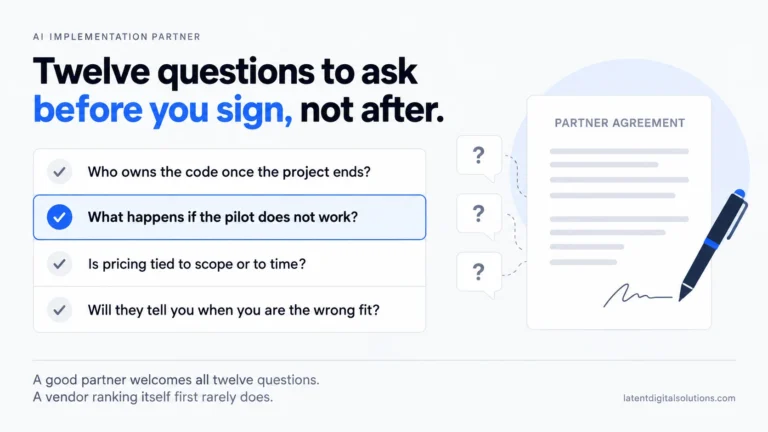
Ask the same due-diligence questions you’d want answered by OpenAI consulting itself.
- Which model or provider is the system actually built on, and what happens if pricing or availability changes?
- Who owns the code and the integration once the project is delivered?
- How is a wrong or hallucinated answer caught before it reaches a customer?
- What does a realistic first project look like, in weeks, and what happens after launch?
- Can your own team maintain and adjust the system later, or does every change require going back to the consultant?
A partner who answers these plainly, including where something is still being tested, is more trustworthy than one promising a system that never gets anything wrong. Every GPT-based deployment improves after real use. The honest ones say so upfront.
Want this scoped for your business?
Talk to our OpenAI consulting team in the UAE. We start with a working prototype, not a large proposal.
Conclusion
OpenAI building its own consulting arm, OpenAI consulting, is a real, useful signal: the gap between “having model access” and “having a working system” is wide enough that even OpenAI thinks it’s worth closing directly, for its largest clients. For everyone else, the same underlying technology is available through a right-sized implementation partner, without needing to be OpenAI’s next flagship account.
If you want GPT-based systems built into how your business actually runs, without the enterprise price tag, see how we scope OpenAI and Azure OpenAI projects and describe the specific problem you’re trying to solve.
Frequently Asked Questions
What is OpenAI consulting?
A dedicated services business OpenAI built in 2026 through the acquisition of the consulting firm Tomoro, placing OpenAI’s own engineers inside client organisations to build working AI systems, backed by a reported $150 million enterprise partner programme.
Do I need to be a large enterprise to use OpenAI’s models?
No. Standard API access to GPT-based models is available to any business. What’s sized for large enterprise clients specifically is OpenAI’s own embedded consulting team, not the underlying technology.
What’s the alternative if my business is too small for OpenAI consulting?
A right-sized implementation partner using the same underlying models. The engineering work, connecting the model to your data and building a reliable system, is the same category of work regardless of who does it.
How much does a smaller GPT-based implementation cost?
It depends heavily on scope, but a narrow, single-workflow project, like automating one type of customer response or document extraction, costs far less than a company-wide rollout and is the realistic starting point for most UAE mid-size businesses.
What should an implementation partner be able to explain before I hire them?
Which model the system runs on, who owns the code once it’s delivered, how incorrect answers get caught before reaching a customer, and what a realistic first project timeline looks like.
What do OpenAI consulting services include?
Scoping one workflow, building a prototype on your real data, integrating it with your CRM, ERP, email or WhatsApp, testing and guardrails so bad outputs do not reach customers, a staged launch with monitoring, and a handover where the code and accounts are in your company’s name.
What is the difference between OpenAI consulting and Azure OpenAI consulting?
The models are the same family. The difference is the delivery route: Azure OpenAI suits businesses already on Microsoft’s cloud or with procurement and data-residency requirements, while the OpenAI API is often simpler if you have no Microsoft footprint. The consulting work is largely the same either way.
How do I find an OpenAI consulting partner in the UAE?
Look for an independent implementation team that prototypes before asking for a large commitment, can show working systems, explains which model route it recommends and why, and assigns you ownership of the code and accounts. Ask the due-diligence questions in this guide before you sign.
Usually a reply within one working day.