Article Overview
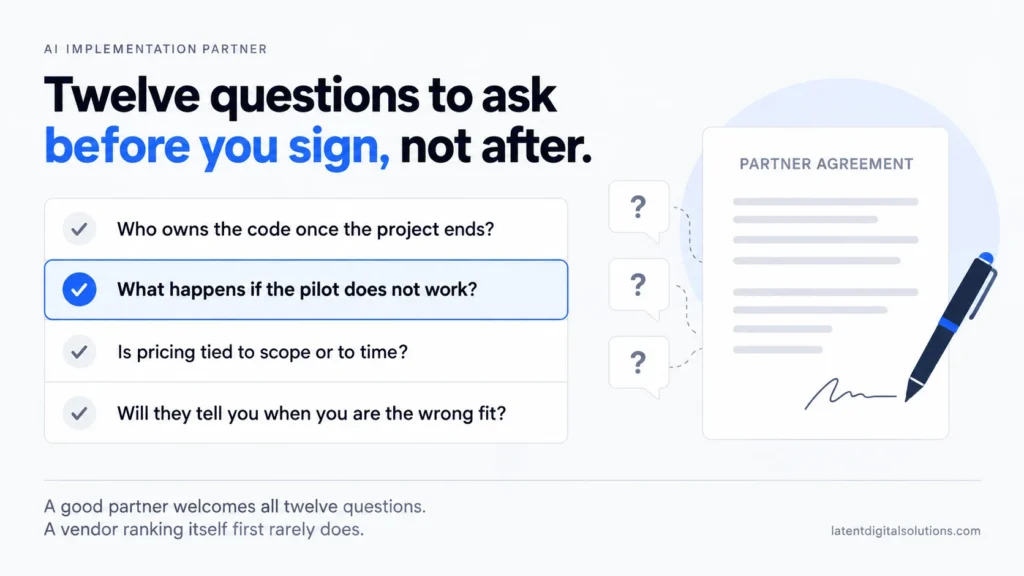
An AI implementation partner is the firm that does the build-and-integration work on an AI project, as distinct from a consultant who mostly advises on whether and how to start. Choosing one is harder than it should be, mostly because the search results are dominated by vendors ranking themselves first. This checklist is written for the buyer, not the vendor list, and it’s the same set of questions worth asking whether you’re evaluating one firm or five:
- Who owns the code once the project ends?
- Who owns the data, and where does it live?
- What happens if the pilot doesn’t work?
- Is pricing tied to scope, or to time?
- What does the handover actually include?
- Can they name a comparable project?
- Who is actually doing the work?
- What’s the exit plan if the relationship ends early?
- Do they understand your specific regulatory context?
- How do they handle security and access?
- What’s the realistic timeline?
- Will they tell you when you’re the wrong fit?
If you’re a UAE business trying to evaluate an AI implementation partner honestly, work through these twelve questions before you sign anything. Most of them take one direct question in a first call to answer.
Key takeaways
- 01Most “top AI implementation partner” lists are self-ranked vendor directories, not neutral buyer guides.
- 02The three questions that matter most: who owns the code, what happens if the pilot fails, and how is pricing structured.
- 03An AI implementation partner who’s never had a pilot fail is either lucky or not being honest with you.
- 04A good partner will tell you when you’re the wrong fit for what they do.
What is an AI implementation partner?
An AI implementation partner is a firm that does the build-and-integration work: assessment, pilot, connecting to your systems, and handover. That’s different from AI consulting, which is mostly the decision of whether and how to start, before any building happens. Demand for this work is real: the UAE’s own national AI strategy names developing an AI-friendly ecosystem among its stated goals, according to OECD.AI’s policy tracker, which has drawn no shortage of firms willing to call themselves an AI implementation partner.
In the UAE, this market is dominated by two kinds of pages. Global platform comparisons that rank large enterprise vendors against each other. And vendor-authored listicles where the company writing the list ranks itself first. Neither is written to help a UAE business evaluate a real AI implementation partner for a project their size.
1. Who owns the code once the project ends?
Some AI implementation partner engagements hand over full ownership of what gets built. Others keep you dependent on the original vendor indefinitely. That can happen through licensing, proprietary tooling, or simply never documenting the system well enough for anyone else to touch it. Ask this before signing, not after the final invoice. If the answer changes depending on which plan or tier you sign up for, get the specific tier’s terms in writing, not the general pitch.
2. Who owns the data, and where does it live?
If the project touches customer or employee data, get a direct answer on where that data is stored and who can access it. For a UAE business, this connects directly to the Personal Data Protection Law, which sets real rules on how personal data can be handled and moved.
3. What happens if the pilot doesn’t work?
An AI implementation partner who’s never had a pilot fail to reach production is either very lucky or not being fully honest with you. The useful question isn’t whether it can fail. It’s what happens next if it does. Do you get a clear diagnosis? Or just a bigger invoice for a bigger attempt at the same thing? A partner who can describe a specific past failure, and what they changed because of it, is usually more trustworthy than one who claims a perfect record.
4. Is pricing tied to scope, or to time?
| Model | What you get | Main risk |
|---|---|---|
| Scope-based | A fixed deliverable for a fixed price | Less flexible if requirements genuinely change |
| Time-based | You pay for hours worked | Can drift once integration gets messier than expected |
Neither model is automatically the wrong one. You should know which one you’re agreeing to before the project starts.
5. What does the handover actually include?
A good AI implementation partner names who on your team receives the system before the project starts. What documentation comes with it, and what support period follows, should be settled at the same time. A vague answer here usually means the handover hasn’t been thought through yet.
6. Can they name a comparable project?
Not a case study with invented numbers. Ask for a real, specific description of a project at a similar size and complexity to yours, including what went wrong along the way. An AI implementation partner who only describes successes is giving you half the picture. The missing half is usually the part that would actually help you plan.
7. Who is actually doing the work?
Some firms sell the engagement with senior people in the room. Delivery then goes to a more junior team once the contract is signed. Ask specifically who will be doing the day-to-day work, not just who’s in the sales call.
8. What’s the exit plan if the relationship ends early?
Businesses change direction. AI implementation partners sometimes underperform too. Ask what happens to the code, the data, and the documentation if you need to end the engagement before it’s finished. A clear answer here is more trustworthy than one that treats the question as unlikely to matter.
9. Do they understand your specific regulatory context?
PDPL is the obvious one for any UAE business touching personal data. If the project touches invoicing or finance, the UAE’s e-invoicing mandate is also worth raising, since it phases in through 2027. An AI implementation partner who hasn’t heard of either is worth a second look before you proceed. This doesn’t need to be a legal deep-dive on your side. A partner who’s clearly thought about it will answer specifically; one who hasn’t will answer vaguely or change the subject.
10. How do they handle security and access?
This overlaps with data ownership, but it’s worth asking directly. What gets access to what? Who reviews AI-generated outputs before anything reaches a customer or a financial system? A practical AI security checklist covers the basics worth confirming here, most of which take an afternoon to review rather than a compliance department.
11. What’s the realistic timeline?
A single-process pilot typically runs weeks, not months, and a partner should be able to name what would extend that. Vague timelines with no stated exit point are the ones most likely to drift well past what was originally quoted. Ask specifically what would push the number out, not just what the best-case number is.
12. Will they tell you when you’re the wrong fit?
This is the question most vendor-authored lists can’t answer honestly, because their business model depends on saying yes. A genuine AI implementation partner will tell a business its project isn’t scoped realistically yet. Or that a smaller first step makes more sense than the one being asked for. That’s a harder thing for a vendor ranking itself first to say. The same buyer-first approach applies to software builds; see the same checklist for a custom software development company.
When is a vendor the wrong fit?
Not every business needs the same kind of AI implementation partner. A business with an internal engineering team may only need enablement support, not a full build. A business whose immediate problem is a fragile old system may need that fixed first, separately, before AI gets layered on top of it. A good answer to question twelve above should surface this distinction early, rather than after a contract is signed.
This is also where it’s worth asking what kind of partner you’re actually looking for. A genuine AI Transformation partner should be able to say plainly whether your project fits what they do, or whether you need something else first, like a legacy system stabilised or an internal team upskilled rather than replaced. For the software-build version of this decision, see in-house vs. outsourced software development.
How does this checklist differ from a vendor ranking?
Vendor-authored rankings answer a different question than the one a buyer actually has. A list built by a vendor tends to rank that same vendor first, whoever it happens to be. That’s not dishonest exactly, but it isn’t a neutral answer to “which AI implementation partner is right for me” either. It matters more now than it used to: Microsoft’s 2026 AI Economy Institute analysis ranked the UAE first globally for AI adoption, according to The National’s reporting on the data, which means more vendors than ever are competing for the same buyer’s attention with the same self-ranked lists. If you are still building a shortlist, see how to tell which AI consulting companies will actually ship.
The twelve questions above work regardless of who’s answering them, which is the actual point. A genuinely strong AI implementation partner should welcome being asked all twelve. Clear answers are themselves a competitive advantage against vendors who’d rather keep the conversation vague.
If you are evaluating a partner specifically for OpenAI or Azure OpenAI work, see how our OpenAI consulting team works, including the prototype-first approach.
Conclusion
Choosing an AI implementation partner comes down to a small number of concrete questions. Who owns the code and data? What happens if the pilot fails? How does pricing actually work? Will the partner admit when you’re not a good fit yet? Most vendor-authored “top partner” lists answer none of these, because answering them honestly isn’t in a self-ranking vendor’s interest. Working through all twelve before signing anything takes one focused conversation, and it tells you more than any ranked list will. For what the work itself actually involves once you’ve picked a partner, see the full AI implementation guide.
Talk to Latent about where your project actually stands, and which of these twelve questions matter most for it.
Frequently Asked Questions
What is the role of an AI implementation partner?
To do the build-and-integration work: assessment, pilot, connecting the pilot to your existing systems, and handover to someone on your team who owns it. That’s distinct from an AI consultant, who mostly helps decide whether and how to start.
What is an AI implementation company?
A firm offering the same service as an AI implementation partner, delivery rather than just recommendation. In the UAE, this market is currently dominated by vendor-authored rankings and enterprise platform comparisons, with little genuinely neutral buyer guidance.
How do I choose between several AI implementation partners?
Run each one through the same twelve questions: code and data ownership, what happens if a pilot fails, pricing structure, handover plan, and whether they’ll admit when you’re the wrong fit. Consistency in how they answer matters more than any single answer.
Who are the biggest AI companies?
The largest AI platform providers are well known, but being large doesn’t make a company the right AI implementation partner for a 50 to 250 person UAE business. Scale and fit are different questions, and the biggest names are usually priced and scoped for a very different size of client.
What should I ask before signing with an AI implementation partner?
At minimum: who owns the code once the project ends, what happens if the pilot doesn’t work, and how pricing is structured. If a firm can’t answer these three plainly, the rest of the checklist usually reveals more gaps.
Is a bigger AI implementation partner always a safer choice?
Not necessarily. A larger firm often means enterprise pricing and assumptions that don’t fit a smaller business. A smaller, delivery-focused partner may be better scoped to your size, provided they clear the same ownership and pricing questions honestly.
Usually a reply within one working day.


