Article Overview
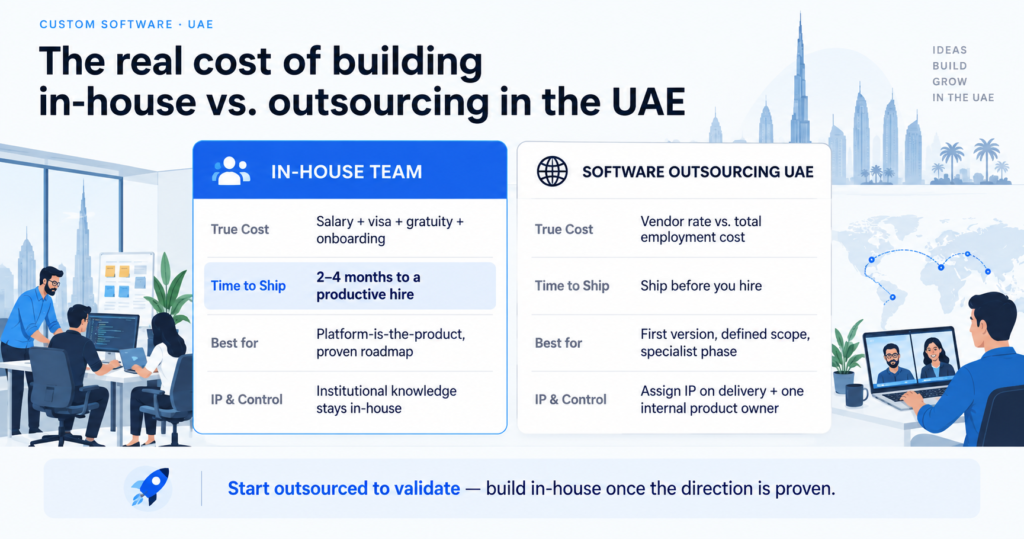
Most business owners asking this question aren’t looking for a vendor directory. They want to know what the decision actually looks like in a market like the UAE, where hiring a developer involves visa sponsorship, gratuity obligations, and a hiring cycle that often stretches months before someone is genuinely productive.
Software outsourcing UAE options run from freelancers to dedicated development teams and structured delivery partnerships. In-house hiring offers control and continuity, but at a cost structure that surprises most founders the first time they model it honestly.
If you’re working with a team UAE businesses outsource to or considering building in-house, this is a plain account of what the comparison actually covers — costs, control, speed, and the specific situations where each path makes more sense.
- Hiring an in-house developer in the UAE costs significantly more than the salary alone — visa sponsorship, end-of-service gratuity, and onboarding time all factor into the true employment cost.
- Software outsourcing UAE trades salary overhead for scope risk — the model works best when requirements are clear and the engagement has a defined outcome.
- Most UAE businesses that make outsourcing work keep one internal person who owns the product roadmap and manages the vendor relationship.
- The decision isn’t permanent — start with outsourced delivery to validate the product, then build in-house once the direction is proven.
What does it actually cost to hire an in-house dev team in the UAE?
The cost is almost always higher than the salary figure suggests. In the UAE, every developer hire involves employer obligations that sit outside the salary itself:
- Employment visa sponsorship
- Medical insurance
- Annual flight allowance
- End-of-service gratuity
- Compliance with the Wage Protection System (WPS)
Gratuity alone is calculated at 21 days of basic salary per year for the first five years of service. That means every employee carries a growing accrued liability from day one.
Add the time cost of recruitment, the weeks before a new hire is genuinely contributing, and equipment and licensing costs. The true employment cost runs well above the salary figure most founders first plan around.
Then there’s the timeline. In 2024, the UAE’s Work Bundle platform reduced the administrative burden for work permits and visa issuance.
Even so, the full hiring cycle still spans months once you account for recruitment, offer, medical clearance, entry permit, Emirates ID registration, and the onboarding period that follows.
For a single developer, these costs are manageable if the hire is the right one. For a team of three to five, you’re committing significant capital at a scale that doesn’t shrink easily if the project changes direction or the product doesn’t land as expected.
On the outsourced side, freelance developer rates in the UAE run about AED 75–150 an hour for a junior, AED 150–260 for a mid-level developer and AED 260–750 for a senior (see our custom software development cost guide). A project scoped at 120 hours at AED 200 an hour comes to AED 24,000. For the in-house side, take the salary you would offer and add the items above, with gratuity at 21 days of basic salary per year for the first five years, before comparing the two totals.
What does software outsourcing UAE typically cost?
Software outsourcing UAE pricing depends primarily on the engagement model. Fixed-price contracts give you cost predictability when scope is fully defined before work begins. Time-and-materials gives you flexibility but requires tighter governance to prevent scope from drifting beyond budget.
The comparison that matters isn’t a vendor day rate against a developer’s monthly salary. It’s the vendor rate against the total employment cost of an equivalent in-house hire, covering every employer obligation described above, amortised across the engagement. When that comparison is made honestly, software outsourcing UAE is often less expensive for time-bound projects. The saving comes from not carrying fixed employment overhead between active phases of work. The day rate is a secondary factor.
Offshore development teams, typically based in Eastern Europe, South Asia, or Southeast Asia, often quote lower rates than UAE-based vendors. But coordination has a real cost even when it doesn’t appear on an invoice. Time-zone misalignment, longer feedback loops, and the management effort required to write requirements precisely enough for a distant team to work independently can absorb much of the apparent saving.
The bigger cost risk in software outsourcing UAE isn’t the contract price. It’s scope. A fixed-price agreement on poorly defined requirements will either produce a product that doesn’t match the vision or generate change requests that push the final cost beyond the original quote. That’s a requirements problem, not a vendor problem. Define scope first, then go to market.
When does in-house development make sense for a UAE business?
In-house development makes the most sense when the software is the product, not a tool that supports it. If you’re building a platform that customers use directly (a fintech application, an enterprise SaaS product, a marketplace), that work requires deep institutional knowledge that doesn’t transfer cleanly to an outsourced team and back. The IP lives in the people who built it, not just in the codebase. If you are inheriting an old codebase, see modernizing an old system.
It also makes sense when security or data sovereignty requirements mean you can’t share codebase access with a third party. Financial services and healthcare businesses in the UAE face these constraints more often than other sectors.
And it makes sense when the product direction is already validated. In-house development returns the most value when the roadmap is stable, iteration pace is high, and the team’s accumulated knowledge of the product compounds over time. At that stage, an in-house team is cheaper per unit of output and builds institutional knowledge that outsourced delivery doesn’t accumulate.
What it doesn’t suit is early validation. At that stage, software outsourcing UAE is almost always the more practical starting point. Building an in-house team before confirming the product has market fit means absorbing employment costs at exactly the moment when the ability to change direction quickly is most valuable.
When is software outsourcing UAE the better choice?
Software outsourcing UAE makes the most practical sense in three situations:
- Scope is clear and the engagement has a defined endpoint.
- You need to ship faster than you can hire.
- The work runs parallel to existing operations without drawing internal resources away from day-to-day business.
The most common use case is building a first version before committing to permanent hires. Software outsourcing UAE lets you ship a working product, collect real user feedback, and validate direction before taking on the employment obligations of an in-house team. Once the product is proven, you have a much clearer picture of which skills you actually need in-house, which makes the hiring decision better-informed and the team more effective from day one. That’s also the point where it’s worth checking whether the product itself is ready for real customers, not just the hiring plan — our MVP to production review covers exactly that.
The timeline argument is real. In the UAE, the gap between “we decided to hire” and “the developer is shipping feature work” is measured in months. If a deadline is four months away, software outsourcing UAE closes that gap in a way that internal recruitment simply cannot match.
Outsourcing also gives you access to specialist skills you don’t need permanently, such as:
- A mobile developer for a one-off iOS build
- A data engineer for a migration project
- A specific framework expert
A custom software development partner brings that skill in for the phase that needs it, without building the specialist into a permanent payroll.
The hybrid model: when and why UAE businesses blend both
The businesses that make software outsourcing UAE work most consistently don’t treat it as a binary choice. The arrangement that holds up most reliably looks like this: one internal person (a product owner or technical lead) owns the product vision, sets the requirements, and manages the vendor relationship. The outsourced team handles delivery. If you land on outsourcing, how to choose a custom software development company in Dubai sets out the questions worth asking any firm.
That internal person doesn’t need to be a developer. They need to understand what the product does, have the authority to make decisions quickly, and carry enough technical literacy to review output and challenge assumptions. That profile is different from a developer, and it’s a role most UAE businesses can fill from within.
This structure keeps IP ownership, product direction, and institutional knowledge inside the business. The outsourced team provides delivery capacity without the employment overhead. Staff augmentation, where you bring in individual specialists for a defined period alongside an internal team, is a variation on this when the need is more targeted than a full project build.
Questions to ask before you decide
Before choosing between in-house and software outsourcing UAE, these questions are more useful than any pros-and-cons comparison.
1. How well-defined are your requirements?
If you can’t describe what success looks like in enough detail for a developer to build it independently, you’re not ready to outsource. An in-house team will hit the same wall. Write the requirements first, whichever path you take.
2. Do you have someone internally who can own the product?
Software outsourcing UAE without internal ownership creates dependency. The product gets built, but you don’t fully understand what you have or how to evolve it without the vendor. Identify that person before you start.
3. What’s your actual deadline?
Map your timeline backwards. If a hard delivery date makes recruitment impossible, software outsourcing UAE is simply the only path that works. Many UAE businesses end up outsourcing not by plan but because the hiring timeline ran over.
4. What happens to IP and code when the engagement ends?
Any software outsourcing UAE contract should explicitly assign IP ownership to you on delivery, hand over the complete codebase, and leave no runtime dependencies that only the vendor can maintain. For broader due-diligence on platform and technology decisions at this stage, our ERP implementation guide covers a parallel checklist worth working through.
The right choice starts with honest answers
There’s no version of this decision that’s correct in the abstract. It depends on your product stage, requirements clarity, hiring capacity, and how much timeline risk you can absorb.
The businesses that struggle with software outsourcing UAE tend to arrive with either too little requirements definition (expecting the vendor to fill the gaps) or too much optimism about how quickly in-house hiring moves. Both paths end up more expensive than planned.
If you’ve worked through these questions and still aren’t certain which model fits your situation, that conversation is worth having before you sign anything. Get in touch with the Latent team. We work with UAE businesses from first specification through to in-house handover, and we’ll give you a direct view of which approach makes sense for your situation before we discuss any commercial arrangement.
Frequently asked questions
Is software outsourcing in the UAE more cost-effective than hiring in-house?
For time-bound projects with well-defined scope, software outsourcing UAE is typically more cost-efficient than in-house hiring. In-house employment in the UAE carries visa sponsorship, medical insurance, gratuity, and onboarding costs that run well above the salary line alone. Outsourcing avoids those fixed obligations. For long-term, continuously evolving products, in-house teams often deliver better value once the product direction is proven.
What are the IP risks of outsourcing software development in the UAE?
The primary risk is a contract that doesn’t explicitly assign IP to you on delivery. Any software outsourcing UAE engagement should include a full IP assignment clause, full codebase delivery at project close, and no runtime dependencies that create ongoing reliance on the vendor. These terms are standard in well-drafted contracts; resistance to including them is worth treating as a signal.
How long does it take to hire a software developer in the UAE?
The full cycle from open role to productive hire typically runs two to four months for mid-to-senior developers, covering recruitment, offer, medical clearance, visa issuance, Emirates ID registration, and the onboarding period. That timeline is one of the main practical arguments for software outsourcing UAE when there is a near-term delivery deadline that internal recruitment cannot realistically meet.
Can UAE businesses keep control when working with an outsourced team?
Yes, with deliberate structure. The businesses that retain the most control in a software outsourcing UAE engagement have a single internal product owner managing requirements and the vendor relationship. Without that internal anchor, decision-making migrates to the vendor by default. Outsourcing is a delivery model. Control belongs to whoever holds the product brief, not whoever writes the code.
What’s the best way to start outsourcing software development in the UAE?
Begin with the requirements, not the vendor search. Define what you’re building and what each delivery milestone looks like. Then evaluate software outsourcing UAE options on communication practices, contract transparency, and process clarity, not price alone. A fixed-price discovery or proof-of-concept phase is the lowest-risk way to test a vendor relationship before committing to the full build.
Usually a reply within one working day.