Article Overview
Most “best custom software development company in Dubai” lists are directories or the company ranking itself first. This is a working checklist, written for the business hiring, not the company being hired.
Already know you need one?
Skip ahead to our custom software development company in Dubai for UAE businesses.
When comparing vendors, it also helps to use a structured framework: our app development company UAE buyer’s checklist covers track record verification, scope, ownership and red flags.
Search for a custom software development company in Dubai and the results split into two kinds: “Top N companies” lists built by review platforms and agency marketing pages, each claiming to be the right fit for everyone. Neither actually helps you evaluate the specific company in front of you.
Key takeaways
- 01Most “top custom software development company” lists are directories or self-ranked marketing, not a way to evaluate one specific company against your project.
- 02The three questions that matter most: who owns the code and data afterward, how pricing is structured, and what a failed pilot or missed deadline actually looks like.
- 03A company that can’t show a live product, only screenshots, is asking you to take its portfolio on faith.
- 04A UAE-registered company adds faster response times, easier in-person meetings, and no need to explain UAE PDPL from scratch.
What actually makes a company a fit for your project?
Size and technology stack matter less than three things: whether they’ve built something like yours before, whether their pricing model matches how you want to pay, and whether they’ll tell you when they’re the wrong fit. A company that says yes to everything is not a safe default; it’s a company that hasn’t thought about scope.
Our guide to Python programming machine learning explains what the work involves, which roles you may need and how a prototype becomes a dependable system.
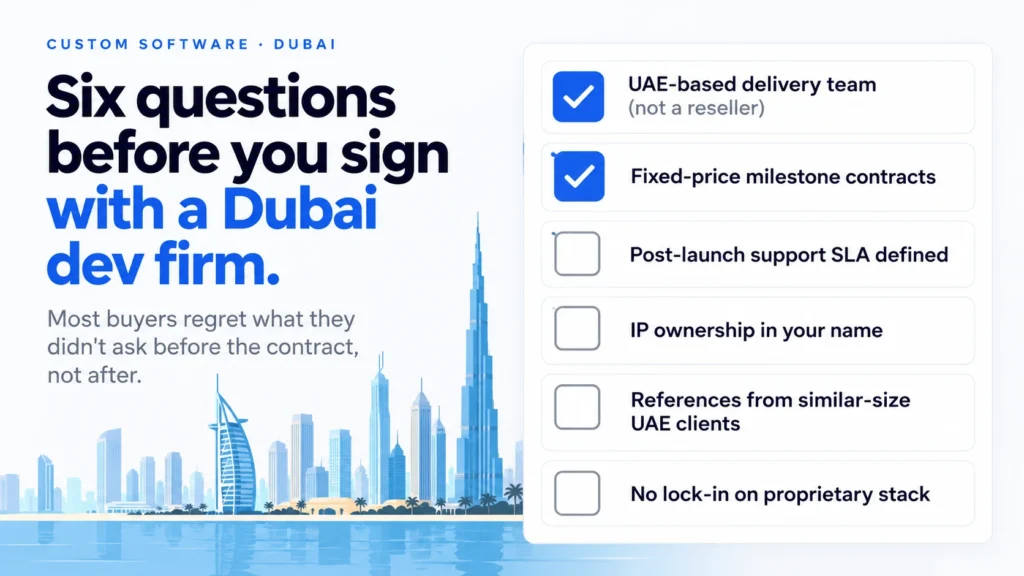
1. Who owns the code and data once the project ends?
Source code, designs, documentation and third-party account access should be assigned to your company on delivery, not licensed to it. This should be written into the contract before work starts, not negotiated afterward. If a company hedges on this question, that’s the answer.
2. Is pricing tied to scope, or to time?
Scope-based pricing gives you a fixed deliverable for a fixed price. Time-based pricing can drift, especially once integration work starts, and the company has less incentive to finish quickly. Ask which model applies to your project specifically, not which one the company generally prefers to quote.
3. Can they show you a live product, not a portfolio page?
A screenshot proves a design was made. A live product you can actually use proves it shipped and kept working. Ask for one, and ask to speak directly to that client. A company with real delivery history will connect you; one relying on portfolio pages alone may not have much to show past the pitch.
4. What happens when the first version doesn’t work?
Every real software company has had a first version that needed real changes. What matters is whether they start with a working prototype before asking for a large investment, so a wrong turn costs weeks and a conversation, not months and a contract dispute. If you already have an AI-built MVP and are wondering whether it can handle real customers, that is a related but different question — see how we approach taking an MVP to production.
5. How do they handle security and access?
A company should be working under a signed NDA before any detail of your project is discussed, and should be able to describe, plainly, how they handle access control and security practice on a typical project. If they can’t answer this without checking with someone else, that’s worth noting.
6. Do they understand your specific industry and region?
A company that has built for real estate, logistics, fintech, healthcare or retail in the UAE will talk about your industry in specifics: the systems it usually has to integrate with, the compliance context, the edge cases that surprise first-timers. A company reciting generic capability slides has not necessarily built in your space before, and that’s a fair thing to ask directly.
7. Does the company need to be based in Dubai?
Not strictly, but it changes practical things: response times in your working hours, the ease of an in-person meeting when one actually helps, and whether UAE PDPL and local business norms need explaining or are already understood. A UAE-registered company removes friction a remote one has to work around.
8. What does the handover actually include?
Documentation, credentials, and a system your own team (or the next company) could actually pick up, not a working demo that only the original developers understand. Ask what handover looked like on their last project, specifically.
How to use this checklist
Work through these eight questions in a first conversation, not after signing anything. Most take one direct question to answer, and a company’s willingness to answer plainly is itself useful information. If you want a working prototype before committing to a full build, that’s how we approach custom software development in Dubai, and our cost guide covers what a fair quote actually looks like.
Want this scoped for your business?
Talk to our custom software development team. We start with a working prototype, not a proposal.
Frequently asked questions
Should I hire a custom software development company or a freelancer?
A company for anything with real ongoing risk: a product customers depend on, integrations with other systems, or a build that needs to outlive one person’s availability. A skilled freelancer can be the right, cheaper call for a small, contained, one-off tool.
How much does custom software development cost in Dubai?
It depends on scope, integrations, and how much of the product is designed from scratch versus adapted from existing patterns. Our custom software development cost guide breaks down the real cost drivers and UAE developer rates.
How long does it take to build custom software in Dubai?
A focused first release usually lands in 6 to 10 weeks after a 1 to 2 week discovery phase; a larger platform runs 3 to 6 months. Ask any company you’re evaluating for their own numbers on a project close to yours, not an industry average.
Does the company need to be based in Dubai?
No, but it changes response times and how easy in-person meetings are. A company registered in the UAE also understands UAE PDPL and local business norms without you having to explain them.
What’s the difference between a custom software development company and a software development agency?
Mostly none in practice; both terms describe firms that build custom applications rather than sell a packaged product. What matters is what’s actually asked in this checklist, not which label the company uses for itself.
How do I check if a company has really delivered the work it claims?
Ask for a live product you can use, not just a screenshot, and ask to speak to a past client directly. A company that can’t produce either is asking you to take its portfolio on faith.
What should a first conversation with a custom software development company cover?
What you’re trying to build, who owns the code and data afterward, how a failed pilot would be handled, and how pricing is structured. If a company can’t answer these plainly in a first call, that’s information too.
Usually a reply within one working day.