Article Overview
Hiring AI consulting help in the UAE usually means choosing between a strategy firm that hands you a deck and a boutique studio that actually builds something. Most business owners can’t tell which one they’re getting from a website alone, and the difference determines whether the engagement produces a working system or a 40-page report. That distinction is what this guide to AI consulting is actually about.
Most of what does rank is written for a different buyer than a Dubai business with 50 to 300 people. It’s strategy language, aimed at organisations with a transformation budget and a dedicated innovation team. None of it says what an engagement actually includes. What it costs. How long it takes. This article does. It’s written from the same place we help UAE businesses solve one specific operational problem with technology, rather than sell a transformation programme nobody asked for.
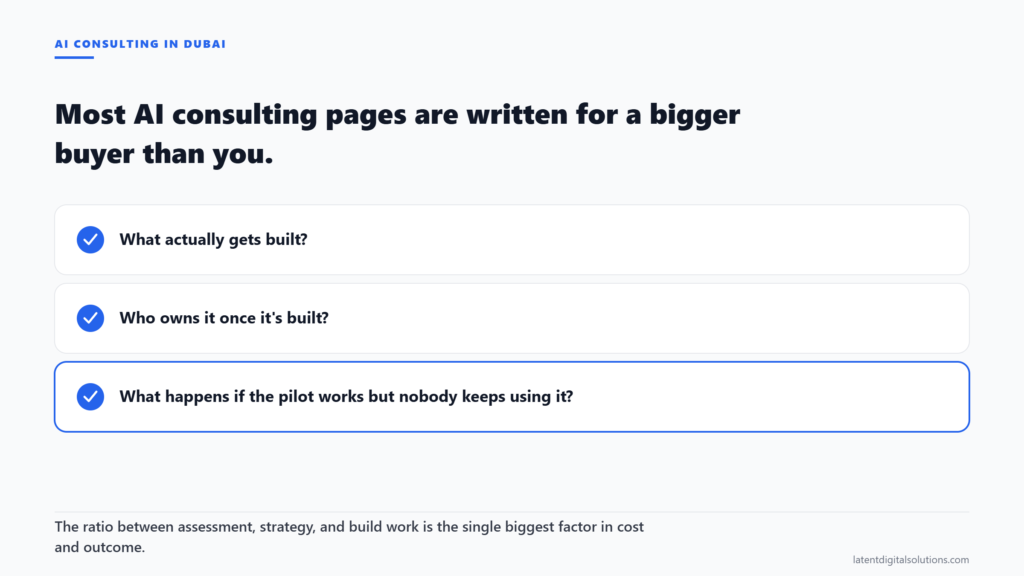
- AI consulting is not one fixed thing. What you’re actually buying is a mix of assessment, strategy, and hands-on build work, and the ratio between them is the single biggest factor in cost and outcome.
- Global strategy firms sell AI consulting the same way they sell every other kind of consulting: as advice. A studio built for mid-size businesses sells it as work that ends in something running.
- Cost depends far more on scope than on the firm’s brand name. A one-week readiness assessment and a six-month build are both called “AI consulting,” and they aren’t remotely comparable.
- Before hiring anyone, get a straight answer to three questions: what gets built, who owns it once it’s built, and what happens if the pilot works but nobody keeps using it.
What does an AI consulting engagement actually include?
An AI consulting engagement is usually some mix of three things. Figuring out where AI is worth using in your business. Planning how to get there. Doing the work to make it happen. The confusion starts because different firms sell wildly different mixes of those three, all under the same label.
Our guide to data scientist and machine learning explains the roles, when a business needs one and how to get value from the hire.
At one end, AI consulting means a report. A consultant interviews your team, looks at your processes, and hands you a document recommending where AI could help. Nothing gets built. You’re paying for judgement and a second opinion. That has real value if you genuinely don’t know where to start. But it leaves you needing another firm, or another budget line, to actually do anything with the recommendations.
At the other end, AI consulting means the same firm does the assessment and then builds the thing. They scope a specific use case. They connect it to your existing systems. They test it against real data and hand over something your team is actually using by the end. This is closer to what most UAE business owners assume they’re buying when they search for AI consulting services. It’s also the version almost nobody in the current top search results actually sells.
A smaller number of engagements sit in between: a paid pilot that proves whether an idea works before either side commits to a larger build. This is often the most sensible starting point for a business that hasn’t worked with an AI consulting firm before. It limits the downside if the use case turns out to be wrong.
Before you agree to anything, ask which of these three you’re buying. “AI consulting” on its own tells you almost nothing about what lands on your desk at the end.
How much does AI consulting cost in Dubai?
The current top-ranking pages answer this least honestly, mostly because the honest answer is “it depends on scope, not on the firm’s name.” A short readiness assessment, a fixed-scope pilot, and a full build-and-integrate engagement are priced on completely different scales. Comparing them directly is like comparing the cost of a home inspection to the cost of a renovation.
Here’s an illustrative example, not a quoted rate. Picture a 60-person logistics company in Dubai considering AI for demand forecasting. A pure assessment, with no build, might run one or two weeks and cost a fraction of a working pilot connected to their existing systems, which would run six to ten weeks. A full rollout with ongoing support sits above both. None of these figures are universal. Any firm quoting a single number before understanding your systems, your data, and your team’s capacity is quoting blind.
What genuinely moves the cost:
- How much of your data is usable as-is. Messy or scattered data adds real time before any AI work starts, and that time is usually billed.
- Whether you’re connecting to existing systems or starting from a blank slate. Integrating with an ERP or CRM your business already runs on is a different job than building a standalone tool.
- Who owns delivery after the engagement ends. A firm that hands over documentation and walks away costs less upfront and more later, when something breaks and nobody who built it is still around.
- How many iterations the use case actually needs. The first version of an AI system rarely works exactly as hoped. Budgets that assume it will are usually wrong.
If a quote arrives before any of these have been discussed, that’s a signal to ask more questions, not to sign.
One question worth asking early: how the firm handles your data once it leaves your systems. If the engagement touches customer or financial records, that data is subject to the UAE’s personal data protection laws, and a consulting firm that can’t explain where your data goes and who’s accountable for it is a firm you shouldn’t be handing it to.
A rough shape of how the three engagement types compare, to make quotes easier to sanity-check against each other:
| Engagement type | Typical duration | What you actually get |
|---|---|---|
| Readiness assessment | One to three weeks | A written recommendation, no build |
| Fixed-scope pilot | Six to ten weeks | One use case, connected to real data, tested with your team |
| Full build and integrate | Three to six months+ | A system running inside daily operations, with ongoing support |
Two quotes that look wildly different in price are often not competing offers at all. They’re answers to two different questions, and the only way to tell is to ask which of these three rows each one is actually describing.
As a frame, UAE advisory work generally runs AED 350–1,100 an hour, or a fixed AED 9,000–37,000 for a scoped quick-win project, before 5% VAT (see our small-business AI consultant guide). Moving from advice to building, a single-workflow integration typically costs AED 30,000–80,000, and a multi-system engagement covering three or four core platforms AED 150,000–400,000 (see our AI integration services guide). These are ranges, not quotes.
Global strategy firms vs. a studio built for a business your size
McKinsey’s QuantumBlack, BCG, and Bain all sell AI consulting, and all three do genuinely capable work. They sell it the way they sell every other kind of consulting: as advice delivered to an internal team that then executes it. That model makes sense for an organisation with its own engineering function and a mandate to build. It makes far less sense for a business that doesn’t have either. That business ends up paying strategy-firm rates for a document it then hands to a second team to actually implement.
This is where the size mismatch matters more than most articles admit. A firm built to serve enterprise transformation programmes is priced, staffed, and structured for that scale. A mid-size UAE business asking one of them for help with a single use case, like automating quote generation or flagging anomalies in supplier invoices, is often the smallest, least profitable client in their pipeline. That’s not a criticism of the firms. It’s a mismatch of who the work is actually for.
A studio built specifically to serve businesses this size works differently by design. It’s the same reasoning behind custom software development in Dubai, instead of forcing a team to adapt to an off-the-shelf platform. Automation makes it economically viable to solve a business problem at a scale and price the larger firms aren’t structured to serve. The point isn’t that smaller means cheaper for its own sake. It’s that the engagement is shaped around one business’s actual problem, not fitted into a standard methodology built for organisations ten times the size.
If your business already has a mandate for a large, multi-year transformation programme with its own internal team, the global firms are a reasonable fit. If you’re trying to solve one or two specific problems without hiring an internal AI team, a smaller studio is usually the better match. The search results currently make that distinction very hard to find.
There’s a middle category worth naming too: boutique AI consulting firms and freelance consultants working at roughly the same scale as a small studio, but without the delivery capacity to build once the assessment is done. Some are genuinely strong at the strategy side and worth hiring for exactly that. The risk is assuming strategy and delivery come from the same place by default. They don’t. Asking the question up front costs nothing.
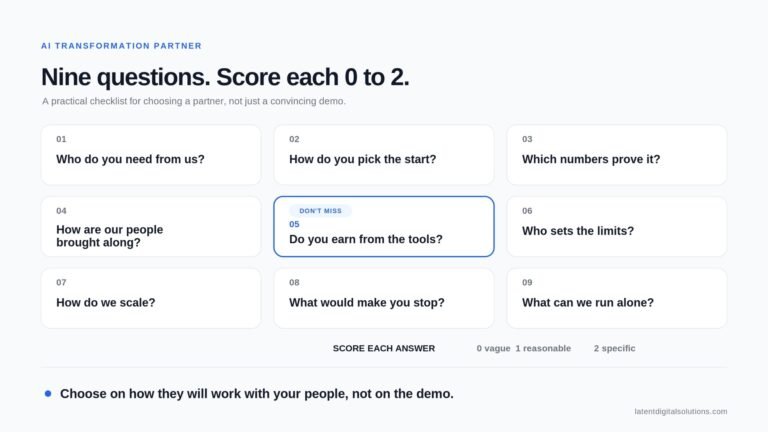
What to ask before hiring an AI consulting company
Almost every list of “top AI consulting companies” ranking in the UAE right now is written by a company that put itself at the top of its own list. That’s not a minor bias. The rankings you’ll find are closer to advertising than evaluation. The useful work is asking better questions yourself, not trusting a list.
This matters more in the UAE market specifically. The pool of firms calling themselves AI consultants has grown faster than the pool of firms that have actually delivered anything. A directory listing or a five-star review tells you almost nothing about whether a firm can scope a project correctly, handle your data responsibly, or still answer your calls six months after the invoice is paid. The questions below are a better filter than any ranking.
A short, practical set to start with:
- What exactly gets delivered, and in what state? A working system your team can use, or a recommendation someone else has to build?
- Who owns the code and the data once the engagement ends? This should be answered before you sign, not discovered afterwards.
- What’s the plan if the pilot works but nobody keeps using it? This happens more often than most vendors admit, and a firm with a real answer is more trustworthy than one that assumes it won’t happen.
- How does the team handle your data once it’s connected to a model? Under the UAE’s Personal Data Protection Law, the entity processing personal data carries real obligations around consent, storage, and cross-border transfer. That responsibility doesn’t disappear because a vendor is doing the technical work. Ask specifically how they handle this, not just whether they’ve “heard of it.”
- Can they name a comparable business size they’ve actually delivered for? Not a logo wall. A specific description of the kind of business and the kind of problem.
None of these questions require technical knowledge to ask, and a firm that can’t answer them plainly is telling you something useful. If it helps to see what “delivered” actually looks like in practice rather than in a pitch deck, our work page is a reasonable place to compare against.
How long does an AI consulting engagement actually take?
Timelines get stretched or compressed in marketing copy far more than any other part of an AI consulting engagement, so it’s worth separating the phases honestly.
A standalone readiness assessment typically runs one to three weeks. A consultant reviews your processes and data and hands back recommendations. There’s no build involved, so the time is mostly interviews, document review, and a final report.
A fixed-scope pilot usually takes six to ten weeks, aimed at proving one use case works before committing further. That includes connecting to at least one real system, testing against actual data rather than a sample dataset, and getting a small group of your team using it. Firms that promise a working pilot in a week or two are almost always oversimplifying what “working” means, or reusing a generic template that hasn’t been adapted to your systems.
A full build-and-integrate engagement commonly runs three to six months, sometimes longer if it touches multiple systems or departments. This is where the AI system becomes part of daily operations rather than a proof of concept. It’s also where the gap between AI consulting and AI implementation tends to disappear entirely. The firm doing the strategy work is also the one doing the build, because splitting the two rarely serves the business well.
The honest red flag isn’t a long timeline. It’s a firm that quotes the same short timeline regardless of what you’re asking for, which usually means the scope hasn’t actually been thought through yet. If you’re past the “should we hire someone” question and want a practical sequence for the work itself, our AI transformation roadmap covers how that pilot-first sequencing actually plays out.
Who should hire an AI consultant right now, and who shouldn’t?
Not every business is ready for AI consulting. Pretending otherwise wastes everyone’s time and money. A business is a reasonable fit if it has a specific, named process that’s slow, expensive, or error-prone, and that process produces enough structured data (invoices, tickets, orders, records) for a system to learn from. Retail businesses reconciling stock across channels, logistics companies forecasting demand, and professional services firms buried in repetitive document review are common, genuine fits.
A business is usually not ready yet if its core data lives in scattered spreadsheets nobody maintains consistently. Or if the team doesn’t have capacity to test and give feedback on a pilot. Or if the honest goal is “we should probably be doing something with AI” rather than a specific operational problem. None of these are permanent disqualifications. They’re usually signs that the useful next step is smaller and cheaper than a full engagement: a short data-readiness conversation, not a six-figure programme.
A few concrete examples make this easier to judge against your own business. A contracting firm spending hours each week matching supplier invoices to purchase orders by hand has a specific, expensive, well-documented process. That’s exactly the kind of problem AI consulting is built to solve. A retail business with three years of sales records across two systems that don’t talk to each other is a strong fit for demand forecasting, once someone reconciles that data. A clinic manually re-entering the same patient intake details into three separate systems is a clear candidate for automation, even before anyone mentions the word “AI.” In each case, the fit isn’t about the industry. It’s about having a named process, real data behind it, and a team with enough capacity to use whatever gets built.
Compare that to a business that wants “an AI strategy” without being able to name the process it would apply to. That’s not a bad instinct. But it’s not yet ready for an AI consulting engagement. It’s ready for a shorter conversation about where to look first.
The businesses that get the most out of AI consulting are rarely the ones chasing the newest model. They’re the ones that can point at one process, describe exactly why it’s expensive, and want that specific thing fixed.
If the work you have in mind is a GPT-based assistant or workflow, our OpenAI and Azure OpenAI consulting services page shows how we scope and prototype that kind of project.
Conclusion
AI consulting, as a category, has a trust problem right now. The search results prove it: a complaint thread outranking three of the biggest names in the industry isn’t an accident. The way out isn’t a bigger brand name. It’s a clearer answer to three questions before you sign anything: what actually gets built, who owns it afterwards, and what your business specifically needs fixed. Get straight answers to those, from a firm whose size actually matches your business, and the rest of the decision gets much easier.
If you’re trying to work out whether an AI consulting engagement is the right next step, or you already know the process you want fixed, get in touch and describe the problem. That’s a more useful starting point than any ranking list.
Frequently Asked Questions
What is AI consulting, in plain terms?
AI consulting is advice, planning, or hands-on work that helps a business figure out where artificial intelligence can solve a real operational problem, and how to get there. The exact mix of advice versus hands-on building varies enormously between firms, which is the main source of confusion when comparing quotes.
How much does AI consulting cost for a business in Dubai?
It depends far more on scope than on which firm you choose. A short readiness assessment costs a fraction of a full build-and-integrate engagement, and the two shouldn’t be compared directly. Ask for a quote only after a firm understands your data, your systems, and what you actually want delivered.
What’s the difference between AI consulting and AI implementation?
AI consulting typically covers the assessment and strategy side: working out where AI fits and how. AI implementation is the hands-on build and integration work that turns that plan into something running inside your business. Many firms, including the ones worth hiring, do both under one engagement.
Should a small business hire an AI consulting company, or wait?
It depends on whether there’s a specific, named process worth fixing and enough usable data behind it. A business with a clear, expensive bottleneck and structured records (invoices, tickets, orders) is usually ready. A business whose main motivation is “we should be doing something with AI” is usually better served by a shorter, cheaper conversation first.
How do I know if an AI consulting company is legitimate?
Ask what gets delivered, who owns the code and data afterwards, how they handle your data under the UAE’s data protection obligations, and whether they can describe a comparable business they’ve actually delivered for. A firm that answers plainly, rather than pointing to a logo wall, is worth taking seriously.
Is AI consulting worth it if my business is small?
Hiring AI consulting help in the UAE usually means choosing between a strategy firm that hands you a deck and a boutique studio that actually builds something. Most business owners can’t tell which one they’re getting from a website alone, and the difference determines whether the engagement produces a working system or a 40-page report. That distinction is what this guide to AI consulting is actually about.
Usually a reply within one working day.