Article Overview
An Arabic chatbot only works if it understands how your customers really write, which in the UAE means Gulf Arabic, English, or both in one message, usually on WhatsApp. Most chatbots are built in English and translated afterwards, and an Arabic chatbot built that way shows its weakness quickly. This guide, written for owners adopting conversational AI for UAE businesses, explains why many fail, how to test one before you pay, and what the choice between a ready-made platform and a custom build comes down to.
- An Arabic chatbot that is fluent in formal Arabic can still fail on the way your customers actually write, so judge it on your own customers’ real messages, including Gulf dialect and informal spelling, rather than on a polished demo script prepared in advance by the vendor.
- Real UAE conversations mix Arabic and English, switch language mid-sentence and often happen on WhatsApp, so a language toggle in a settings menu does not solve the problem. The assistant must follow a customer who changes language halfway through a sentence.
- Quality varies by dialect and by topic, so a native Arabic speaker on your own team should review a sample of real conversations before launch. No vendor can promise the assistant will be right everywhere, and a polite hand-off is better than a confident wrong answer.
- A ready-made platform suits one language and a narrow set of questions. A custom build earns its cost when the assistant must connect to your booking or CRM systems and handle mixed-language conversations well, so the decision usually turns on integration, not price.
What Is an Arabic Chatbot?
An Arabic chatbot is an assistant that holds a conversation in Arabic: it understands what a customer means, answers usefully, and hands the conversation to a person when it should. For a UAE business it usually lives on WhatsApp, your website or your app, and handles bookings, orders, enquiries and support questions.
Why is translating an English chatbot not enough?
Translating an English chatbot into Arabic rarely works, for three reasons:
- Arabic is written right to left, which affects layout in every message, button and form.
- Arabic has formal and spoken forms that differ a lot, and customers write the spoken form.
- In the UAE, customers routinely mix Arabic and English in one message.
A bot that handles one language at a time is built for a customer who does not exist, and the gap between what your customers write and what the bot expects is where enquiries go missing. The cost of a weak Arabic chatbot shows up as unanswered enquiries, repeated questions and customers who give up and phone instead.
Why Do Many Arabic Chatbots Disappoint?
Many disappoint because they were trained and tested on formal Arabic, while customers write the way they speak. The Technology Innovation Institute in Abu Dhabi, which builds Arabic AI models, explains that dialectal Arabic has different vocabulary, grammatical structures and pronunciation patterns, and that most global AI systems treat dialects as variants of one language, the way they would handle English. That approach breaks down for Arabic.
What are the most common problems?
For a UAE business, the same few problems appear again and again:
- Formal Arabic only: the bot understands textbook Arabic but stumbles on the Gulf dialect your customers use, and on informal spelling.
- Mixed-language messages: a customer writes half the sentence in Arabic and half in English, or writes Arabic words in Latin letters. The bot loses the thread.
- Right-to-left as an afterthought: numbers, names and punctuation appear in the wrong order, or the interface looks broken on a phone.
- Confident wrong answers: when the bot does not know, it guesses. In a customer conversation, a polite “I will pass this to a colleague” is far better than a fluent wrong answer.
- No real hand-off: the conversation ends in a dead end, or the customer has to repeat everything to a person.
Quality also differs by topic. An assistant can handle appointment booking well in Arabic and still struggle with a detailed product question. That is why a single accuracy figure in a sales deck tells you little. If you are unsure whether your current assistant has these problems, our Arabic and English conversational AI service starts with exactly that kind of review.
What Should You Test Before You Buy an Arabic Chatbot?
Test any Arabic chatbot yourself, with real messages from your own customers, and never rely on the vendor’s demo. This table is the checklist we would use:
| Test | What to look for |
|---|---|
| Gulf dialect and informal spelling | Does it understand how your customers actually write, not just formal Arabic? |
| Mixed Arabic and English in one message | Does it keep the thread, and reply in a sensible language? |
| Names, numbers and dates | Do they display correctly in right-to-left text, and does it read them correctly? |
| A question it should not answer | Does it say so and hand over, or does it guess? |
| The hand-off | Does the person receive the conversation history, so the customer does not repeat themselves? |
| Voice notes | Many customers send voice messages on WhatsApp. What happens when one arrives? |
| Your own systems | Can it read from and write to your CRM or booking system, or is it only an answer machine? |
How do you run the test?
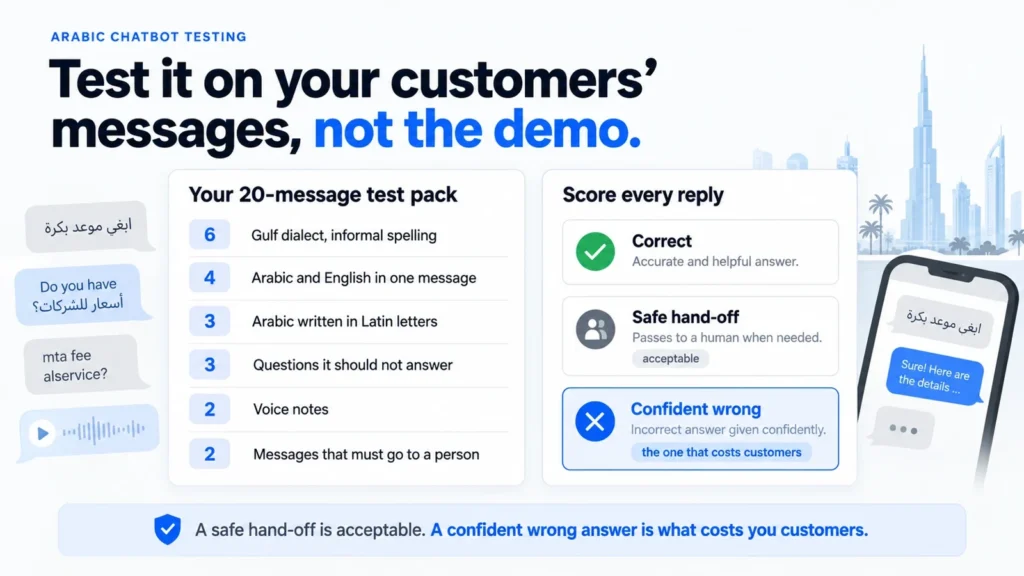
A useful Arabic chatbot test uses about 20 real customer messages and scores every reply as correct, a safe hand-off or confident wrong. Build a test pack of about 20 real messages from your own inbox, then score every reply. A pack that reflects how UAE customers write might look like this:
- Six messages in Gulf dialect, including informal spelling.
- Four messages that mix Arabic and English in one sentence.
- Three messages that write Arabic in Latin letters.
- Three questions the bot should not answer, such as a refund exception or a complaint.
- Two voice notes.
- Two messages that should clearly go to a person.
Score each reply as one of three outcomes: correct, safe hand-off (it admitted it could not help and passed the conversation on) or confident wrong. A safe hand-off is an acceptable result. A confident wrong answer is the one that costs you customers, so treat even a few of them in the out-of-scope group as a reason to stop and fix the bot before launch. This pack is a method for comparing options, not a benchmark, so use the same messages on every vendor you evaluate.
A good result is a bot that answers the routine messages correctly, hands over the awkward ones cleanly and never invents an answer. Then ask a native Arabic speaker from your own team to review a sample of the conversations. They will spot tone and wording problems that automated metrics miss. A vendor who resists this is worth worrying about.
Ready-Made Platform or Custom Build?
Both are legitimate. The right one depends on how demanding your use case is. If a platform meets your needs, use it. We would rather tell you that than sell you a build you do not need.
| Ready-made platform | Custom build | |
|---|---|---|
| Best for | One language, a narrow set of questions, a channel the tool supports well | Mixed Arabic and English, many topics, connection to your own systems |
| Speed to start | Fast | Slower, but a prototype is usually quick |
| Arabic quality | Varies by vendor and dialect, and is often weakest on Gulf dialect | Tuned and tested on your real customer wording |
| Ongoing cost | Monthly platform fee plus message costs | Build cost, then hosting and message costs |
| Ownership | You rent it | Code and accounts can sit in your company’s name |
What should you ask a platform vendor?
Before you sign with any vendor, put these questions to them in writing and keep the answers:
- Evidence: can they show conversations in Gulf dialect, not only formal Arabic, and will they run your test pack live?
- Ownership: will the WhatsApp number, the customer conversations and the configuration stay in your company’s name if you leave?
- Hand-off: how does a conversation reach your team, and does the history travel with it?
- Limits: what does the assistant do when it is unsure, and can you change that behaviour yourself?
- Cost: what are the platform fee, the message costs and any charge per conversation or per seat?
The switch point for an Arabic chatbot is usually integration. A platform that only answers questions is fine until customers expect it to check a booking, update an order or open a ticket. Our build vs buy AI guide covers how to make that call without overpaying either way.
Where Does WhatsApp Fit for an Arabic Chatbot?
For most UAE customer conversations, WhatsApp is where the chat actually happens. An Arabic chatbot should therefore be designed for WhatsApp from the start, not adapted from a website widget later. Two rules matter before you build anything.
The rules on AI: Meta’s terms for the WhatsApp Business Platform prohibit AI providers from using it when their AI is the primary functionality being offered, which is aimed at general-purpose assistants. An assistant built to serve your own customers, handling your bookings, orders and questions, is what the platform is intended for. Keep the WhatsApp account in your company’s name.
The messaging costs: Meta now bills per message rather than per conversation. Charges apply to template messages, which are classed as marketing, utility or authentication, and rates vary by the recipient’s country calling code. Ordinary replies inside an open customer service window are free, so an assistant that mostly answers customers who wrote first costs less to run than one that sends outbound campaigns. Meta changes its pricing from time to time, so work out the messaging cost for your expected volume before you commit.
How Much Does an Arabic Chatbot Cost?
The cost of an Arabic chatbot depends mainly on three things: how many different conversations the assistant must handle well, how many languages and dialects it must cover, and how many of your systems it connects to. Message fees and hosting come on top.
That is why a fixed price quoted before anyone has seen your real customer conversations is a guess. A sensible process starts with a short discovery of about a week, where you share real conversations, followed by a working prototype on WhatsApp within roughly two weeks. You can then try it yourself before committing to the full build. For wider context on how AI projects are priced, see our guide to AI implementation cost for UAE projects.
For a rough frame, published ranges for AI chatbots run from about AED 18,000–73,000 for a basic chatbot to AED 73,000–294,000 for an advanced one connected to your systems. Our custom AI development cost guide converts those published figures into dirhams. An Arabic assistant that handles Gulf dialect, mixed Arabic and English messages and a hand-off to your staff sits closer to the advanced band than the basic one. These are market ranges, not a quote for your project.
How Should You Get Started with an Arabic Chatbot?
Start small with your first Arabic chatbot, using real conversations and one job:
- Collect real messages: pull a few hundred genuine customer conversations, in whatever mix of languages they arrive.
- Pick the first job: one high-volume, low-risk task, such as booking or order status, is a better start than “handle everything”.
- Decide where it hands off: list the questions a person must always answer.
- Test the Arabic chatbot with your own team: include a native Arabic speaker, and try to break it.
- Launch to a small group first: expand once the answers hold up.
What should a first month look like?
The first month of an Arabic chatbot is a test, not a launch: review real conversations weekly and fix the biggest pattern first. Treat the first month as a test of the Arabic chatbot, not a launch. Review a sample of real conversations every week with your native Arabic speaker. Log every confident wrong answer, every missed hand-off and every message the bot could not read, then fix the biggest pattern first. Track how many conversations end with a person stepping in and whether customers have to repeat themselves, because those two numbers show whether the hand-off works.
Illustrative example (not a client result): a Dubai clinic starts with appointment booking only. Messages like “ابغى موعد بكرة” and “can I book بكرة الصبح” go to the assistant. Anything about prices, insurance or complaints goes straight to reception with the conversation attached. After a few weeks of review, the clinic widens the assistant to cover rescheduling and opening hours, and keeps insurance questions with staff.
Conclusion
A good Arabic chatbot is judged by how it handles your customers’ real messages: their dialect, their mixed languages, the questions it should not answer, and the hand-off to a person. Test it on those before you buy, and keep a native Arabic speaker involved from the start.
If you want this scoped for your business, talk to our conversational AI team. We start with your real customer conversations and a working prototype, not a long proposal.
Frequently Asked Questions
What is an Arabic chatbot?
An Arabic chatbot is an assistant that holds conversations in Arabic, understands what a customer means, answers questions or takes requests, and hands over to a person when needed. For UAE businesses it usually runs on WhatsApp, a website or an app.
Does an Arabic chatbot understand Gulf and Emirati dialect?
It depends on how it was built and tested. Many tools sold as an Arabic chatbot handle formal Arabic better than spoken Gulf dialect, and quality varies by topic. The reliable way to find out is to test it with your own customers’ real messages and have a native Arabic speaker review the results.
Can an Arabic chatbot work in Arabic and English on WhatsApp?
Yes, including for customers who mix both languages in one message. WhatsApp assistants should be scoped to your own business, such as bookings, orders and enquiries, and the WhatsApp account should stay in your company’s name.
How much does an Arabic chatbot cost in the UAE?
It depends on how many conversations the assistant must handle, how many languages and dialects it covers and how many of your systems it connects to, plus WhatsApp message fees and hosting. A fixed price before anyone has seen your real conversations is a guess, so a short discovery and a working prototype come first.
Should I use a ready-made platform or build a custom Arabic chatbot?
A ready-made platform often suits one language, a narrow set of questions and a channel the tool supports well. A custom build earns its cost when conversations mix Arabic and English, cover many topics, or need to connect to your CRM or booking system. Test the platform with real messages before deciding.
Can an Arabic chatbot understand WhatsApp voice notes?
Some can, but for an Arabic chatbot it is a separate capability from reading text, and quality in Gulf dialect varies. Ask any vendor exactly what happens when a voice note arrives, and include two voice notes in your test pack before you decide.
Usually a reply within one working day.