Article Overview
The build vs buy AI question sounds strategic. In practice, for most mid-size businesses, it is not a difficult one. The answer is buy, and it has been for most cases for most of the past three years.
UAE businesses facing a build vs buy AI decision are often asking the question because a vendor or a consultant has put the “build” option in front of them, and it sounds more serious — more bespoke, more owned. The less interesting truth is that buying a product that does roughly what you need — and adjusting your workflow to fit it — is the right call for most business processes. Building makes sense in a minority of situations, and knowing which minority you are in is the whole decision.
Key takeaways
- 01.Deloitte’s 2025 GenAI enterprise research found that most companies are using commercially available AI tools rather than building custom systems. Building in-house remains a small fraction of deployed enterprise AI.
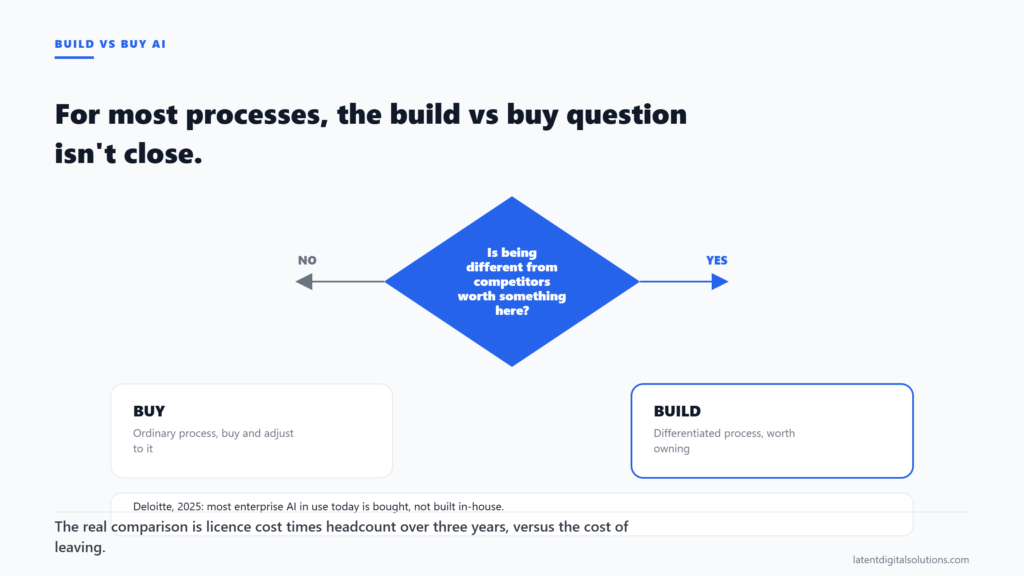
- 02.The question that decides the build vs buy call is not budget, not technical complexity, and not how mature the AI market is. It is whether your process is one where being different from competitors is worth something.
- 03.Buying looks cheap because the price is visible. The real figure is the licence cost multiplied by headcount over three years, plus the cost of leaving. Put both paths on the same footing and the answer often changes.
- 04.Two options most comparisons skip: using what your existing software already includes, and waiting. Both are frequently right.
What does build vs buy AI actually mean now?
The classic build vs buy AI framing — build a custom AI system or buy an off-the-shelf product — was accurate for a few years before foundation models changed the landscape. The options are now closer to four, and any build vs buy AI conversation that does not mention all of them is missing something. If you are weighing a GPT-based build, see Latent’s OpenAI and Azure OpenAI consulting.
Our buyer’s guide to choosing a custom AI development company covers what to own, what to ask and which red flags to watch for once you decide to build.
Use what you already have. Most business software — CRMs, accounting systems, ERP platforms, document management tools — now includes AI features in the base subscription or as low-cost add-ons. Before evaluating external products or commissioning custom development, check whether the problem is already partially solved by tools your team uses every day. A significant number of “AI strategy” conversations end here.
Buy a product. Purchase a product that addresses the use case. Accept that it will do it in the way the product was designed, which may require adjusting your workflow. This is the right path when the process is ordinary — when the goal is to do a normal thing reliably and cheaply, not to do it differently from how competitors do it.
Have something built around your workflow. Commission software built to your specifications — specifically to the way your business operates today, with your data structures, your edge cases, your terminology. This is slower and more expensive upfront, but it produces a system that fits your process rather than requiring your process to fit it.
Wait. The AI market is moving fast enough that a tool that does not exist or costs too much today may be a standard product feature in eighteen months. “Not yet” is a legitimate answer, especially for lower-urgency use cases. It is the option nobody selling AI services will tell you.
Most businesses land on “buy” when they actually work through build vs buy AI properly. Most that choose to build would be better served by buying. The analysis below is about understanding which minority of situations genuinely warrants the build path.
Why is buying the right build vs buy AI answer most of the time?
Because most business processes are not differentiating.
The build vs buy AI decision is easiest for payroll, accounting, email management, scheduling, expense reporting, document filing — these are things every business does. The goal is to do them reliably and at low cost, not to do them in a proprietary way that competitors cannot copy. For these processes, the correct decision is to buy the best available product, train the team, and stop revisiting the question.
Deloitte’s State of AI in the Enterprise research (deloitte.com, retrieved September 2026) found that the number of companies with 40%+ of AI projects in production is set to double within six months. In Latent’s experience scoping AI projects for UAE businesses, the large majority of that scaling activity sits on top of existing AI products and platforms rather than in-house model development. This is not because custom development is technically inferior. It is because most use cases do not need it.
A bought product also transfers vendor risk. The AI market is moving fast enough that a custom system built on a specific model or API version may require significant rework within two years. A product vendor carries that maintenance obligation. A custom system built by your team or an external agency puts it on your balance sheet.
The argument for buying, in the build vs buy AI decision, is not that custom systems are bad. The bar for needing one is just higher than most conversations assume.
When does the build side of build vs buy AI actually pay for itself?
In build vs buy AI, building pays when the process being automated is the reason customers choose you over a competitor doing the same thing with off-the-shelf tools.
The test: if your competitor bought the product you are considering building, would they be indistinguishable from you in that part of the business? If yes, buy the product. If their version would be materially worse than yours — because your process is faster, more accurate, or more tailored in ways that matter to customers — building may be warranted. Before committing either way, read how to tell if you actually need a proof of concept.
Three situations where the build side of build vs buy AI is consistently the right answer:
-
Proprietary data — your business has accumulated data no product can use well Your business has accumulated data that no product can use well — historical records in a format specific to your industry, customer interaction data spanning many years, internal knowledge structured in a way that requires custom retrieval architecture. A product cannot access this data the way a system built around it can.
-
Regulatory or confidentiality constraints — financial records under Central Bank regulations, patient records under UAE healthcare law, contracts under legal privilege; API-based products send data to third-party servers, which is not acceptable
- The process is your competitive advantage — specifically better in ways customers notice and pay for (a logistics routing algorithm, a pricing model, a fraud detection system where the AI is the business)
Proprietary data. Your business has accumulated data that no product can use well — historical records in a format specific to your industry, customer interaction data spanning many years, internal knowledge structured in a way that requires custom retrieval architecture. A product cannot access this data the way a system built around it can.
Regulatory or confidentiality constraints. The data cannot leave your systems — financial records under Central Bank regulations, patient records under UAE healthcare law, contracts under legal privilege. An API-based product typically sends data to a third-party server. A system built on-premise or in your own cloud infrastructure does not.
The process is genuinely your competitive advantage. Not just different — specifically better in ways customers notice and pay for. A logistics routing algorithm, a pricing system, a fraud detection model — cases where the AI is not supporting the business but is the business.
Data readiness is often the deciding factor in whether building is feasible at all. The AI Readiness Assessment Framework covers this systematically: is the data accessible, consistently labelled, in sufficient volume, and up-to-date enough to train or fine-tune on? Building without it produces a system that is technically complete and practically useless.
What does each option really cost over three years?
In build vs buy AI, the number people compare is the wrong number.
| Cost factor | Buy (product) | Build (custom) |
|---|---|---|
| Upfront | Subscription setup, onboarding | Development cost (visible) |
| Year 1–3 ongoing | Per-seat fee × headcount growth | Maintenance ~15–20% of dev cost/year |
| Exit cost | Migration, retraining, workflow disruption | Negligible — you own the system |
| Risk transferred | Vendor maintains model updates | You maintain model updates |
| Hidden cost | Price renegotiation at renewal | Edge cases not in original spec |
What buying looks like. The sticker price is a per-seat or per-user fee. At 20 users and £100/seat/month, that is £24,000 a year, or £72,000 over three years. What does not appear in the initial comparison: what happens when the team doubles, whether the price renegotiation goes well, and what switching to a competitor costs in migration, retraining, and workflow disruption. For real project prices, see what UAE AI projects actually bill, in AED.
Forrester’s 2025 enterprise software predictions (forrester.com, retrieved September 2026) found that 79% of technology decision-makers in US organisations reported an increase in their software costs over the past year — a cost pressure that rarely surfaces in the sign-up conversation but appears reliably once usage and pricing both scale up.
What building looks like. Development cost is upfront and visible. What is typically not budgeted: the time to maintain the system when the underlying model or API changes, the person responsible for monitoring output quality, the cost of retraining when business processes evolve, and the work required to fix edge cases that the development phase did not anticipate. EY’s AI advisory research (ey.com, retrieved September 2026) points to ongoing maintenance as the primary underestimated cost in enterprise AI builds — the budget for the first version rarely reflects the total cost of ownership over three years. The same trade-off applies to software builds; see in-house vs. outsourced software development in the UAE.
The honest comparison. Build: upfront development cost plus ongoing maintenance, estimated at 15-20% of development cost per year for functional systems. Buy: annual subscription at headcount-scaled rate, plus migration cost if you ever leave. Run both scenarios over 36 months. The answer often shifts when maintenance is included.
Latent’s AI Transformation engagements begin with this comparison built out for the specific use case — the three-year cost model for both paths — because the decision changes often enough that skipping it produces the wrong answer.
On the build side, published ranges run from about AED 18,000–73,000 for a basic chatbot to AED 367,000–1.84 million or more for a fully custom solution (see our custom AI development cost guide), and a single-workflow integration typically costs AED 30,000–80,000 (see our AI integration services guide). Add maintenance at roughly 15–20% of the build cost each year. For example, a build of AED 80,000 would carry about AED 12,000–16,000 a year in maintenance, which puts the three-year total at about AED 116,000–128,000. Compare that with the per-seat subscription multiplied by your headcount over the same three years.
What are the two options nobody lists in build vs buy AI?
The build vs buy AI framing leaves out the two most practical answers for a significant number of UAE businesses in 2026.
Use what you already have. Before running the build vs buy AI analysis at all, check what you already own: most software used by mid-size businesses — Salesforce, Microsoft 365, QuickBooks, Xero, SAP Business One, Monday.com — has released AI features in the past eighteen months. Before any external evaluation, audit what your current subscriptions already include. In Latent’s experience working with UAE businesses on AI scoping, approximately half of the “AI use cases” identified in a discovery session can be partially addressed by features that already exist in the client’s current software stack and are simply not being used.
The audit takes one day. It is not a glamorous engagement. It is almost always worth doing before anything else. Where the audit confirms that existing tools cannot cover the gap, Latent’s Custom Software work is scoped specifically to that remaining gap — not to replacing working software with something custom-built.
Wait. The rate of product development in AI means that categories which had no viable off-the-shelf solution twelve months ago now have three. Document extraction, contract review, customer-facing chatbots, internal search — each of these moved from “custom build required” to “product available at reasonable cost” within a two-year window. If the use case is real but not urgent, and the product market is visibly maturing, the expected cost of waiting six months may be lower than the cost of building now.
In build vs buy AI, “do nothing yet” is not the answer to everything. It is the answer to use cases where urgency is overstated, the product market is moving fast, and the cost of a premature build commitment is real.
How do you decide build vs buy AI without a spreadsheet?
The spreadsheet is useful after the decision, not before it. The decision comes from one question answered honestly.
The one question that actually settles build vs buy AI: is this process one where being different from competitors produces better outcomes for customers?
If yes — if the specific way your business handles this workflow is genuinely better in ways customers notice — building preserves that. A product makes everyone do it the same way.
If no — if the process is standard, and your goal is to do it reliably and at reasonable cost — buy the product and adjust the workflow. Optimising a non-differentiating process is a distraction from whatever actually differentiates the business.
Most of the complexity in the build vs buy AI decision comes from avoiding that question. The honest answer often points at buying, and buying is less exciting than building. The total cost analysis — maintenance, vendor risk, switching cost — is useful for confirming the answer, not for finding it.
The situation where neither buying nor building is correct is the two unlisted options above — where the software you already pay for covers the need, or where the right call is to wait.
Conclusion
The build vs buy AI decision is a real question for a minority of business processes: those where the process is a genuine competitive differentiator, where proprietary data or regulatory constraints rule out external products, and where the team has the capability to maintain what they build.
For most processes, buying is the right answer. Accepting that a product will require some workflow adjustment in exchange for low maintenance cost and vendor-managed updates is a reasonable trade. The cost comparison that changes the answer — building in maintenance, buy in switching cost — is worth running, but it usually confirms the buy decision rather than overturning it.
Build vs buy AI is a decision about the process, not a decision about ambition.
Start the conversation if you are working out whether your use case warrants building or whether a product handles it well enough.
Frequently Asked Questions
What is the difference between build vs buy AI?
Building means commissioning or developing a custom AI system tailored to your specific workflows, data structures, and requirements. Buying means purchasing an existing product that addresses the use case, with the expectation that you will adapt your workflow to fit how the product works. A third path — using AI features already included in your current software — is often overlooked. Deloitte’s 2025 GenAI enterprise research shows that buying commercially available AI is the dominant approach across enterprises; building remains a minority of deployed cases.
In build vs buy AI, when should you build instead of buy?
Building is warranted when the process being automated is a genuine competitive differentiator — when the specific way your business handles a workflow produces better outcomes than competitors using off-the-shelf tools would. Additional cases include proprietary data that no product can access well, and regulatory or confidentiality constraints that prevent data from leaving your own systems. If neither of these applies, buying is almost always the better path.
What does the build vs buy AI decision actually cost?
The comparison most people make — development cost versus subscription fee — is incomplete. For buying, the true figure includes the subscription multiplied by headcount growth over three years, plus the cost of switching to a different product. For building, the true figure includes ongoing maintenance, typically estimated at 15-20% of development cost per year. Running both scenarios over 36 months often changes the apparent winner.
What is the buy, boost, or build framework for AI?
“Buy, boost, or build” is a three-option framing of build vs buy AI: buy a product, buy a product and customise or extend it, or build from scratch. A fourth option — use what your current software already includes — is often the most practical starting point before any of the three. For most mid-size businesses, the answer is in the first category. The “build” option is for cases where the process is differentiating and the data or regulatory situation rules out external products.
In build vs buy AI, how do you know if building is worth it?
Answer one question: if a competitor bought the best available product for this use case, would their version be meaningfully worse than yours would be with a custom build? If no — if the product would make them functionally equivalent to what you would build — buy the product. If yes — if your data, process design, or domain knowledge would produce something materially better — building may be justified. Data readiness is the next check: a custom system built on insufficient, inconsistent, or inaccessible data produces a technically complete and practically useless result.
In build vs buy AI, is it possible to start by buying and switch to building later?
Yes, and this is often the sensible sequence. Start with the best available product, run it for six to twelve months, and use real operational data to identify where the product’s limitations actually affect outcomes. The gaps that emerge from real use are more reliable than the gaps anticipated during initial evaluation. If a product gap is consistently causing problems and the volume justifies custom development, that is the moment to build — not before the product has been given a genuine test.
Usually a reply within one working day.