Article Overview
An AI proof of concept is supposed to answer one question: does this actually work for your business. Most guidance on how to run one is written by the same companies trying to sell you the engagement, which doesn’t make the advice wrong, but does mean the incentives are worth knowing before you read it. This covers what a proof of concept should actually prove, and when it’s the wrong step to take first.
UAE businesses being offered an AI proof of concept by a vendor or an agency are usually being offered something real and sometimes worth buying. The question none of the page-one results asks is whether the specific problem in front of you is one a PoC is the right tool for. For a significant number of mid-size business problems, a free trial or a two-week supervised test answers the question faster, cheaper, and with less risk than a paid proof of concept. Knowing which situation you are in is worth working out before you sign anything.
Key takeaways
- 01.A proof of concept is the right tool only when the thing being tested does not yet exist as a product — when the question “will this work” genuinely requires building something to answer.
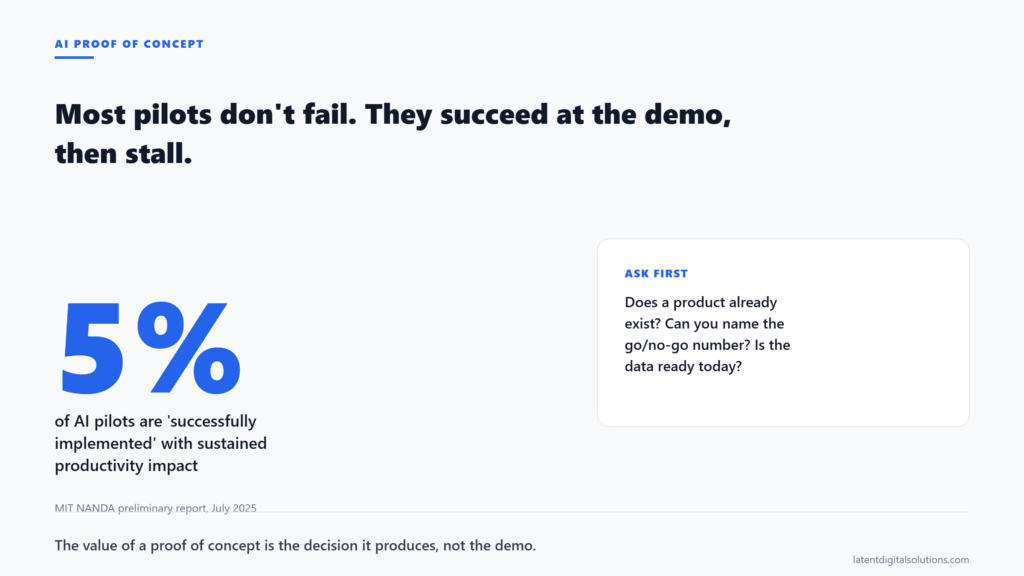
- 02.A July 2025 MIT NANDA preliminary report found that only 5% of AI pilots are “successfully implemented” — defined as tools causing a marked and sustained productivity or P&L impact. Most of the 95% did not fail; they succeeded at the PoC stage and then stalled in production.
- 03.Three questions before you commission anything: does a product already exist that does this? Can you name the one number that will decide go/no-go? Do you have the data the PoC needs, today?
- 04.The value of a proof of concept is the decision it produces, not the demo.
What is an AI proof of concept?
A proof of concept is a small, time-bounded test designed to answer one question: can this technical approach work for this specific problem? The deliverable is a decision — go, no-go, or not-yet — not a finished product.
If your proof of concept was an AI agent, our guide to the AI agent prototype explains how to decide whether to rebuild it or keep patching it.
Before you test, it helps to know which learning approach your data supports. Our guide to supervised vs unsupervised machine learning explains the choice with business examples.
An AI proof of concept is not the thing you will use. It is evidence that the thing you might build would be worth building. This distinction matters because a PoC that produces a compelling demo but cannot be reliably run by your team, integrated with your systems, or scaled to your actual data volume has answered the wrong question.
A well-scoped AI proof of concept has four characteristics that distinguish it from a poorly-scoped AI proof of concept: it tests one specific workflow rather than an entire process, it names the success criterion before starting, it runs on real data from day one, and it ends with a documented decision rather than a recommendation to do more testing. If a PoC proposal does not specify what number, percentage, or qualitative outcome will constitute a pass, ask for that before agreeing to anything.
When is an AI proof of concept the wrong thing to buy?
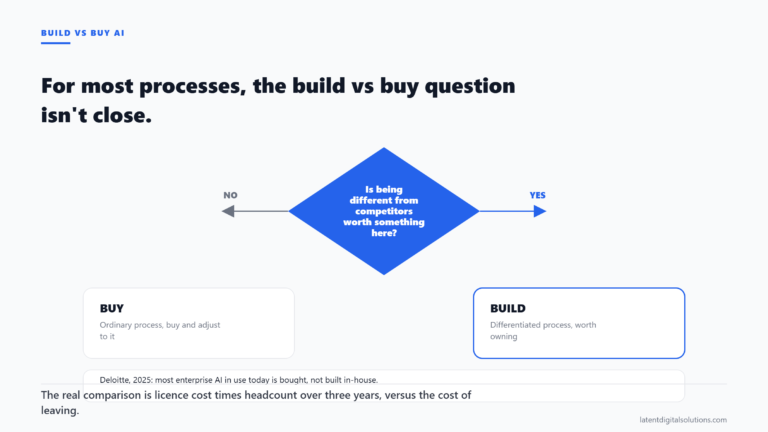
A paid AI proof of concept is the appropriate tool when the technical approach is genuinely uncertain — when the question “will this work” can only be answered by building a version of it. For many business problems, the technical approach is not uncertain. What is uncertain is whether the vendor’s existing product will fit your workflows and your team.
That second kind of uncertainty does not require an AI proof of concept. It requires a trial.
If a product already exists that does approximately what you need — a document extraction tool, an AI scheduling assistant, a contract review system — a two-to-four-week structured trial with your own documents and your own team answers the fit question without commissioning custom development. The trial is usually free or covered by a standard subscription. A PoC for a problem a product already solves is paying a development company to build something you could have evaluated for nothing.
MIT NANDA’s July 2025 preliminary report, covering 300+ disclosed AI initiatives and interviews with 52 organisations, found that about 5% of AI pilots achieve rapid revenue acceleration while the vast majority stall with little to no measurable P&L impact — reported by Fortune (fortune.com, retrieved September 2026). The research also found that buying a specialised vendor solution succeeds roughly 67% of the time, versus about a third that often for internal builds. The 95% who do not reach that outcome did not necessarily run bad pilots — many ran technically successful PoCs that then stalled when deployment revealed integration complexity, data problems, or adoption issues the PoC did not surface. For the wider set of blockers, see AI implementation challenges that stop projects at your size.
This is not an argument against PoCs. The AI Readiness Assessment Framework puts data and integration readiness before pilot work for exactly this reason: the conditions that cause a PoC to pass at demo stage and stall at production are detectable before the engagement begins, if you look for them.
What are the three questions to answer first?
Before commissioning an AI proof of concept, answer three questions about the AI proof of concept you are considering. If all three point the same way, a PoC is likely warranted. If any one of them does not, the PoC is probably the wrong next step.
| Question | What “no” means | Next step |
|---|---|---|
| Does a product already exist that does roughly this? | Technical approach uncertain — no product covers it | PoC may be warranted |
| Can you name the single number that will decide go/no-go? | You are not ready to define success | Define the criterion first |
| Do you have the data the PoC needs, today? | PoC will spend its budget on data work | Fix data readiness first |
Question one: does a product already exist that does roughly this?
Not a perfect product — roughly this. Search the category, request trials from two or three vendors, and run a structured two-week test with real documents and real users. If any existing product scores above your minimum threshold in the trial, you do not need a PoC. The answer to “will this work” is sitting in the trial results.
If no product exists that does roughly what you need — if the workflow is specific enough to your operations that off-the-shelf tools do not address it — then the technical approach is genuinely uncertain, and a PoC may be the right way to test it.
Question two: can you name the one number that will decide go/no-go before starting?
This is harder than it sounds. The metric needs to be specific, measurable, and consequential — something that would actually change a business decision if it came in above or below a threshold. “The AI extracts fields from our contracts with 90% accuracy” is a real metric. “The AI performs well” is not.
If you cannot name that number before the PoC starts, you are not ready to commission one. A PoC without a defined success criterion tends to end with a demo that looks impressive enough to justify further investment, regardless of whether the actual performance met a real business need. That is a good outcome for the vendor. It is not necessarily a good outcome for you.
Question three: do you have the data the PoC needs, today?
This is the question most often skipped, because the answer is often uncomfortable. AI proof of concept proposals frequently assume data quality and availability that does not exist in the client’s systems. A PoC that starts without the data it needs will spend its budget on data preparation work — labelling, cleaning, restructuring — and end with a conclusion that is really about the state of the data, not the feasibility of the approach. Before scoping one, run through five questions to answer about your data.
In Latent’s experience working with UAE businesses on AI scoping, data readiness problems are the most common reason a PoC does not produce a clean decision. The data exists in principle, but not in the format, volume, or accessibility the PoC requires on day one. A honest scoping conversation before the engagement starts catches this. A PoC proposal that does not ask about data structure in detail may not.
What does a well-scoped AI proof of concept look like?
A well-scoped AI proof of concept has four components that should be visible in any proposal before you sign it:
- One workflow, not one process — scope is narrow enough that the test produces a clean pass or fail
- A named success criterion agreed upfront — the number or outcome that constitutes a pass, set before work begins
- Real data from week one — not synthetic samples, not an export from six months ago
- A documented decision as the output — not “we recommend a pilot”
One workflow, not one process. A document extraction PoC that covers invoices is well-scoped. A document extraction PoC that covers all inbound documents is not — the variety in format, language, and structure makes the test ambiguous. The narrower the scope, the cleaner the decision at the end.
A named success criterion, agreed upfront. The criterion is the number or outcome that constitutes a pass. It should be set before the engagement starts, not negotiated after the demo. If it is not in the proposal, request it in writing before agreeing.
Real data from week one. A PoC that runs on synthetic or sample data for the first two weeks, then switches to real data in the final week, is not testing the thing that matters. The PoC should start with a representative sample of actual operational data — messy, inconsistently formatted, and from live systems.
A documented decision, not a recommendation for more testing. The output of a PoC is a decision memo: the test passed or it did not, here is why, here is the recommended next step. “We recommend a pilot” as the PoC output means the PoC did not produce a decision. That is sometimes appropriate — but it should be acknowledged as a result, not presented as a success.
Understanding which tools are best evaluated through trial versus PoC is part of this scoping work. OpenRouter and similar tool routing platforms represent a category where the evaluation question is almost always capability fit, not technical feasibility — the right answer is usually a structured trial rather than a custom proof of concept.
What should an AI proof of concept cost and how long should it take?
There is no standard price for an AI proof of concept, and any figure given for an AI proof of concept without knowing the scope is not useful. What determines cost and duration:
Data preparation. If the data required for the PoC does not exist in a usable form, the engagement includes data work — labelling, structuring, or extracting from source systems. This is often the largest cost item and the most frequently underestimated. A PoC proposal that does not include a data audit phase is likely underpriced.
Integration scope. A standalone PoC that runs in isolation from your production systems is cheaper than one that connects to your ERP, CRM, or document management system. The question to ask is: will the PoC run against live data in your actual environment, or against a data export? The answer determines both the cost and how much the result will reflect real operating conditions.
Model approach. Using an existing API (OpenAI, Anthropic, Google) for inference is significantly cheaper than fine-tuning a model or training from scratch. Most mid-size business use cases do not require custom training — they require a well-designed prompt, the right retrieval architecture, and clean data. A proposal that defaults to custom training for a use case that existing APIs handle should be queried. McKinsey’s State of AI 2025 research (gend.co, retrieved September 2026, summarising McKinsey’s findings) points to operating model and measurement — not model architecture — as the usual barrier to AI value, which is consistent with why most PoC costs sit in scoping and integration rather than in training a bespoke model.
Latent’s Services include AI scoping and proof of concept design — including the pre-engagement data and integration audit that determines whether a PoC is warranted, and what the right scope is if it is.
As a frame, a scoped quick win or assessment typically runs AED 9,000–37,000, and a proof of concept connected to one workflow on real data sits closer to AED 30,000–80,000, the single-workflow integration range in our AI integration services guide. If the data needs clean-up first, a week of remediation can add AED 20,000–40,000. These are ranges, not a quote for your project.
What happens after an AI proof of concept succeeds?
An AI proof of concept that passes its success criterion produces a decision: build this. That decision then needs a different kind of conversation than the PoC conversation.
The AI proof of concept tested technical feasibility in a controlled scope. Production deployment involves the full workflow at operating scale, with real users, real error rates, real integration dependencies, and a team that needs to adopt a new system alongside their existing one. Most of the 95% who do not reach successful implementation did not fail at the PoC stage — they failed in the gap between a successful demo and a deployed tool that people actually use.
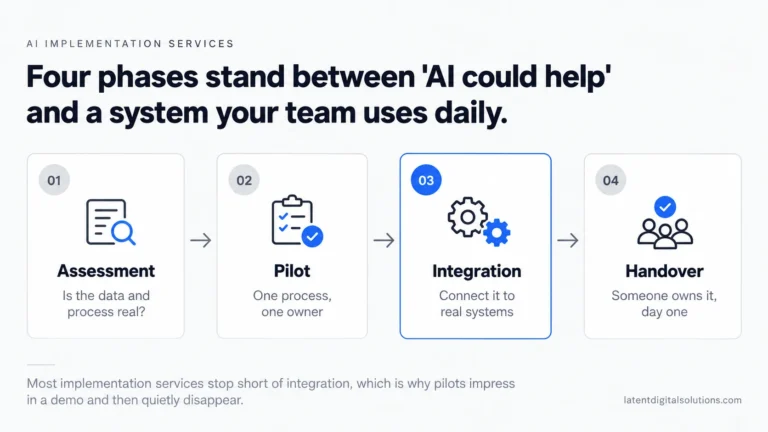
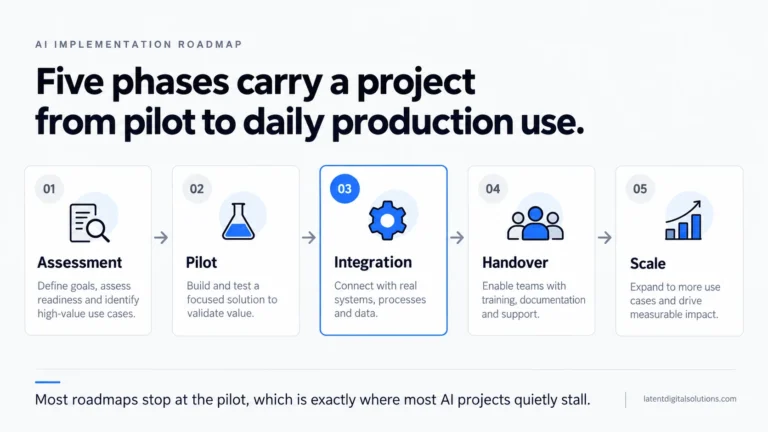
The questions that matter after a PoC succeeds: what is the deployment architecture for full scale? Who owns the system in production — who monitors it, retrains it, and handles edge cases? What is the rollout plan for the team using it? What is the switch-off date for the old process? These are not technical questions. They are operational questions, and they are answerable before deployment begins, which is when they need to be answered. The World Economic Forum’s 2025 guidance on scaling AI (weforum.org, retrieved September 2026) identifies strategy, data, and workforce readiness as the consistent gaps between a successful pilot and a deployed system — consistent with what the pilot-to-production funnel data shows. Where a proof of concept sits in the wider sequence is covered in the five phases from pilot to production.
An AI proof of concept that ends with a pass result and no defined path from demo to production is a successful experiment heading toward a shelf. The gap between demo and deployed is where the business value either materialises or disappears.
Once the proof of concept succeeds, the harder question starts — for a structured approach to that transition, moving an AI pilot to production in UAE businesses covers the structural steps that decide whether it scales.
Conclusion
An AI proof of concept belongs in a specific situation: the technical approach is genuinely uncertain and “will this work” can only be answered by building something. For most mid-size business AI questions, a structured trial of an existing product answers the same question faster and without commissioning custom development.
The three questions before commissioning anything — does a product already exist, can you name the go/no-go number, do you have the data today — take less than a week to answer. If all three point toward a PoC, commission one with a named success criterion, real data from day one, and a documented decision as the deliverable, not a recommendation to continue.
The value of an AI proof of concept is the decision it produces.
Start the conversation if you are trying to work out whether a PoC, a trial, or a scoping engagement is the right first step.
Frequently Asked Questions
What is an AI proof of concept?
An AI proof of concept is a small, time-bounded test designed to answer one question: can this specific technical approach work for this specific problem? The deliverable is a decision — go, no-go, or not-yet — not a finished product. A PoC is appropriate when the technical approach is genuinely uncertain. When the question is whether an existing product fits your workflows, a structured trial answers it faster and without commissioning custom development.
How do I know if I need an AI proof of concept or just a trial?
If a product already exists that does roughly what you need, start with a trial. A two-to-four-week structured test with your own data and your own team answers the fit question without paying for custom development. A PoC is warranted when no existing product addresses your specific workflow — when the approach you need to test does not yet exist as a purchasable system. Most mid-size business AI problems land in the trial category, not the PoC category.
What should be in an AI proof of concept proposal?
Four things: the specific workflow being tested (one workflow, not one process), the success criterion agreed upfront (the number or outcome that constitutes a pass), a confirmation that the PoC will run on real operational data from week one, and a clear output — a decision memo, not a recommendation for more testing. A proposal that lacks any of these should be queried before signing.
What does an AI proof of concept typically cost?
There is no standard price — cost depends on whether data preparation is required, the integration scope, and whether the approach uses existing APIs or custom model development. Most mid-size business use cases do not require custom model training; they require a well-designed architecture and clean data. A PoC proposal that does not include a data audit phase is typically underpriced and underscoped.
What happens after a PoC succeeds?
The PoC produced a decision: build this. The next conversation is different — it covers deployment architecture, who owns the system in production, the rollout plan for the team using it, and the switch-off date for the old process. Most AI implementations that do not reach production failed in this gap, not at the PoC stage. Answering the post-PoC operational questions before deployment begins is where the business value is either secured or lost.
Why do most AI pilots not reach production?
A July 2025 MIT NANDA preliminary report found that only 5% of AI pilots reach “successfully implemented” status. The most common reasons are not technical failures at the PoC stage — they are integration complexity, data problems, and adoption challenges that the PoC did not surface because it ran in a controlled environment. A PoC that runs on real data, in real systems, with real users from day one is significantly more predictive of production outcomes than one that runs in isolation.
Once a proof of concept proves the concept, the harder work begins. The AI pilot to production guide covers the 12-week transition checklist, integration audit, and the production readiness process UAE businesses use to move from a successful PoC to a live system.
An AI proof of concept is supposed to answer one question: does this actually work for your business. Most guidance on how to run one is written by the same companies trying to sell you the engagement, which doesn’t make the advice wrong, but does mean the incentives are worth knowing before you read it. This covers what a proof of concept should actually prove, and when it’s the wrong step to take first.
Usually a reply within one working day.