Article Overview
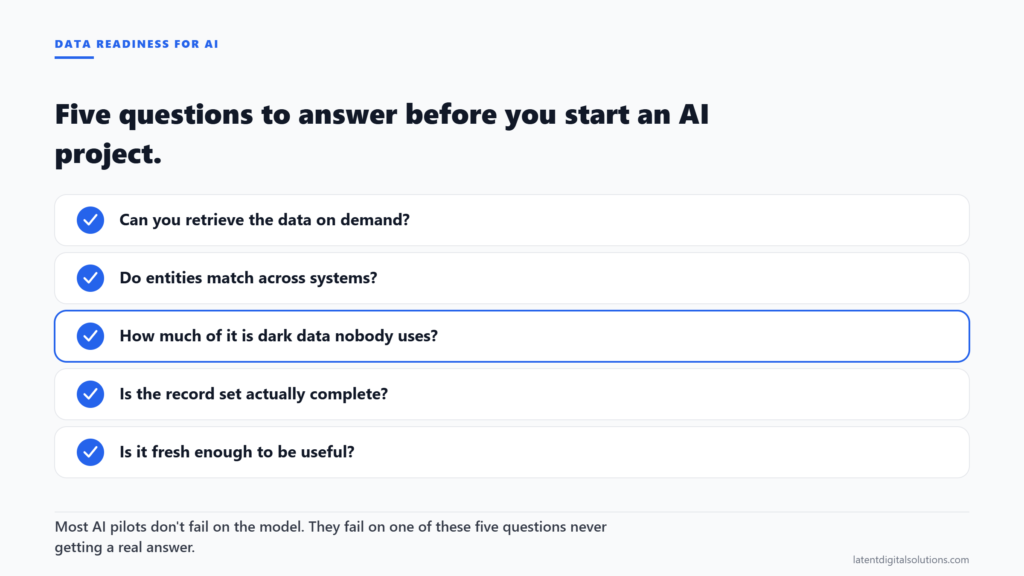
Data readiness for AI comes down to five plain questions about your own data — not a platform assessment or a maturity framework sold by the company answering it. If you can answer all five honestly in an afternoon, your data readiness for AI is good enough to proceed; if you can’t, no platform purchase changes that.
UAE companies planning their first AI deployment do not need a platform assessment. They need five plain questions they can answer about their own data in an afternoon. If the answers are good, an AI project is feasible. If the answers are bad, no platform purchase changes that — and fixing them has value regardless of whether AI is part of the plan at all.
Key takeaways
- 01.According to a Q3 2024 Gartner survey of 248 data management leaders, 63% of organisations either do not have, or are unsure whether they have, the right data management practices for AI.
- 02.Data readiness for AI comes down to five questions: can you retrieve it, is the same entity named consistently, is it complete enough, is it fresh enough, and does anything critical still live only in email?
- 03.The fixes required to pass these questions have value in reporting and operations even without any AI project — readiness work is not sunk cost.
- 04.An AI project that stalls in week three because the data cannot be pulled without manual retyping costs more than the licence fee — in time, trust, and the twelve-month gap before the next attempt.
What does data readiness for AI actually mean?
Not “clean data” and not “a data lake.” Data readiness for AI means: the data that describes the process you want to automate is available, consistent, complete, recent enough, and reachable by a system without a person in the middle.
That is five conditions for data readiness for AI, and most organisations fail at least one of them on the first process they try to automate.
Gartner’s definition is close to this in practice. According to a Q3 2024 Gartner survey of 248 data management leaders (gartner.com, retrieved September 2026), 63% of organisations either do not have, or are unsure whether they have, the right data management practices for AI. The same research predicts that through 2026, organisations will abandon 60% of AI projects that are unsupported by AI-ready data. The condition matters: projects fail not because AI does not work but because the data it needs is not in the form it needs to be in.
Data readiness for AI is not a one-time audit. It is a property of a specific process’s data, evaluated before that process is selected for an AI project.
Can you get your data out without retyping it?
This is question one, and it rules out more candidates than any other.
The test: pick the process you want to automate. Now describe how you would get twelve months of data from that process into a spreadsheet. If the answer involves asking someone to reformat an export, combine multiple systems manually, or transcribe records from a field in one system to a format another can read — the data is not retrievable without a person in the loop.
Most ERP systems can export. Most exports require someone to choose the fields, set the date range, and often clean the result. That is not retrieval — it is a recurring task. An AI system that depends on a recurring manual export is not automated; it has a hidden human step. If old systems are what is trapping the data, see legacy modernization for UAE businesses.
For data readiness for AI, the practical fix is not always a data warehouse. For a first AI project, a daily or weekly automated export to a shared folder — one that runs without anyone initiating it — is often enough. The question is whether that export exists, not whether the architecture is elegant. The AI Readiness Assessment Framework maps data retrievability alongside the other readiness dimensions — people, process, and governance — in a format designed for a non-technical owner to complete.
A 2026 report from Cloudera and Harvard Business Review Analytic Services (cloudera.com, retrieved September 2026) found that siloed data and integration difficulty (56%) rank as the top obstacle to enterprise AI adoption — ahead of data quality concerns (41%). Access and integration, not the underlying content of the data, is where most organisations actually get stuck.
Does the same customer exist once or three times?
Entity consistency is the second question in data readiness for AI, and the one that most often comes as a surprise.
A common data readiness for AI symptom: you ask for all transactions with a customer over the last year and the system returns three records — one with their trading name, one with their registered legal name, and one with a legacy entry from before a company name change. The data is all there. It describes the same organisation. The system does not know that.
Entity consistency is not a data quality problem in the conventional sense — there is nothing wrong with any individual record. It is a data model problem: the same real-world thing is represented multiple times, with no link between representations. AI systems trained on this data learn to distinguish the three entities, not to recognise them as one.
The practical check: run a query for your ten largest customers. Look at how they appear across your ERP, your CRM, and your accounts system. If the same entity appears under different names, with different identifiers, in different systems, entity resolution is a prerequisite before any AI project that spans those systems.
Enterprise AI Security covers one consequence of this directly: an AI system trained on inconsistently identified entities can produce outputs that expose one customer’s data to another — not through a system breach but through a model that has learned to treat the entities as interchangeable.
What is still only in someone’s inbox?
The third question in data readiness for AI is about dark data — records that exist but are not in any system that can be queried.
The most common form: a supplier sends certificates of conformity, quality records, or compliance documents by email. They are received, opened, checked against a specification, and either filed in a folder or deleted. The information in them — whether a batch passed, which standard it was certified to, who signed off — never enters the ERP. It exists only in the email thread and, if the recipient is careful, a folder named by date.
This is not an edge case. In most UAE manufacturing and trading businesses, a large share of the data that governs supplier quality, customs compliance, and batch traceability lives in email threads rather than systems. Any AI use case that touches supplier quality, procurement compliance, or logistics documentation needs this data — and it is not retrievable.
The fix for dark data is not complex, but it requires a change to an existing process: the information captured in email must also be entered into a retrievable system at the point of receipt. This is a workflow change, not a technology change.
How do you fix data readiness for AI gaps in a sensible order?
The order matters when fixing data readiness for AI gaps. Not every gap needs to be fixed before a project can start.
The data readiness assessment framework published by NIST (nist.gov, retrieved September 2026) notes that data quality requirements are use-case specific — a model that summarises documents has different data requirements than one that forecasts demand, which has different requirements than one that monitors for anomalies. Fixing all gaps before starting any project is a years-long prerequisite. Fixing the gaps relevant to the first use case is a weeks-long one.
The practical sequence:
First: Confirm retrievability for one process. Set up the automated export or query for the specific dataset the first use case requires. Everything else can wait.
Second: Check entity consistency for that dataset only. If the use case does not span multiple systems, entity resolution is not required for phase one.
Third: Assess completeness for the specific output. A demand forecast needs volume and date. It does not need the sales rep’s name or the promotional discount applied to the order. Completeness is relative to the use case.
MVP to Production — getting a working AI pilot into actual production use — depends on this sequencing. The projects that stall between pilot and production are almost always the ones where the data scope for production was never confirmed against the data scope of the pilot. Production uses more data, from more sources, at higher frequency. If that gap is not mapped before the pilot is approved, it appears as a blocker three months later. For manufacturing examples, see AI use cases in manufacturing that work without a smart factory.
What if you never adopt AI at all?
Data readiness for AI work still pays off, even here.
The five questions — retrievability, entity consistency, dark data, completeness, freshness — are also questions about operational data quality for reporting, auditing, and management decisions. An organisation that can pull twelve months of process data from one system without manual retyping, with customers identified consistently, and with no significant decisions living only in email, has better reporting, faster audits, and clearer management information regardless of whether AI is part of the picture.
This is the information-gain section of this article that no data-platform vendor includes. Their business model depends on AI being the reason for the purchase. The practical reality is that the prerequisite work for AI readiness is useful infrastructure — and if the AI project is later paused, delayed, or descoped, the infrastructure remains. Ready to scope a GPT-based project? See OpenAI consulting for UAE businesses.
Start the conversation to map which of your current processes pass the five questions above and which require remediation before an AI project can be scoped against them.
Conclusion
Data readiness for AI reduces to five questions: can the data be retrieved without a person in the loop, is the same entity named consistently across systems, is relevant data still trapped in email, is the dataset complete enough for the use case, and is it recent enough to reflect current operations?
Organisations that cannot answer yes to all five for a specific process have a readiness gap on that process — not a platform gap and not a capability gap. The fix for each question is specific and bounded. It does not require a data transformation programme. And the value of fixing it accrues regardless of whether an AI project follows.
Frequently Asked Questions
What is data readiness for AI?
Data readiness for AI means that the data describing a specific process is available (retrievable without manual intervention), consistent (the same entity is named the same way across systems), complete enough for the use case, recent enough to reflect current operations, and not trapped in unstructured systems like email. It is evaluated per process, not organisation-wide, because readiness is use-case specific. A July 2024 Gartner survey found that 63% of organisations either do not have, or are unsure whether they have, the right data management practices for AI.
How do you assess data readiness for AI?
Answer five questions for the specific process you plan to automate: Can you pull twelve months of data from this process without manual retyping? Does the same customer or supplier appear under one identity across all relevant systems? Does any decision-critical data for this process exist only in email? Is the dataset complete enough for the AI output you need? Is it recent enough to reflect how the process runs today? Any no answer identifies a specific remediation before the project starts.
How long does data readiness for AI preparation take?
For a single, well-scoped first AI project, confirming retrievability and checking entity consistency for one dataset typically takes two to four weeks, assuming the ERP can generate an automated export. Fixing dark-data gaps — moving information from email into a queryable system — requires a process change and usually takes four to eight weeks to embed. Organisation-wide data readiness is a multi-year programme; use-case-specific readiness is not.
What is the difference between data quality and data readiness for AI?
Data quality refers to the accuracy, completeness, and consistency of individual records. Data readiness for AI is broader: it includes whether the data is accessible at all (retrievability), whether the right entities are linked across systems, and whether the data structure matches what the AI use case requires. A dataset can have high data quality in every individual record and still fail a readiness assessment if it is not retrievable without a person or if the same entity appears under multiple identities.
Can you start an AI project without fully ready data?
For a narrowly scoped first project, yes — if you can confirm retrievability and basic consistency for one specific dataset. The risk is that the data scope expands between pilot and production. Projects that stall between those stages almost always stall because the production data requirements were never confirmed against the pilot data scope. Scoping the pilot against the actual production dataset is the most reliable way to avoid this.
Does data readiness for AI apply to small businesses?
Yes, and often more acutely. Small businesses are more likely to have critical data in email, to have a small number of people who know where data lives, and to lack automated exports from legacy systems. The five questions above require no technology investment to answer — only the time to pull a sample and check it. The remediation steps, where needed, are process changes rather than infrastructure purchases.
Usually a reply within one working day.