Article Overview
Most AI tools for change management on the market are built for enterprise change teams running formal adoption programmes — not for a business with eleven people and one spreadsheet to retire. The tools that actually help at that smaller scale are just two: in-app guidance and usage analytics, and neither works without a set date to switch the old process off.
UAE businesses rolling out a new AI system usually have no change team at all — there is one person, usually the owner or the head of operations, trying to shift eleven people’s habits while managing everything else. The first kind of AI tools for change management — communication drafting, sentiment analysis, adoption tracking at scale — is built for a 3,000-person organisation with a transformation office, not this situation.
Key takeaways
- 01.“AI tools for change management” covers two different questions: tools for change professionals and tools for managing AI adoption. Most search results answer the first; most business owners asking the question mean the second.
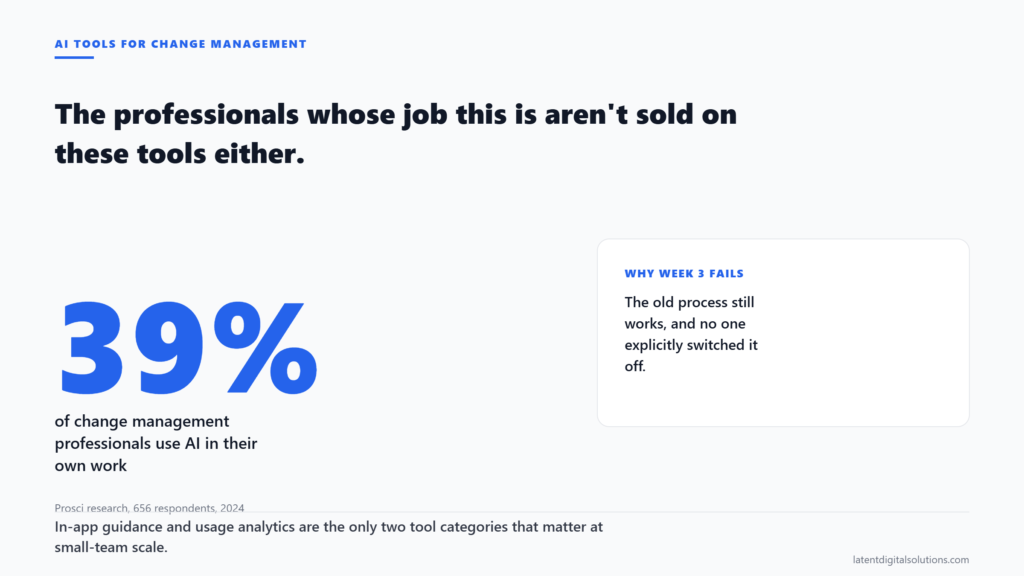
- 02.Prosci’s 2024 research of 656 change management respondents found that only 39% use AI in their change management work — the professionals whose job this is are not yet confident in these tools either.
- 03.The reason new systems stop being used in week three is almost never the tool — it is that the old process still works and no one explicitly switched it off.
- 04.In-app guidance and usage analytics are the two categories of software that provide genuine leverage at small-team scale. Everything else is optional.
What do AI tools for change management actually do?
In the commercial sense, AI tools for change management fall into roughly four categories:
Communication drafting — AI writes the change communication: the announcement email, the FAQ, the update message. This speeds up a task that used to take a change manager two hours.
Sentiment analysis — AI reads survey responses, meeting notes, or Slack messages and identifies concerns or resistance patterns at scale. Useful when the affected population is large enough that a human cannot read everything.
In-app guidance — software that sits on top of the new system and shows users what to click, step by step, the first time they perform a task. Walkthroughs, tooltips, checklists built into the interface.
Adoption analytics — dashboards that show who is logging in, how often, which features they are using, and where they stop. Real usage data rather than self-reported adoption.
Of these four categories of AI tools for change management, only the last two are relevant at small-team scale. Communication drafting saves time that a small-business owner does not spend — the announcement is one email and it takes fifteen minutes. Sentiment analysis is designed for populations of hundreds. In-app guidance and adoption analytics produce value regardless of team size.
Are AI tools for change management managing change, or managing AI adoption?
The phrase “change management for AI” covers two different problems.
The first is change management as a discipline applied to AI: using established frameworks — Prosci’s ADKAR, Kotter’s 8 steps — to run an AI transformation programme. This is what large organisations with HR and organisational development functions do. It involves stakeholder analysis, resistance mapping, communications plans, reinforcement mechanisms. It assumes people whose job is managing the change.
The second is the practical problem of getting a team to use a new system. This is what most business owners mean, and it does not require a methodology. It requires three things: making the new way easier than the old way on day one, making the old way unavailable at some specific point, and checking actual usage at week two rather than asking people how it is going.
According to Prosci’s 2024 research of 656 change management respondents (prosci.com, retrieved September 2026), only 39% of change professionals currently use AI in their change work. Among the stated reasons for not using it: privacy and security concerns, unclear accuracy, and — the honest one — insufficient time. If the professionals whose job is change management have mostly not integrated these tools, that should reset expectations for a business owner evaluating a six-product comparison on a listicle.
The UAE’s National Strategy for AI 2031 (oecd.ai, retrieved September 2026) sets a national-level push toward broad AI adoption — a push that only converts into real usage if the people side of adoption is handled deliberately, not left to the technology. The AI Adoption Framework maps the non-tool side of this — governance, process design, and the internal ownership model — which is what most AI tool comparisons skip. The framing applies directly: tools support change, but they do not cause it.
What works when there is no change function for AI tools for change management?
Five things, in order:
Name one person responsible for the transition. Not a committee. One person who checks usage, answers questions, and escalates blockers. If that person is you, block the time explicitly before the rollout starts.
Set a switch-off date for the old process. The reason new systems fail to stick is that the old way still works. If the spreadsheet is still accessible and familiar in week three, the team will use it. “We’re switching off [the old process] on [date]” is the most effective change management intervention available, and it does not require any software.
Run a live session in week one. Not a demo. A live session where each person in the team completes their actual first task in the new system while the owner watches. Problems surface in real time. This is in-app guidance delivered by a person rather than software, which is often faster for a small team.
Check usage data at day eight. Not day thirty. If three of eleven people have not logged in by day eight, find out why before they fully reinstate the old habit. Usage data is only useful if someone looks at it early enough to act on it.
In Latent’s experience implementing AI tools in UAE businesses, the moment most critical to adoption is not the go-live day — it is week three. Week one runs on novelty. Week two runs on reminder. Week three is where the team decides whether the new tool is actually part of how they work, or an experiment that is winding down.
Which AI tools for change management can software genuinely help with?
Two categories that genuinely add value at small-team scale:
In-app guidance software provides step-by-step walkthroughs overlaid on the new system’s interface. The first time a user performs a new task, a guide appears showing exactly what to click. The benefit is not that it replaces training — it is that it is available at 3pm on a Wednesday when the user has forgotten how to run the task they were shown in the launch session. IBM’s analysis of AI adoption tooling (ibm.com, retrieved September 2026) identifies in-app guidance as the category that most reliably reduces support burden during rollout.
Usage analytics, one of the two AI tools for change management worth paying for, shows who is logging in, when, and what they are doing. The value is that it replaces “I think the team is using it” with a number. At small-team scale this is not a sophisticated BI dashboard — it is usually a built-in report in the new system itself. The question to ask before purchasing any AI tool is: does it show me who is using which features, at what frequency, and where they stop? Grok Bot use cases in business covers how AI-native tools embed usage tracking — the adoption analytics pattern that helps teams know whether the tool is actually being used.
AI that drafts change communications and AI that analyses sentiment are both genuinely useful at scale. At 11 people, they are features you will not use enough to justify the additional cost or complexity.
Scoping AI tools for change management — specifically the transition design question: what is the rollout plan, who is responsible, what is the switch-off date, and how will usage be confirmed in week two — is where the technology decision ends and the people decision begins.
Why do AI tools for change management stop being used in week three?
Not because the tool is bad. Because the old way still works.
This is the point none of the AI tools for change management comparison articles address, because it has nothing to do with tools. The spreadsheet is still accessible. The person who was fastest on the old system is still faster on it. The new system has a slightly different layout and requires a login. In the friction contest between familiar and new, familiar wins by default.
The technical term for this in change management is “reinforcement” — the set of mechanisms that make the new behaviour easier or more rewarded than the old one, consistently, after the initial launch energy has dissipated.
For a small team, reinforcement comes down to two things: removing the old process (the switch-off date) and confirming that outputs produced in the old way are not accepted after the date. If a manager still accepts a report produced in the old spreadsheet, the team’s conclusion is that the switch-off was not real.
Latent’s Services include this rollout design work alongside the technology implementation — the combination that determines whether the tool actually gets used.
Want this scoped for your business?
Talk to our AI transformation consulting team in the UAE. We start with a working prototype, not a large proposal.
Conclusion
Most AI tools for change management on the market were built for enterprise change teams, not for small businesses rolling out AI tools for change management on their own. They are useful at scale, and they address problems a small business owner does not have. The tools that are useful at small-team scale are the ones that show actual usage data and provide in-app guidance for the new system.
The non-tool interventions — naming one owner, setting a switch-off date, checking usage at day eight — predict adoption outcomes better than any software choice. They require time and attention rather than a product purchase.
If a new AI system stops being used in week three, the question is not which AI tools for change management to add. The question is whether the switch-off date was set and enforced.
Start the conversation to scope an AI tool rollout that includes the transition design — not just the technology.
Frequently Asked Questions
What are AI tools for change management?
There are two categories with the same name. The first covers tools designed for change management professionals: AI that drafts communications, analyses survey sentiment, and tracks programme adoption at scale. The second covers tools that help a business manage the adoption of a new AI system: in-app guidance and usage analytics. Most commercial tools are built for the first category. Small businesses rolling out a new AI system are in the second.
How do you get a team to actually use AI tools for change management?
Four actions in order: name one person responsible for the transition, set a switch-off date for the old process, run a live session in week one where each team member completes their first real task in the new system, and check usage data at day eight. Prosci’s 2024 research found that even change management professionals — whose job is making change stick — have mostly not yet adopted AI tools in their own work, which tells you that adoption is not automatic even for motivated users.
Why do AI tools for change management fail to get adopted after launch?
The most common reason is that the old process remains available. If the team can still use the spreadsheet, the CRM, or the email thread they were using before, they will — especially when the new system is unfamiliar and the old one is fast. The decisive intervention is not a better tool; it is a specific date on which the old process is switched off and outputs produced in the old format are no longer accepted.
Do small businesses need dedicated AI tools for change management?
For most AI tool rollouts at 5–50 people, the change management work does not require dedicated software. One person with a calendar reminder, a usage report from the new system itself, and a confirmed switch-off date is sufficient. In-app guidance built into the tool is useful if the new system has complex workflows. Standalone change management platforms are designed for transformation programmes affecting hundreds of people.
What is the difference between AI change management and change management for AI?
AI change management means using AI tools to run change programmes — communication drafting, sentiment analysis, adoption tracking. Change management for AI means managing the people-and-process change caused by adopting an AI system. Most business owners searching “AI tools for change management” mean the second; most articles on the first page mean the first. This article covers the second.
What should week one of rolling out AI tools for change management look like?
One live session where each team member completes their first real task in the new system with the owner present. Not a demo, not a recording. The live session surfaces real problems — login issues, unclear workflows, missing permissions — before they become reasons to stop using the system. The owner’s visible engagement in week one signals that the rollout is real, which is the first reinforcement mechanism.
Usually a reply within one working day.