Article Overview
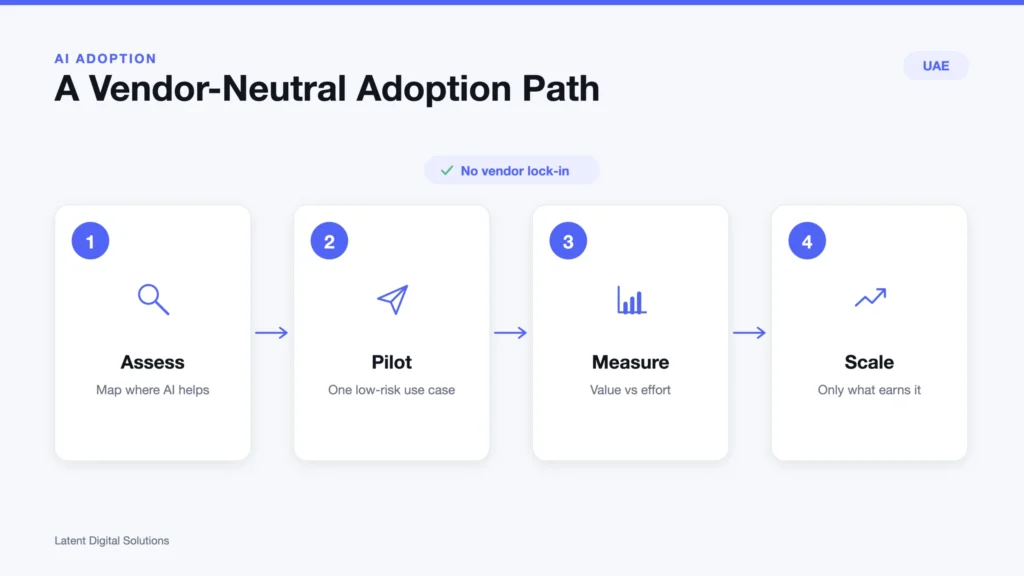
Most AI adoption frameworks published online are built by a vendor to sell their own platform. Follow one and you end up locked into whichever tools that vendor sells, not a structure that fits how your business actually operates. A real AI adoption framework should work regardless of which tools you eventually choose, starting with the decision of where AI is worth adopting at all.
An adoption framework for your business should do the opposite: decide what AI tools are allowed, who signs off, and how you stay in control, independent of whose cloud any of it runs on.
- Most published AI adoption frameworks are platform-specific, even when they don’t say so upfront.
- A vendor-neutral framework has three real parts: what’s allowed, who approves it, and how it’s reviewed.
- Skipping a framework doesn’t stop AI adoption. It just means it happens without anyone deciding it should.
- Unsanctioned tool use is common even at companies with a formal AI policy on paper.
What is an AI adoption framework in plain terms?
A working AI adoption framework is a short, written answer to three questions: which AI tools can people at your company use, who approves a new one before it touches real work, and how often that list gets reviewed. Everything else vendors add on top of that is either useful detail or a sales pitch.
Enterprise AI adoption frameworks dress this up with maturity models, capability matrices, and readiness scores. Those aren’t wrong, they’re just built for organisations big enough to need a scoring system to keep track of forty tools across twelve departments. A business with one operations team and a handful of people using AI day to day doesn’t need a maturity model. It needs a one-page answer to the three questions above.
Why are most AI adoption frameworks really vendor sales tools?
Because whoever writes the framework usually also sells the platform it recommends. A cloud provider’s AI adoption framework will walk you through governance, security, and rollout, all correctly, and every example will run on their infrastructure. That’s not dishonest, it’s how vendor content works. But it means “framework” and “onboarding plan for our product” quietly become the same document.
The cost of an AI adoption framework built the vendor’s way shows up later. A framework built around one vendor’s tools makes switching expensive even when a better tool exists, because your approval process, your logging, and your team’s habits are all shaped around that one platform. A vendor-neutral framework separates the decision of what’s allowed from the decision of which vendor sells it, so evaluating a new tool doesn’t mean rebuilding your governance from scratch. Tooling built specifically to sit above any single vendor, the way OpenRouter routes between models, is one practical example of what that separation looks like at the tool level rather than just the policy level.
How do the big vendor frameworks compare?
Three frameworks come up most often when you search for an AI adoption framework, and each comes from a cloud vendor:
- Microsoft’s Cloud Adoption Framework: seven adoption phases, Strategy, Plan, Ready, Adopt, Govern, Secure and Manage, with guidance for adopting AI on Microsoft’s cloud.
- The AWS Cloud Adoption Framework for AI, ML and generative AI: an adoption cycle that starts with an Envision stage, built on foundational capabilities across business, people, governance, platform, security and operations.
- Google Cloud’s AI Adoption Framework: organised around four themes: people, process, technology and data.
They are useful references, and they agree on more than they differ: all three cover business value or strategy, people and skills, data, technology, and governance and security. Where they differ is the platform they assume. Each is written to help you adopt AI on that vendor’s cloud, which is why a vendor-neutral version is worth having. The sections below keep what they share and drop the platform assumption.
What are the parts of an AI adoption framework that actually matter?
Three things make up an AI adoption framework that works: an allowed-tools list, an approval step before anything new goes live, and a review point where the list gets revisited. Everything past that is implementation detail specific to your business.
The allowed-tools list. Not every AI tool a team wants to try, just the ones cleared for real work with real data. This should distinguish between low-risk use (drafting internal notes, summarising a public document) and higher-risk use (anything touching customer data, financials, or code that ships to production).
The approval step. Someone has to say yes before a new tool moves from “someone’s trying it” to “the team relies on it.” In an AI adoption framework this doesn’t need to be a committee. For most businesses this size, it’s one named person who asks a short set of questions: what data does this touch, where does that data go, and what happens if the tool disappears tomorrow.
The review point. Tools and their terms change. A tool that was fine to approve six months ago may have changed its data-retention policy since. A quarterly five-minute check against the allowed list catches this before it becomes a problem instead of after.
How do you decide which AI tools are allowed?
By what data the tool touches, not by how popular or well-reviewed it is. A tool that only ever sees public information is a much smaller decision than one that sees customer records or unreleased financials, regardless of which one is more well known.
A workable way to sort this: does the tool touch anything you wouldn’t want to see reused elsewhere, and does the vendor’s own terms let them train on what you send them. Free consumer versions of most AI tools default to using your input for training unless you specifically opt out or pay for a business tier that excludes it. That single setting, checked once, resolves most of the actual risk without needing a longer policy document.
Who signs off before a new tool goes live?
Whoever already owns the decision it touches, not a dedicated AI committee that doesn’t exist yet at your size. If a tool affects how customer enquiries get handled, whoever owns that process signs off. If it touches financial reporting, that’s finance’s call.
This is the part enterprise frameworks get wrong for a smaller business: they assume a cross-functional governance board, because at their scale that board already exists for other reasons. A business without one doesn’t need to invent it just for AI. The approval just needs to sit with someone who’ll notice if the tool starts behaving differently, which is usually the person closest to the work it touches. If you’re weighing whether that oversight is something to build in-house or bring in help for, it’s worth seeing the broader picture of what a technology partner can support across our services rather than assuming it’s all or nothing.
How do you review it as things change?
On a fixed schedule, not only when something goes wrong. A quarterly ten-minute check: which tools are still in active use, has anyone added one without going through approval, and has any vendor changed its terms since the last review.
Adoption without a framework doesn’t mean adoption doesn’t happen, it just means it happens without anyone deciding it should. A 2026 SAP and Oxford Economics survey of director-level respondents found that 68% of organisations report staff using unapproved AI tools at least occasionally, often because getting an unofficial tool approved feels slower than just using it quietly. A short, honest review catches that drift long before it becomes a real exposure, and it’s a lot less work than the incident response that follows finding out about it late.
Conclusion
An AI adoption framework for a business your size doesn’t need a maturity model or a governance board. It needs three things written down: what’s allowed, who approves the next thing, and when the list gets reviewed. The vendor-authored versions of this online usually work fine as a checklist, as long as you notice which parts are genuinely about control and which parts are quietly about which platform you end up locked into.
If you want a second pair of eyes on what your team is already using versus what’s been approved, talk to us — that conversation usually surfaces more than either side expects. If you want help turning a framework into a first working use case, see our AI Transformation service, or use our AI readiness self-check to see where you stand first.
Frequently Asked Questions
What are the phases of AI adoption?
Most versions of an AI adoption framework describe three real phases regardless of how many they list: deciding what’s allowed, approving specific tools against real use cases, and reviewing that list as tools and terms change. Enterprise material often splits this further, but those three cover what a smaller business needs to do.
How do we measure AI adoption?
For a business this size, the honest measure isn’t a maturity score, it’s whether the tools people are actually using match the tools on your approved list. A short quarterly audit answers that more reliably than any scoring framework.
What are the four stages of AI adoption?
Awareness, evaluation, approval, and review is a reasonable way to name them, but the two that matter most in practice are approval (someone signs off before real data flows through a new tool) and review (that decision gets revisited, not left in place forever).
What is an AI adoption strategy?
It’s the framework above plus a sense of sequence, which tools to evaluate first, based on which parts of the business would benefit most and which carry the least data risk to start with. The strategy is the ordering; the framework is the ongoing set of rules.
Do we need a formal AI policy document before allowing any AI tool use?
Most AI adoption frameworks published online are built by a vendor to sell their own platform. Follow one and you end up locked into whichever tools that vendor sells, not a structure that fits how your business actually operates. A real AI adoption framework should work regardless of which tools you eventually choose, starting with the decision of where AI is worth adopting at all.
What are the main AI adoption frameworks?
The three most cited come from cloud vendors: Microsoft’s Cloud Adoption Framework (seven phases from Strategy to Manage), the AWS Cloud Adoption Framework for AI, ML and generative AI, and Google Cloud’s AI Adoption Framework (people, process, technology and data). They share the same core themes. A vendor-neutral framework keeps those themes without assuming which cloud you use.
Usually a reply within one working day.