Article Overview
A data strategy for AI, as Bain, Google Cloud, AWS and IBM describe it, assumes you already have a data warehouse, a data team, and a governance board to run both. Most fast-growing UAE businesses are five to fifty people running on an accounting system, a CRM, and a spreadsheet someone updates by hand, nowhere near that starting point. The real question is what a data strategy actually looks like before any of that infrastructure exists.
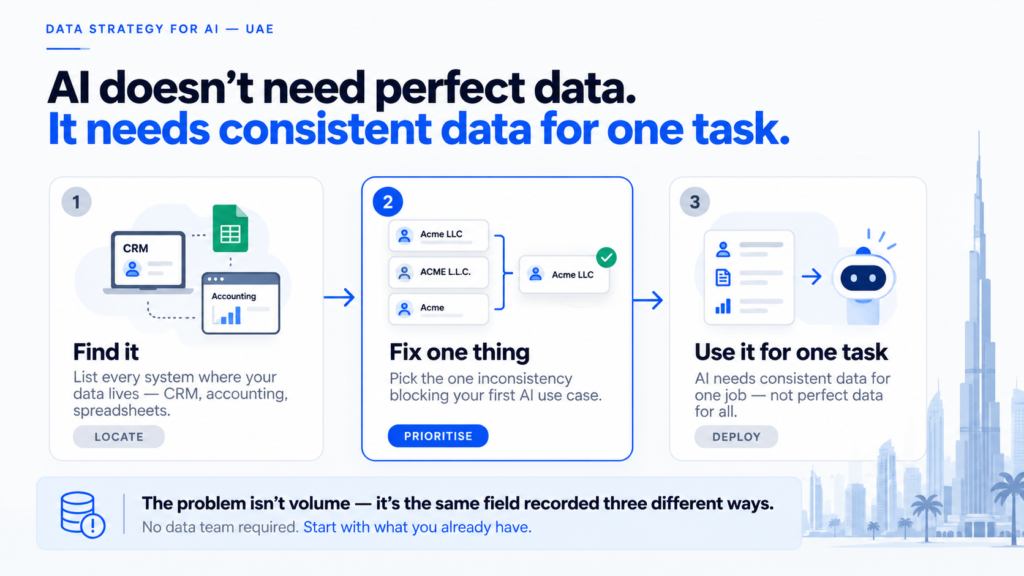
A working data strategy for AI doesn’t start with infrastructure. It starts with knowing what data your business has, where it sits, and which piece of it is worth fixing first.
- Most data strategy advice assumes a data team. A business without one needs a much smaller starting point.
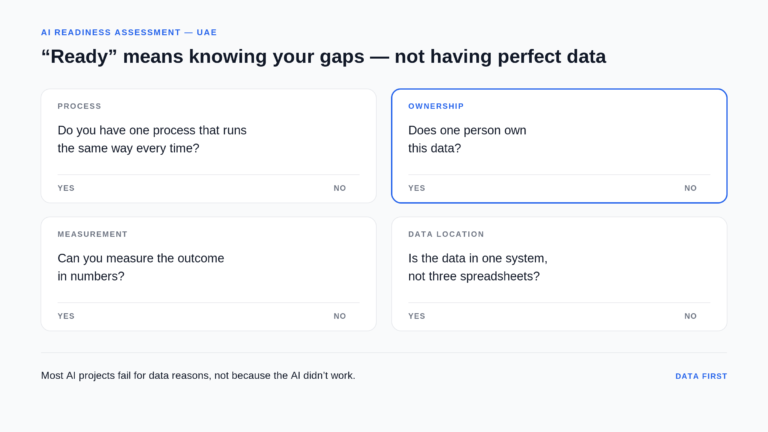
- AI doesn’t need perfect data. It needs data that’s consistent enough to trust for one specific task.
- The biggest data problem for most small businesses isn’t volume, it’s that the same information is recorded three different ways in three different systems.
- Enterprises with entire data teams are struggling with this too, which says something about how hard “data readiness” actually is.
Why does a business need a data strategy for AI at all?
A data strategy for AI starts here: AI tools are only as reliable as the data they’re shown, and most businesses have never looked closely at what that data looks like. A tool trained or prompted on inconsistent records produces inconsistent output, and the fault gets blamed on “the AI” rather than the mess underneath it.
This isn’t unique to small businesses. A March 2026 study from Harvard Business Review Analytic Services and Cloudera found that only 7% of enterprises say their data is completely ready for AI, and more than a quarter call it not very or not at all ready. These are companies with dedicated data teams, so the honest takeaway isn’t that a business your size is behind, it’s that data readiness is a genuinely hard problem regardless of size, and most of the enterprise material on this topic is written by people still solving it themselves.
What does “good enough” data actually look like?
Not perfect, not centralised, not warehoused. Good enough means the answer to a specific question is consistent no matter which system you pull it from.
If someone asks “how many active customers do we have” and your CRM says 340 while your invoicing system says 290, that gap is the real problem, not the absence of a formal data strategy for AI. Good enough data means picking the field that matters for a given task (customer status, order total, ticket category) and making sure it’s recorded the same way everywhere it’s entered, even if the rest of the business stays exactly as unstructured as it is today.
Where is your business data actually sitting right now?
Almost certainly in three or four separate places that were never designed to talk to each other: an accounting platform, a CRM, a shared spreadsheet, and whatever’s in people’s inboxes.
That’s normal, and it isn’t the failure enterprise content implies it is. The first real step, for a business this size, is simply writing down where each important piece of information lives today. Not moving it, not consolidating it, just mapping it. Most businesses have never done this exercise, and it usually takes an afternoon, not a project.
How do you build a data strategy for AI without a data team?
By fixing one thing at a time, starting with whichever inconsistency is blocking a specific AI use case, rather than trying to clean everything at once.
Pick the task you want AI to help with first: summarising customer enquiries, drafting a weekly report, flagging overdue invoices. Then look only at the data that task touches. If it’s customer enquiries, that means checking whether tickets are categorised consistently, not auditing every spreadsheet in the business. This is the opposite of the enterprise approach, which usually starts with a company-wide data audit before anything gets used. That audit has its place eventually; it’s rarely the right place to start. Once that first task is working reliably, deciding how far to take it is a separate, later question, closer to what our AI Transformation work covers than to getting the data itself in order.
What do you fix first?
Whatever inconsistency shows up most often in the task you picked, not whatever looks worst on a slide.
A useful filter: does this inconsistency change the answer AI gives you, or is it just untidy. A spreadsheet with inconsistent date formats is untidy but rarely breaks anything. A CRM where “customer status” means five different things to five different people will quietly break every AI tool you point at it. Fix the second kind first. The tidy-but-harmless kind can wait, sometimes indefinitely.
When is your data ready enough to start?
When the specific task you’re piloting gives a trustworthy answer most of the time, and you know which cases it still gets wrong.
That’s a much lower bar than “clean,” and it’s the right one. Waiting for fully clean, centralised data before trying AI on anything is how businesses this size end up doing nothing for a year. A narrower pilot, run against the one piece of data you’ve already checked, tells you far more than another round of planning.
Conclusion
A data strategy for AI, for a business without a data team, isn’t a smaller version of the enterprise playbook. It’s a different exercise entirely: map where your data sits, fix the one inconsistency that’s blocking your first real use case, and treat “good enough for this task” as the finish line rather than “clean everywhere.” Even companies with full data teams are only a few percentage points further along than that, so there’s less to catch up on than the enterprise material suggests.
If you want help figuring out which piece of your data is worth fixing first, talk to us — that’s usually a shorter conversation than people expect going in.
Frequently Asked Questions
What are the five pillars of data strategy?
Most versions of a data strategy for AI describe some combination of governance, quality, integration, security, and accessibility. For a business without a data team, the two worth focusing on first are quality (is the data consistent where it matters) and accessibility (can the people who need it get to it), rather than trying to build out all five at once.
What is an example of a data strategy?
A small example beats an abstract one: deciding that “customer status” will only ever be recorded as active, paused, or closed, everywhere it’s entered, so any AI tool reading that field gets a consistent answer. That single decision, applied consistently, does more for a data strategy for AI than a formal multi-page document most businesses this size never finish anyway.
Do we need to centralise our data before using AI?
No. Centralising data is a large, slow project that enterprises take on because they have dozens of systems and hundreds of use cases to support. A business with three or four systems can usually get a real AI use case working by fixing the specific data that use case touches, without moving anything.
How much data do we need before AI is useful?
A data strategy for AI, as Bain, Google Cloud, AWS and IBM describe it, assumes you already have a data warehouse, a data team, and a governance board to run both. Most fast-growing UAE businesses are five to fifty people running on an accounting system, a CRM, and a spreadsheet someone updates by hand, nowhere near that starting point. The real question is what a data strategy actually looks like before any of that infrastructure exists.
Usually a reply within one working day.