Article Overview
The AI use cases in manufacturing that get the most coverage — predictive maintenance, digital twins, visual inspection — all need sensor-equipped machinery and a historian database most mid-size plants haven’t built yet. Twelve use cases ordered by what you can actually start now, beginning with the paperwork already sitting in your ERP, give a more realistic starting point.
UAE manufacturers working through what AI can realistically do for their operations hit this wall early. The famous examples assume infrastructure that most plants at the 50–500 employee size band have not built yet. This article lists twelve use cases ordered by what you can start now, with the honest prerequisite for each. The ones that need instrumentation you probably do not have are labelled as such.
Key takeaways
- 01.Predictive maintenance is the headline AI use case in manufacturing, but it requires sensor-equipped machinery and a historian database — most mid-size plants do not have either.
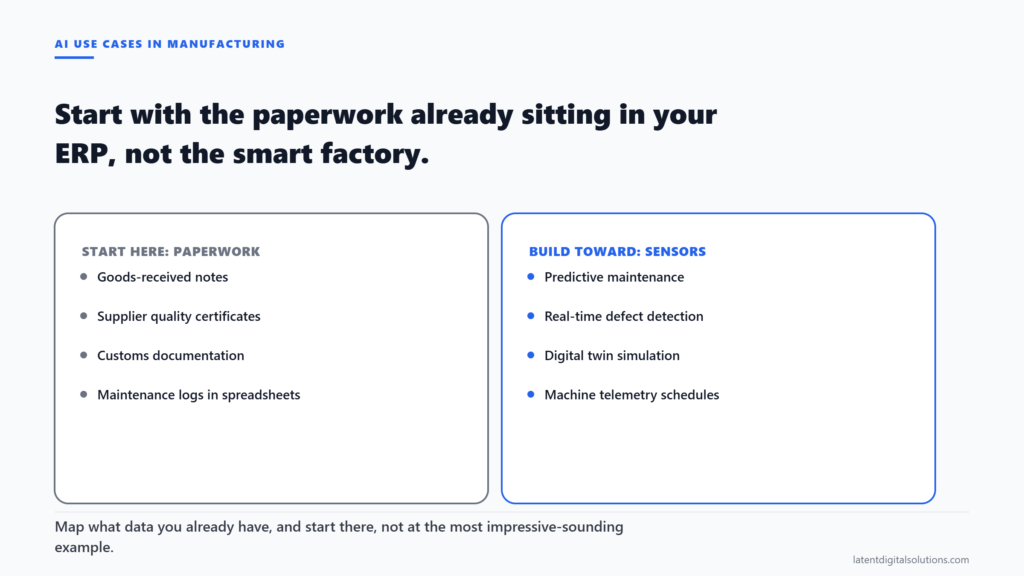
- 02.The first workable AI use case in many UAE factories is in the paperwork: goods-received notes, supplier quality certificates, customs documentation, and maintenance logs kept in spreadsheets.
- 03.The UAE’s Ministry of Industry and Advanced Technology runs the Technology Transformation Programme, which includes a free digital maturity assessment for UAE manufacturers.
- 04.Before choosing a use case, map what data you already have — structured, in a system, consistently collected — and start there, not at the most impressive-sounding example.
What counts as AI use cases in manufacturing?
An entry on this list of AI use cases in manufacturing counts if: there is a repeating task, data that describes it already exists or can be collected at low cost, and a wrong output from the AI system is recoverable before it causes a production problem or a compliance failure.
That definition rules out quite a few headline AI use cases in manufacturing at the early stages. Real-time defect detection on a camera-instrumented line requires cameras on the line. Digital twin simulation requires a parametric model of the plant. AI-generated maintenance schedules require machine telemetry. None of these are impossible to build — but calling them “AI use cases you can start” misrepresents the onboarding cost.
The twelve AI use cases in manufacturing below start from where the data already exists. At a typical mid-size UAE manufacturer, that is: the ERP (even an old one), the inbox, the shared drive, the quality log in Excel, and the paper records that get transcribed at month-end. That is not a shortcoming — it is the starting point.
Which AI use cases in manufacturing need sensors you may not have?
These are real AI use cases in manufacturing, and they work well at scale. They are worth planning toward even if they are not the right starting point today.
Predictive maintenance monitors sensor data from production equipment — vibration, temperature, pressure, current draw — to detect patterns that precede failures. Prerequisites: sensor-equipped machines, a historian or time-series database, and enough historical failure data to train a model. Without those, there is nothing to predict from. Most of these depend on usable data first; see five questions to answer about your data before you start.
Real-time visual quality inspection uses cameras and a trained model to flag defective parts on the line before they pass to the next stage. Prerequisites: cameras at inspection points, sufficient lighting consistency, and a labelled defect image library. This is the right use case for a plant with a defined visual defect type that happens frequently enough to generate training data.
Digital twin simulation creates a parametric model of the plant that can be used to simulate process changes before applying them. Prerequisites: a complete plant model (often built from CAD files and equipment specifications) plus live or historical process data to calibrate it.
These three sensor-dependent AI use cases in manufacturing are worth putting on a 12–24 month roadmap if the infrastructure investment is justified. The AI Readiness Assessment Framework covers how to structure that roadmap — including which capability gaps to address before committing to instrumentation spend. They should not be the first experiment.
Which AI use cases in manufacturing start with paperwork instead?
These AI use cases in manufacturing are less impressive to describe and more achievable to deploy. They also deliver faster because the data already exists.
Document classification and routing takes incoming supplier invoices, goods-received notes, or quality certificates and routes them to the correct destination — the right ERP entry, the right folder, the right approver. The data is already in the inbox. The prerequisite is consistent enough document formats to train a classifier.
Purchase order and GRN matching compares purchase orders against goods-received notes and flags discrepancies for human review. This is currently a manual reconciliation step at most plants. The prerequisite is that POs and GRNs are in a retrievable system — even an Excel export works.
Maintenance log summarisation takes engineer notes, fault logs, and work order histories — often in mixed Arabic and English, on paper or in a field in an ERP — and produces a structured summary: which equipment, what fault class, how resolved. The prerequisite is that logs exist in some form that can be digitised.
Deloitte’s 2025 Smart Manufacturing and Operations Survey (deloitte.com, retrieved September 2026) found that 46% of manufacturers ranked process automation as a first or second investment priority, ahead of the 37% who prioritised physical/line automation — administrative and process automation is already where manufacturers are choosing to start. In Latent’s experience working with UAE manufacturers, document-based use cases are consistently the fastest to deploy and the least disruptive to existing operations — they sit behind existing workflows rather than interrupting them.
12 AI use cases in manufacturing, ordered by what you can start now
The table summarises each of these AI use cases in manufacturing, its data prerequisite, and whether it requires instrumentation.
| Use case | Data prerequisite | Needs instrumentation? |
|---|---|---|
| PO / GRN matching | POs and GRNs in a system | No |
| Supplier certificate validation | Certificate documents (scanned or digital) | No |
| Maintenance log summarisation | Engineer notes in any form | No |
| Document routing and classification | Consistent document formats | No |
| Demand forecast from ERP history | 24+ months of order history | No |
| Quotation and costing assistance | Historical job cards and pricing | No |
| Defect log pattern analysis | Structured defect log (even Excel) | No |
| Energy usage anomaly detection | Utility meter readings (monthly) | Light |
| Equipment utilisation from schedules | Production schedules and work orders | Light |
| Visual defect inspection | Camera-equipped inspection stations | Yes |
| Predictive maintenance | Sensor-equipped machinery | Yes |
| Digital twin simulation | Full plant parametric model | Yes |
1. PO / GRN matching
Compare purchase orders against goods-received notes line by line and flag discrepancies — one of the simplest AI use cases in manufacturing to start with. Most plants do this manually. The data exists in the ERP or in email. No new data collection required.
2. Supplier certificate validation
Check incoming supplier quality certificates against specification requirements. Flag certificates that are expired, incomplete, or do not match the referenced standard. Prerequisite: certificate documents in a consistent format that can be parsed.
3. Maintenance log summarisation
Convert mixed-language, unstructured engineer notes into a structured fault history. Useful for identifying repeat failures before they become expensive downtime. Prerequisite: logs exist in any form that can be digitised — paper, a shared drive, a field in the ERP.
4. Document routing and classification
Route incoming documents — invoices, customs paperwork, quality records — to the correct destination without manual triage. Prerequisite: enough document volume to justify training a classifier.
5. Demand forecast from ERP history
Use historical order data to forecast demand by SKU, improving production scheduling and raw material purchasing. Prerequisite: 24+ months of order history in a consistent format.
6. Quotation and costing assistance
Use historical job cards, material costs, and cycle times to generate first-cut estimates for new jobs. Reduces the senior engineer time spent on standard quotations. Prerequisite: historical job card data in a retrievable system.
7. Defect log pattern analysis
Identify which machine, operator shift, or material batch correlates with elevated defect rates in your existing quality log. No new data collection — just structured analysis of what is already recorded.
8. Energy usage anomaly detection
Flag months where energy consumption per production unit deviates from the historical norm, prompting investigation before a meter fault or process inefficiency grows. Prerequisite: utility meter readings (even monthly ones).
9. Equipment utilisation from schedules
Compare actual production throughput against scheduled capacity to identify systematic underutilisation. Prerequisite: production schedules and work orders in a system.
10. Visual defect inspection
Camera-based inspection for consistent, visually detectable defect types. Requires cameras at inspection points and a labelled image library. Worth piloting if defect inspection is a bottleneck.
11. Predictive maintenance
Monitor equipment sensor data to detect failure precursors. Requires instrumented machines and historical failure data. The right goal for a plant that is building toward full instrumentation deliberately.
12. Digital twin simulation
Simulate process changes before applying them physically. Requires a plant model and calibration data. High-value at scale; high-cost to build.
How do you tell which AI use cases in manufacturing fit your plant?
Three questions in order:
What data do you have that is already structured and consistently collected? Start there. If you have 36 months of order history in the ERP and a quality defect log in Excel, use cases 5 and 7 from the list above are immediate candidates. If you have sensor-equipped machines and a historian, use cases 10 and 11 are in range.
Which problem costs the most to leave unsolved? Rank the AI use cases in manufacturing by cost, not by how impressive they sound. Unplanned downtime from a machine with no telemetry is a different problem from manual reconciliation eating three days of admin per month. The use case that addresses the real cost wins over the one that makes the best slide.
Can a wrong output be caught before it causes damage? Any first AI deployment should have a human review step before the output affects production, procurement, or compliance. The Custom Software and Product Development work Latent does in this space always starts with a human-in-the-loop design — the question is not whether to review the output but how the review step fits into the existing workflow without adding more time than the automation saves.
A structured way to map existing data against these AI use cases in manufacturing is the Data Strategy for AI guide — it applies to manufacturing operations directly, including how to assess which datasets are actually ready for AI use without extensive cleaning.
What UAE support exists for industrial technology?
The UAE Ministry of Industry and Advanced Technology (MoIAT) runs the Technology Transformation Programme (moiat.gov.ae, retrieved September 2026), which includes:
- The Industrial Technology Transformation Index (ITTI) — described by MoIAT as the first digital maturity assessment tool of its kind in the region. UAE manufacturers can be assessed against the index to identify their current technology adoption stage.
- Transform 4.0 — an enablement initiative targeting Industry 4.0 adoption across UAE industrial facilities.
- Industry 4.0 Enablement Centers — regional support centres for manufacturers working through technology transformation.
- A Technology Transformation Incentive Scheme for qualifying businesses.
IDC’s research on agentic AI in Asia/Pacific manufacturing (idc.com, retrieved September 2026) predicts that by 2027, more than 40% of manufacturers with a production scheduling system in place will have upgraded it with AI-driven capabilities — a timeline that assumes exactly the kind of structured, sequenced adoption path MoIAT’s programme is designed to support.
Most English-language content about AI use cases in manufacturing does not mention the ITTI or the TTP at all. A UAE manufacturer aware of both has a concrete starting point for evaluating AI use cases in manufacturing that is better than an arbitrary selection.
Start the conversation to map your plant’s existing data against these AI use cases in manufacturing and identify the fastest realistic first deployment.
Conclusion
The AI use cases in manufacturing that dominate the literature — predictive maintenance, digital twins, real-time visual inspection — are all genuine. They also require infrastructure that most mid-size UAE plants are still building. The use cases that are actually available first are in the paperwork: documents, logs, purchase orders, defect records. These are less impressive to present and faster to deploy.
The practical order is: inventory what data exists, identify which problem costs the most to leave unsolved, and confirm the output can be reviewed before it touches production. That sequence produces AI use cases in manufacturing that actually work, rather than a well-designed proof of concept that never moves to production.
Frequently Asked Questions
What are the most common AI use cases in manufacturing?
The most cited are predictive maintenance, visual defect inspection, demand forecasting, and digital twin simulation. Of these, demand forecasting and defect log analysis are accessible without instrumented machinery; the others require sensor equipment, cameras, or a full plant parametric model. For a plant that does not yet have that infrastructure, document-processing use cases — PO matching, certificate validation, maintenance log summarisation — are typically the fastest first deployment.
How do AI use cases in manufacturing differ between large and mid-size plants?
In large, instrumented plants, AI is used primarily for equipment monitoring, quality control on the production line, and supply chain forecasting. In mid-size plants without full sensor coverage, the most common actual deployments are document automation — processing invoices, goods-received notes, and quality certificates — and structured analysis of existing ERP and quality log data.
What data does a manufacturing plant need before starting AI?
At minimum: consistent records of the process you want to automate, in a format that can be retrieved and parsed. For demand forecasting, that means order history in the ERP. For defect analysis, a quality log. For maintenance log summarisation, engineer notes in any retrievable form. The most common blocker is not insufficient data but data that exists in inconsistent formats across multiple systems.
Can small manufacturers in the UAE benefit from AI?
Yes, specifically through document-based use cases that require no capital investment in sensors or cameras. PO matching, supplier certificate validation, and maintenance log summarisation all work with data that already exists in most plants. The UAE’s Technology Transformation Programme also offers a free digital maturity assessment for UAE manufacturers through the Industrial Technology Transformation Index.
Which of these AI use cases in manufacturing should you try first?
The one where the data is already clean, structured, and consistently collected. For most plants, that is a document workflow — invoices, quality certificates, or goods-received notes — rather than a sensor-dependent use case. A first deployment that works on a small, defined task builds the confidence and operational knowledge needed for more ambitious ones later.
How does predictive maintenance actually work?
Sensors attached to production equipment collect readings — vibration, temperature, pressure, current — at regular intervals. A model trained on historical data identifies patterns that preceded past failures. When those patterns recur, the system alerts maintenance before the failure happens. Without sensor-equipped machines and historical failure data, there is nothing for the model to learn from and nothing to monitor in real time.
Usually a reply within one working day.