Article Overview
AI implementation challenges get described the same way everywhere: data quality, talent shortage, legacy integration, governance, unclear ROI, as if the fix is a data science hire and a governance board. That’s advice sized for a 5,000-person company with a transformation office, not for the UAE businesses actually running into these problems day to day. The real question is which challenge matters at your size, and what closes it without hiring a department.
Mid-size companies in the UAE working through an AI project face a different version of the same problems. They do not have a transformation office. The data scientist is the CTO, who is also managing the ERP rollout. The person who said yes to the AI pilot is now unavailable. The advice on every ranking page does not describe any of this because it was not written for this situation.
Key takeaways
- 01.The five standard AI implementation challenges — data quality, talent, integration, governance, ROI — are real but the standard remedies assume headcount and budget that most mid-size companies do not have.
- 02.BCG’s 2025 AI value research found that just 5% of companies have reached full AI maturity, and 60% report only minimal material value from what they have invested — most pilots stall well short of full production value.
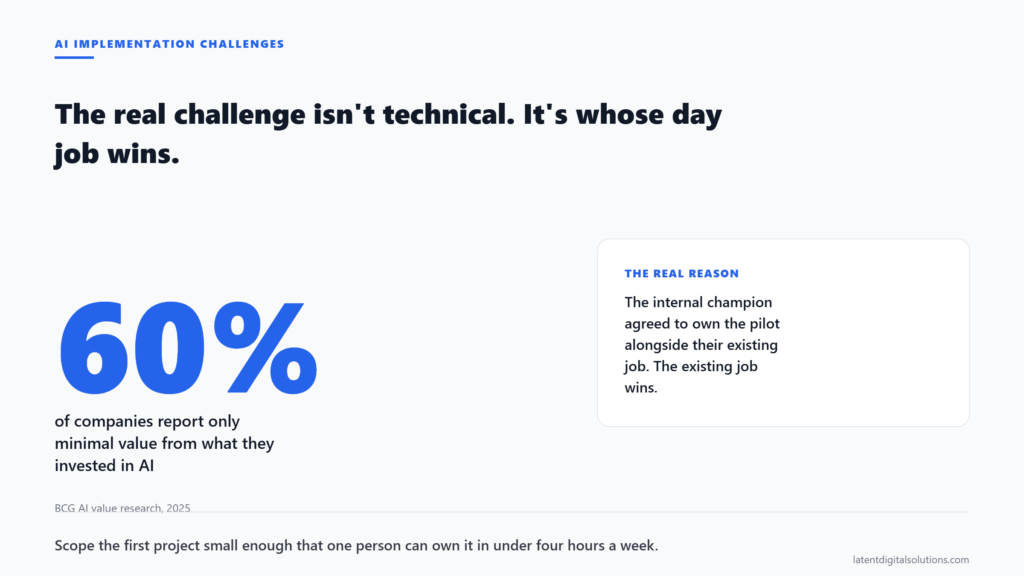
- 03.The most common reason a project stalls is not technical: it is that the internal champion agreed to own the project alongside their existing job, and their existing job wins.
- 04.Scoping the first project small enough that one person can own it in under four hours per week is the single intervention that most reliably gets a pilot to production.
What are the real AI implementation challenges?
The standard list of AI implementation challenges is accurate for large organisations. For a 50–500 person business, the same AI implementation challenges look different in practice.
Our guide to machine learning pattern recognition explains the four kinds, where it is used and how to judge false alarms and missed cases.
Data quality, one of the most cited AI implementation challenges, is real, but the constraint is rarely that the data is dirty — it is that no one has time to clean it alongside their other work. A data quality audit takes weeks. Weeks require a person with weeks available. That person does not exist in most organisations at this size.
Talent shortage, another of the standard AI implementation challenges, is real, but the version that matters here is not “we cannot hire a data scientist.” It is “we have no one internally who can evaluate whether the vendor’s proposal makes sense.” The knowledge gap is in procurement and evaluation, not in daily operation.
Legacy integration, a third of the recurring AI implementation challenges, is real. Most ERP systems, CRMs, and production databases at this size were not designed to be connected to anything external. Adding a layer of AI tooling usually means a custom integration project that exceeds the original scope estimate by a factor of two.
Governance and security, the fourth of the standard AI implementation challenges, matter, but the actual challenge is that no one has written a policy, not because governance is complicated, but because no one had a spare afternoon to do it. BCG’s 2025 research on AI value generation found that 60% of companies report only minimal material value from their AI investment, and just 5% have reached what BCG calls “future-built” maturity (bcg.com, retrieved September 2026) — the same pattern shows up in governance and other foundational work: the intention is there, the follow-through capacity is not.
Unclear ROI, the fifth of the standard AI implementation challenges, gets the most attention and the least useful advice. “Define success metrics before you start” is correct, and no one who writes it explains how to calculate the baseline that makes a metric meaningful. The AI Governance Framework guide includes a section on defining measurable AI success criteria — written for organisations without a dedicated analytics team.
Why do AI implementation challenges look different at a smaller business?
Because the standard advice was written by organisations that sell to large businesses, and large businesses have a team assigned to the problem. The AI implementation challenges that mid-size companies actually encounter are structurally different — not harder, just different — and the remedies need to match that difference.
“Invest in AI talent” assumes you can hire. “Modernise your data infrastructure” assumes a capital budget. “Build a governance framework” assumes someone whose job title includes the word “governance.” The academic and consultancy literature that generates these recommendations was written for a company where the person managing the AI project is not also the person who wrote the employee contracts, managed last month’s audit, and is covering for someone on leave.
According to Accenture’s Technology Vision 2025 (accenture.com, retrieved September 2026), 69% of executives believe AI brings new urgency to how their organisation’s systems and processes are designed and operated, and 77% say unlocking AI’s real benefit depends on a foundation of trust that most organisations have not yet built. Urgency and stated intent are not the same as an assigned owner, and that gap is exactly where most mid-size AI projects stall.
These AI implementation challenges are more acute at a smaller organisation. There is no AI team to assign ownership to. The ownership goes to whoever raised their hand in the meeting where the project was approved.
Which of these AI implementation challenges stops most projects first?
The internal champion problem. It is not on the standard list, and it predicts the outcome of a project better than any technical factor.
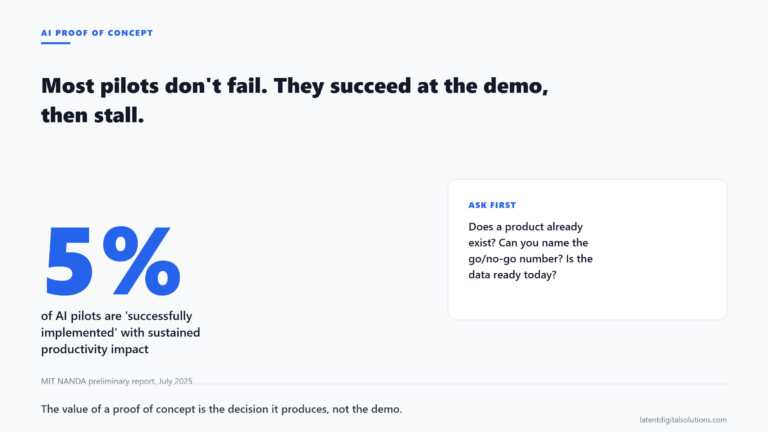
Here is the pattern: a business owner or department head identifies a workflow that AI could improve. A pilot is approved. The person responsible for running the pilot is someone in that department, named explicitly or implied. That person has their existing job. The pilot starts. The first two weeks go well. In week four, a real work deadline arrives, and the pilot work moves to next week. In week six, the pilot is still described as “ongoing.” By month three, it has quietly stopped, and no one is sure exactly when. A common way out is a smaller test first; see how to tell if you need a proof of concept.
This is not a failure of capability or commitment. It is a scoping failure. This particular AI implementation challenge — insufficient champion capacity — is the one that predicts project outcomes most reliably, and it never appears on the standard list. The project was designed as if the internal champion had four to six hours per week available to manage it, and they did not.
Legacy Modernization — making existing systems AI-capable without replacing them — is the technical problem Latent most often addresses. But the operating model question is equally important: who owns this, what does that ownership actually require per week, and is the named person genuinely available for that? In Latent’s experience scoping AI implementation projects for UAE businesses, a mismatch between the named project owner and their actual available capacity is the single most predictable reason a pilot does not reach production.
The people side of this challenge is covered in depth in AI transformation change management for UAE businesses.
How do you scope a project one person can own?
Three constraints that address the real AI implementation challenges, applied before any technical design:
Under four hours per week. If the project requires more than four hours per week of the internal champion’s time in the first three months, it is too large. That ceiling should be set explicitly, not assumed. Most pilots are scoped for what would be ideal if the person had time, not for what is possible given their actual schedule.
One task, one measurable output. A first AI project that covers three workflows and reports on five metrics is not a first project — it is a transformation programme. A first project covers one workflow, produces one output, and has one metric that says whether it worked.
No integration with legacy systems in phase one. Every integration point adds scope, risk, and dependency on IT availability. The fastest first project reads from a file, sends an email, or writes to a spreadsheet. It does not require an API connection to the ERP.
These constraints feel limiting. They are intended to be. The alternative is a well-designed project that does not finish.
What do AI implementation challenges actually cost when a project stalls?
More than the licence fee.
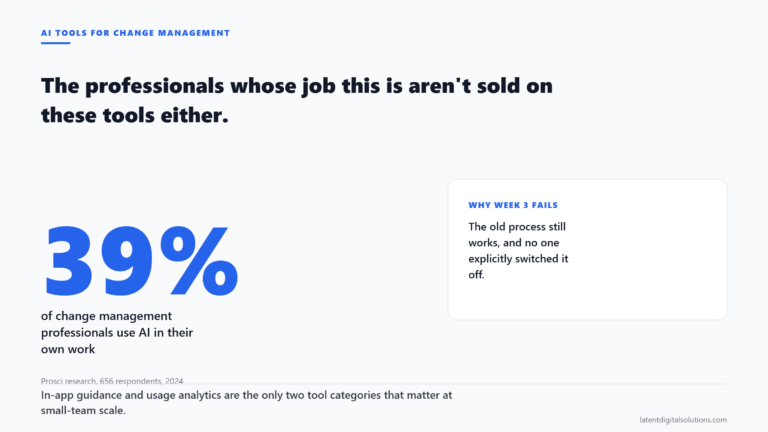
The direct cost is straightforward: the subscription, any consultant time, and the time the internal champion spent on it before stopping. The AI Adoption Framework guide covers how to sequence a first project against real capacity constraints — and how to calculate the cost of a second failed attempt before starting. If adoption is the sticking point, see AI tools for change management when you have no change team.
The indirect costs are harder to see:
Trust erosion. When a first project stalls quietly, the organisation’s informal judgment about AI goes negative. The next proposal takes longer to get approved, not because it is weaker but because the previous one is remembered as a waste of time.
Twelve months. The realistic gap between a stalled project and the next serious attempt is roughly a year. The people involved need time to stop feeling burned. A year of competitive peers deploying the same tools is a real cost. For what projects typically cost, see what UAE AI projects actually bill.
Scoping debt. The next project inherits the assumptions of the first one — “we tried this and it did not work” — even if the first project stalled for reasons that have nothing to do with the use case.
A 2025 S&P Global Market Intelligence survey of more than 1,000 enterprise leaders across North America and Europe (ciodive.com, retrieved September 2026) found that the share of companies abandoning most of their AI initiatives jumped to 42% in 2025, up from 17% the year before. A stalled project does not reset the clock — it feeds directly into that abandonment pattern.
Start the conversation if you want to scope a first AI project around your real AI implementation challenges before committing to a vendor or a timeline.
For scale, a single-workflow project typically costs AED 30,000–80,000, and a week of data remediation can add AED 20,000–40,000 on top of a fixed scope (see our AI integration services guide). A project that stalls after the build has already spent most of that, and has produced nothing in daily use.
Conclusion
The AI implementation challenges that stop most projects at mid-size companies are real but not the ones most commonly written about. Data quality and talent are genuine, but they are rarely what causes the pilot to stop. What causes it to stop is that the person responsible for running it ran out of hours, and no one had scoped the project against their actual availability before approving it.
The fix is not motivational — it is structural. A project scoped to one person’s genuinely available time, covering one task with one measurable output and no legacy integrations in phase one, is far more likely to reach production than a well-intentioned programme that requires four people’s part-time attention for six months.
Frequently Asked Questions
What are the most common AI implementation challenges?
The five most commonly cited are data quality, talent shortage, legacy integration, governance, and unclear ROI. All are real. For a mid-size business, the most predictable blocker is a sixth item that does not appear on most lists: no internal champion with sufficient available time to manage the project through to production. Scoping the project against the champion’s actual capacity — not their ideal capacity — is the most reliable intervention.
Which AI implementation challenges cause most AI projects to fail?
BCG’s 2025 research found that just 5% of companies have reached full AI maturity and 60% report only minimal material value from what they have invested. The most common pattern is a project that starts well, encounters a capacity constraint in the first two months, slips into maintenance mode, and is eventually described as “paused” rather than cancelled. The technical factors — integration problems, data issues — are usually secondary to the organisational one: the project did not have a genuine owner with genuine available time.
Given typical AI implementation challenges, how long does it take to implement AI in a business?
A well-scoped first project covering one task should produce a usable result within six to ten weeks. Projects that run longer in the scoping phase typically do so because they are covering too many workflows, require legacy integration in phase one, or have not confirmed the champion’s real available hours. A six-week timeline with one person owning it beats a six-month timeline with four people dipping in and out.
What is the biggest mistake companies make when starting an AI project?
Approving a project without confirming who owns it, specifically, and how many hours per week that person has available for it. The meeting where AI is approved and the meeting where ownership is assigned are often the same meeting, but ownership tends to be implicit rather than explicit. The first question to answer before any technical discussion is: who is the internal champion, and is that person’s schedule actually compatible with running this project?
How do you handle data quality issues in AI implementation?
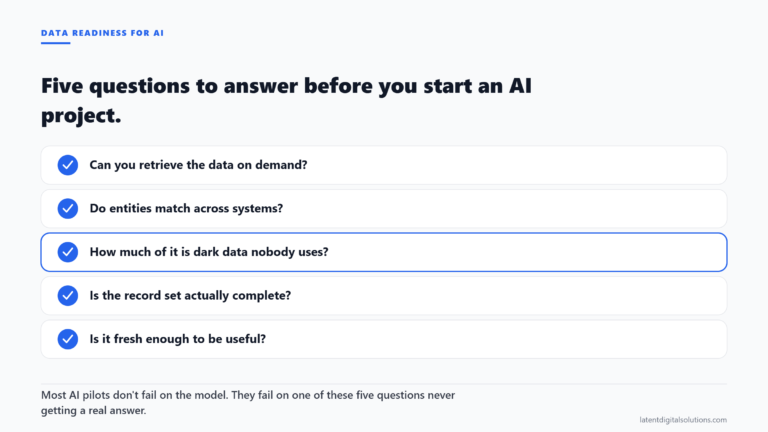
By scoping the first project around data that is already clean and structured, rather than starting with a data remediation programme. Most organisations have at least one dataset that is consistent and retrievable — ERP order history, a quality log, incoming document formats — even if other data is messy. Start there. Data quality as a first step is a project in itself; it delays the AI project by three to six months and uses the same limited internal resource.
What should be included in an AI governance policy?
At minimum: who can approve an AI tool for use in the organisation, what data it is permitted to access, what the review process is for AI-generated outputs before they affect a customer or a regulated process, and who is responsible if the tool produces a harmful output. A one-page document covering those four points is a policy. The governance problem at mid-size companies is almost never complexity — it is that no one spent the afternoon writing it.
AI implementation challenges get described the same way everywhere: data quality, talent shortage, legacy integration, governance, unclear ROI, as if the fix is a data science hire and a governance board. That’s advice sized for a 5,000-person company with a transformation office, not for the UAE businesses actually running into these problems day to day. The real question is which challenge matters at your size, and what closes it without hiring a department.
Usually a reply within one working day.