Article Overview
AI transformation programmes in the UAE fail more often at adoption than at implementation. The system works. The AI processes faster, classifies more accurately, and handles volume no manual team can match.
Then six months in, half the staff are still running the old process alongside it.
The AI system is not what failed. AI transformation change management is. This article explains why AI transformation programmes in the UAE fail at adoption, what the three failure patterns look like in practice, and what a competent implementation team does before go-live to stop them.
- Most UAE AI transformation programmes fail at adoption due to people-and-process gaps, not technology failures. The AI system works but the team does not use it.
- AI transformation change management is a delivery problem embedded in the technical build, not an HR programme that starts after go-live.
- UAE-specific adoption barriers, Emiratisation sensitivities, multilingual workforces, hierarchical management cultures, and government mandate deadlines, are not addressed by global change management frameworks such as Prosci ADKAR.
- The three most common failure patterns in UAE AI programmes are workaround culture, silent rejection, and escalation avoidance, all three can be designed out before deployment begins.
Why is AI transformation change management different from other change programmes?
Change management has been a recognised discipline since the 1990s. Prosci’s ADKAR model, McKinsey’s frameworks, and the standard IT project playbook all exist and are widely used.
Our guide to AI project management explains how to decide between a tool and a process and how to pilot AI on one live project.
What they do not address is the specific challenge of AI transformation change management in the UAE, a programme that does not just change how people do a task, but changes whether they do a task at all.
Why standard IT change management does not transfer to AI
A standard IT change management programme assumes the technology replaces a manual step with a digital step. Staff learn to use the new system, and the old manual step is retired. The change is visible, the outcome is measurable, and resistance is predictable, people dislike learning new interfaces.
AI transformation change management is structurally different.
When an AI system takes over a document processing queue or a customer inquiry, the staff member’s role does not change to “use the new software.” It changes to “review the AI’s work when the AI flags something as ambiguous.”
That is a different kind of cognitive shift. The person is no longer the primary actor in the workflow. They become the exception handler. This transition requires a redesign of how that person understands their own role, not a software training course. AI transformation change management, done well, starts with that role redesign before a single line of code is written.
The adoption gap Prosci does not address for UAE businesses
Prosci’s ADKAR model covers Awareness, Desire, Knowledge, Ability, and Reinforcement. Applied to an AI transformation programme, it misses two UAE-specific dynamics that determine whether adoption happens at all.
The first is hierarchical deference:
In many UAE businesses, staff will not surface problems with an AI system to their manager because doing so implies the project has failed — and the project was the manager’s initiative. The AI system produces a wrong output. The staff member knows it. They correct it manually rather than escalating it.
The error rate looks fine in the dashboard. Adoption looks fine. The AI is not actually trusted. This is the most dangerous failure mode in AI transformation change management: the programme looks successful while the underlying trust problem goes undetected.
The second is Emiratisation sensitivity:
UAE businesses with Emirati quota roles face a specific adoption dynamic when the AI system automates tasks previously performed by Emirati staff. This is not a technology problem. It is a stakeholder management problem that requires senior executive and HR involvement before the system goes live, not during a post-launch adoption review.
According to Accenture’s 2024 AI research, 97% of executives believe generative AI will fundamentally transform their companies. Yet the gap between executive conviction and frontline adoption is where most UAE AI transformation programmes lose their investment.
What are the three adoption failure patterns in UAE AI programmes?
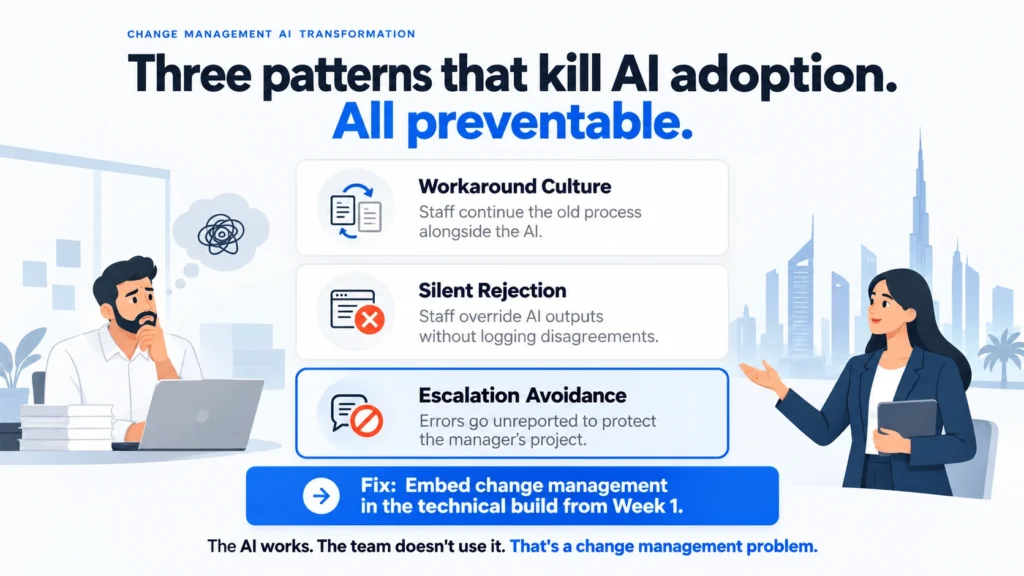
Across AI transformation programmes in the UAE, three failure patterns appear consistently. All three are detectable before go-live if the implementation team is looking for them. All three are preventable if AI transformation change management is integrated into the technical build from week one.
Workaround culture
The most common AI transformation change management failure is workaround culture: staff continue using the old process alongside the AI system. This happens when the AI system is deployed but not made the mandatory path. The team uses it when convenient and reverts to the manual process when under time pressure or when the AI produces a result they are uncertain about.
Workaround culture is the predictable result of a rollout that did not establish clear accountability for which process is now the authorised one. The fix is not more training. It is a clear decision, communicated before go-live, that the old process is retired on a specific date and the AI system is the only authorised workflow from that point forward.
The AI transformation consulting framework that supports these decisions works precisely because it identifies the authorised workflow and retires the old one before any code is written. Workaround culture cannot take root when there is nothing left to work around. Latent Digital Solutions builds this retirement step into every programme structure before any code is written.
Silent rejection
Silent rejection is harder to detect than workaround culture. The AI system appears to be in use. Adoption metrics, logins, queries processed, throughput, look healthy.
But when you look at the output, staff are systematically overriding the AI’s decisions on specific categories without documenting why.
In a document processing workflow, silent rejection shows up like this: the AI classifies 90% of documents, but the team manually re-classifies a consistent 15% of those. Not the AI’s flagged exceptions — cases the AI passed with high confidence. The team does not trust the AI’s classification on that category. They have developed an informal workaround and never raised it as a problem.
AI transformation change management must include structured feedback loops, a specific mechanism for staff to flag systematic disagreements with the AI’s output, named in their role description, with a regular review cycle. Without this mechanism, silent rejection is invisible until the next audit.
Escalation avoidance
Escalation avoidance is the UAE-specific failure pattern that no global AI transformation change management framework addresses. In hierarchical management cultures, staff will not report AI errors to their manager if they believe the manager is invested in the programme’s success. It is a rational social calculation, not deliberate deception.
The result is an AI system whose error rate is unknown because the humans who observe its errors are not surfacing them. The programme looks successful. It is not.
The AI transformation change management fix requires a specific design choice: an error reporting channel that is not the standard management hierarchy. The report goes to the implementation team, not to the business unit manager. This makes surfacing an AI error a contribution to the programme, not a challenge to the manager’s decision.
Designing the process by which staff use those tools matters more than any single tool choice, and more specifically, so does the channel through which they tell the programme team when something is wrong.
What does AI transformation change management actually cover?
The standard answer to “what does change management cover?” is communication, training, and stakeholder management. These are necessary but not sufficient for an AI transformation programme. AI transformation change management covers three things that a standard change programme does not.
| Standard IT Change Management | AI Transformation Change Management |
|---|---|
| Trains staff to use new software | Redesigns how staff understand their role |
| Covers the go-live transition | Runs in parallel with the technical build from week one |
| Measures adoption via login rates | Measures adoption via AI override rates and error reporting volume |
| Owned by HR or IT | Owned by a named individual inside the business unit |
| Ends at go-live | Runs for 60–90 days post-launch until adoption is stable |
Role clarity before go-live
Every staff member whose role changes because of the AI system needs a rewritten role description before the system goes live, not after. The role description must be specific about what the AI does, what the person does, and what happens when the AI produces an output the person disagrees with.
Role clarity is not a soft deliverable. It is the mechanism that prevents workaround culture. If the role description still describes the task the AI now performs, the staff member’s identity is attached to doing that task manually. AI transformation change management removes the ambiguity about whether the manual process is still part of the job.
This is particularly relevant for system modernisation. When the AI system replaces a legacy workflow that staff have used for years, the role redesign must happen in parallel with the technical migration, not after it. Legacy modernisation projects that skip AI transformation change management at this stage consistently produce the same outcome: the new system is live, the old process runs alongside it, and both continue indefinitely.
Training that is not a one-day workshop
One-day training sessions are the standard delivery mechanism for IT change management. They are not effective for AI transformation change management, for a specific reason: the behaviour being trained is not how to use a piece of software, it is how to exercise judgement about an AI’s output.
Effective training for an AI transformation change management programme covers three things. First, what the AI’s confidence thresholds mean: when to trust the output and when to scrutinise it. Second, what the most common AI error categories are for this specific workflow, drawn from pilot data. Third, what the escalation path looks like when something does not look right.
This training must be specific to the workflow, not a generic “working with AI” programme. It must also be designed in parallel with the technical build, not after it.
Feedback loops from staff to programme team
The third element of AI transformation change management is a structured feedback loop between the staff who use the AI system every day and the programme team that built it. This does not happen automatically. It requires a named mechanism — a regular review meeting, a structured log, a ticket type in the issue tracker — that makes staff feedback on AI output a visible and valued part of the programme. What specific AI tools for change management in the UAE get used matters less than whether the feedback mechanism exists and is actively maintained.
How do you build AI transformation change management into a programme before go-live?
AI transformation change management is a delivery problem embedded in the technical build, not a separate HR programme that begins after the system is live. That distinction has one operational consequence: the adoption planning checklist runs in parallel with the technical build from week one.
The adoption checklist that runs parallel to the technical build
The adoption planning checklist for AI transformation change management includes five items that must be complete before go-live:
- Role descriptions rewritten for every affected position (completed before UAT begins)
- Training programme designed and scheduled, based on pilot error category data, not a generic AI curriculum
- Error reporting channel live and tested, separate from the standard management hierarchy
- Escalation avoidance mitigations in place, specific to Emiratisation sensitivities, hierarchical culture, and UAE workforce dynamics relevant to this deployment
- A defined cut-over date for the old process, confirmed in writing at senior leadership level
None of these items requires the AI system to be live. All of them must be done before it is. Businesses that have successfully deployed AI transformation programmes in financial services, healthcare, and logistics embedded AI transformation change management into the technical build from day one, not as an afterthought.
Who owns AI transformation change management in a UAE business
The most common failure of AI transformation change management is the assumption that HR owns it. HR owns the Emiratisation and training logistics. The implementation partner owns the technical delivery. Nobody owns adoption, the specific question of whether the staff who interact with the AI system every day actually use it, trust it, and surface its errors constructively.
Adoption needs an owner inside the business unit. Not HR, not IT, not the implementation partner. This person is responsible for the feedback loop, the role clarity reviews, and the early warning that workaround culture is developing. The AI transformation delivery framework builds this ownership into the programme structure before the first technical sprint begins, because without it, AI transformation change management exists on paper and fails in practice.
What do the first 90 days of AI transformation change management look like?
What week one looks like
In the first week after go-live, the adoption owner should be logging two things daily: how many staff are using the AI system as the primary workflow (not alongside the old process), and what categories of AI output are being manually overridden without a logged reason.
Week one is also when escalation avoidance is most likely to develop. The AI system will produce some outputs that staff are uncertain about. If there is no visible, easy mechanism for surfacing those uncertainties, staff will begin quietly correcting them.
The implementation team should be conducting brief structured check-ins with a sample of users every day in week one, not as a management review, but as a feedback collection mechanism that makes it genuinely easy to say “the AI got this category wrong.”
The AI transformation change management principle here is simple: the first week’s data is more valuable than any pilot data. Pilots are run by motivated early adopters. Week one is run by the whole team.
When to declare adoption stable
Adoption is stable when three conditions hold simultaneously. The AI system is the authorised workflow with no active manual parallel process running alongside it. The error reporting channel is receiving a consistent volume of inputs — near-zero input signals that escalation avoidance has taken hold, not that the AI is perfect. And the AI’s output quality has been reviewed against the baseline established before deployment began.
The 90-day mark is a common milestone for an initial adoption stability review. The specific threshold should be set before go-live: what percentage of old manual process throughput the AI system is expected to handle, and what error rate is acceptable. A declared stable AI transformation change management programme that was never benchmarked against a pre-deployment baseline is not a meaningful declaration.
Conclusion
AI transformation change management fails in UAE businesses for three reasons: workaround culture, silent rejection, and escalation avoidance. All three are preventable when adoption planning is treated as a delivery task from week one of the technical build, not an afterthought deployed after the system goes live. The UAE-specific barriers — Emiratisation sensitivities, multilingual workforces, hierarchical management cultures, and government mandate timelines — require an approach built for UAE businesses. Global enterprise frameworks designed for different contexts will not cover these gaps. If you are planning an AI transformation programme, the most important question to ask before the technical build begins is not “what will the AI do?” but “who in this business owns AI transformation change management, and what is their plan for the first 90 days?”
FAQ
Why do most AI transformation programmes fail at adoption?
Most AI transformation programmes fail at adoption because AI transformation change management is treated as an afterthought, a communication and training exercise deployed after the system is live, rather than a delivery task embedded in the technical build. The three failure patterns are workaround culture (staff continue the old process alongside the AI), silent rejection (staff override AI outputs without logging disagreements), and escalation avoidance (staff do not surface AI errors because they perceive it as challenging a manager’s decision).
What are the five pillars of change management in AI transformation?
The five pillars for AI transformation change management are: role clarity (rewritten role descriptions before go-live), structured training (specific to the AI’s error categories, not generic), feedback loops (a named mechanism for staff to surface AI output disagreements), stakeholder management (Emiratisation and hierarchy-specific for UAE businesses), and adoption ownership (a named individual inside the business unit responsible for adoption metrics in the first 90 days).
How is AI transformation change management different from standard IT change management?
Standard IT change management trains staff to use new software. AI transformation change management redesigns how staff understand their role, from primary actor in a workflow to exception handler for an AI system. This requires role redesign, not just software training, and must begin before the system is built, not after it is deployed.
How long does AI transformation change management take in a UAE business?
AI transformation change management runs in parallel with the technical build, typically 12 to 20 weeks for a single-process AI deployment. The adoption planning work (role redesign, training design, feedback loop setup) begins in week one of the technical project and should complete before UAT begins. Post-go-live adoption stabilisation takes 60 to 90 days, depending on the complexity of the workflow and the size of the affected team.
What does adoption failure look like in practice in a UAE AI programme?
Adoption failure in a UAE AI programme typically looks like success on the surface: the AI system is live, throughput is high, and adoption metrics show regular usage. The failure is visible only when you examine what staff are doing alongside the AI, a parallel manual process running for certain output categories, systematic silent overrides of the AI’s high-confidence decisions, and an error reporting channel receiving near-zero inputs despite the AI making errors that staff are aware of. AI transformation change management that addresses these gaps before go-live is the difference between a programme that works and one that looks like it works.
Usually a reply within one working day.