Article Overview
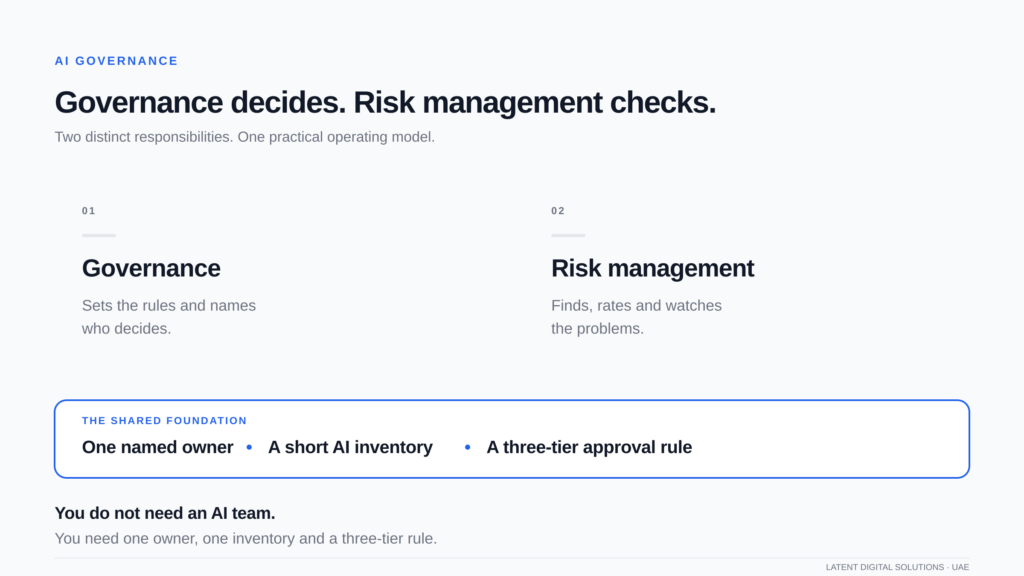
When staff use AI tools nobody approved, AI governance and risk management is what tells you who decides and what could go wrong. Picture a finance team drafting supplier emails with AI while sales pastes customer lists into a chatbot. Governance sets the rules and names who approves such uses, and risk management finds and tracks the problems. Latent’s AI transformation work starts from that split.
Already know you need a governance plan?
Skip ahead to our AI transformation services for UAE businesses.
- AI governance and risk management are two halves of one job: governance sets the rules and names who decides, while risk management finds, rates and watches the problems.
- A mid-size UAE business does not need an AI team to do this. It needs one named owner, a short AI inventory and a three-tier approval rule.
- The UAE AI Charter lists governance, accountability and human oversight among its 12 principles, and the voluntary NIST framework makes governance one of its four functions.
- The first 90 days are about listing every AI tool in use, rating each one, and agreeing who signs off what.
How do AI governance and risk management differ?
AI governance decides who may use AI, for which jobs, and who approves exceptions. AI risk management finds what could go wrong with each use, rates how serious it is, and keeps watching. Governance is the rulebook and the decision rights. Risk management is the working list of problems and the controls that contain them.
The easiest test is to ask two questions. “Are we allowed to do this, and who says so?” is a governance question. “What happens if it fails, and how would we know?” is a risk question. Most businesses answer the first informally and never ask the second. That gap is where the surprises in AI governance and risk management come from.
The US National Institute of Standards and Technology (NIST) draws the same line. Its AI Risk Management Framework, a voluntary guide released on 26 January 2023, has four functions: Govern, Map, Measure and Manage. Govern covers policies and accountability, which is the governance half. The other three cover the risk work.
| Question | AI governance | AI risk management |
|---|---|---|
| What does it answer? | Who may use AI, for what, and who approves? | What could go wrong, and how bad would it be? |
| What does it produce? | A short policy, decision rights, a named owner | A risk register, ratings, controls, monitoring |
| How often does it run? | Set once, reviewed every year | Runs all year, reviewed every month |
| Who leads it? | Managing director or board | The named AI owner, with IT and finance |
Neither half of AI governance and risk management works alone. Rules with no risk list are guesses about what to forbid. A risk list with no one empowered to act is a document nobody reads. Latent Digital Solutions builds the two together because the owner who approves a tool needs to see its risks in the same place.
Why does AI governance and risk management matter?
AI governance and risk management matters for UAE businesses now because AI is already inside everyday tools, and the national direction on accountability is clear. Staff use AI in email, spreadsheets, recruitment and customer chat whether or not the company has chosen it. Customers, banks and larger clients increasingly ask how that use is controlled.
The UAE government’s AI Charter sets out 12 principles for developing and using AI. Two map directly onto this work. One is governance and accountability, which says AI should be used ethically and transparently. The other is human oversight, which keeps human judgement in place to correct errors and bias.
Data is the second pressure. An AI tool that handles customer or employee personal data raises data protection duties. Free zones such as DIFC and ADGM run their own data protection regimes, so the rules depend on where you are licensed. Check this with your legal adviser before you decide which tools are low risk.
For AI governance and risk management, you do not need a legal opinion on every tool. You need a record of what is in use, a view on how risky each use is, and a person who can say yes or no. For the model and platform choices behind your controls, see our OpenAI consulting service.
What does AI risk management involve in practice?
Day to day, AI governance and risk management comes down to a loop of four jobs: list the AI you use, rate each use, put controls in place, and review on a schedule. It is closer to a monthly housekeeping routine than a project. Each pass leaves a written record, so a new manager, an auditor or a client can see what was checked and when. That record is the evidence that AI governance and risk management is working, and it is the part most businesses cannot produce when asked.
NIST’s Map, Measure and Manage functions translate into plain steps for a business owner, with a review on top:
- List every AI use (close to NIST’s Map function): include tools staff bought themselves, and AI features switched on inside software you already pay for. This is the AI inventory, and it is the step most businesses skip.
- Rate each use: score it on how much harm a mistake would cause and how likely a mistake is. A spell-checker and a loan-scoring tool should not get the same attention.
- Add controls: decide what stops the harm. That might be a human check before sending, a ban on pasting customer data, or a vendor contract clause.
- Review on a schedule: look at the register monthly, and after any incident. Remove tools nobody uses.
The governance half sits above all four steps. If you are comparing software to run the register, our guide to AI risk management tools covers what is worth paying for. For many mid-size businesses a shared spreadsheet is enough for the first year.
Who owns AI governance and risk management?
In a mid-size UAE business, the managing director owns the decision on how much AI risk is acceptable, and one named AI owner runs the day-to-day work. This split keeps senior time free while making sure someone is accountable, which is what the UAE Charter’s governance and accountability principle asks for. It matters most in companies of 50 to 500 people, where there is no AI team and no risk department to run AI governance and risk management.
A good ownership model passes one simple test. If a team member wants to start using a new AI tool tomorrow, they know who to ask and get an answer within a week. If nobody can say who decides, ownership is still missing.
Decision rights look like this:
- Managing director or board: sets how much risk the business will accept and signs off the highest-risk uses.
- Named AI owner: often the COO, finance director or head of operations, giving a few hours a week. Keeps the inventory and register, and chairs the monthly review.
- Department heads: request new AI uses, own them day to day, and report problems.
- IT or security lead: checks access, where data goes, and vendor security.
- All staff: follow a one-page policy and say when something looks wrong.
To avoid reviewing everything at the same depth, use a three-tier rule. Tier one is any use that touches no personal or commercial data. Tier two is any use that handles personal or commercial data, or talks to customers. Tier three is any use that influences a decision about a person or about money. It is a working framework to keep reviews proportionate, not a regulatory standard.
| Tier | Test | Who approves |
|---|---|---|
| One: low | No personal or commercial data, internal use | Department head |
| Two: medium | Handles personal or commercial data, or faces customers | AI owner |
| Three: high | Influences a decision about hiring, credit, pricing or health | Managing director |
Illustrative example (not a client case): a 120-person logistics company in Dubai runs its first inventory and finds 11 AI uses. They include a chatbot on its website, an AI feature in its accounting software, route suggestions and several staff using free writing tools. Two land in tier three: a CV-screening feature in its recruitment system and automated credit limits for customers. Four are tier two and five are tier one. The managing director signs off the two tier-three uses, and the finance director becomes the AI owner. The company buys nothing new. It simply learns what it already had.
If you want an outside view on where your business sits, our AI transformation partner team can review the register with you. The aim is that your own people can run it afterwards.
How do you start AI governance and risk management?
Start with an inventory, then rate and approve, and keep the first policy to one page. The order follows NIST’s own: map what exists, then measure it, then manage it. A business can have working AI governance and risk management within 90 days without hiring anyone. The goal of the first quarter is a register that is true, an owner who is named, and one review meeting that has actually happened.
- Weeks 1 to 2: Ask every department head to list the AI tools and AI features their team uses. Include free tools and browser extensions. Expect the list to be longer than you thought.
- Weeks 3 to 4: Put each use into a tier using the three-tier rule. Mark the tier-three uses first, because they carry the most risk.
- Weeks 5 to 6: Name the AI owner and write the one-page policy. It should say what staff may do, what they must not paste into AI tools, and who to tell if something looks wrong.
- Weeks 7 to 8: Ask your main software vendors where your data goes, whether it is used to train their models, and how you would be told about an incident. Record the answers in the register.
- Weeks 9 to 12: Hold the first monthly review. Close anything unresolved, remove unused tools, and set the date of the next one.
Keep the targets modest. By day 90 you should be able to say how many AI uses the business has, which ones sit in tier three, and who signs off each one. If you cannot answer those three questions, the programme is not yet working, however good the policy looks on paper.
When you are ready to turn this into a fuller policy, our AI governance framework guide covers the structure in more depth. The 90-day plan above is deliberately lighter, because a short plan for AI governance and risk management that people follow is worth more than a long one nobody opens.
Why does AI governance and risk management fail?
AI governance and risk management usually fails because nobody owns it, not because the rules are wrong. The same four patterns appear again and again, and each one is avoidable.
- Treating it as an IT task: IT can check security, but it cannot decide whether HR may use AI to screen CVs. That is a business decision.
- Writing a long policy no one reads: a ten-page document with no owner changes nothing. One page and a monthly meeting change behaviour.
- Building the register once: a risk list that is not reviewed is out of date within a quarter, because new AI features arrive in existing software without notice.
- Ignoring AI built into other products: many of the biggest exposures come from features inside tools you already use, not from tools someone chose on purpose.
The UAE Charter’s human oversight principle applies here too: a person must still be able to catch errors, even when the AI arrives inside a vendor’s product. A business that fixes only the first pattern, by naming one accountable person, tends to see the other three improve. The owner notices the stale register, asks for the missing tools, and trims the policy until people read it. Start there, and add detail to your AI governance and risk management only when a real incident or a client request demands it.
Conclusion
AI governance and risk management is one job in two halves. Governance decides who may use AI and who approves it. Risk management lists what could go wrong and keeps watching. A UAE business of 50 to 500 people can run AI governance and risk management with one named owner, an honest AI inventory, a three-tier approval rule and a monthly review.
If you would like to talk through where your business stands and what the first 90 days should cover, talk to Latent’s team.
Frequently Asked Questions
How do AI governance and risk management differ?
AI governance and risk management split the job in two. Governance sets the rules: who may use AI, for what, and who approves. AI risk management finds what could go wrong with each use and keeps checking. You need both, and the same owner should see both.
Who is responsible for AI governance and risk management in a company?
The managing director is accountable for how much risk the business accepts. A named AI owner, often the COO or finance director, runs the register and the monthly review. Department heads own the AI they use day to day.
Does a UAE business need a formal AI policy?
A short written policy is sensible for any business using AI with customer or employee data. The UAE AI Charter is a set of principles, and data protection law and sector regulators add duties, so confirm what applies to your sector with your legal adviser.
What is the NIST AI Risk Management Framework, and do we have to follow it?
It is a voluntary framework from the US National Institute of Standards and Technology, released in January 2023, built around four functions: Govern, Map, Measure and Manage. No one in the UAE is required to follow it, but it is a useful checklist for structuring your own register.
How often should AI governance and risk management be reviewed?
Review the register monthly in the first year, and again after any incident or when a major new AI tool is added. Review the policy itself once a year.
Usually a reply within one working day.