Article Overview
A vendor says the automation will pay for itself in six months. Automation ROI is how you check that claim: the money a process saves or earns after automation, minus what it costs to build and run, measured over a set period. This guide shows the five-line sum, the costs and benefits that quotes leave out, and the cases where a promised payback will not appear.
Latent’s legacy modernisation work begins with the same discipline: run the sum on a business’s own numbers before anything is rebuilt.
Already know old systems are holding you back?
Skip ahead to our legacy modernisation services for UAE businesses.
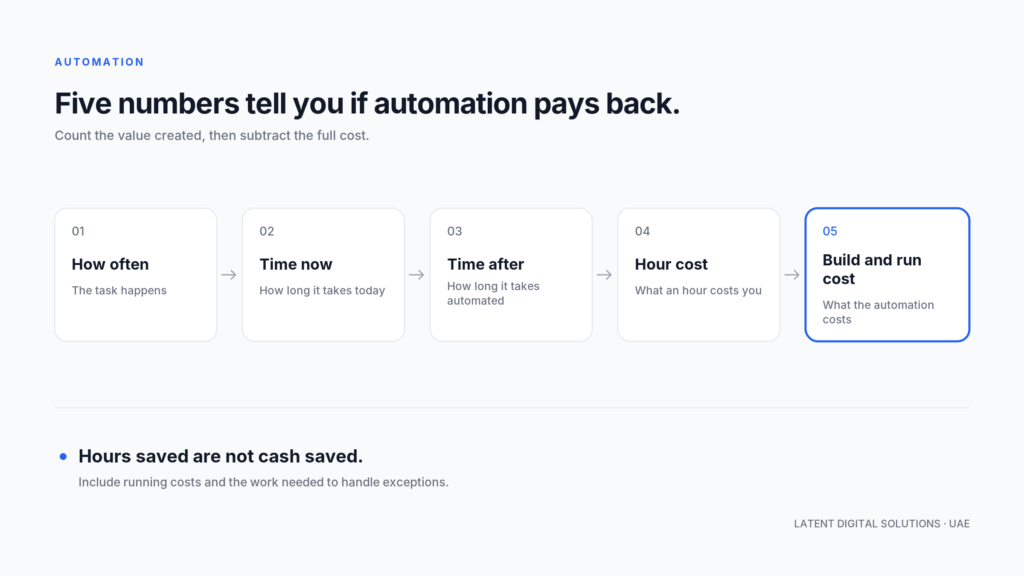
- Automation ROI needs five numbers: how often the task happens, how long it takes now, how long it takes after, what an hour costs you, and what the automation costs to build and run.
- Hours saved are not cash saved. They turn into savings only when someone is redeployed, overtime stops or a hire is avoided.
- Most quotes show the build cost and leave out running costs, exception handling and the time your own team spends supporting the project.
- The fastest automation ROI comes from high-volume, rule-based work with a clear owner, such as invoice processing, and the slowest from rare or unstable tasks.
What is automation ROI in plain terms?
Automation ROI compares what an automated process gives back with what it costs. The gain can be staff hours you no longer spend, errors you no longer fix or sales you no longer lose to slow replies. The cost is the build, the yearly running bill and the effort of changing how people work. If the gain is larger than the cost over a period you choose, the project has a positive automation ROI.
Two measures tell the story. Payback period is how many months it takes for savings to repay the build cost. ROI percentage is the net gain over a set period, divided by the build cost. Owners usually care about payback first. It answers the question “when do I get my money back?” In the worked example below, an AED 90,000 build pays back in about 12 months.
Automation ROI is also specific to one process in one business. A saving quoted for a call centre in another country says very little about an accounts team in Sharjah. That is why a general figure such as “30% to 300% return” on a vendor page is not a number to plan around.
Latent Digital Solutions uses the sum to decide whether to build at all. If it does not clear your own hurdle, the right answer is to leave the process alone.
How do you calculate automation ROI?
You calculate automation ROI with five lines in a spreadsheet: volume, time before, time after, cost of an hour, and the cost of the automation. From those you get hours saved, a yearly saving, a payback period and an ROI percentage. Any simple automation ROI calculator is a version of this sheet. Building it yourself shows you which assumption the answer depends on.
| Line | What goes in | Illustrative figure |
|---|---|---|
| Volume | Times the task happens each month | 1,200 invoices |
| Time before | Minutes per task today | 12 minutes |
| Time after | Average minutes after, including exceptions | 4 minutes |
| Cost of an hour | Salary plus visa, insurance and overheads | AED 60 |
| Cost of automation | Build once, plus yearly running cost | AED 90,000 and AED 24,000 |
Illustrative example (not a client case): a Sharjah trading company processes 1,200 supplier invoices a month. Each takes 12 minutes to key in, check and chase, which is 240 hours a month. After automation the average falls to 4 minutes, because most invoices pass straight through and only exceptions need a person. That leaves 80 hours a month, so 160 hours are saved.
At AED 60 an hour, 160 hours is AED 9,600 a month, or AED 115,200 a year. The yearly running cost of AED 24,000 comes off that. The net benefit is AED 91,200 a year, or AED 7,600 a month. Divide the AED 90,000 build cost by AED 7,600 and payback is about 12 months. Over three years the net benefit is AED 273,600, so the three-year automation ROI is (273,600 minus 90,000) divided by 90,000, which is 204%.
Every figure in that example is an assumption chosen to show the method. Swap in your own volume and your own hourly cost, and test the answer by making the time saved 25% smaller. If the project still pays back inside your hurdle, you have a solid case. If not, you have learned that before spending the money.
Choose your hurdle before you run the sum, not after. A common approach is to set a maximum payback, such as 12 or 18 months, and a minimum three-year return. Deciding in advance stops the numbers from being bent to fit a project that someone already wants. It also gives the vendor a clear target to meet with evidence.
Measuring a whole programme is a wider question. Our guide on how to measure AI transformation ROI covers the KPIs and timing above a single process.
Which costs do most automation ROI sums miss?
Most automation ROI sums miss the costs that arrive after launch: running fees, exception handling, upkeep and the time your own team spends supporting the project. A quote usually covers the build. The bill for the next three years is larger than it looks, and it is where a promised payback quietly stretches. In the worked example above, AED 24,000 of yearly running costs moves payback from about 9 months to about 12.
Check each of these before you trust a number:
- Running costs: software licences, hosting, usage fees and support contracts, paid every year, whether or not volume grows.
- Exceptions: the cases the automation cannot handle still need a person. If 30% of invoices still go to staff, the hours saved shrink accordingly.
- Maintenance: systems change. A supplier changes its invoice layout, a tax rule updates or a connected system is upgraded, and someone must fix the automation each time.
- Your team’s time: a process owner has to define the rules, test the results and sign off changes. That time is real even if no invoice is raised for it.
- Change effort: staff need training, and the old way of working has to stop. If the manual route stays open as a fallback, savings shrink.
- Data cleaning: automation fails on messy inputs. If supplier names, codes or formats are inconsistent, cleaning them is part of the cost.
Ask the vendor four direct questions. What is the yearly cost after the first year? What happens to that cost if volume doubles? Who fixes the automation when an input format changes, and at what rate? What share of cases do they expect to need a person? Plain answers to these four questions make the sum far more reliable.
Ask the vendor for the full three-year cost, not the build price. Then write down every line above next to it. For a view of what AI projects cost in dirhams, see our guide to AI implementation cost.
Which benefits does automation ROI usually miss?
Automation ROI usually misses benefits that do not appear as saved hours: fewer errors, faster cycles, better service and lower risk. These are real, but they are harder to price. The safe approach is to keep them out of the headline sum and list them beside it.
The first is accuracy. A person keying 1,200 invoices will make mistakes. Each one costs time to find and fix, and sometimes a late-payment dispute with a supplier. The second is speed. Invoices approved in two days instead of nine can capture early-payment discounts and keep suppliers on good terms. The third is capacity. Staff who were buried in data entry can handle more volume without a new hire.
Who uses the tool changes the size of the benefit. A well-known study followed 5,179 customer support agents who were given an AI assistant. The NBER working paper found that productivity rose by 14% on average, by 34% for novice and lower-skilled workers, and very little for the most experienced. The lesson for your sum is to price the benefit for the people who will actually use the tool, not for an average employee.
Keep these benefits as a second column. If the project clears your hurdle on hours alone, the extra benefits are a bonus. If it only clears the hurdle once you add them, treat the case as weak until you can measure them.
Hours saved also need a plan. Two hours saved across ten people is not cash. It becomes cash when you stop paying overtime, avoid a planned hire, or move people to work that earns money. Decide which of these will happen before you count the saving.
Which processes give the fastest automation ROI?
The fastest automation ROI comes from work that is high in volume, rule-based, repeated the same way and owned by one person. Four tests sort the candidates. Tasks that pass all four tend to pay back inside a year. Tasks that fail two or more usually do not. If the process needs software built around it, our custom software development service applies.
| Test | Pass looks like | Fail looks like |
|---|---|---|
| Volume | Hundreds of repeats a month | A few a month |
| Rules | A clear yes/no for most cases | Judgement every time |
| Stability | The steps rarely change | New rules each quarter |
| Owner | One named person | Shared by three teams |
Accounts payable is the textbook candidate, which is why accounts payable automation ROI is so widely discussed. Invoices arrive in volume, follow a standard check, and cost real time to key and chase. In the UAE there is an extra push. The Ministry of Finance has issued guidelines for the national e-invoicing system, with a phased implementation and a readiness checklist for businesses. Companies that must change how invoices are produced and received anyway can often fold automation into that work, which can spread the cost.
The worked example above is one such case. A high volume of near-identical invoices, a clear set of checks and a single accounts owner meant the build could be justified on hours alone. A company with 60 invoices a month and three approvers would see a very different answer from the same technology.
Other strong candidates for business process automation ROI include:
- Customer enquiry triage, where staff sort and route messages before anyone answers.
- Monthly report compilation, where the same data is pulled from the same systems.
- Onboarding paperwork for staff, suppliers or customers.
- Quote and order entry between a sales tool and an accounts system.
A legacy modernisation review is most useful at this stage, because ageing systems often decide whether a process can be automated at all. You need an outside view of which processes pass the four tests and which only look good in a demo.
When does automation ROI fail to appear?
Automation ROI fails to appear when the volume is too low, the process keeps changing, the data is messy or nobody owns the result. In each case the cost is real from the first month and the saving never reaches the size the sum promised.
The common thread is that the cost starts on day one, while the saving depends on conditions the business does not fully control. Check those conditions first. If you cannot say who owns the process, how stable its rules are and how many cases arrive each month, you are not ready to price it.
- Low volume: if a task happens 40 times a month, even a large time saving is small money. A spreadsheet macro may be a better answer than a build.
- Unstable process: if the rules change every quarter, you pay for rebuilds and the saving disappears.
- Messy data: the automation inherits every inconsistency in the source, so exceptions stay high.
- No owner: without one person accountable for the result, nobody checks whether the hours were actually saved.
- One-off tasks: a migration or a year-end clean-up pays back once, if at all, so the build must cost less than the single saving.
Before you commit, run a simple screen. List the tasks your team repeats most often, count the monthly volume of each, and score them against the four tests from the previous section. Anything with low volume or an unclear owner drops out. What remains is a short list with a real chance of paying back, and each item on it deserves its own five-line sum. Our guide to digital automation explains what to automate first and how to avoid building around a process nobody understands.
A failed sum usually means the process was unsuitable, and it says little about automation itself. Sometimes the cheapest result of a good automation ROI sum is a decision not to build.
How do you track automation ROI after launch?
You track automation ROI after launch by measuring the same five lines every month. Compare them with the baseline you recorded before the project. In the worked example the baseline was 1,200 invoices a month at 12 minutes each, so those two numbers are the first thing to re-measure. Without a baseline you cannot prove the saving, and the project becomes a matter of opinion.
Record the baseline before you start. Count the volume, time a sample of tasks, and note the error rate. After launch, review these each month for the first six months:
- Volume: is the process handling as many tasks as planned, or are staff routing around it?
- Time per task: has the average fallen to the target, including exceptions?
- Exception rate: how many cases still go to a person, and why?
- Running cost: is the bill in line with the quote?
- Redeployed time: where did the saved hours actually go?
If a number moves the wrong way, find out why before the next review. A rising exception rate usually points to a data problem that can be fixed. Falling volume usually means staff do not trust the system. Track the result for at least a year, so the reported automation ROI is a measured figure rather than the forecast.
Conclusion
Automation ROI is a simple sum with five inputs, and the discipline lies in using honest ones. Count the full cost over three years. Treat hours saved as cash only when something changes. Keep soft benefits in a separate column, and pick processes that pass the four tests. In the worked example, an AED 90,000 build paid back in about 12 months and returned 204% over three years, but only because the assumptions were stated and tested.
If you have an automation quote on your desk and want a second opinion on the sum, talk to Latent’s team.
Frequently Asked Questions
What is a good automation ROI?
It depends on your own hurdle, but many owners look for payback inside 12 to 18 months using conservative numbers. A project that clears that bar even when the time saved is cut by a quarter is usually worth doing.
How long does automation take to pay back?
It depends on volume and cost. In the worked example above, a high-volume invoice process paid back in about 12 months, while a task done 40 times a month might never pay back. Run the five-line sum on your own numbers.
Is there an automation ROI calculator I can use?
A spreadsheet with five lines does the job: volume, time before, time after, cost of an hour and cost of automation. Online tools use the same logic. Building the sheet yourself shows you which assumption the answer depends on.
What is accounts payable automation ROI?
It is the saving from processing supplier invoices with less manual work, minus the cost of the automation. It is often one of the quickest returns because invoice volume is high and the checks follow clear rules.
How is business process automation ROI different from AI ROI?
Business process automation ROI is measured on one process, using hours, errors and cost. AI ROI across a whole programme also depends on adoption and long-term capability, so it needs wider measures than a single process sum.
Do hours saved count as savings?
Only when something changes. Hours saved become savings when you stop paying overtime, avoid a hire or move people to work that earns money. Until then they are capacity, not cash.
Usually a reply within one working day.