Article Overview
The board wants AI examples. Your team Googles them and comes back with Amazon, JPMorgan, and Pfizer (enterprises with dedicated AI labs and nine-figure technology budgets).
AI in UAE retail operations: what UAE retailers are actually deploying and where to start
None of it applies to a UAE business with 50 to 500 staff.
This article covers AI transformation examples from UAE financial services, healthcare, logistics, and retail: what is actually live in production, not what is planned or in pilot. You will see what separates the businesses that have deployed from those still stuck in planning.
- UAE businesses in financial services, healthcare, logistics, and retail are running live AI deployments, not just pilots, in document processing, triage, route optimisation, and customer service.
- The difference between an AI tool and an AI transformation is whether the technology is embedded into a core operational workflow and changing business outcomes.
- Mid-size UAE businesses (50–500 staff) are starting with one high-volume, repeatable process, not an organisation-wide programme.
- According to Accenture’s 2024 AI research, 65% of executives say they lack the expertise to lead generative AI transformations, which is why real AI transformation examples from businesses of a comparable size and sector matter more than strategy frameworks.
What does AI transformation actually look like for a UAE business?
Before reviewing sector-specific AI transformation examples, it helps to be clear about what the phrase means in practice.
AI transformation examples are not the same as buying an AI subscription tool. A business that adds ChatGPT to its workflow has adopted an AI tool. An AI transformation is something narrower and more consequential: an AI system embedded into a core operational process, handling decisions or outputs that previously required staff, at a scale and consistency that changes the unit economics of that process.
The difference between an AI tool and an AI transformation
| AI Tool | AI Transformation |
|---|---|
| Supplements an existing workflow | Replaces or restructures a workflow |
| Removing it causes inconvenience | Removing it breaks the process |
| Staff volume unchanged | Staffing model restructures around it |
| Examples: ChatGPT subscription, AI writing assistant | Examples: Credit decisioning AI, claims processing AI |
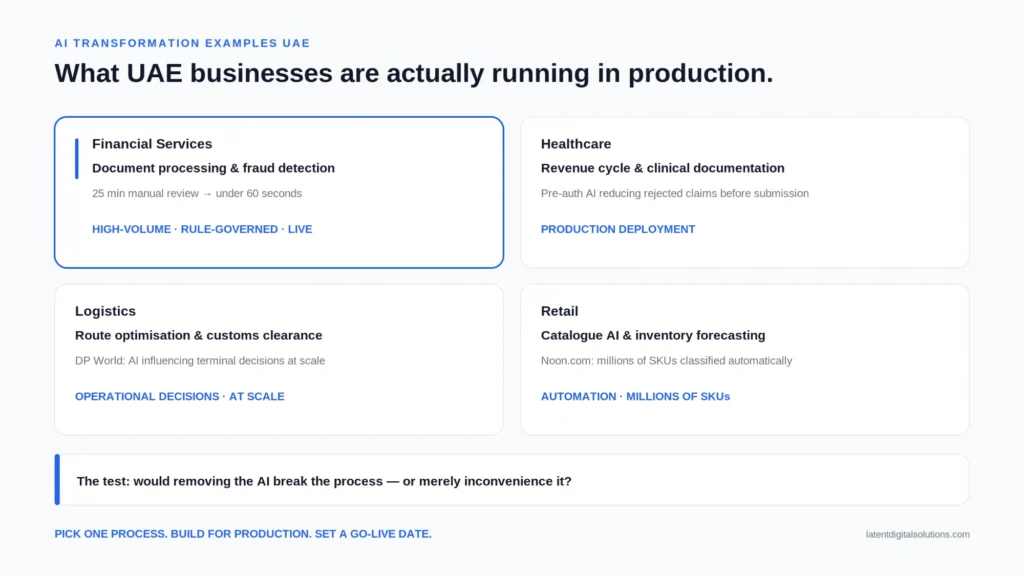
The practical test is whether removing the AI system would break the business process, or merely inconvenience it.
A chatbot that answers FAQs is an AI tool. A credit decisioning model that processes every personal loan application in under 90 seconds, using data no human analyst would review in full, is an AI transformation example. The process cannot return to manual operation at the same throughput.
This distinction matters for UAE businesses evaluating where to start. AI transformation programmes in the UAE begin with one operational workflow that is high-volume, rule-governed, and currently expensive to staff. The transformation happens when that workflow is handed to an AI system and the old staffing model is restructured around it.
Where UAE mid-size businesses are starting
The pattern across the sectors below is consistent.
UAE businesses start with document-heavy or data-heavy workflows where the input is predictable and the cost of errors is manageable. They do not start with customer-facing AI or decision-making in regulated contexts. They start with back-office automation, validate the output quality over 60–90 days, then expand.
The UAE National AI Strategy 2031, which targets making the UAE one of the world’s leading AI nations, has accelerated private sector deployment timelines. Businesses that might have waited are moving faster because the regulatory and talent environment has matured around them.
What AI transformation examples are UAE banks and fintechs deploying?
Financial services leads every other sector in UAE AI deployment.
UAE banks and fintechs have moved from experimentation to production faster than comparable markets, driven by the Central Bank regulatory sandbox and the volume economics of document-heavy operations.
Document processing and compliance automation
The clearest AI transformation examples in UAE banking are in document processing.
UAE financial institutions are using natural language processing to extract, classify, and validate data from unstructured documents (passports, trade licences, utility bills, financial statements) that previously required manual review teams.
A document that took a compliance analyst 25 minutes to process manually can be classified and verified in under 60 seconds. The analyst’s role shifts to exception handling: reviewing the cases the AI flags as ambiguous, rather than processing every document from scratch.
This is what distinguishes an AI transformation from automation. The workflow structure changes, not just the speed.
AI fraud detection in payments follows the same pattern. Transactional AI models monitor payments in real time against behavioural baselines, flagging anomalous patterns faster than any rule-based system. UAE banks have publicly announced production deployments in this area, and the capability has become a competitive differentiator in retail banking.
Customer service and credit decisioning
Agentic AI for enterprise represents the next generation of UAE banking AI deployments. Some UAE fintechs and digital banking platforms have moved beyond scripted chatbots to AI systems that can handle multi-step customer service journeys (balance queries, transaction disputes, product applications) without escalation for the majority of cases.
Credit decisioning is a more advanced AI transformation example. UAE fintechs and some UAE banks are using machine learning models that incorporate alternative data sources — telco data, e-commerce transaction history, social data with consent — alongside traditional credit bureau data. This extends credit to segments underserved by traditional scoring models. These are production deployments, not pilots.
Where are UAE healthcare providers starting with AI transformation?
The AI transformation examples in UAE healthcare cluster in two areas: administrative workflow automation and clinical decision support. Administrative deployments are further ahead because the regulatory pathway is clearer and the failure cost is lower.
Administrative workflow automation
The Dubai Health Authority’s HealthConnect platform incorporates AI-assisted appointment scheduling and triage, directing patients to the appropriate level of care before they arrive at a facility. This is a significant AI transformation example for UAE healthcare. It is a production system affecting patient flow across multiple facilities, not a departmental trial.
Private UAE healthcare providers are deploying AI in revenue cycle management: processing insurance pre-authorisation requests, coding clinical notes for billing, and flagging claims likely to be rejected before submission. These are the AI transformation examples most comparable to what a 100-to-500-staff UAE healthcare business can replicate. The processes are standardised and the inputs are predictable. The cost of a wrong output — a miscoded claim — is visible and correctable.
Clinical documentation and patient triage
Of all UAE healthcare AI transformation examples, clinical documentation has moved fastest at the individual provider level. AI transcription and summarisation tools are being used to convert clinical consultations into structured notes, reducing the administrative burden on UAE doctors and nurses. The transformation is in the workflow: clinicians spend less time on documentation and more time on clinical decisions.
Aster DM Healthcare, which operates across the UAE, has publicly referenced AI in administrative automation as part of its operational efficiency programme. The AI transformation examples most replicable for UAE healthcare businesses start with administrative AI, not diagnostic AI. Administrative AI carries lower regulatory risk and delivers measurable ROI within months. Diagnostic AI — imaging analysis, clinical decision support — is a later-stage deployment with a longer regulatory pathway.
Which logistics and supply chain AI transformation examples are live in the UAE?
Logistics produces some of the highest-volume AI transformation examples in the UAE. The UAE’s position as a global hub — centred on DP World, Jebel Ali Port, and a network of free zones — has compressed the implementation timeline. The data volumes that make AI route and demand optimisation viable already exist in these operations.
Route and demand optimisation
The route and demand AI transformation examples from UAE logistics are among the most documented anywhere in the region. DP World has published case studies on AI-driven route and demand optimisation across its port and logistics operations. These are production deployments that influence operational decisions at scale, not aspirational announcements.
AI models process shipping schedules, vessel arrival data, berth availability, and real-time container tracking to optimise terminal throughput. The transformation is in the planning function: what was previously a combination of manual scheduling and experience-based judgement is now augmented by models that process more variables than any planning team could hold simultaneously.
For UAE businesses with their own logistics or supply chain operations — warehousing, last-mile delivery, cross-border freight — these AI transformation examples translate directly into route optimisation for fleets, demand forecasting for inventory, and dynamic scheduling for distribution networks. All are deployable with AI transformation services built around UAE-specific workflows rather than off-the-shelf global platforms that do not account for UAE constraints.
Customs documentation and supplier communication
Customs clearance documentation is one of the highest-friction processes in UAE trade. In our work with UAE businesses across manufacturing and trading sectors, the time spent on manual pre-clearance validation consistently ranks among the top three operational pain points we encounter before any AI programme begins.
For sector-specific parallels, the AI use cases in UAE manufacturing we cover elsewhere show how the same document-classification approaches apply across the supply chain. AI transformation examples in this area include automated extraction and validation of customs declarations, certificates of origin, and compliance documentation, reducing manual data entry and error rates in pre-clearance workflows.
Several UAE free-zone operators have begun automating supplier communication workflows using AI: generating, translating, and routing purchase orders, delivery notifications, and compliance certificates between Arabic and English without manual intervention. Process automation of this kind is an AI transformation example that any UAE trading business handling significant import or export volumes can evaluate directly.
What retail and e-commerce AI transformation examples are beyond pilot stage in the UAE?
Retail and e-commerce AI transformation examples in the UAE have moved furthest in personalisation, inventory management, and customer service. These are areas where the ROI cycle is short and the baseline is measurable before deployment starts.
Product cataloguing and inventory
Among retail AI transformation examples in the UAE, product catalogue management is the most widely deployed. Noon.com and other UAE e-commerce platforms use AI to classify new products, generate descriptions, match items to the correct taxonomy, and flag duplicate or fraudulent listings. For a platform with millions of SKUs, manual operation at equivalent scale is not economically viable.
Inventory forecasting AI is in production at UAE retailers that operate both physical and online channels. These models integrate point-of-sale data, seasonal demand patterns, and promotional calendars to generate replenishment recommendations that outperform manual forecasting on stockout rates and overstock costs. The AI transformation is not that the forecast exists (every retailer forecasts); it is that the model processes more data signals and updates recommendations in near-real time rather than weekly.
Customer interaction and returns
AI-powered customer service for returns, exchanges, and delivery queries is now in production at UAE e-commerce businesses. These systems handle a significant proportion of inbound service volume without escalation, operating in both Arabic and English. That bilingual capability matters specifically in the UAE, where a significant portion of the customer base prefers Arabic-language service.
What separates UAE businesses that have deployed from those still planning?
Looking across the AI transformation examples above, the technology is not what distinguishes the businesses that have deployed.
The pattern of decision-making is.
The adoption pattern that works
Every live AI transformation example in the UAE sectors above follows the same four-step structure:
- Identify one high-volume, rule-governed process with predictable inputs.
- Establish a measurable baseline (cost, time, error rate) before any AI is built.
- Build for production from the start, not a pilot extended indefinitely.
- Set a defined go-live date before the project begins. The UAE businesses that have deployed AI are not those with the most sophisticated AI strategies. They are those that picked one process, built for production from the start, and set a date.
The AI transformation consulting framework that underpins these deployments is not complex. It starts with a process audit, identifies the highest-volume workflows with the most predictable inputs, and builds a production-ready system for one of them before expanding. The businesses still in planning typically have the opposite problem: a broad ambition, no defined starting point, and a pilot that has been running for six months without a production decision.
What is still mostly talk
Not every claimed AI transformation example in the UAE is real. In UAE financial services, there is significant marketing activity around AI that is, on closer examination, a rules-based automation system labelled as AI for commercial reasons. In UAE healthcare, there are numerous announced AI partnerships that have not produced a production deployment. The useful test remains the operational one: is the AI system embedded in a workflow that would break without it? If not, it is a tool or a pilot, not a transformation.
Conclusion
The AI transformation examples that matter for UAE businesses are not the global enterprise case studies that dominate most articles on the topic. The sector-by-sector examples above are production deployments running in UAE financial services, healthcare, logistics, and retail — many of them in businesses of similar size to yours. The common thread is specificity: one workflow, one defined production target, and a team that commits to a go-live date. If you are evaluating where to start, the most useful question is not “what could AI do for us?” but “which of our highest-volume processes is most predictable, and what would it mean to automate it entirely?” Latent Digital Solutions works with UAE businesses to identify that process and build production-ready systems, not pilots.
FAQ
What is an AI transformation example for a small UAE business?
A small UAE business AI transformation example typically starts with one back-office process, invoice processing, customer service triage, or document classification. An AI transformation example at this scale is an accounts payable team that used to process 200 invoices per day manually, now using an AI system that processes the same volume with one person reviewing exceptions. The key is that the workflow restructures around the AI, not alongside it.
Which sectors have the most AI transformation examples in the UAE?
Financial services leads, followed by logistics, healthcare, and retail. UAE banks and fintechs have the most live AI transformation examples in production, driven partly by the Central Bank regulatory sandbox and partly by the volume economics of document processing and fraud detection. Logistics is second, anchored by DP World’s published deployments.
What are the five stages of AI transformation?
The five stages typically progress from AI readiness assessment, to pilot deployment, to production build, to workflow integration, to scale and optimisation. Most UAE businesses that have successfully deployed AI transformation examples moved through these stages for one process at a time, not all processes simultaneously.
What are the three pillars of AI transformation?
The three pillars are data readiness (having the volume and quality of data the AI system needs), process clarity (a well-defined workflow with measurable inputs and outputs), and change management (ensuring the people whose roles change because of the AI system understand and adopt the new workflow). UAE businesses frequently focus on data and technology while underinvesting in the third pillar.
How long does AI transformation take for a UAE business?
A single-process AI transformation, from process selection to production go-live, typically takes 12 to 20 weeks for a UAE mid-size business. The variation is driven by data readiness, integration complexity with existing systems, and the speed of internal sign-off. The businesses in the AI transformation examples above that moved fastest had a defined production date before the project started.
Usually a reply within one working day.