Article Overview
Agentic AI use cases in healthcare get written about as one category, when they’re really two. At a mid-size UAE clinic or diagnostic centre, the paperwork and follow-up calls that still eat a staff member’s day are almost entirely administrative, not clinical. That distinction matters more than most guides admit.
- Agentic AI use cases in healthcare split into two groups: administrative work running in production today, and clinical work still stuck at pilot stage.
- Appointment scheduling, insurance authorisation, and billing coordination are where adoption is already highest, according to IBM’s own survey of healthcare executives.
- Clinical and diagnostic use cases need regulatory clearance most mid-size providers shouldn’t pursue first.
- Separating these two categories explicitly, rather than blurring them, is the gap almost every other guide on this topic misses.
What does agentic AI mean in healthcare?
Agentic AI use cases in healthcare mean software that finishes a task with several steps on its own, not just a single answer. That’s different from a chatbot that replies to one question. It’s also different from a clinical tool that flags a scan for a doctor to check.
Our guide to AI for travel agencies explains which agency tasks AI can take over and which stay with staff.
An agent handling scheduling can check open slots, confirm insurance, and send a reminder. It does all three without a person running each step by hand. That’s the category this piece covers. It also faces fewer rules and less red tape than clinical or diagnostic AI.
The word “agentic” gets used loosely across healthcare marketing, often to describe a chatbot that just answers questions faster. The genuine distinction is whether the software completes a multi-step task end to end, with a person checking the outcome, rather than answering one question at a time. That’s the definition this article uses consistently.
Which use cases are genuinely running today?
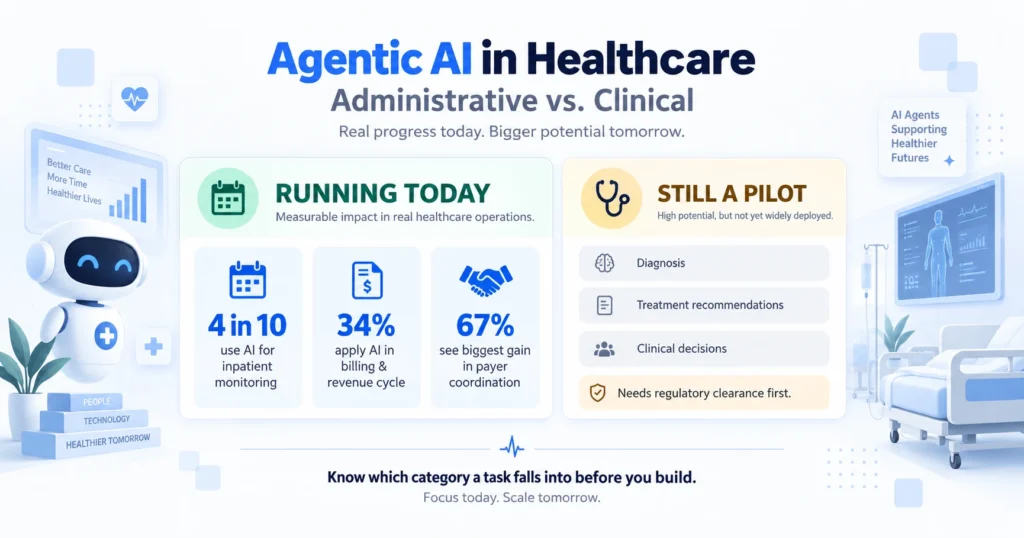
The clearest proof comes from IBM’s own survey of healthcare bosses. Four in ten already use AI to watch inpatients and catch early warning signs. That’s a live number, not a pilot count.
A further 34% report using AI for billing and budget work. That kind of work is office-based, not clinical. It’s exactly the sort of task a mid-size clinic can take on without hospital-scale systems behind it.
IBM’s survey also found that 67% see the biggest near-term gain in dealing with insurers. That’s the back-and-forth between a clinic and a payer. It eats up a large share of office staff time today.
Taken together, those three figures point the same direction: the highest-adoption agentic AI use cases in healthcare are all administrative, not clinical. None of them touch a diagnosis or a treatment decision.
Can AI handle scheduling and patient follow-up?
Scheduling is the easiest starting point for a smaller provider. An agent can handle the routine parts: checking a patient’s cover, finding an open slot, sending a confirmation and reminder.
Follow-up works the same way. A patient who missed a check-in, or who needs a nudge about a refill, doesn’t need a person working a call list every day. The agent handles the routine cases on its own. It flags the ones that need a person’s judgment, like a patient who hasn’t replied after several tries.
A clinic running this well typically sees the change first in staff time, not in a dashboard metric. The person who used to spend an hour a day working through a call list is instead reviewing the handful of cases the agent flagged as needing judgment.
Does AI help with insurance authorisation and billing?
Insurance pre-authorisation takes up more staff time than almost any other office task in healthcare. It’s also mostly rule-based. An agent can gather the paperwork, check it against an insurer’s own rules, and send off the request. That removes a repetitive job from clinical staff.
Billing works the same way. Checking what was billed against what an insurer actually paid, then chasing the gap, is a pattern-matching job with several steps. Agentic AI handles that kind of work well. None of it touches a clinical call at any point. That’s the same rule behind an enterprise AI security guide: know exactly which kind of data a system touches, office records or clinical decisions, before deciding what oversight it needs.
What still requires clinical validation?
Not all agentic AI use cases in healthcare are ready today. Diagnosis, treatment choices, and anything that touches patient care sit in a different group entirely. These use cases need regulatory sign-off and heavy testing. Most mid-size UAE clinics and diagnostic centres shouldn’t build toward them first.
This gap is the real problem with most content on this topic. Papers and vendor content alike tend to lump office work and clinical AI into one group. Treating scheduling and diagnosis as the same kind of problem is exactly how a clinic ends up spending on the wrong one.
The two groups also carry very different levels of risk if something goes wrong. A scheduling agent that books the wrong slot is a minor inconvenience, fixed with a phone call. A diagnostic tool that misreads a scan is a patient-safety issue with regulatory consequences. That gap in stakes is exactly why administrative use cases are the sensible place to start, and why clinical ones need a much longer runway before deployment.
What does a mid-size clinic need to start?
Start with the administrative task causing the most visible strain on staff time, not the most technically interesting one. For many clinics, that’s scheduling or insurance authorisation. Both are high-volume and rule-based enough for an agent to handle reliably.
Building a system around the clinic’s own scheduling and billing workflows is what makes this practical for a business this size. That’s a different starting point from adapting to a generic healthcare AI platform sized for a hospital system. The right early goal is hours returned to staff, not a sweeping AI transformation.
There’s no need to pick the single “right” use case in advance. Start with whichever administrative task the front-desk or billing team already complains about most often. That’s usually a more reliable signal than any framework, since it reflects where the actual time is being lost today, not where a vendor’s demo looks most impressive.
Conclusion
Agentic AI use cases in healthcare aren’t one category. Administrative work, scheduling, insurance authorisation, billing coordination, is already running in production at scale, according to IBM’s own executive survey. Clinical and diagnostic use cases are a different, much longer road that most mid-size providers shouldn’t try to walk first.
Knowing which category a given task falls into is the decision that actually matters. Get that split right early, and the rollout stays small, cheap, and low-risk. Get it wrong, by treating a clinical use case as if it were as simple as scheduling, and the project stalls on regulatory review long before it returns any value to staff.
For context on where the UAE healthcare market is heading — including the regulatory framework across DHA, DoH, and MoHAP, and which AI investments mid-size providers can make without clinical device approval — see our practical guide to AI in UAE healthcare.
If you want to work out where your clinic or healthcare group should start, get in touch and we’ll talk it through.
Frequently Asked Questions
What is agentic AI in healthcare?
Software that can complete a multi-step administrative task on its own, like scheduling an appointment or processing an insurance authorisation, rather than just answering a single question.
Can AI agents handle patient scheduling?
Yes. This is one of the most accessible use cases, since checking availability, confirming insurance eligibility, and sending reminders are all rule-based tasks an agent can handle reliably.
Is AI used for medical billing?
Yes, and it’s one of the areas with the highest reported adoption. IBM’s survey found 34% of healthcare executives already applying AI in revenue and budget cycle management.
Is agentic AI approved for clinical use?
Clinical and diagnostic AI use cases require regulatory clearance and are a genuinely different category from the administrative use cases this article covers. Most mid-size providers should start with administrative work, not clinical deployment.
Do small clinics use AI agents?
The clinics seeing real value tend to start with one specific administrative task, like scheduling or insurance authorisation, rather than attempting a broad AI rollout across clinical and administrative work at once.
Usually a reply within one working day.