Article Overview
A mid-size freight, distribution, or trading operation in the UAE has almost nothing in common with the businesses most AI in logistics and supply chain management guides are written for. Those guides assume the size of a global carrier. The manual work a smaller operator is still doing by hand is usually the more honest starting point.
- AI in logistics doesn’t require an enterprise data science team. The highest-value uses run on data a mid-size operator already has.
- The clearest working example is route and demand forecasting, where AI models routinely outperform manual planning on messy, real-world data.
- Exception handling, not full automation, is often where AI earns its keep first: catching a delayed shipment or a mismatched order before it becomes a customer problem.
- The UAE’s position as a global logistics hub makes this more relevant here than the generic guides suggest, even though none of them mention it.
What does AI actually do in logistics?
AI in logistics and supply chain management means using software that learns patterns from shipment, inventory, and order data. It then makes or supports a decision automatically. That covers demand forecasting, route planning, and flagging shipments that look likely to go wrong.
Our guide to machine learning computer vision explains the six tasks, the image data they need and how to test a system before you rely on it.
It’s a different thing from digital record-keeping. A tracking system that shows you where a container is right now is not AI. A system that predicts which containers are likely to be delayed is. It makes that prediction from patterns in past shipments, not from a rule someone wrote down in advance.
That distinction matters because the two get sold under the same label. A vendor can call a dashboard “AI-powered” simply because it displays live data. The real dividing line is whether the system makes a prediction or a recommendation on its own, based on patterns, rather than just presenting information for a person to interpret.
Do you need an enterprise platform to use it?
No, and this assumption is what makes most guides useless for a mid-size operator. Enterprise supply chain platforms are built for businesses managing thousands of shipments. They’re sized for dozens of routes and warehouses at once.
A freight forwarder, distributor, or trading business usually has a smaller, more concentrated set of routes and customers. It doesn’t need that scale of platform. The useful AI applications here work from the shipment and order data the business already records. They don’t need a new enterprise data warehouse.
The pitch for the enterprise platform usually leads with breadth: dozens of modules, dashboards for every department, a system meant to run an entire global network. A mid-size operator adopting that platform ends up paying for capability it will never use, and spending months configuring modules nobody on the team asked for. If your core systems are the constraint, see what an ERP implementation actually takes.
Where is it working today for smaller operators?
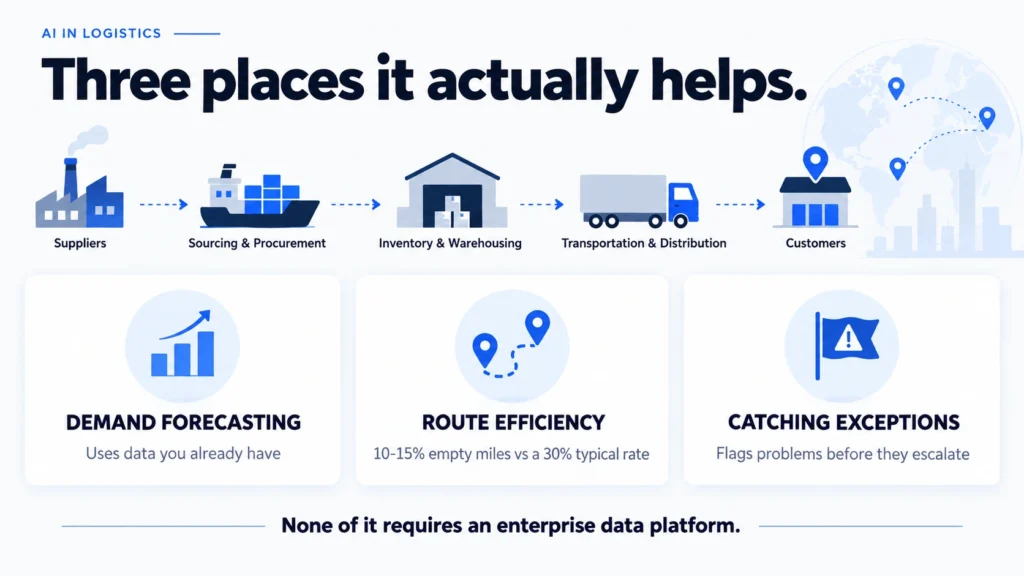
The clearest evidence comes from route planning. MIT Sloan reports that Uber Freight’s AI-optimised routing cut empty miles to 10 to 15%. A typical US trucking rate runs closer to 30%. That’s a US benchmark, not a UAE one. But the underlying mechanism still applies here: an AI model finds patterns in real routing data that a person planning routes manually can’t reliably spot at scale.
Chris Caplice, who leads MIT’s Center for Transportation and Logistics, makes a sharper point. AI models trained on real operational data can generalise beyond what they were shown. They don’t just replay past patterns. That’s the difference between a system that genuinely helps and one that just automates what a planner already knew.
Can you forecast demand without a data science team?
Yes. Demand forecasting is the second clear use case in AI for logistics and supply chain planning, and it’s more accessible than it sounds. Most businesses already track order history by customer and by season. That data is usually enough to build a forecasting model that beats a manual spreadsheet estimate. For the production-floor side of the supply chain, see our guide to AI use cases in manufacturing that work without a smart factory.
The gap most businesses hit isn’t the model. It’s the data being scattered across separate systems that don’t talk to each other. Getting that data into one place is usually the real first project, before any forecasting model gets built. It’s the same starting point behind a clear data strategy for AI. Here, it just applies specifically to shipment and order records rather than the whole business.
A business that has already consolidated its order history sees results fast. One that hasn’t should expect the data-consolidation step to take longer than building the forecasting model itself, since it usually means reconciling records across a booking system, a warehouse tool, and a spreadsheet nobody else can access.
Where does exception handling earn its keep first?
Exception handling is the most underrated use case here. Instead of automating an entire process end to end, an AI system flags the shipments, orders, or invoices that look wrong. A person still handles them, just earlier.
This matters because most of the actual cost in logistics operations comes from exceptions, not the routine cases. A shipment running on schedule doesn’t need attention. One that’s likely to miss its delivery window does. Catching it two days earlier is worth more than automating the ninety-eight shipments that were never going to be a problem.
A useful way to think about it: routine shipments are already handled well by the systems most businesses run today. It’s the handful that go wrong each week that eat up a coordinator’s time in phone calls and manual checks. Flagging those earlier is where the actual time savings show up first, well before any full-process automation project.
What still needs a person?
Judgment calls involving a customer relationship, a contract dispute, or a genuinely novel situation still need a person. AI in logistics and supply chain management works best on patterns that repeat often enough for a model to learn from. It’s not built for the one-off situations that define a business relationship.
The businesses that get this wrong usually try to automate the exception itself, rather than just the flagging of it. Automating the flag, and leaving the judgment call to a person, is the more reliable split. Building that kind of system around your own operation, rather than forcing your process into a generic platform, is how we approach a project like this.
Conclusion
AI in logistics and supply chain management isn’t reserved for businesses with an enterprise data platform. The clearest value for a mid-size UAE freight, distribution, or trading business sits in three places. Demand forecasting from data the business already has. Route efficiency. And catching exceptions before they escalate into a customer problem.
Getting AI in logistics and supply chain management right doesn’t require replacing how the business runs today. It requires knowing which of the three is already causing visible pain, and starting there. A mid-size operator that gets one of these three genuinely working usually finds the other two easier to justify afterward. The first result becomes visible to the rest of the team, and that’s what makes the case for the next one.
If you want to work out which one applies to your operation, get in touch and we’ll walk through it together.
Frequently Asked Questions
How is AI used in supply chain management?
AI in logistics and supply chain management most commonly means demand forecasting, route optimisation, and flagging shipments or orders that look likely to go wrong. All three work from data most businesses already collect.
Do small logistics companies need AI?
Not urgently. The businesses seeing real value are the ones that started with one specific, well-defined use case, like exception flagging. They didn’t try to automate their whole operation at once.
What data do you need to start using AI in logistics?
Shipment history, order history, and delivery timing are usually enough for the most common use cases. The data doesn’t need to be perfect. It needs to be in one place.
Is AI replacing supply chain jobs?
In the deployments we’ve seen, it changes what the job involves rather than removing it. A planner spends less time on routine forecasting and more time on the exceptions and relationships that actually need judgment.
How does AI improve route planning?
AI models can find patterns in real routing data, like which combinations of stops and timing reduce empty or wasted mileage. Those patterns are difficult for a person to calculate manually across many variables at once.
Looking for UAE-specific AI logistics guidance?
If you run a UAE freight, courier, or 3PL business, see our dedicated guide to AI in UAE logistics for operators — covering what’s running at Jebel Ali, which operational layer to start with, and the UAE regulatory picture.
Usually a reply within one working day.