Article Overview
The search results for "generative AI for business" are dominated by courses. Coursera, DataCamp, LinkedIn Learning, Microsoft Learn — five of the first nine results are selling certifications. That is a useful signal about what most companies actually want from this technology right now: to understand it well enough to decide whether to use it, not a syllabus.
This article is for that decision. Latent Digital Solutions works with UAE businesses on AI adoption, and the honest starting point for generative AI for business is a single question: which outputs in your operation can tolerate a draft that a person then checks, and which cannot tolerate being wrong at all? That line divides the genuinely useful applications from the ones that add work rather than remove it.
Key takeaways
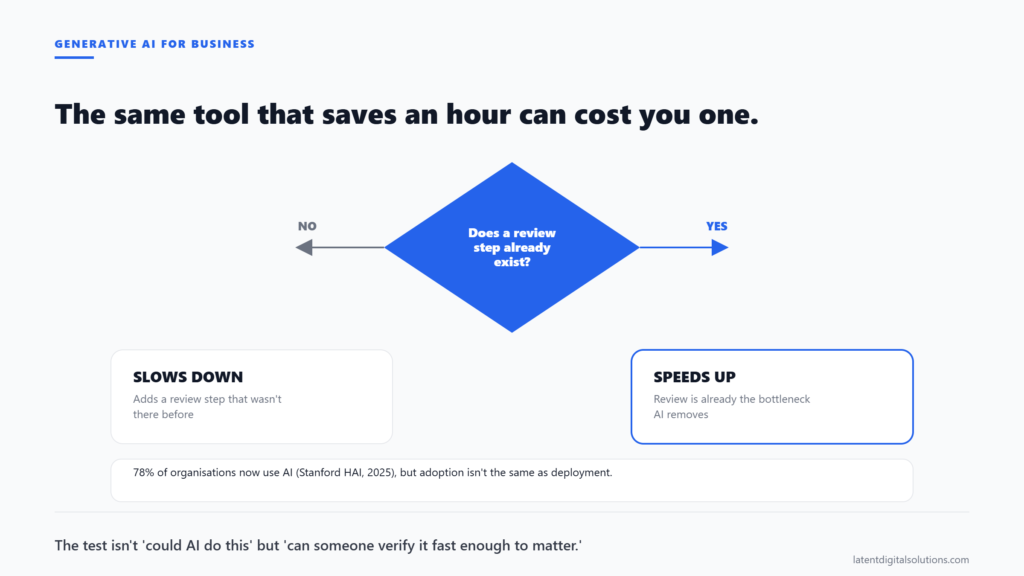
- 01.Generative AI for business is most useful where a human review step already exists in the process — where it doesn't, the tool adds a review step and costs time instead of saving it.
- 02.Stanford HAI's 2025 AI Index found that 78% of organizations reported using AI in 2024, up from 55% the previous year — adoption is real, but the gap between using AI and deploying it productively remains wide.
- 03.The practical test is not "could AI do this" but "can someone verify the output quickly enough to make the speed gain worth it."
- 04.Generative AI for business fails predictably on tasks where a wrong output causes a concrete problem before anyone checks it.
What is generative AI for business, in plain terms?
Generative AI produces text, summaries, drafts, structured outputs, and code from a prompt. Given a question, a document, or a set of instructions, it returns something that looks like a finished answer. The key word is "looks."
Our guide to generative AI use cases in manufacturing explains which uses factories run today and who checks each result.
Our guide to the AI agent LLM explains what the language model does inside an agent and what the rest of the system does.
It is a pattern-completion machine. It has read a very large amount of text and learned what a reasonable answer to a given prompt sounds like. That is different from knowing whether the answer is correct. The distinction matters for business use because it means generative AI for business is excellent at producing outputs that are plausible and well-formatted and wrong.
The practical implication: it works well on tasks where being plausible and well-formatted is most of the job (first drafts, summaries of documents you will then read, replies to routine queries), and poorly on tasks where correctness is the job and plausibility is the risk.
The three common failure points in generative AI for business are: outputs presented directly to a client or customer before anyone reads them; outputs that contain a specific number or factual claim that nobody verifies; and outputs used to make a consequential decision by someone who trusts the format enough to skip the check.
Which work does generative AI actually speed up?
Generative AI for business accelerates work where a human was already producing a first draft before checking it. The AI removes the blank-page step; the human step is still there.
The task categories where generative AI for business shows the clearest documented returns are customer operations, marketing communications, and software engineering — broadly the same areas where a review step is easiest to establish. Databricks' implementation guide for generative AI for business maps these as the highest-value task clusters across businesses of different sizes.
Specific tasks where the speed gain is real:
- Summarising long documents — contracts, reports, meeting notes, RFPs, regulatory updates. The AI produces a summary in seconds. A person reads it and confirms the summary is accurate. If it is not, the person catches it. If the original document matters, someone was going to read it anyway.
- First-draft written outputs — proposals, emails, internal memos, job descriptions, product descriptions where the category and facts are provided. These go through review regardless. The AI compresses the starting time.
- Customer query responses — initial responses to routine incoming queries, classified and drafted for a person to review before sending. This works where the queries are patterned enough that a draft is usually right.
- Code and data tasks — writing boilerplate, formatting data, converting formats, generating test cases. The developer reviews and runs the output. Bugs surface in testing.
- Internal knowledge retrieval — asking questions of a company's own documents when the system is set up to cite sources. The person reads the cited section to confirm.
| What generative AI for business speeds up | What generative AI for business slows down |
|---|---|
| Document summaries with a human review step | Outputs used directly without a check |
| First-draft written content before editing | Tasks requiring verified numbers |
| Routine query classification and triage | Ad-hoc prompting rebuilt from scratch each time |
| Boilerplate code for developer review | Processes without a baseline to measure against |
The common structure is the same: the output goes through a person before anything consequential depends on it. Generative AI for business is a first-draft accelerator, not a decision-maker.
Where does generative AI cost you time instead?
Where there is no review step, generative AI adds one rather than removing it. That is when the time saving runs negative.
Three categories where generative AI for business typically costs time:
Tasks where the output is used directly. If a summary of a contract is used directly in a negotiation without a person reading the contract, the risk is that the summary is wrong in a way that matters. Adding a review step for every contract summary to catch the minority of wrong summaries takes longer than reviewing the contracts in the first place.
Tasks requiring accurate numbers. Generative AI for business will produce figures that look correct. If the figure needs to be accurate (a financial projection, a regulatory number, a quoted statistic), someone has to verify it against the source. This is slower than producing the number correctly in the first place.
Tasks where the prompt has to be rebuilt each time. If writing a good prompt for a specific task takes fifteen minutes and using the result saves five, the generative AI for business application has a negative return. This problem is usually solved by building a template and a system around the prompt rather than using the model ad hoc, but that system takes time to build.
Latent's Services covers AI implementation scoping for exactly this kind of decision: which tasks in a specific operation are worth building around and which should be left alone.
How do you tell the two apart in your own business?
Two questions, applied to each candidate task.
First: is there already a review step? If a person checks the output before it is used, generative AI for business can accelerate the input to that review. If there is no review step, and adding one is not practical, generative AI for business is not a fit for that task.
Second: can you verify the output quickly? If it takes five minutes to confirm whether the output is correct, and producing the output manually takes ten, the generative AI for business application saves five minutes. If verification takes fifteen minutes, it saves nothing and adds five minutes of false confidence. The verification time has to be shorter than the production time, by a margin worth the complexity of adding a system.
These two questions are enough to sort most candidate tasks before running any experiment. The tasks that pass both are worth piloting. The tasks that fail either are not worth it at current capability levels, not because the technology is poor, but because the task structure does not fit. For organisations already moving beyond text generation into autonomous work, the Generative AI Risk Management guide covers where additional controls are needed as the output stakes increase.
What has to be in place before you roll it out?
Three things, in order of how often they are missing.
A review process for the output. Not a plan to create one: an existing workflow where someone already reads the thing before it goes further. If that workflow doesn't exist, building it to accommodate generative AI for business is a separate project, and should be priced and scoped as one. IBM's implementation guide for generative AI for business identifies the review-process gap as the single most common reason rollouts stall in the first ninety days.
A way to measure the time saving. Stanford HAI's 2025 AI Index Report (hai.stanford.edu, retrieved September 2026) found that 78% of organisations reported using AI in 2024, up from 55% in 2023. That adoption is real. What is rarely tracked is whether it saves time on specific tasks at the task level. A business that wants generative AI for business to be more than an experiment needs to be able to say, after eight weeks, whether the time cost of producing and reviewing AI outputs is lower than the previous method. That requires measuring both. Not having a baseline is the single most common reason generative AI for business initiatives cannot show a return. Latent has worked through this scoping process with UAE businesses across professional services, logistics, and finance — in each case, the first step was agreeing on exactly two or three tasks, not a company-wide rollout.
A handling rule for wrong outputs. When the AI produces an incorrect output, and it will, what happens? If the answer is "someone catches it in review," that is sufficient. If the answer is "we are not sure," that is a gap that needs to be closed before the system handles anything consequential. UAE-based teams, in particular, often operate across Arabic and English simultaneously — verifying AI outputs in both languages adds a step that should be planned for explicitly, not discovered after the rollout starts.
For UAE businesses considering a generative AI for business rollout at any scale, a short scoping conversation is the fastest way to check whether these foundations are in place. Start the conversation here: the starting point is understanding the task structure before agreeing on anything else.
When a business is ready to build rather than just experiment, our OpenAI and Azure OpenAI consulting services cover the build side.
Conclusion
Generative AI for business saves time on tasks where a first draft helps and a person verifies the result. It does not save time on tasks where the output is used directly without a check, or where verification takes longer than producing the output manually. The distinction is not technical. It is about the structure of the task and whether a review step already exists.
The companies seeing real returns from generative AI for business are not necessarily the largest or most technically sophisticated. They are the ones that started with the right task, measured whether it worked, and did not extend beyond tasks that fit the same pattern. The AI Readiness Assessment Framework maps this task-structure evaluation across common UAE business functions — it is a practical starting point for any organisation before committing to a tool or a vendor. That is a straightforward decision if the evaluation happens before the rollout rather than after.
Frequently Asked Questions
What is generative AI for business and how is it different from automation?
Generative AI for business produces written, structured, or coded outputs from a prompt — drafts, summaries, replies. Standard automation runs a fixed process when triggered. The difference is that generative AI handles variable inputs and produces something that looks like it was written for the situation. The shared limitation is that neither should be trusted to operate without a human check where the output matters.
Which business tasks are the best fit for generative AI?
Tasks where a human review step already exists: summarising documents, drafting routine communications, producing first-draft proposals, classifying incoming queries, writing boilerplate code. In each case, the AI shortens the time to a reviewable draft. The review step stays.
Is generative AI for business only useful for large companies?
No. The fit depends on the task structure, not the company size. A business with fifteen people can have a customer query process that generative AI for business accelerates just as effectively as a company with fifteen hundred. The relevant factor is whether the task is repetitive, whether the output format is consistent, and whether a review step exists.
What are the biggest risks of generative AI for business?
Three. First, using outputs without review — generative AI produces plausible-looking text that can be wrong in ways that are not obvious. Second, applying it to tasks that require accurate numbers, where the model will produce a figure that looks correct but is not verified. Third, measuring adoption without measuring productivity — tracking how many people use the tool is not the same as measuring whether it saves time.
How long does it take to see a return from generative AI for business?
On well-scoped tasks, eight to twelve weeks is a realistic window to measure whether a specific use case saves time. The measurement requires a baseline — how long the task took before — and a consistent record of output and review time after. Businesses that do not establish a baseline before rolling out generative AI for business typically cannot show a return, even when one exists.
What should a business do before rolling out generative AI?
Three things: confirm a review process exists for the outputs, establish a way to measure time saved at the task level, and decide in advance what happens when the AI produces an incorrect output. These do not require technical work. They require the same planning that any process change needs before it goes live.
Usually a reply within one working day.